

This article is co-produced by PANews and BIT US Stocks. BIT US Stocks provides over 16,000 U.S. listed stocks and ETFs, supporting stablecoin deposits and withdrawals as well as traditional U.S. dollar wire transfers, enjoying full shareholder rights and dividend voting rights.
Bitcoin Returns to Key Position, Bullish Sentiment Reignited, Ethereum Builds Base
Last night and this morning, the core positive news in the crypto market came from U.S. inflation data. U.S. June CPI fell year-on-year to 3.5%, below market expectations of 3.8%; core CPI also fell year-on-year to 2.6%, also lower than previous levels. To put it simply, after inflation cooled, the market felt less pressure for the Federal Reserve to continue raising interest rates, and funds were willing to buy risk assets again.
As a result, Bitcoin rebounded quickly, briefly breaking above $65,000. Crypto analyst Killa stated that if BTC cannot stabilize after rising above $65,000, it may just be a short-term temptation, followed by a drop to test $60,000. Loma believes that the overall structure of BTC after falling from its high position is still clear, and the current low point is indeed stronger than before, but more time is needed to confirm the bottom. Unless the daily close stands above $67,200, he will not easily chase long; if the price returns to around $54,000 to $55,000, that would be a more suitable weekly support area for direct buying.
Ted warned that the current Bitcoin CVDD price is about $48,500, and historically, the bottoms of bear markets in 2018 and 2022 were close to this indicator, so the possibility of BTC actually bottoming after breaking below $50,000 cannot be completely ruled out. Murphy provided an easier-to-understand judgment based on the on-chain metric MVRV: in the past, when MVRV was above 3, Bitcoin usually entered a bull market top area; when below 1, it usually entered a bear market bottom area. However, as Bitcoin's market value grows larger, the fluctuations of this indicator are becoming smaller. He believes that this round of bottom may appear above $50,000, which also means that those in the market waiting for $30,000 or $20,000 may be overly pessimistic.
ETF funds have also begun to improve. On July 14, the net inflow of U.S. Bitcoin spot ETFs was $181 million. Previously, on July 13, BTC ETF experienced a single-day net outflow of $425 million, now reversing to inflows, indicating that traditional institutional funds are beginning to follow this round of rebound.
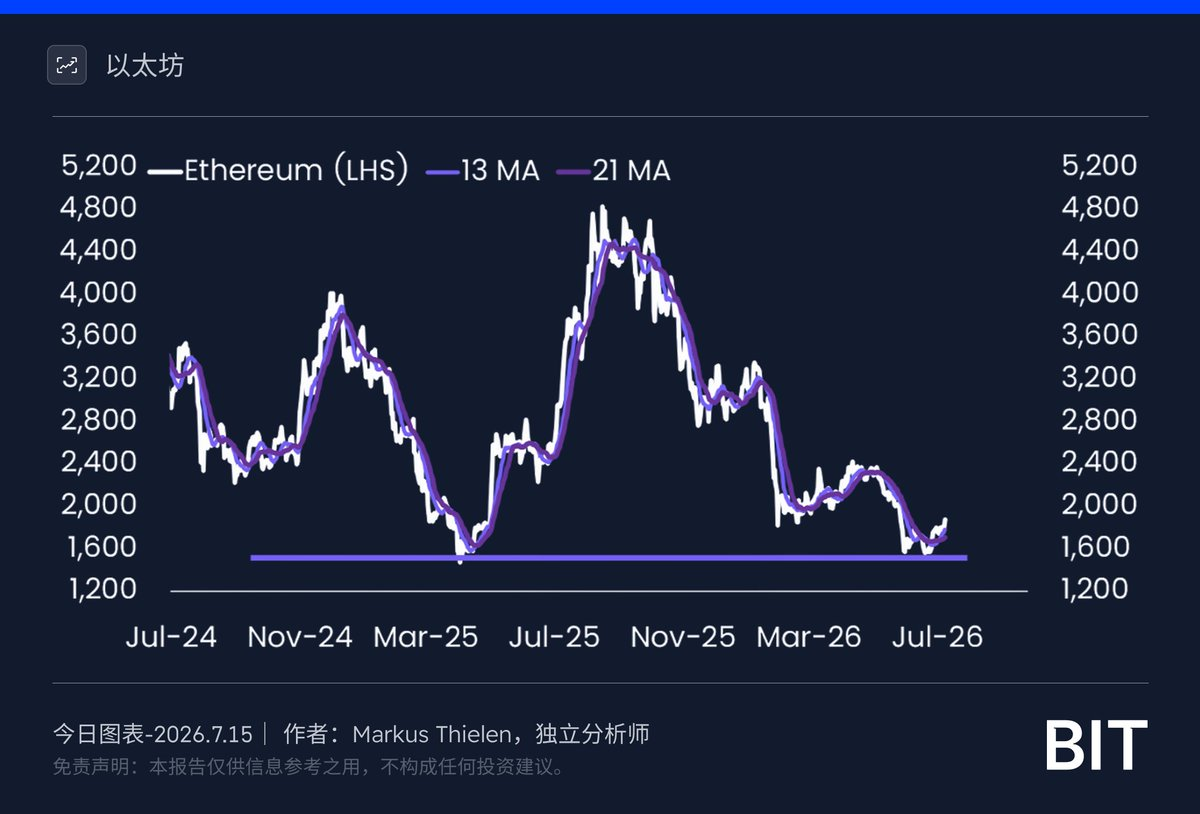
Ethereum has performed stronger than Bitcoin, with ETH rising 6.48% yesterday, nearing $1,900, significantly outperforming BTC. BIT indicated that Ethereum is attempting to form a "double bottom formation," which means as long as ETH does not drop below the recent low, there is room for technical improvement; at the same time, the lower-than-expected inflation data has improved the environment for risk assets. After eight consecutive months of outflows, Ethereum ETF may turn to net inflows for the first time this month, which is expected to support institutional demand.
ETF data also supports this judgment, with a total net inflow of $58.3385 million for Ethereum spot ETFs on July 14, with none of the ten ETFs experiencing net outflows.
The fundamentals are also continuously improving. Bitmine's latest quarterly report shows that about 98% of the company's revenue now comes from ETH staking services, and it is expected that after full staking, annualized income could reach $284 million. Meanwhile, EthSystems, founded by core members of the Ethereum Foundation's privacy working group, has officially launched and received support from institutions like Bitmine, Sharplink, and Joe Lubin, further promoting the construction of Ethereum's institutional-grade privacy financial infrastructure.
The founder of Axie Jihoz stated that the Dencun upgrade has significantly reduced the cost of using Ethereum's second-layer network, which is good for users, but also caused ETH mainnet fee revenue to plummet by 99%, weakening ETH's value capture ability. He believes that discussions around minimum blob fees, base fees, and Gas limits will become more intense in the future. If ETH drops to around $1,400, he would consider buying.
Next, the most important observation point in the crypto market is: Can BTC hold above $65,000 and further break through $67,200? Can ETF funds continue to flow in? Will U.S. PPI and retail sales continue to be good for risk assets? If the data continues to cool, BTC may push for $65,000 to $66,000; if macro data fluctuates, $60,000 or even $54,000 to $55,000 could still be retested.
Today's Key Points:
Strategy's new dividend distribution mechanism will issue the first dividend on July 15
Sei (SEI) will unlock approximately 55.56 million tokens on July 15, worth about $2.8 million
Starknet (STRK) will unlock approximately 127 million tokens on July 15, worth about $3.9 million
Connex (CONX) will unlock approximately 1.32 million tokens on July 15, worth about $13.52 million
Arbitrum (ARB) will unlock approximately 92.65 million tokens on July 16, worth about $8.5 million
Upbit 24-hour trading volume ranking: BTC, ETH, DRV, XRP, B3
Bitcoin spot ETF: +$181 million, BlackRock IBIT leads with a net inflow of $139 million
Ethereum spot ETF: +$58.3385 million, with none of the ten ETFs experiencing net outflows
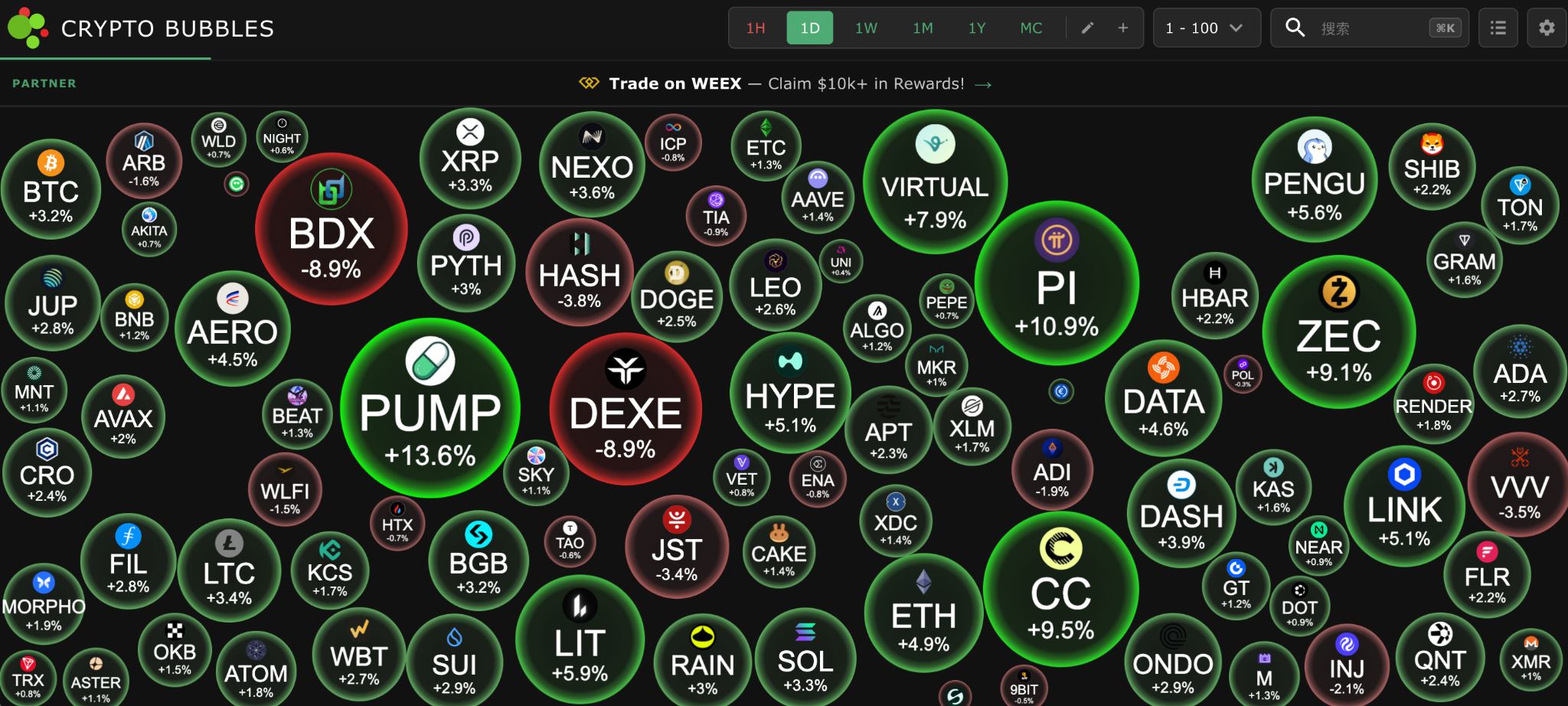
Today the largest increase among the top 100 cryptocurrencies by market capitalization: PUMP up 13.6%, PI up 10.9%, CC up 9.5%, ZEC up 9.1%, VIRTUAL up 7.9%.
Wall Street Re-embraces Risk, Bank Stocks Report Good News, AI Capital Expenditure Logic Further Strengthened

U.S. stock index futures are all up, Nasdaq futures up 0.8%, Dow futures up 0.06%, S&P 500 futures up 0.23%.
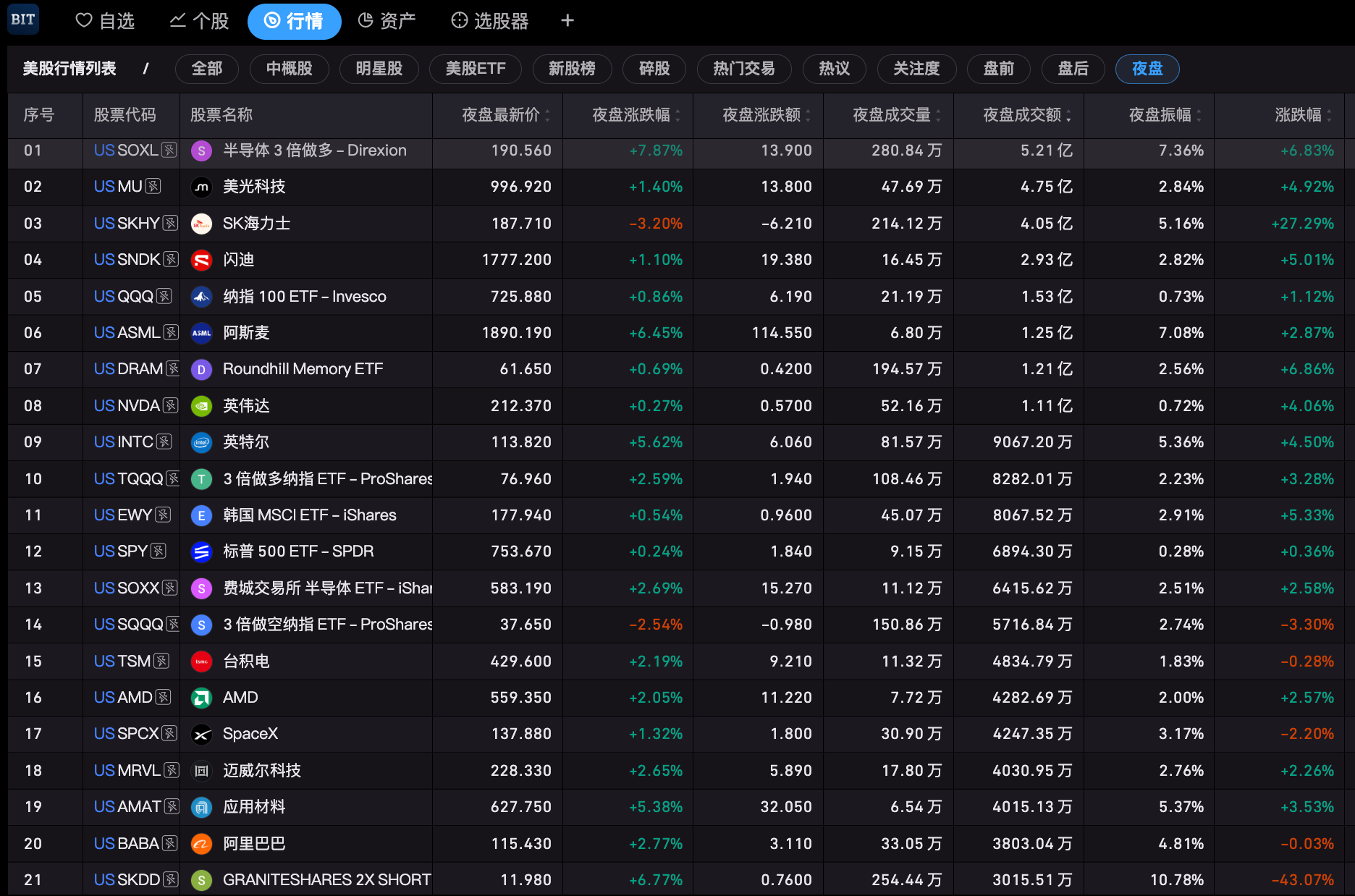
BIT Night Market Data shows that 3x long semiconductor ETFs rose 7.87%, Micron and Sandisk slightly rose by 1%, while SK Hynix fell by 3.2%. Additionally, the lithography machine giant ASML released its Q2 earnings report showing that the company achieved a net sales of €9.3 billion for the quarter, far exceeding the market expectation of €8.88 billion. CEO Christophe Fouquet stated that the demand for AI chips is "extremely strong," and customers are accelerating expansion plans. The company will increase EUV and DUV lithography machine capacity by about 30% over the next two years, ASML rose 6.45% in night trading.
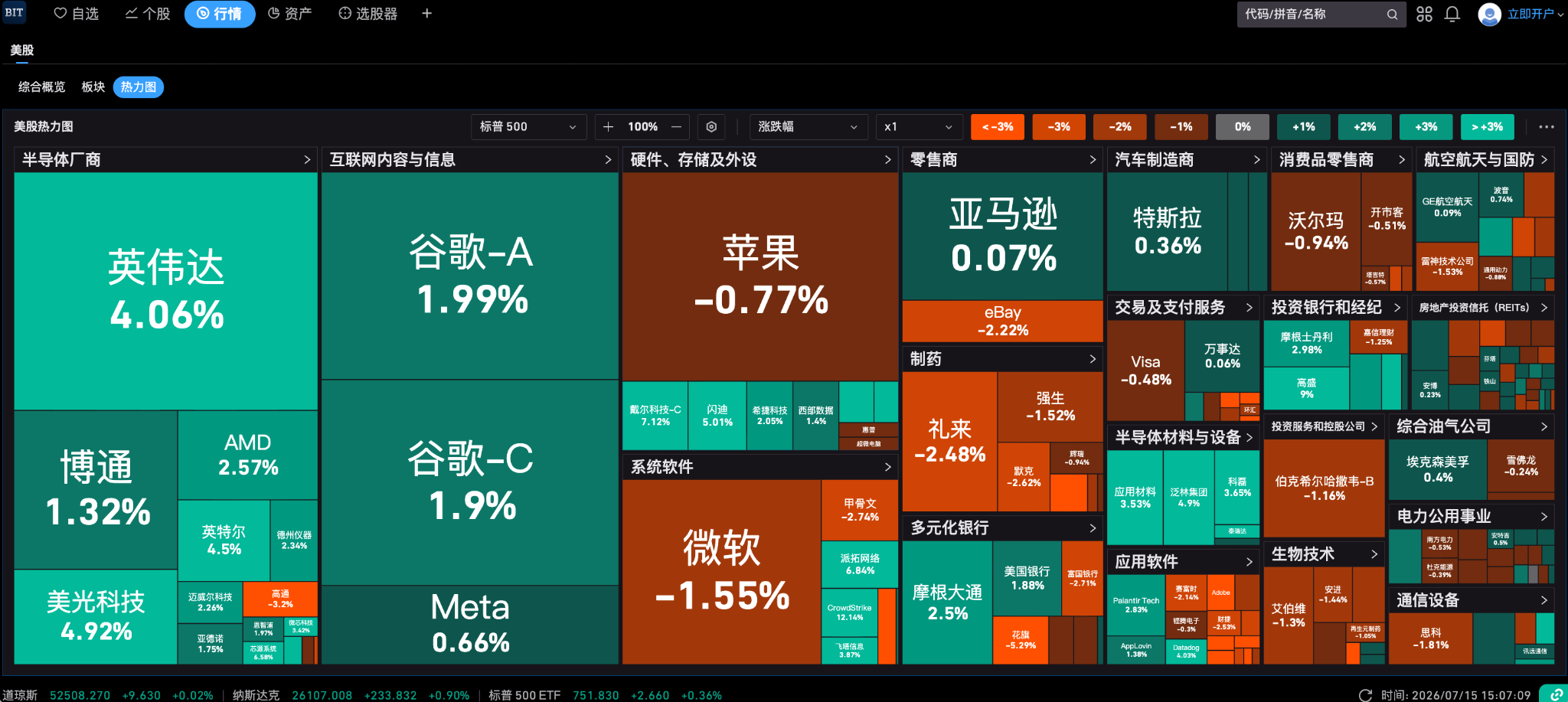
U.S. June CPI fell 0.4% month-on-month (the first negative growth in six years), falling to 3.5% year-on-year, significantly lower than expected, with the sharp decline in gasoline prices being the main reason, directly boosting the probability of the Federal Reserve maintaining interest rates in July, and risk appetite fully revived. The three major indices rose collectively, and the good start to the bank earnings season further consolidated market confidence, despite IBM's earnings warning causing some local noise.
The AI hardware chain continues to be strong, SK Hynix shares surged 27.29%, mainly due to leveraged ETF listings, the launch of options trading, and the market's optimism about HBM, DRAM, and NAND price increase cycles. Micron rose 4.92%, also reflecting that funds continue to bet on the storage supercycle brought by AI.
Banking giants' earnings reports were all positive, with Goldman Sachs posting an EPS of $20.98 in the second quarter, driven by a 72% surge in equity trading business, with the stock skyrocketing by 9%; JPMorgan and Bank of America also rose by 2.5% and 1.88% respectively. In contrast, Citigroup, while reporting the best quarterly revenue in a decade, saw its stock price plummet by 5.29% as management insisted on increasing future investments and maintaining annual return guidance unchanged.
The biggest shock to the market came from IBM, as IBM issued an early warning for Q2 revenue and profit due to clients shifting budgets toward AI servers, storage, and memory, with its stock plummeting by 25.21%, marking the largest single-day drop in history. Goldman warned that the IBM incident could confirm the risk of a "software bear market." This means that AI infrastructure spending is picking off traditional IT budgets faster than the market anticipated. Lark Davis also pointed out that IBM's crash is not just "a tough quarter," but more like the market discovering that AI infrastructure is swallowing IBM's core business.
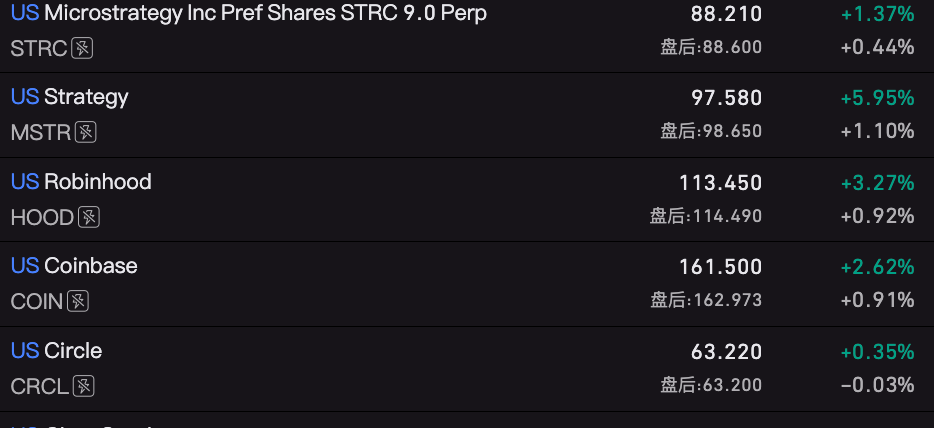
According to BIT US Stocks, crypto-related stocks followed Bitcoin's rebound. Coinbase rose 2.62%, Strategy rose 5.95% to $97.58, Robinhood rose 3.27%. Ark Invest increased its holdings of Circle stocks by about $13.9 million and Block stocks by $1.5 million on Tuesday while reducing its Robinhood stocks by about $3.2 million. Meanwhile, Mizuho downgraded Circle's rating from Neutral to Underperform, lowering its target price from $85 to $50, due to competition in stablecoins possibly compressing Circle's profit margins.
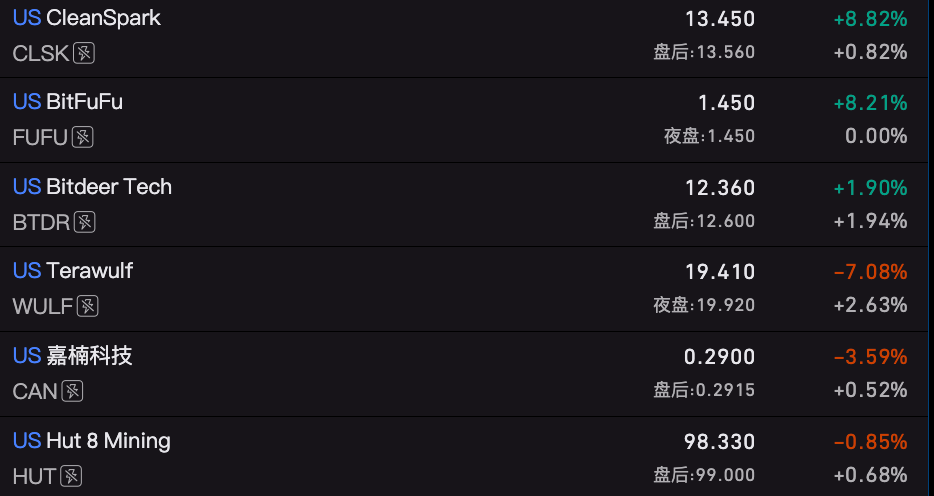
Bitcoin mining companies generally saw declines in June production, with CleanSpark producing 614 BTC in June, down about 9% month-on-month; BitFuFu and Canaan both saw production decline by about 29%. However, CleanSpark signed a $6.6 billion, 20-year data center lease during the same period (involving up to 885 megawatts of power assets in Georgia and Texas), and the stock price rose by over 24% at one point, ultimately closing up 8.82%. Additionally, Benchmark raised Hut 8's target price from $85 to $165, believing that its AI data center business has altered the valuation logic.
U.S. stocks will next focus on two lines: first, whether the U.S. June core PPI, retail sales, and initial jobless claims can continue to verify inflation cooling and economic resilience; second, the release of earnings reports from Morgan Stanley, Johnson & Johnson, and others.
South Korean Chip Stocks Surge to Trigger Circuit Breaker, Japanese Equipment Stocks Rise Along with AI Cycle
The U.S. June CPI better-than-expected cooling has driven a comprehensive repair in global risk appetite, making the Korean and Japanese stock markets core beneficiaries of this rise. Funds continue to be allocated around the AI supply chain, semiconductor equipment, and memory chips, driven by the ongoing expansion of U.S. tech stocks and AI capital expenditure.
The KOSPI index briefly rose over 8%, returning above 7,000 points. SK Hynix rose 8.83%, and Samsung Electronics rose 6.27%. At the same time, Samsung Electronics is in the early stages of evaluating the issuance of American Depository Receipts (ADRs) in the U.S. to try to catch up in valuation with its competitor SK Hynix, which has surged 194% this year. Goldman’s Seoul team pointed out in a recent report that institutional funds are aggressively bottom-fishing at Fibonacci retracement support levels, reaffirming a mid-term target of 12,000 points for the KOSPI.
However, the rapid rise in the South Korean stock market has also drawn regulatory scrutiny. The Korea Financial Investment Association and CEOs of ten leading brokerages held an emergency meeting to discuss whether to increase the investment threshold for single-stock leveraged ETFs. The current minimum margin is about 10 million won, and the proposed plan includes raising it to 50 million won. South Korean President Lee Jae-myung also stated that the South Korean stock market needs time to stabilize after a short-term surge.
The South Korean central bank meeting is also crucial, with the market widely expecting the Bank of Korea to raise interest rates by 25 basis points on Thursday, increasing the benchmark rate from 2.50% to 2.75%. If realized, this will be the first rate hike by the Bank of Korea in about three and a half years. KB Financial Group analyst Lim Jae-kyun believes the Bank of Korea may raise rates twice this year, but is more likely to raise them again in October rather than consecutively in July and August.
The Japanese stock market also rose, with the Nikkei 225 index rising 1.49%, Kioxia rising 5.79%, Tokyo Electron rising 2.70%, and Advantest rising 4.35%, showing that funds continue to buy into the AI chip equipment chain.
New news has also emerged regarding domestic semiconductor investments in Japan, with Tower Semiconductor announcing a $3 billion investment in Japan to strengthen chip manufacturing, including a $1 billion grant from the Japanese government. The project will increase the capacity of 300mm silicon photonic devices and is expected to be fully operational by the fourth quarter of 2027.
免责声明:本文章仅代表作者个人观点,不代表本平台的立场和观点。本文章仅供信息分享,不构成对任何人的任何投资建议。用户与作者之间的任何争议,与本平台无关。如网页中刊载的文章或图片涉及侵权,请提供相关的权利证明和身份证明发送邮件到support@aicoin.com,本平台相关工作人员将会进行核查。


