

Author: Zen, PANews
The large Asia Web3 industry conference WebX just concluded in Tokyo. In a video address, Japanese Prime Minister Sanae Takaichi expressed hope that the synergy between the Web3 conference and government policies could further promote the development of Japan's innovation ecosystem.
The bustling scene contrasted sharply with the quiet of the cryptocurrency market, with many attendees humorously saying they felt the "beauty of the crypto uptrend period" on-site.
This conference, as part of the expanding business layout of Japan's financial group SBI Holdings, also let this active player in the cryptocurrency market take center stage. SBI not only served as the naming sponsor but also had group chairman Yoshitaka Kitao give a keynote speech. Just last October, SBI acquired 51% of shares in CoinPost, the organizing body of WebX, and integrated it into the group.
This change resonates with SBI's recent intensive activities in the digital asset sector. Over the past month, SBI Holdings participated in a $175 million funding for decentralized lending protocol Morpho, launched the yen stablecoin JPYSC, and introduced the US dollar stablecoin RLUSD issued by Ripple in Japan.
Entering July, it invested $125 million in the DeFi risk management and yield strategy platform Gauntlet and established a strategic partnership with the Solana Foundation during the WebX event, planning to expand operations around stablecoins, RWA, cross-border settlements, and institutional on-chain services.
Compared to its previous broad layout focused on Ripple, exchanges, market making, and digital securities, SBI's recent strategic focus has become more concentrated. This traditional financial group, established 27 years ago, is attempting to recombine settlement, asset issuance, trading, credit, and asset management from traditional finance onto the chain.
From Decentralized Layout to On-chain Finance: SBI Integrates Digital Asset Business
SBI has entered the cryptocurrency industry for ten years. Early investments included Ripple and participating in enterprise blockchain company R3, establishing cryptocurrency trading, institutional liquidity, and digital securities businesses, making it one of the earliest and most extensive traditional financial groups to orient towards digital assets in Japan.
However, early businesses were relatively dispersed. SBI VC Trade undertook cryptocurrency asset trading and custody, B2C2 provided liquidity for global institutions, and the digital securities business explored the tokenization of bonds, funds, and other real assets. It wasn't until the past two years that "on-chain finance" began to emerge as a new framework to connect these businesses.
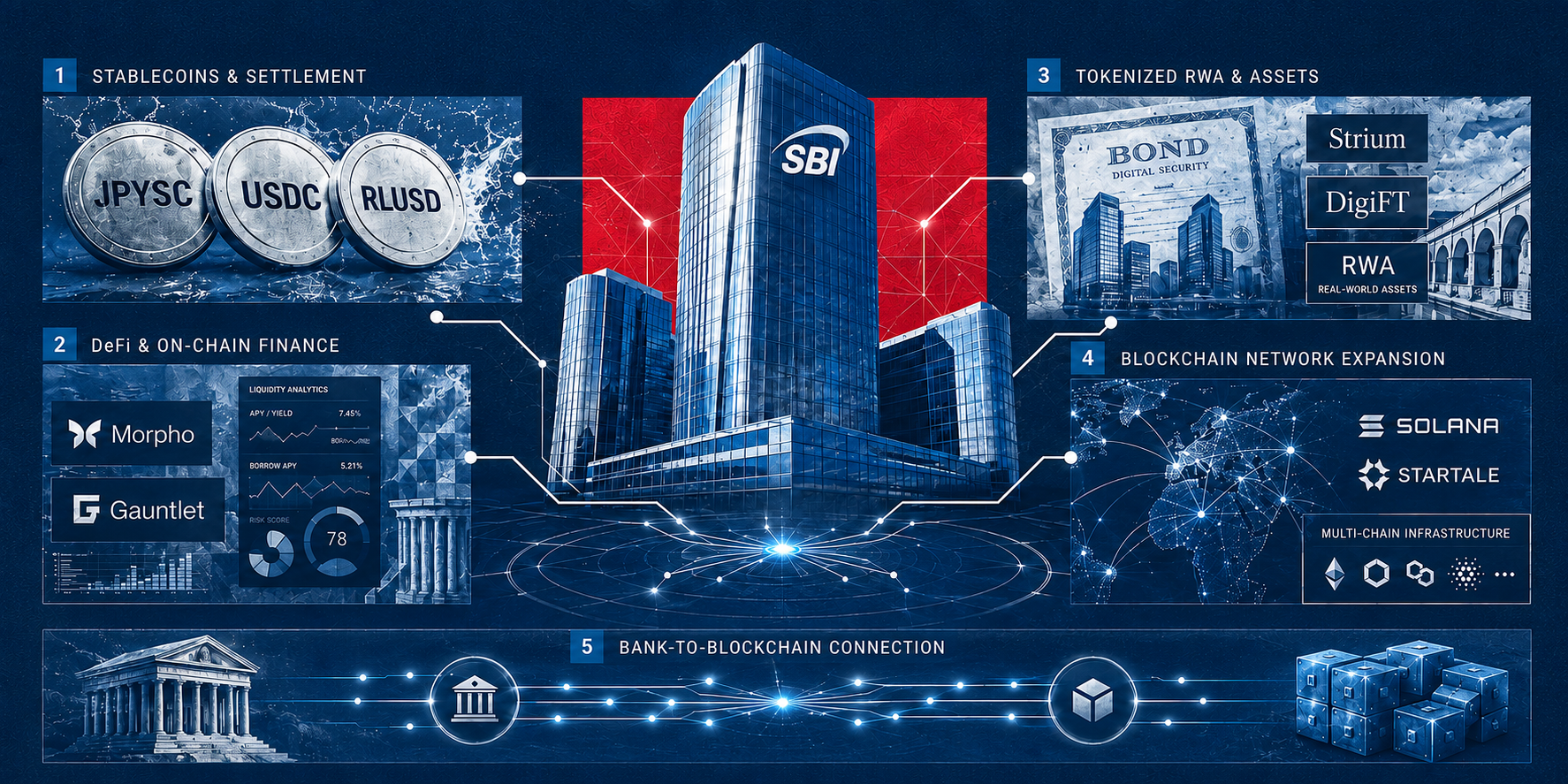
In the strategic materials released in May 2026, SBI categorized on-chain finance into six levels: settlement, assets, markets, yield vaults, distribution, and investors, proposing to build an "SBI On-chain Asset Management Platform."
According to its plan, JPYSC, USDC, and RLUSD are responsible for settlement and fund transfers, the blockchain and RWA platform undertakes asset issuance and trading, DeFi enhances capital efficiency, while internal asset management, securities, and digital asset businesses are responsible for product design and customer outreach.
From recent investments, SBI is strictly following this structure and layering for layout. SBI placed Circle's financial blockchain Arc in the "settlement layer" in its strategic materials, put Morpho in the "market layer," and corresponding Gauntlet to the "yield vault layer."
This classification also reveals SBI's investment thinking — to fill the foundational capabilities missing in its on-chain financial system.
Stablecoins First, Building Yen and Dollar Settlement Networks
In SBI's on-chain finance framework, stablecoins are the first part to enter actual operation.
On June 24, JPYSC, jointly developed by SBI and Startale, officially launched. JPYSC is issued by SBI Shinsei Trust Bank, SBI VC Trade is responsible for circulation, and Startale handles the main technical development. As Japan's first yen stablecoin issued with a trust structure, JPYSC is designed according to Japan's "Fund Settlement Act" as "Type 3 electronic payment means," with reserve assets managed by the trust bank, and 1 JPYSC corresponding to 1 yen.
An important difference brought by the trust structure is that JPYSC is not subject to the 1 million yen transfer and holding limit that "partial fund transfer type" and "overseas issuance type" stablecoins face. Theoretically, this makes it more suitable for corporate fund allocation, large settlements, RWA trading, and cross-border payments.
However, JPYSC is still some distance from open on-chain circulation. Currently, the product is only available internally on SBI VC Trade accounts, and users cannot transfer JPYSC to or withdraw it from external wallets. SBI stated that once relevant legal interpretations, tax practices, and operational arrangements are further clarified, it will shift to public blockchain circulation.

While external transfers are not yet open, SBI has begun expanding the use scenarios of JPYSC within the platform. SBI VC Trade announced on July 16 the opening of loan service applications for JPYSC, officially launching on July 23. Users can lend their held JPYSC to the platform and receive yields paid in JPYSC upon maturity; the initial annual yield rate is 3%, and the regular annual yield is expected to remain around 1% to 3%.
In addition to the yen stablecoin, the US dollar stablecoin provides another connection capability.
In March 2025, SBI VC Trade became the first platform in Japan to offer USDC trading services to regular users. Subsequently, cooperation with Circle has extended beyond stablecoins to capital and business levels.
In March 2025, the two parties signed an agreement to establish a joint venture, Circle SBI Japan, with SBI and Circle each holding 50% shares, primarily responsible for promoting the circulation of USDC in Japan and expanding payment and other financial applications. In June of the same year, when Circle went public on the New York Stock Exchange, SBI Group purchased $50 million worth of Circle shares as a strategic investor.
In March 2026, SBI VC Trade launched USDC lending services, extending the application of stablecoins from trading and payment to yield products.
In addition to USDC, SBI VC Trade further launched RLUSD in June this year. RLUSD, issued by a regulated trust company under Ripple, is processed by SBI as Japan's first "Type 4 electronic payment means." Thus, SBI's licensed digital asset platform has now covered JPYSC, USDC, and RLUSD, forming a product structure where the yen and dollar stablecoins run in parallel.
The roles of the three stablecoins are not entirely the same. JPYSC is responsible for connecting domestic bank funds and yen assets; USDC has broader global on-chain liquidity; RLUSD continues the decade-long cooperation between SBI and Ripple, targeting institutional payments and cross-border financial scenarios.
SBI also hopes to further promote cross-currency settlements between JPYSC and US dollar stablecoins and explore the application of stablecoins in card clearing, cross-border payments, and tokenized asset deliveries. The group has already collaborated with Visa on digital finance and is testing USDC offline payments.
Bringing Traditional Assets on Chain, Connecting Global Markets
Stablecoins solve the problem of how funds enter the chain; the next step is to bring investable financial assets onto the chain.
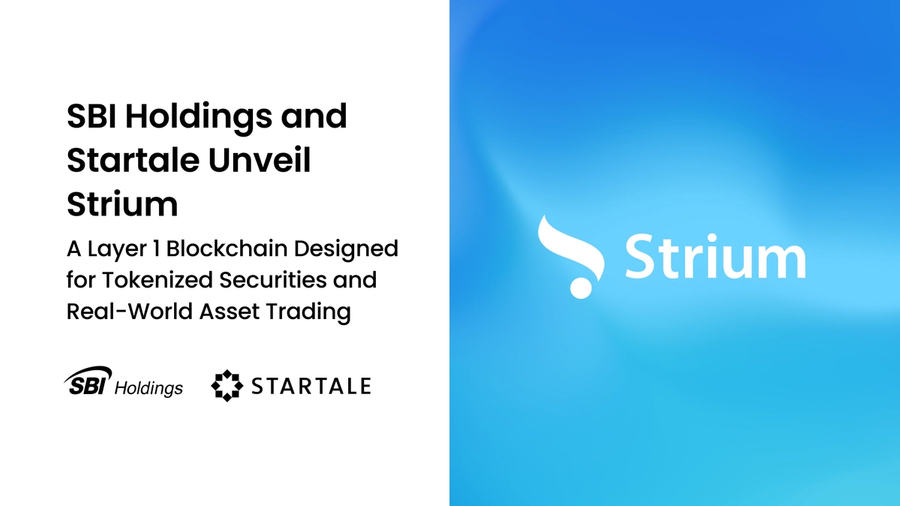
In this phase, Startale is becoming an important technology partner for SBI. In March this year, SBI announced an investment of about $50 million in Startale and plans to include it as an equity method associate company. Both parties are currently jointly promoting two core products: the yen stablecoin JPYSC and the Layer 1 network Strium aimed at tokenized securities and RWA trading.
The Strium project was officially announced in February of this year. The network plans to support around-the-clock spot and derivative trading of tokenized stocks, bonds, and RWA-related products, attempting to establish an on-chain market unrestrained by traditional trading hours. Currently, Strium remains in the concept validation phase, and the timeline for the testnet and commercial deployment has not been officially determined.
SBI also established a joint venture, SBI Onchain, with Singapore-licensed RWA platform DigiFT, where SBI holds a 60% stake. This platform plans to establish a tokenization, legal, and risk management framework around Japanese assets and connect it with overseas on-chain capital. SBI's long-term vision is to convert the group's internal securities, funds, and other financial products into on-chain assets, and then complete transactions and settlements via stablecoins.
On July 13, SBI's collaboration with Solana further supplemented this framework. According to the plan, the Solana Foundation will participate in the subsequent development of SBI R3 Japan, which intends to be renamed "SBI Solana Global" and will expand its operations around stablecoins like JPYSC, corporate bonds, commercial papers as RWA, cross-border settlements, institutional on-chain financial services, and AI intelligent agent payments.
This cooperation also reflects that SBI is strengthening its multi-chain approach. The group continues to develop Strium aimed at tokenized financial assets alongside maintaining layouts in XRPL, Canton, and Ethereum; Solana provides a high-performance public chain and global liquidity entry. How different networks will work together in the future has not been fully disclosed yet, but SBI has indicated that it does not wish to bind financial products and customers to a single chain.
From Morpho to Gauntlet, Filling In On-chain Lending and Asset Management
If stablecoins and RWA mainly address "how funds and assets go on-chain," then the corresponding issues for Morpho and Gauntlet are: once funds are on-chain, how to complete lending, allocation, and generate yield.
In June, SBI participated in a new funding round for Morpho amounting to $175 million, co-led by Paradigm, a16z crypto, and Ribbit Capital. Compared to the early DeFi lending model where asset and risk parameters were unified by the protocol, Morpho employs a modular architecture that allows institutions and developers to create isolated lending markets and independently choose collateral, risk conditions, and yield strategies.
SBI categorized it in the “market layer” of on-chain finance in its official strategic materials, valuing this credit infrastructure that can be embedded within banks, fintech platforms, and asset management products.
In July, SBI led a $125 million C round financing for Gauntlet through its U.S. subsidiary. Gauntlet was originally known for its DeFi risk models, providing market parameters, liquidation risk, and stress testing services for various lending protocols. In recent years, it has gradually shifted towards yield vault management, designing on-chain allocation strategies based on assets, yield goals, and risk preferences.
Morpho and Gauntlet have strong business complementarities. Morpho provides the foundational credit network to establish lending markets, while Gauntlet assesses risks, designs vaults, and allocates funds above these markets. The former is closer to market infrastructure in on-chain finance, while the latter undertakes asset management and risk optimization functions.
With recent intense layouts, SBI's on-chain financial landscape has begun to take on a clearer outline. The advantage of this structure is that SBI does not need to build all technology modules from scratch. The group can introduce technologies from on-chain native companies through investments and partnerships, then leverage its own financial licenses, customer base, and distribution networks to promote implementation.
However, this on-chain financial system is still in the construction phase, and many of the layouts are some distance from large-scale implementation. Currently, SBI has built a relatively complete strategic framework, but whether different businesses can form synergistic effects and eventually transform into a sustainable on-chain financial system will still require time and practical application to test.
免责声明:本文章仅代表作者个人观点,不代表本平台的立场和观点。本文章仅供信息分享,不构成对任何人的任何投资建议。用户与作者之间的任何争议,与本平台无关。如网页中刊载的文章或图片涉及侵权,请提供相关的权利证明和身份证明发送邮件到support@aicoin.com,本平台相关工作人员将会进行核查。


