Pump's total amount repurchased and destroyed is approximately 400 million USD, and the total number destroyed accounts for 15% of the total supply.
Written by: Maher, Foresight News
On July 14, 2026, Pump.fun's native token PUMP experienced its first significant cliff unlock after the TGE. According to Tokenomist, on-chain monitoring, and cross-validation from multiple data platforms, the theoretical maximum number of tokens unlockable on that day was 82.5 billion, accounting for 8.25% of the total supply (1 trillion tokens), valued at approximately 131.35 million USD (calculated at the then price of about 0.00159 USD), equivalent to about 20.23% of the circulating supply before the unlock.
This was the first unlock of the two major distribution categories: team/advisors and private investors, with private investors unlocking 32.5 billion tokens, and the team and advisors unlocking 50 billion tokens.
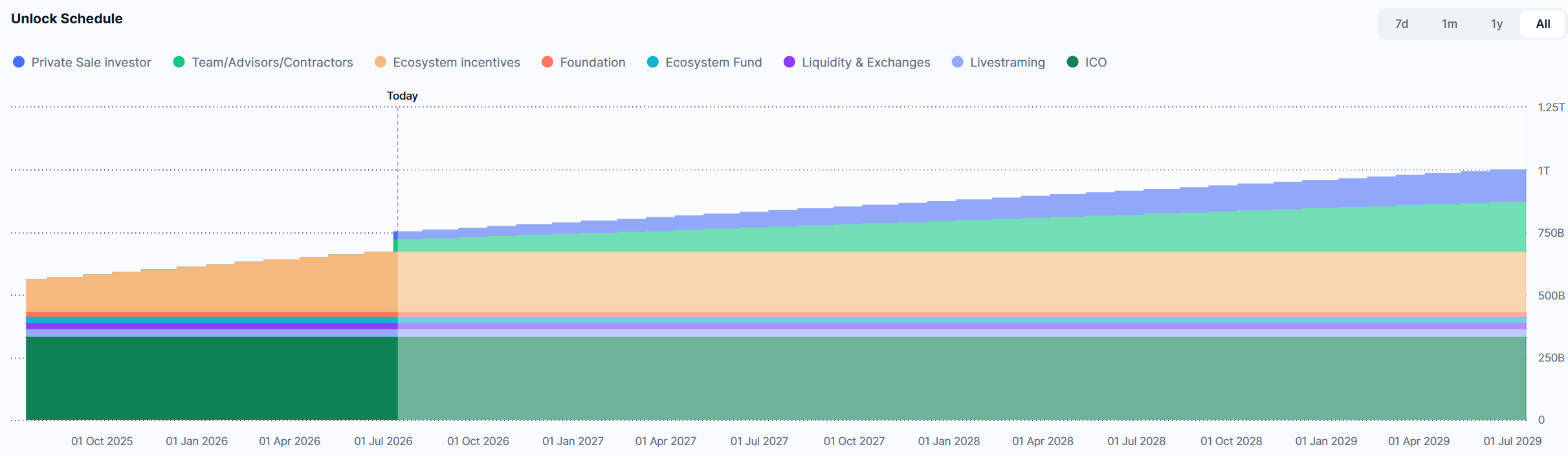
In the early hours of July 15, according to Arkaham's on-chain tracking data, 57.279 billion tokens were unlocked and distributed to 121 wallets. PUMP currently has a market capitalization of approximately 650 million USD, with an FDV of about 1.6 billion USD.
Monthly earnings of 20 million USD, daily earnings of 940,000 USD
This event occurred against the background of Pump.fun having become one of the most profitable applications on Solana and in the entire Web3. Over the past 30 days, the platform's protocol revenue reached 24.52 million USD (DefiLlama data), second only to Hyperliquid's 43.93 million USD, and higher than Polymarket's 22 million USD; cumulative revenue has surpassed 1.05 billion USD, with more than 12 million tokens issued cumulatively.
Even in a deep bear market environment, Pump's weekly revenue is still able to maintain around 5 million USD.
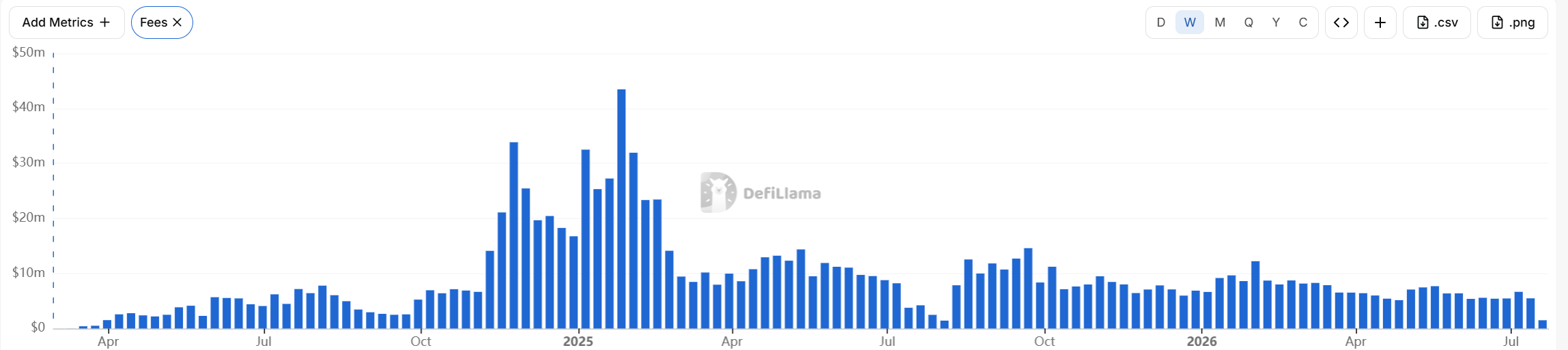
However, such a substantial revenue does not seem to bring about a positive cycle for its token price. PUMP has fluctuated from a peak of 0.008980 USD down to around 0.001628 USD.
What is the underlying issue?
The core value capture mechanism of Pump.fun is the protocol fee repurchase and permanent destruction of PUMP. As of now, its official platform data shows an annualized revenue of 343.71 million USD, with an average daily revenue of 940,000 USD over the past 90 days. The total amount repurchased and destroyed has reached 408.15 million USD, with the total number destroyed accounting for 15.029% of the total supply.
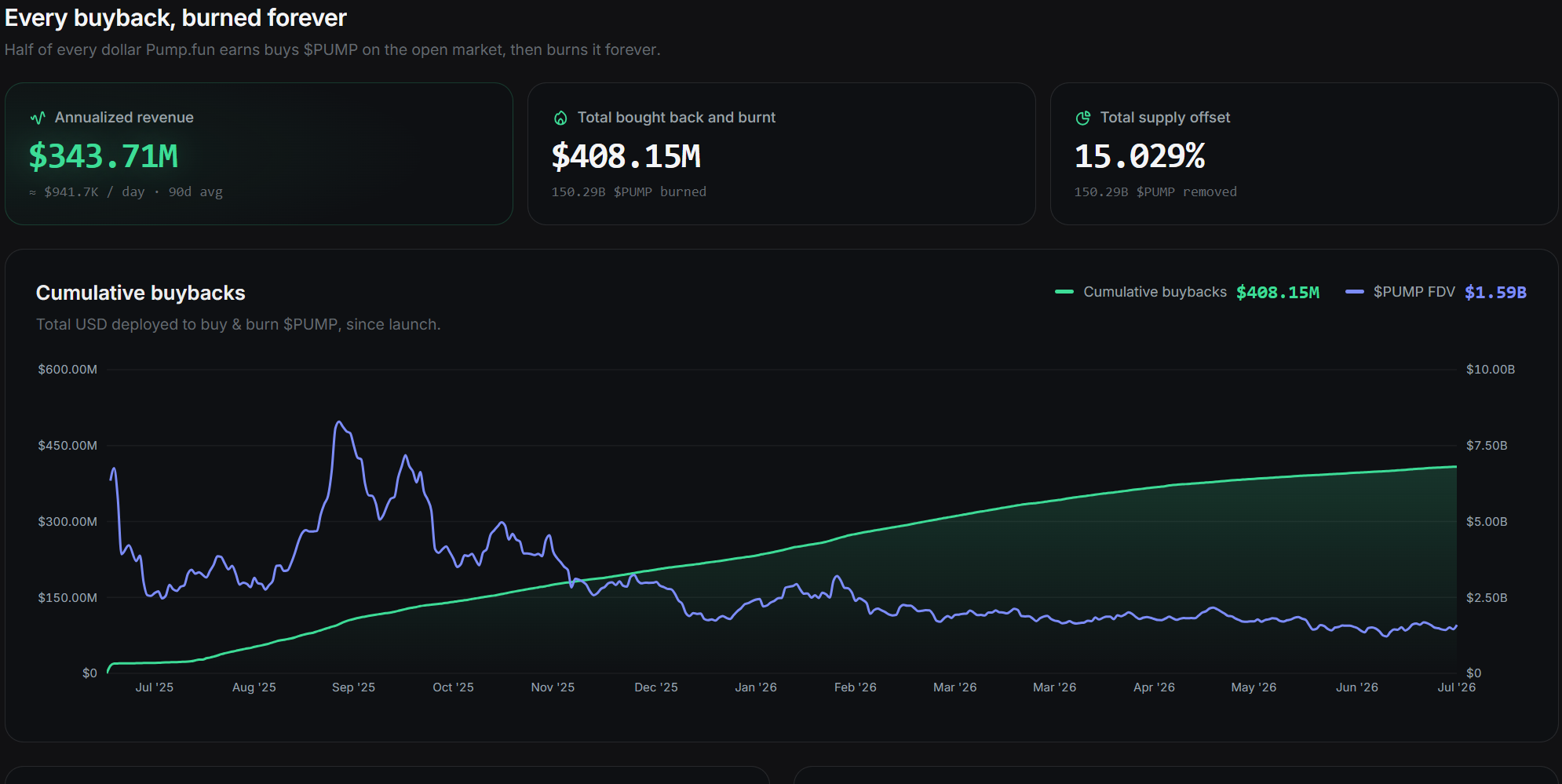
Pump commenced following the TGE in July 2025: initially, 100% of net protocol fees (bonding curve, PumpSwap, Terminal, and other cross-chain revenues, minus referral fees and cashbacks) were used to buy and destroy PUMP in the open market.
On April 28, 2026, it was adjusted: 50% of net revenue was programmed to lock and used for repurchases and destruction for one year; the other half was allocated for hiring, marketing, and product development. All repurchased tokens are permanently destroyed, rather than locked. This forms the core flywheel distinguishing PUMP from most meme or platform tokens— the more profitable the platform, the scarcer the token supply.
However, the intensity and duration of the repurchase have raised significant controversy, as PUMP only uses 50% of net income for repurchasing and destroying, a substantial reduction from the previous 100%, leading to a sharp decrease in buying support. In contrast, HYPE repurchases nearly 99% of fees, and Lighter has also recently used its entire revenue to buy back and destroy tokens, making PUMP's repurchase appear insufficient against a comparable revenue scale, unable to offset the selling pressure from unlocks, naturally resulting in a decline in price.
Moreover, Pump is facing a collective lawsuit. U.S. plaintiffs have characterized it as an "illegal digital casino." Under such intense regulatory pressure, cutting the repurchase by 50% and reallocating substantial funds to the treasury for hiring a "Chief Legal Officer with a salary of 5 million USD" is a political hedge by the team at the expense of secondary holders’ interests to pay for their own compliance.
Furthermore, when the one-year term expires, whether repurchases will continue remains a significant question mark.
A deeper reason is PUMP's "casino genes." It is essentially a meme launch platform, filled with PVP gambling and casino culture, exhibiting violent fluctuations and low-brow narratives, leading to almost zero willingness from institutional funds to buy in or hold long-term. Compliance risks, reputational pressures, and lack of real utility keep mainstream capital at bay, relying only on retail and speculative funding to maintain price support, which, once the unlock occurs, will naturally weaken the capacity to absorb selling pressure.
Can the massive selling pressure be absorbed by the market and repurchase?
On-chain observations show that some wallets that received the tokens are already transferring them on the day of unlock and the following day; while this has not triggered a collapse, short-term volatility and liquidity tests are unavoidable. Additionally, the utility of PUMP itself remains weak (mainly for ecological incentives and potential governance), with the market viewing it more as an "income sharing certificate" rather than a strictly utilitarian token, which amplifies sensitivity to selling pressure in a bearish market sentiment.
In comparison with similar high-revenue protocols: Hyperliquid has higher monthly revenues but a market cap of nearly 15 billion USD (about 20 times that of PUMP); Polymarket has similar revenue but has not issued tokens, with a financing valuation already reaching the 15 billion USD level. The sustained income ability of both has been confirmed, while Pump may experience sharp revenue declines due to the market turning bearish and meme tokens lagging.
However, this unlock is not a "one-time death." The team and investors have a three-year release period, rather than immediate full-scale selling. Historical experience shows that some project teams and early investors will choose to hold or sell slowly to maintain reputation and long-term interests. Additionally, the release of ecological incentives and parts of the foundation can be used for growth rather than pure selling pressure. Pump.fun has expanded from a singular launch pad to PumpSwap, multi-chain support, and live streaming, forming a more complete ecosystem. PUMP, as its native token, directly benefits from the platform's expansion.
The unlocking of 82.5 billion tokens is a true stress test for PUMP, marking the transition from the "100% repurchase honeymoon period" to a "sustainable but more restrained" phase. In the short term (from a few weeks to 1-2 months), the battle between selling pressure and repurchase strength will determine the extent of price fluctuations; if the market can absorb well without liquidity exhaustion, it might even strengthen the narrative of high-revenue protocol tokens.
In the long run, what decides PUMP's fate is not a single unlock, but whether Pump.fun can continue to serve as a core infrastructure for the meme economy to generate revenue. As long as the income flywheel keeps turning, repurchases and destruction will continue to compress supply; conversely, any significant drop in revenue will turn subsequent unlocks into a real burden.
免责声明:本文章仅代表作者个人观点,不代表本平台的立场和观点。本文章仅供信息分享,不构成对任何人的任何投资建议。用户与作者之间的任何争议,与本平台无关。如网页中刊载的文章或图片涉及侵权,请提供相关的权利证明和身份证明发送邮件到support@aicoin.com,本平台相关工作人员将会进行核查。


