Author: Kuri, Deep Tide TechFlow
Deep Tide Reading: The Robinhood Chain mainnet launched two weeks ago, with TVL surpassing 160 million USD, the market cap of stablecoins exceeding 327 million USD, and total DEX trading volume reaching 4 billion USD. The meme coin CASHCAT saw a decline from a peak market cap of 170 million USD to about 138 million USD, with on-chain speculation shifting from memes to utility projects. Among the ecological partners, Arcus (dYdX team) and Rialto (multi-asset DEX) have not issued tokens yet, creating an early interaction window; native projects like Arrow Finance and INDEX have risen against the trend as meme hype wanes.
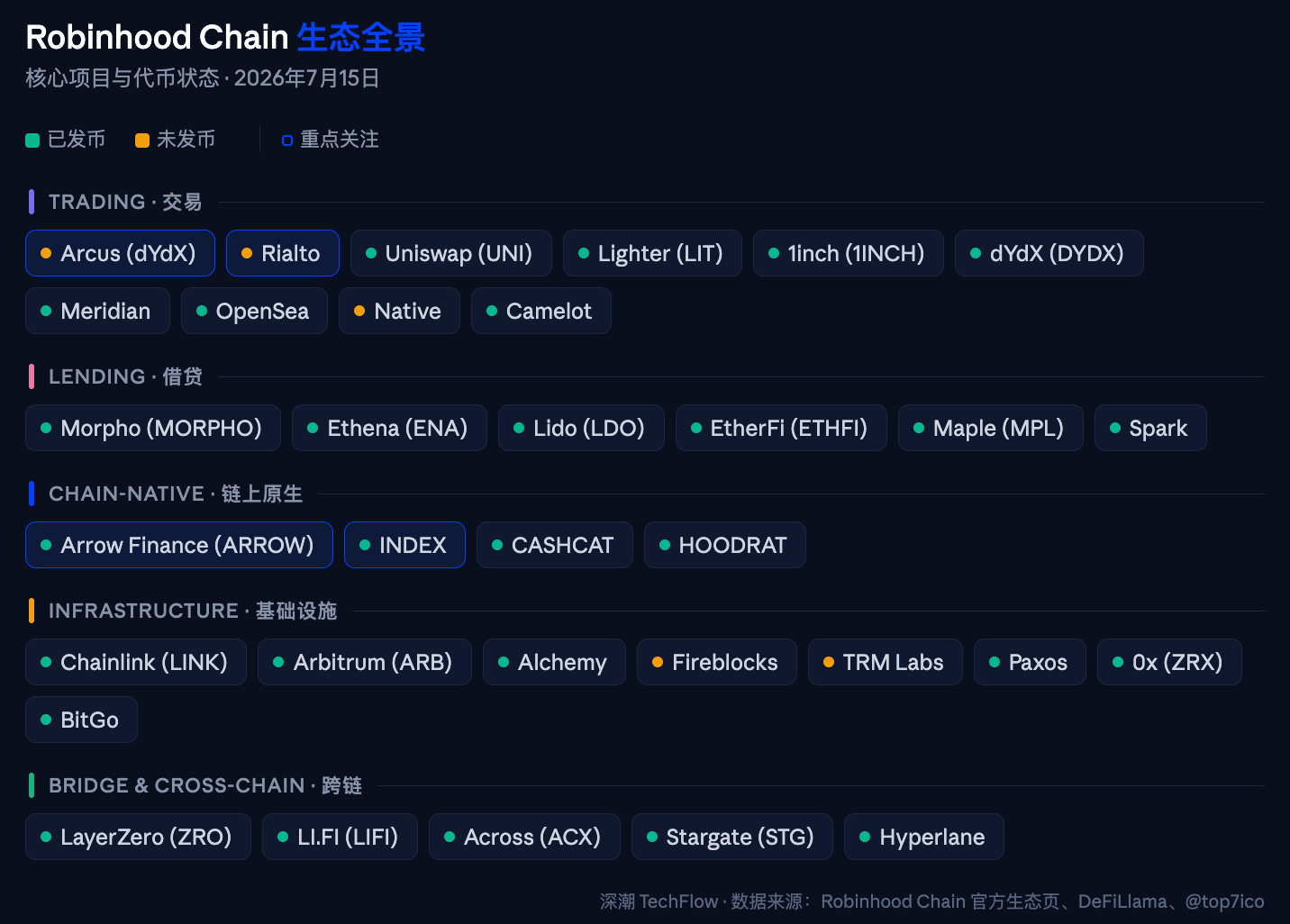
On July 1, Robinhood announced the public mainnet of Robinhood Chain at the London event "The World is Flat". Two weeks later, this Ethereum L2 built on the Arbitrum tech stack experienced a standard cycle of “meme explosion, data peak, heat decline” and is entering a critical window for ecological filling.
According to DeFiLlama data, as of July 15, Robinhood Chain's TVL was about 161 million USD, with the market cap of stablecoins around 327 million USD (USDG accounting for 68.2%), and total DEX trading volume approximately 3.9 billion USD, while active market value of RWA was about 12.4 million USD. For an L2 that has been live for two weeks, these numbers are not bad, but the structure needs to be examined.
CASHCAT ignited the first week, the story of 85 USD turning into 2 million boosts daily activity to 193,000
The first week of Robinhood Chain's activity was almost entirely supported by the CASHCAT token.
The name CASHCAT comes from alternative names that Robinhood founders Vlad Tenev and Baiju Bhatt considered for the company in its early years. This token was deployed before the mainnet launch, contributing about 98 million USD in DEX trading volume on July 8, with its market cap surging to between 150 million and 170 million USD. On that day, the total 24-hour DEX trading volume across the Robinhood Chain reached about 560 million to 570 million USD, briefly surpassing Hyperliquid.
Several typical early wealth creation cases emerged on-chain: one wallet bought CASHCAT for about 85 USD (0.05 ETH), with the position reaching a peak value exceeding 2 million USD; another wallet entered with 838 USD, yielding a return of over 1180 times. These on-chain data quickly spread after being tracked by Lookonchain and Bubblemaps, becoming a major narrative driving new wallets to flood in. On July 8, 141,000 new active wallets were added, leading to a total daily active count of nearly 193,000.
Tenev himself also got involved in boosting. He stated on the X platform that Robinhood Chain “is built for RWA, but also handles memes well.”
However, as of July 15, according to GMGN market data, the market cap of CASHCAT has dropped to about 138 million USD, with a 24-hour decline of 12%. Other meme coins like HOODRAT and JUGGERNAUT have each declined over 25%. The meme decline has already begun.
Utility projects rise against the trend: ARROW and INDEX become new focal points
As the meme decline occurs, some on-chain native projects with real product logic begin to attract funding.
Arrow Finance (ARROW) is a native CDP (over-collateralized debt position) protocol on Robinhood Chain. After users deposit collateral, they can mint aUSD stablecoins. Its core difference from general CDPs lies in the range of collateral: besides mainstream cryptocurrencies and stablecoins, Arrow Finance is the first CDP protocol to accept tokenized public stocks and ETFs as collateral. Users holding tokenized stocks can borrow liquidity without selling their stocks, avoiding triggering taxable events, and do not need to leave Robinhood Chain.
According to CoinGecko data, ARROW currently has a market cap of about 16 million USD, with a price of about 1.79 USD, having risen more than 10 times since its starting price of around 0.15 USD on July 7. Prices shown on CoinMarketCap are even higher, around 2.26 USD. ARROW has launched staking functionality (LP Staking), with trading mainly concentrated on Uniswap V2/V3/V4 (Robinhood Chain).
INDEX is another utility token that has garnered attention. Public data shows that INDEX surged by 160% on the evening of July 14 due to interest from Robinhood team members, reaching a market cap of about 7.36 million USD as of the publication. The core mechanism of this project is using trading fees to purchase on-chain stock tokens, which are then distributed to INDEX holding addresses. This "transaction fee → purchase stock tokens → distribution" flywheel structure essentially builds a revenue distribution layer on top of the stock token ecology of Robinhood Chain.
It is important to emphasize that both INDEX and ARROW are early-stage on-chain native projects, with thin liquidity and volatile prices, and project information mainly comes from on-chain data and community dissemination, lacking institutional-level due diligence verification.
Issued ecological projects: fundamentals and on-chain performance
The first batch of partners on Robinhood Chain covers 16 projects. Most of these already have tokens, and for these projects, investors are concerned with the fundamentals and the actual functions of the tokens on Robinhood Chain.
Lighter (LIT): A ZK-driven perpetual contract and spot DEX, directly integrated into the Robinhood wallet. Eligible users can trade perpetual contracts within the wallet. Lighter promises to invest 11 million USD in LIT tokens for the Robinhood community, earning points through trading (double points for trades through the Robinhood wallet), which can be converted into LIT in the future. This is currently the most direct point mining channel on Robinhood Chain.
Morpho (MORPHO): A lending protocol that supports the majority of the chain's TVL. In its first week, about 90 million USD in TVL was concentrated in Morpho, serving as the underlying infrastructure for Robinhood Earn products (estimated 7% APY on USDG loans). Lloyd's of London and RELM provide insurance coverage for it. The high concentration of TVL in a single protocol poses risks, but also indicates that lending demand is not purely speculative.
Chainlink (LINK): As the official oracle and cross-chain infrastructure of Robinhood Chain, it provides price data for all Stock Tokens, with CCIP, Data Streams, and Data Feeds deployed on the mainnet from day one.
Arbitrum (ARB): The underlying tech stack of Robinhood Chain. Offchain Labs has simultaneously launched a revenue-sharing model: 10% of the net protocol fees from Robinhood Chain flow back to the Arbitrum ecosystem (of which 8% enters the DAO treasury and 2% goes to the Developer Guild). ARB has seen a rise of about 7.6% since its mainnet launch.
Other partners with issued tokens include Uniswap (UNI), LayerZero (ZRO), 1inch (1INCH), etc. These projects have actual deployments on Robinhood Chain, but the price drivers of the tokens themselves do not primarily come from Robinhood Chain.
Unissued projects: interaction paths and airdrop expectations
Among the partner list, there are 4 projects that have not yet conducted TGE. TRM Labs (compliance risk control) and Fireblocks (MPC infrastructure) are more B-side focused, with little participation from retail investors. The real interaction opportunities are with Arcus and Rialto.
Arcus: Incubated by dYdX Labs, built in conjunction with Robinhood Crypto, which has invested in it (amount undisclosed). The CEO is Eddie Zhang, who previously founded the social trading app Pocket Protector (acquired by dYdX Labs in July 2025). dYdX founder Antonio Juliano has joined the board of Arcus.
Arcus currently offers zero-fee spot trading for 95 Stock Tokens, operating 24/7, covering over 120 countries (not available in the US, Canada, and the UK). 35 RWA perpetual contracts are still in the waitlist stage, with plans to open a Pre-IPO market.
Regarding the token, dYdX clarified in its announcement that future Arcus tokens will be prioritized for users who trade, stake, or validate on dYdX. In other words, there are two interaction paths for Arcus airdrops. One is to accumulate trading, staking, and validation history on the dYdX Chain; the other is to trade Stock Tokens directly on Arcus (currently zero-fee, with extremely low interaction costs). The issue date is not yet determined.
The market reaction to Arcus's launch has been mixed: DYDX token fell about 23% within 24 hours (traders worried about resource diversion), while Robinhood stocks (HOOD) rose over 10% in the same period.
Rialto: Launched from stealth mode, a full asset class on-chain spot exchange supports 24/7 trading of cryptocurrencies, Stock Tokens, ETFs, commodities, and Pre-IPO assets. The team comes from backgrounds in hedge funds, high-frequency trading, and market making.
Rialto's core differentiation is the PropAMM (Proactive Automated Market Maker) engine "Rivo Altus". Unlike passive AMMs, PropAMM provides on-chain market-making using the team’s own inventory and proprietary pricing logic, deploying market-making logic directly on-chain using Arbitrum’s Stylus infrastructure, aiming to make the execution quality of on-chain trading approach that of centralized exchanges.
Rialto has no token plans but has launched a referral program: unlocking the referral code after achieving a cumulative trading volume of 10,000 USD, with referrers earning 10% of the fees from their referrals. The new exchange on the chain accumulates early users through the referral program and trading volume before issuing tokens, which is a common early confidence signal ahead of airdrops. Initial launch covers over 90 Robinhood Stock Tokens and mainstream cryptocurrencies.
Structural issues of Robinhood Chain
The data from the past two weeks reveals an inescapable fact: the on-chain TVL is highly concentrated in Morpho, DEX trading volume heavily relies on meme speculation, and RWA's active market value is only about 12.4 million USD. The narrative of Robinhood Chain is "financial infrastructure", but so far, the most active trading target on-chain is a cat meme coin.
The actual on-chain activity of Stock Tokens is also far lower than expected. According to SQD's on-chain data analysis, as of the early mainnet phase, only 24 Stock Tokens and ETF tokens have generated on-chain transfers, totaling 313 transactions, accounting for 0.27% of all ERC-20 transfers on the chain. The real trading demand for tokenized stocks on-chain has yet to be validated.
The 90-day gas fee waiver period is another variable. The current trading activity of Robinhood Chain is influenced by gas subsidies; the retention rate after the subsidies end is a critical window for assessing the true stickiness of the ecosystem.
免责声明:本文章仅代表作者个人观点,不代表本平台的立场和观点。本文章仅供信息分享,不构成对任何人的任何投资建议。用户与作者之间的任何争议,与本平台无关。如网页中刊载的文章或图片涉及侵权,请提供相关的权利证明和身份证明发送邮件到support@aicoin.com,本平台相关工作人员将会进行核查。


