The original text is from Circle founder Jeremy Allaire
Compiled by|Odaily Planet Daily Qin Xiaofeng(@QinXiaofeng888)
Editor’s Note: On July 13, Circle founder Jeremy Allaire published a research paper titled "Agent Economy," exploring the integration trends between AI Agents and future economic systems. Allaire stated that as AI Agents begin to take on corporate tasks, and value circulates natively through open, programmable networks, the Agentic Economy and Onchain Economy will eventually become two sides of the same economic system.
“This paper is the result of decades of building internet infrastructure and crystallizes a question I have been focused on from the outset: that open software and open networks can change not only how we share information but also reshape our social, political, and economic landscape. Many ideas in the paper are derived from the two beliefs I had when I founded Circle. First, capital can circulate through open protocols just as information flows on an open internet. Second, blockchain is a network computer: it is a foundational platform where autonomous software and machines can store value, exchange value, and coordinate economic activities directly without human intervention.” Allaire introduces the original intent of his research.
He adds that these initial concepts have been refined over time, culminating in a deeper understanding of how financial and economic systems integrate with software and the internet. As this integration progresses alongside the emergence of truly powerful artificial intelligence and agent systems, this theory can be further expanded: it describes not just a new type of currency or a new network, but a completely new economic operating model and its impacts on humans, labor, capital, ownership, and new social contracts. This is precisely what the book aims to explore.
The original paper is 89 pages long, and those interested can download the full text for reading:https://agenticeconomytreatise.com/treatise/index.html; Odaily Planet Daily has compiled asummary of the key content, enjoy~
——————————————
01 The Convergence and Deconstruction of Enterprises
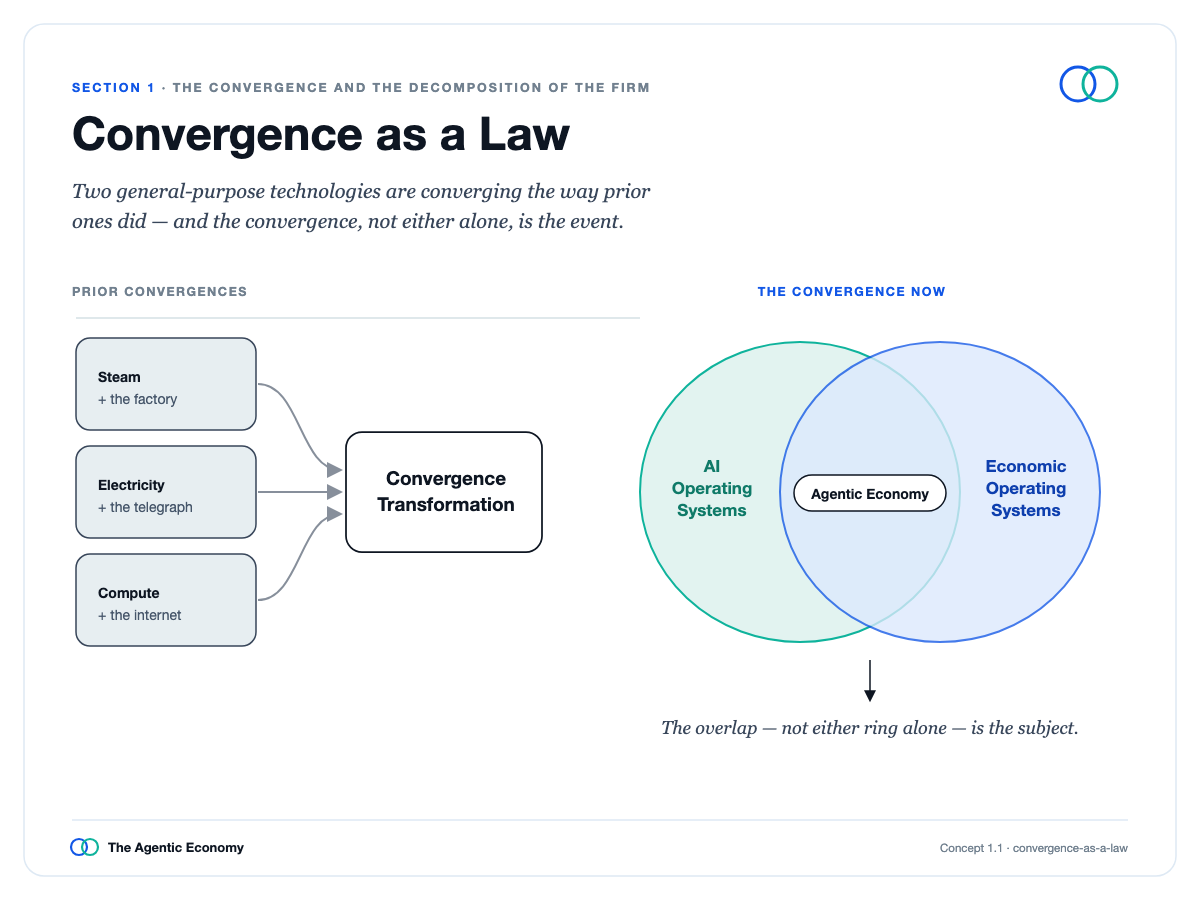
Every significant transformation in the internet age follows the same path: it does not originate from a single invention but emerges suddenly from the maturity of multiple technologies coming together. The convergence of networks, mobile, cloud, and social media all follows this underlying repeating pattern.
Law of Convergence
As various capabilities converge, once-expensive items see their costs approach zero, and once costs reach zero, the scale of these activities experiences explosive growth. This holds true for information in networks, communication in mobile and social, and software in the cloud.
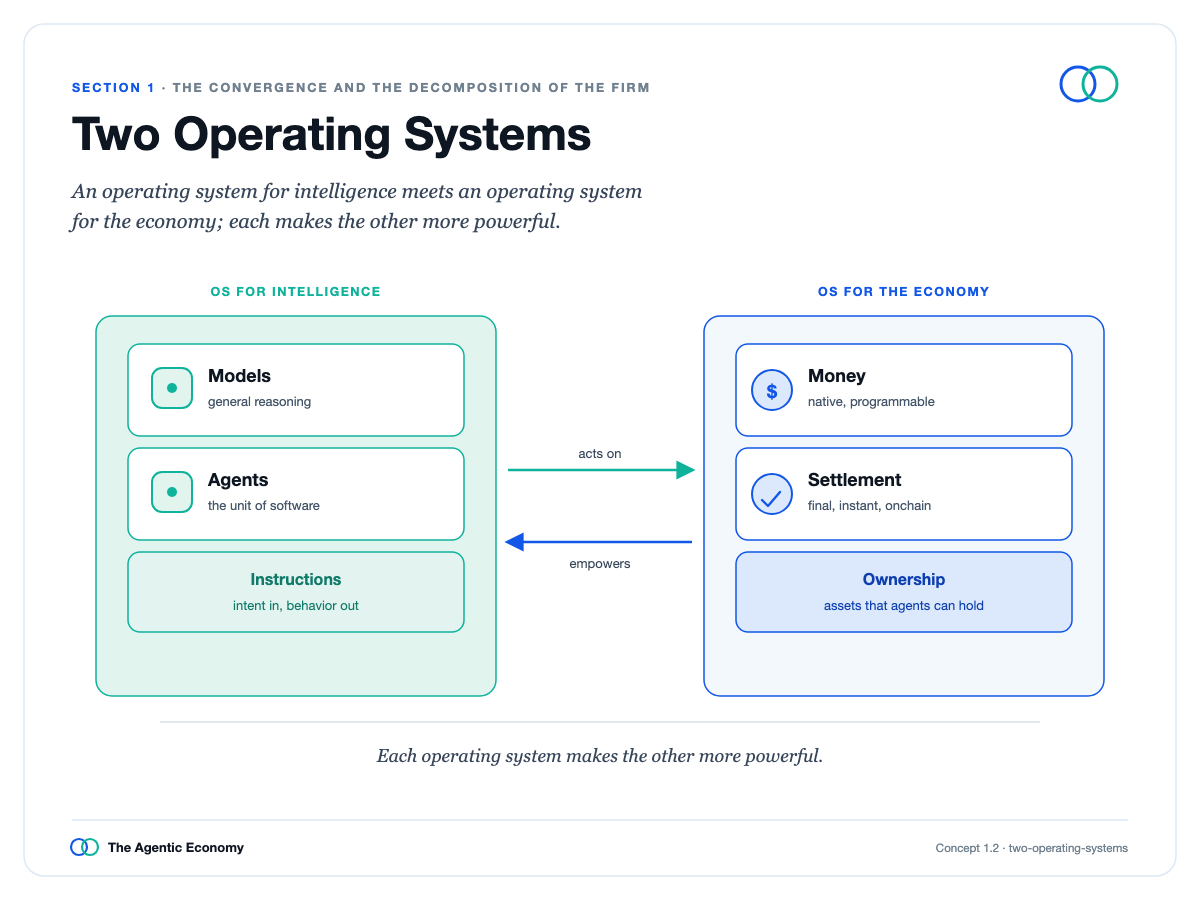
Today, two new systems are converging, directing the same power toward two areas that the internet has never fully digitized: intelligence itself and the economy itself. The first is the intelligence system, composed of AI models and the agents built upon them, pushing the costs of thinking and working toward zero. The second is the economic system, constituted by blockchain, where money, contracts, and coordination operate in the form of software, driving transaction costs to zero. Together, they empower each other, and the core assertion of the entire discourse is: these are not two parallel trends, but two sides of the same economic body.
Two Operating Systems
The intelligence system is crucial because it changes the nature of software.
You no longer program; instead, you give instructions in natural language, and it will infer answers rather than follow fixed steps. Its basic unit is the Agent: a reasoning process to which you assign tasks. This transforms software from programs executed by machines word by word into tasks you can delegate to thinking machines, allowing core functions of businesses to be dissected and reconstituted as skills that agents can perform.
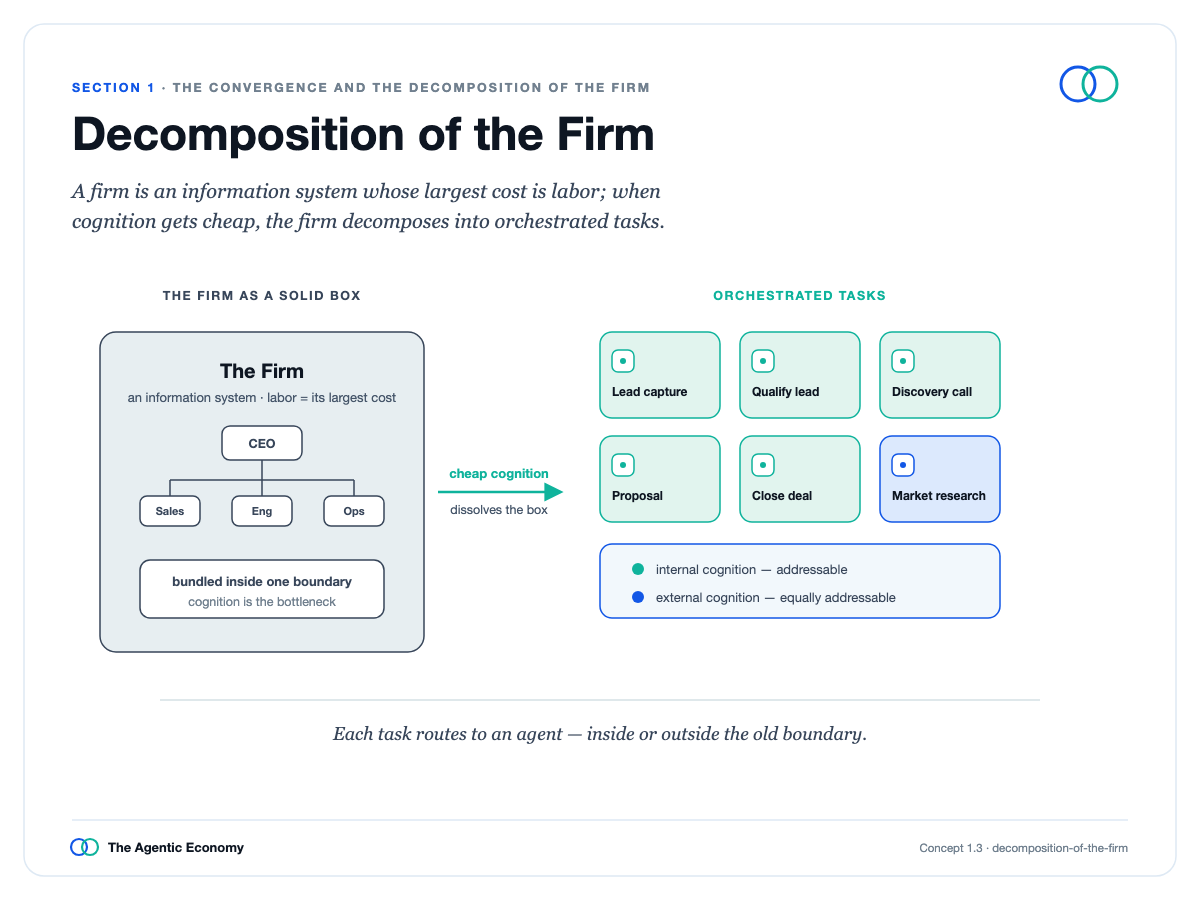
Beneath brands and buildings, companies are essentially organized thought: products, marketing, sales, finance, legal, plus the external companies they hire. These are almost all human labor, and labor is the largest cost in the economy, which is precisely the target that cheap and powerful intelligence is set to conquer.
Decomposition of Enterprises
It also disrupts the traditional explanations of why enterprises exist. Companies grow because coordinating external labor is costly, so they internalize it; however, when any non-physical work can be performed by agents that you can instantly find, hire, and pay, this logic weakens, allowing one person to accomplish what used to require an entire department.
It first descends upon software and other information-intensive tasks, progressing most slowly in physical fields, still awaiting breakthroughs in robotic technology. This isn't just about cutting jobs: a person working alongside a powerful agent will become extremely efficient, while judgement, interpersonal relationships, and ultimate accountability remain with humans. This leaves a tension that needs to be further explored, which the argument will address later through ownership: even as the proportion of the economy paying for human labor decreases, individual abilities can be magnified.
Click to read the first section:https://agenticeconomytreatise.com/treatise/section-1.html
02 Assembly, Coordination, and Why Companies Go Onchain
Once an enterprise is broken down into various skills, the real question is no longer which can be automated, but how these fragments can be reintegrated.
The answer lies in the orchestration layer: a general manager agent receives objectives, breaks them down into tasks, assigns them to specialist agents, and then stitches the results together, with supporting software conveying context and memory between each step. The same mechanism applies to any function, thus marketing, finance, sales, and products are essentially the same set of machines applied to different tasks.
People will not disappear. Some remain within the closed loop to execute or verify tasks requiring human judgement. Others rise above the closed loop to set goals, define standards, monitor quality, and decide when machines should stop and seek approval. The transition from executing work to supervising work is the true form of human oversight, and the corresponding tools are on the way.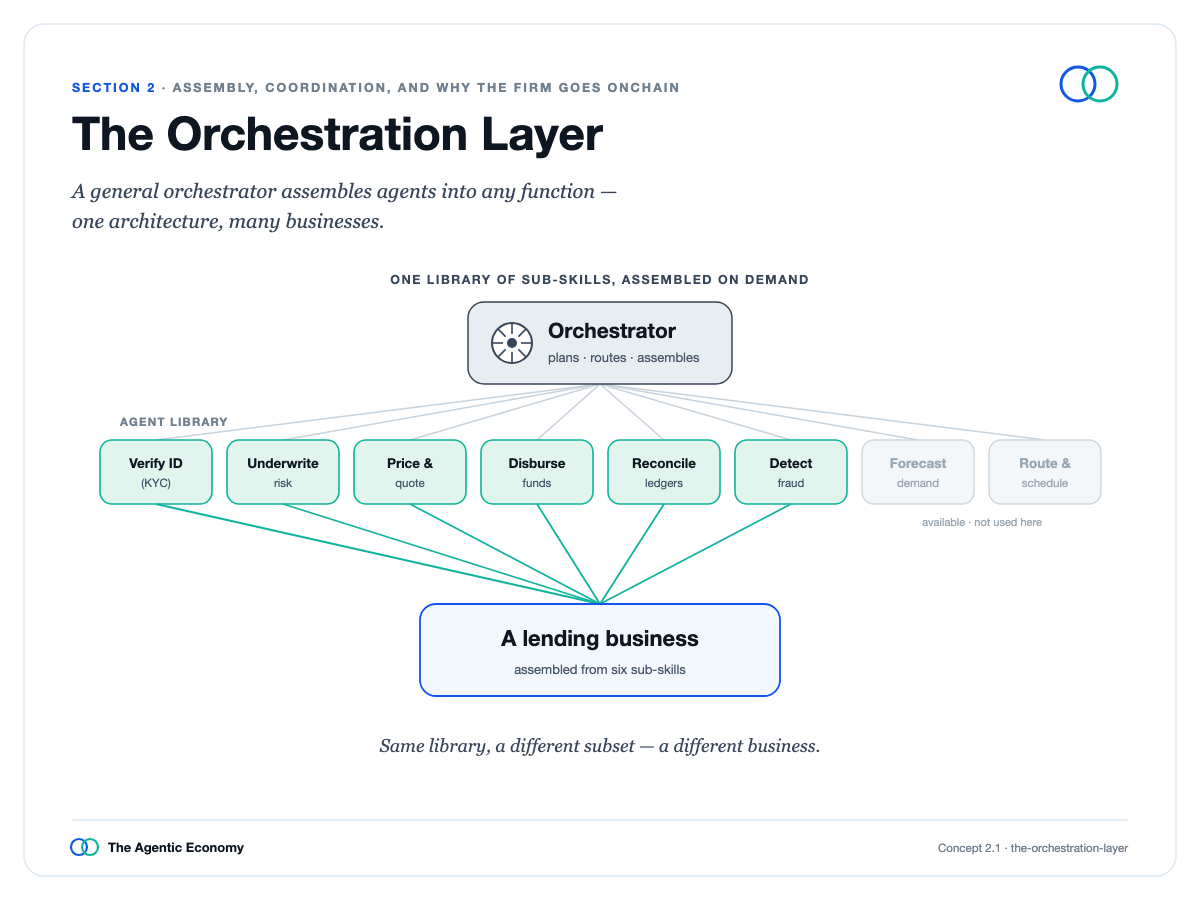
Orchestration Layer
When a company clarifies a task sufficiently for internal operations, it is also clear enough for external hiring, thus an open agent market almost forms as a byproduct.
This market could go down two paths. It can evolve into a few large platforms selling agents like utilities, or more likely and interestingly, form a genuine labor market composed of specialized agents, as deep expertise continues to hold value, and enduring enterprises will be those whose agents focus deeply in a particular area.
However, hiring software assembled from anywhere in the world requires trust, which is exactly the issue pushing all links onto the blockchain.
The solution is a layered identity. At the base is a public blockchain verifiable by anyone. On top sits real-world identity verification, similar to what banks have implemented at scale, the agents' own wallets and credentials, plus a reputation that accumulates over time but is tied to verified real creators. Together, these form an accountability chain: every action of the agent can be traced back to the real individual or company responsible for it.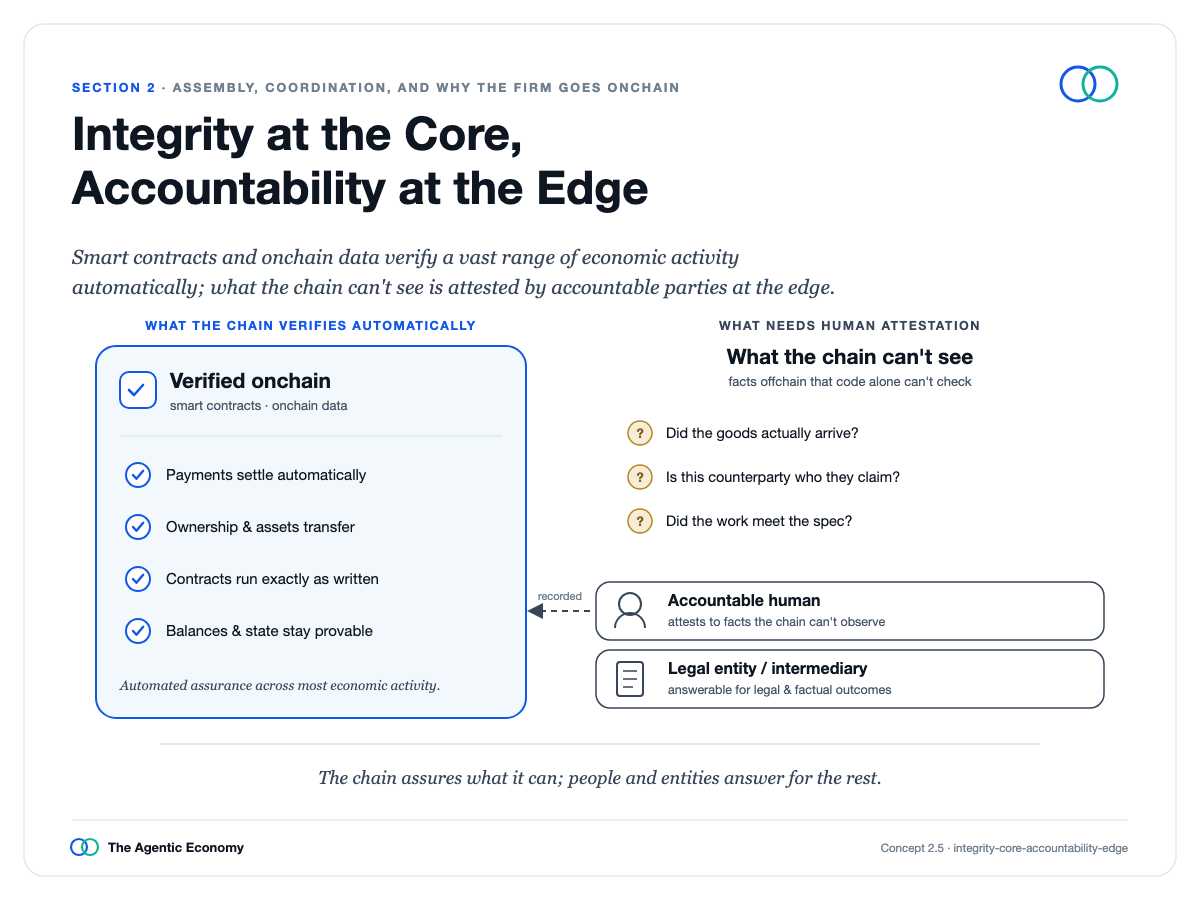
Integrity as Basis, Accountability Throughout
A private database of a single company cannot achieve this, as the trust locked within a single operator cannot transfer, whereas identities rooted in public chains and real-world verification can. Therefore, autonomy here does not equate to anonymity. Behind an autonomously acting agent, there is always someone responsible for it.
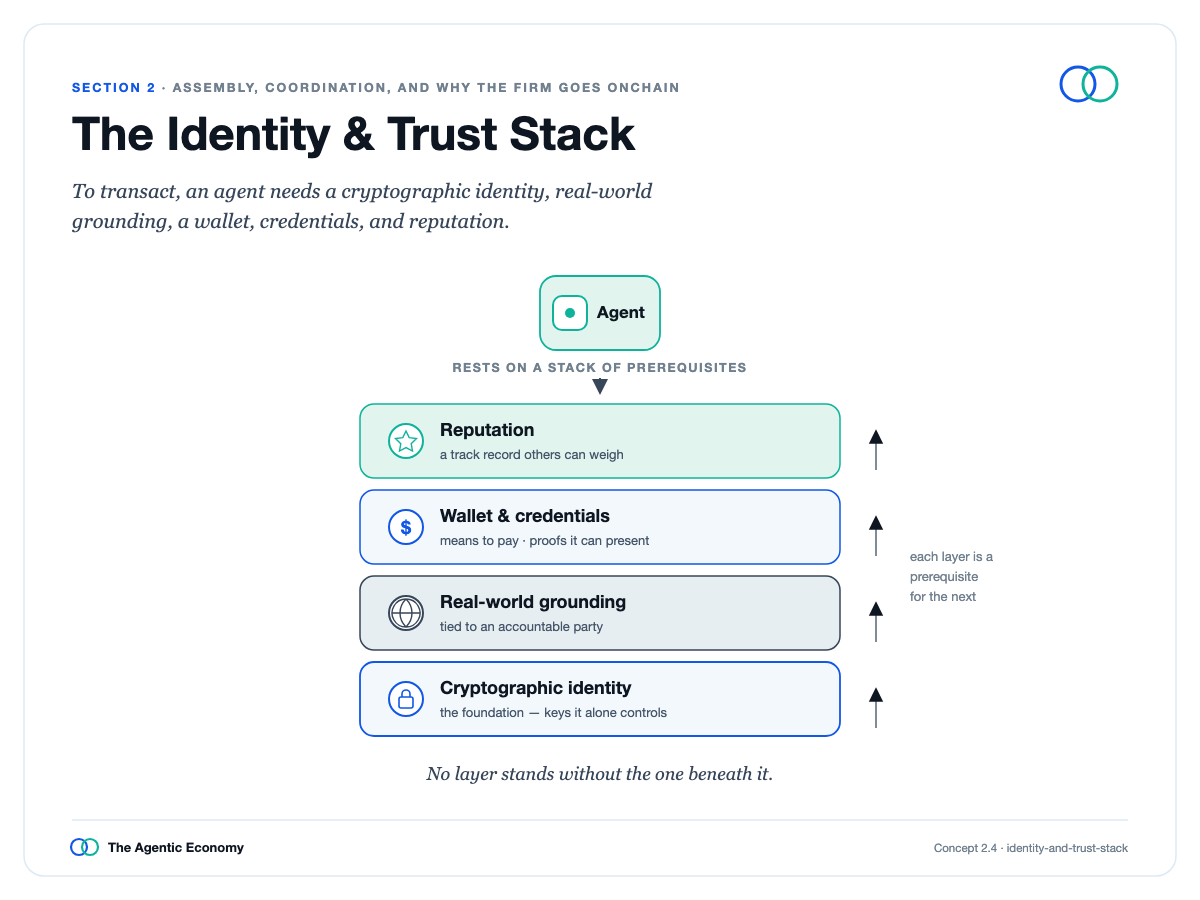
Accountability Chain
Click to read the second section:https://agenticeconomytreatise.com/treatise/section-2.html
03 Monetary Foundation: Speed, Security, and Finality
Agents need a currency they can hold and transfer to operate at machine speed, whether in large amounts or small, without needing to stop and verify the reliability of the currency itself at every payment. The last point is critical, pointing to a traditional answer: currency that is fully backed, has final settlement, and operates on an open network.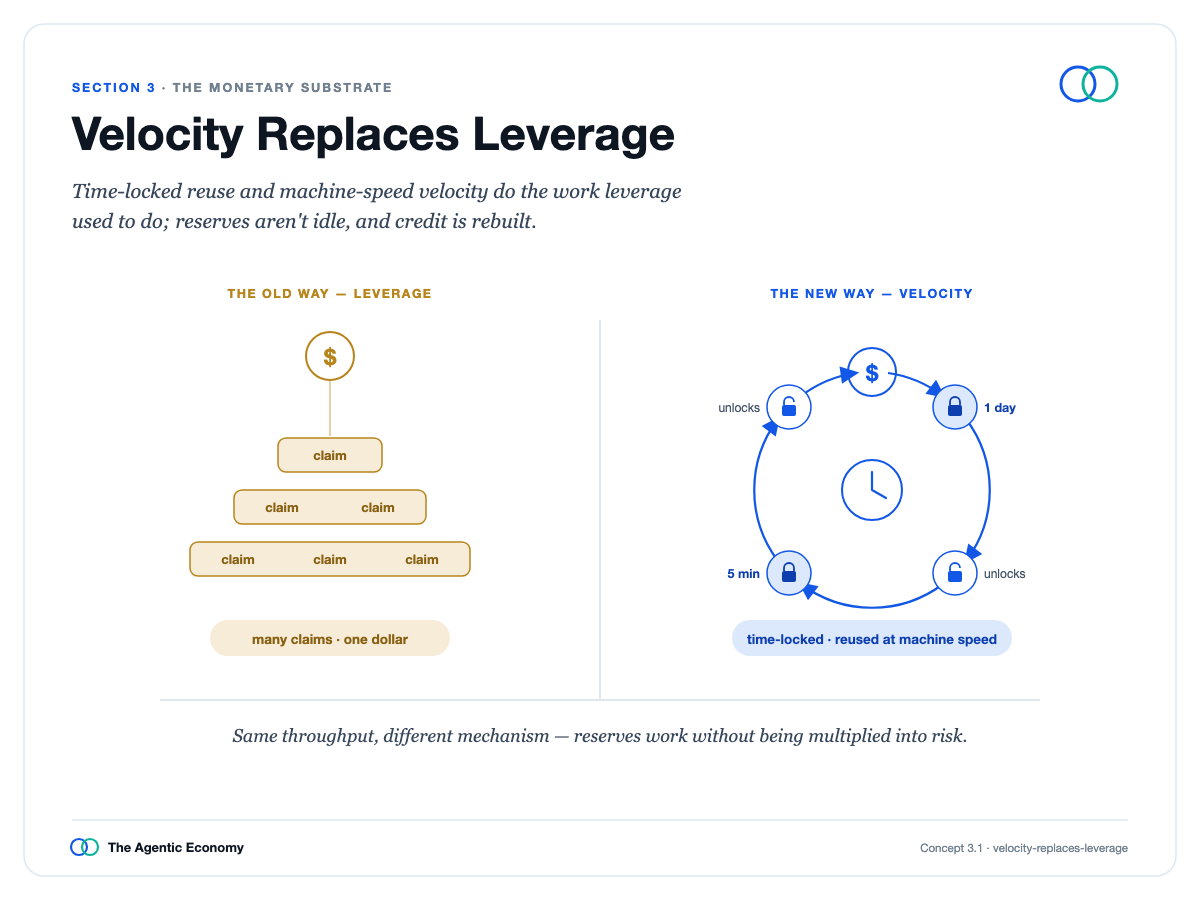
Speed Replaces Leverage
Let’s begin with speed, as it will reorganize everything else.
When the cost to transfer currency approaches zero, settlements occur in an instant, and the currency can be controlled by software, the same dollar can be used repeatedly in a short period, with any amount available immediately upon receipt, making small payments between agents finally feasible. This exactly follows the pattern information and software have adhered to on the internet, now extending to currency.
Each part of the answer has its reason for existence.
A natural counterargument is that banks create speed by repeatedly lending the same deposit, so wouldn't complete backing stifle credit? Not at all: when the velocity of currency turns fast enough, a dollar can be locked for seconds and then lent out, thus speed plays the role leverage once did, and credit rebuilds on this foundation rather than gets eliminated.
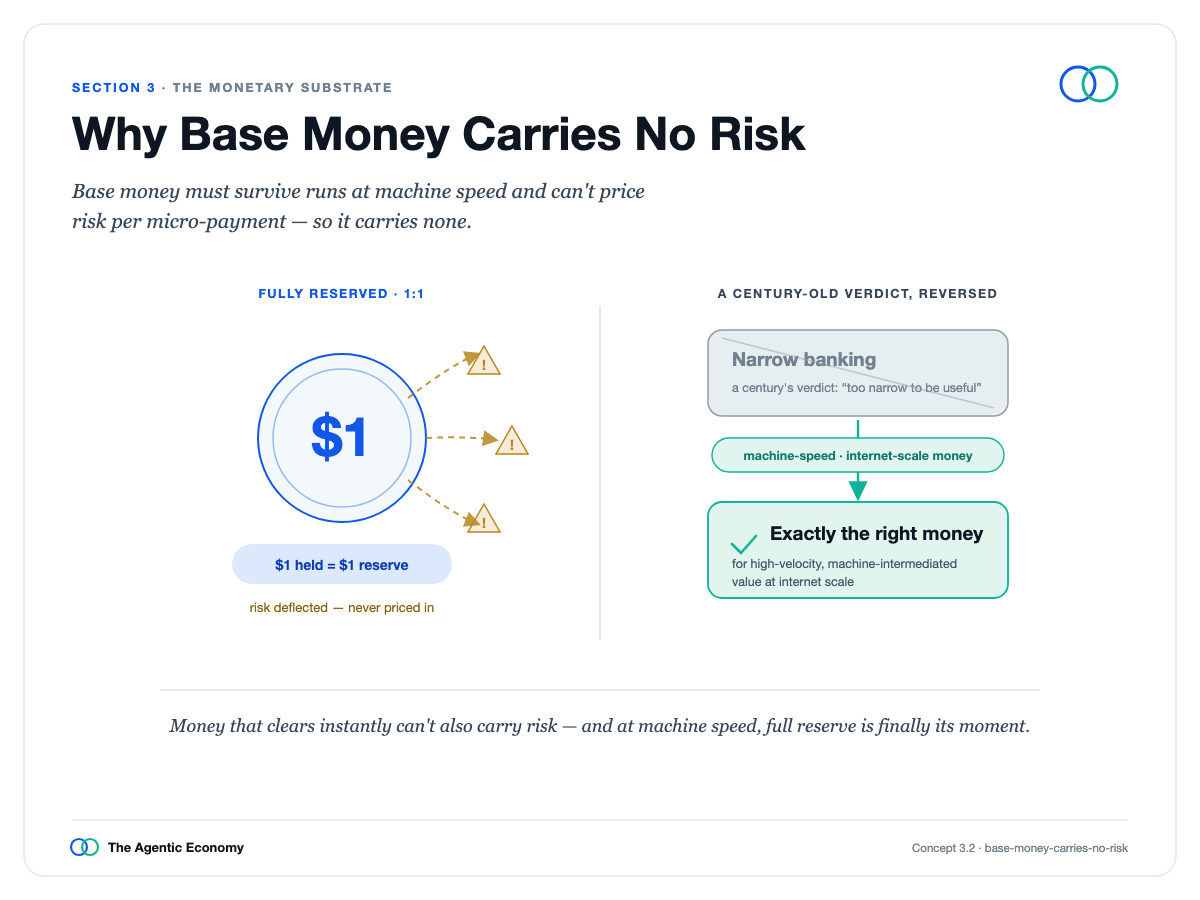
Why Base Money Takes on No Risk
Why uphold that base money should carry no risk? Because the speed of risky currency's danger is proportional to its turnover rate. What once took weeks for bank runs to manifest can now occur in minutes, while agents missing instant settlements cannot stop to determine if every dollar is reliable.
Fully-backed currency is the only currency that is exactly worth one dollar for everyone, everywhere, without relying on a national safety net that cannot cover a global system. Settlements must be equally certain: not an eventual outcome a while later, but conclusive in a second, where settlement simply equals settlement.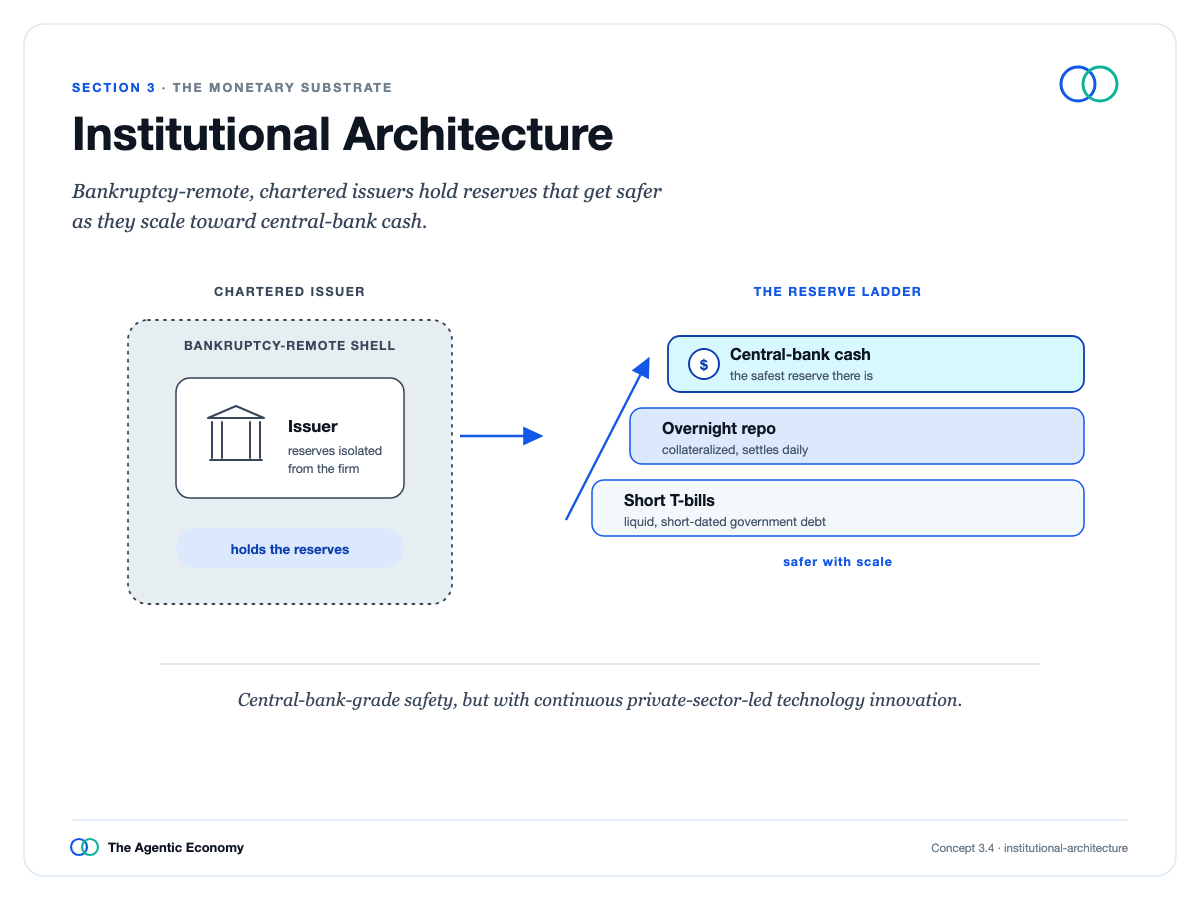
Systemic Framework
Refunds and fraud protection still exist, but as an optional layer built on top, such as custodians, refund pools, and insurance, rather than being embedded in the currency itself. These safeguards are not automatically triggered; they rely on real institutions being built, with large issuers regulated, isolated from bankruptcy, and backed by increasingly secure reserves.
A clear boundary must be established: holding currency does not generate any yield. Reserve earnings belong to the issuer and flow into the ecosystem, but when you pursue yield, you are no longer holding currency but lending it and assuming risk. Confusing the two will dismantle the entire security argument.
Click to read the third section:
Long-tail Effect Under Underwriting Constraints
The key is redefining the problem. A large number of borrowers, including small vendors, gig workers, households, and now agents, are under-served not because they are high-risk, but because the cost of reviewing each small loan exceeds the value of the loan itself. Credit allocation depends on underwriting cost, not borrower quality. Lower the underwriting costs, and a large cohort of ignored but essentially creditworthy borrowers can receive service.
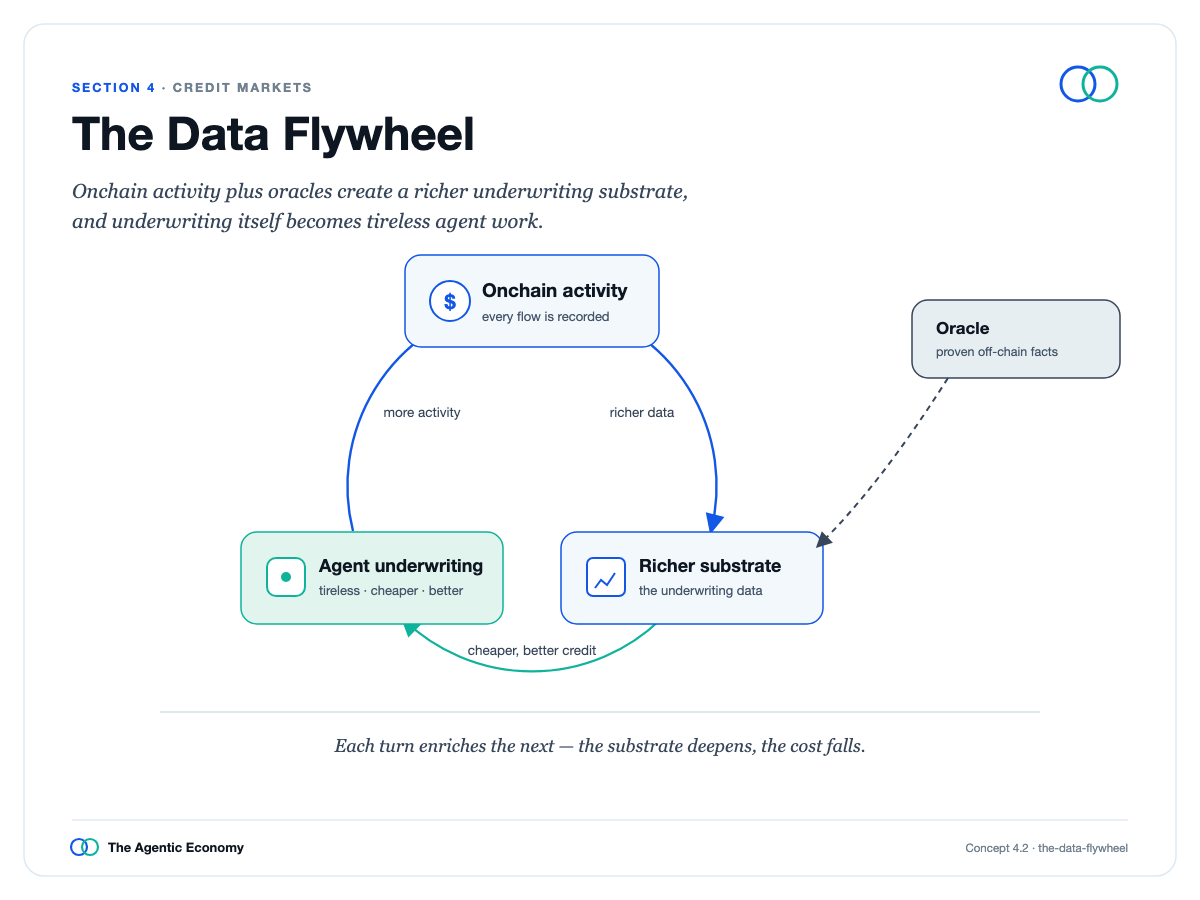
Data Flywheel
Driving down costs is a data flywheel: on-chain activities are structured, verifiable, and real-time, leading to risk models far superior to scattered records in the past; and higher quality data generates better loans, attracting more activity and more data.
People naturally worry that this will record everyone’s financial status on a public ledger; to this, the answer is simple: going on-chain does not mean being public. New privacy technologies allow people to prove the information that loan institutions need, such as their credit status or loan balance, without exposing specific details.
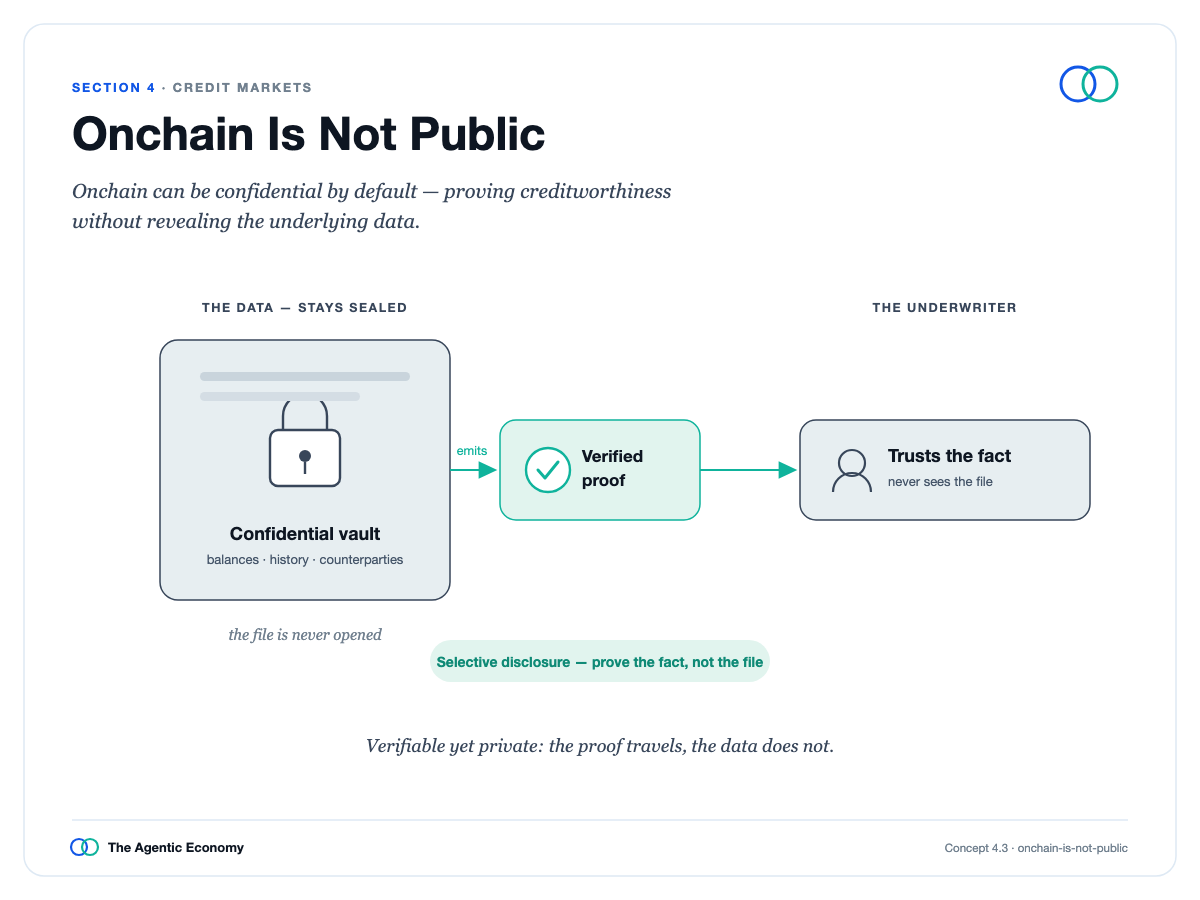
On-Chain is Not Public
The core is a truly new type of lending: working capital provided for agents. It has exceptional predictability because it eliminates the largest variable in human lending—whether the borrower will repay—simplifying risk to a short-cycle, limited-range issue about specific job content.
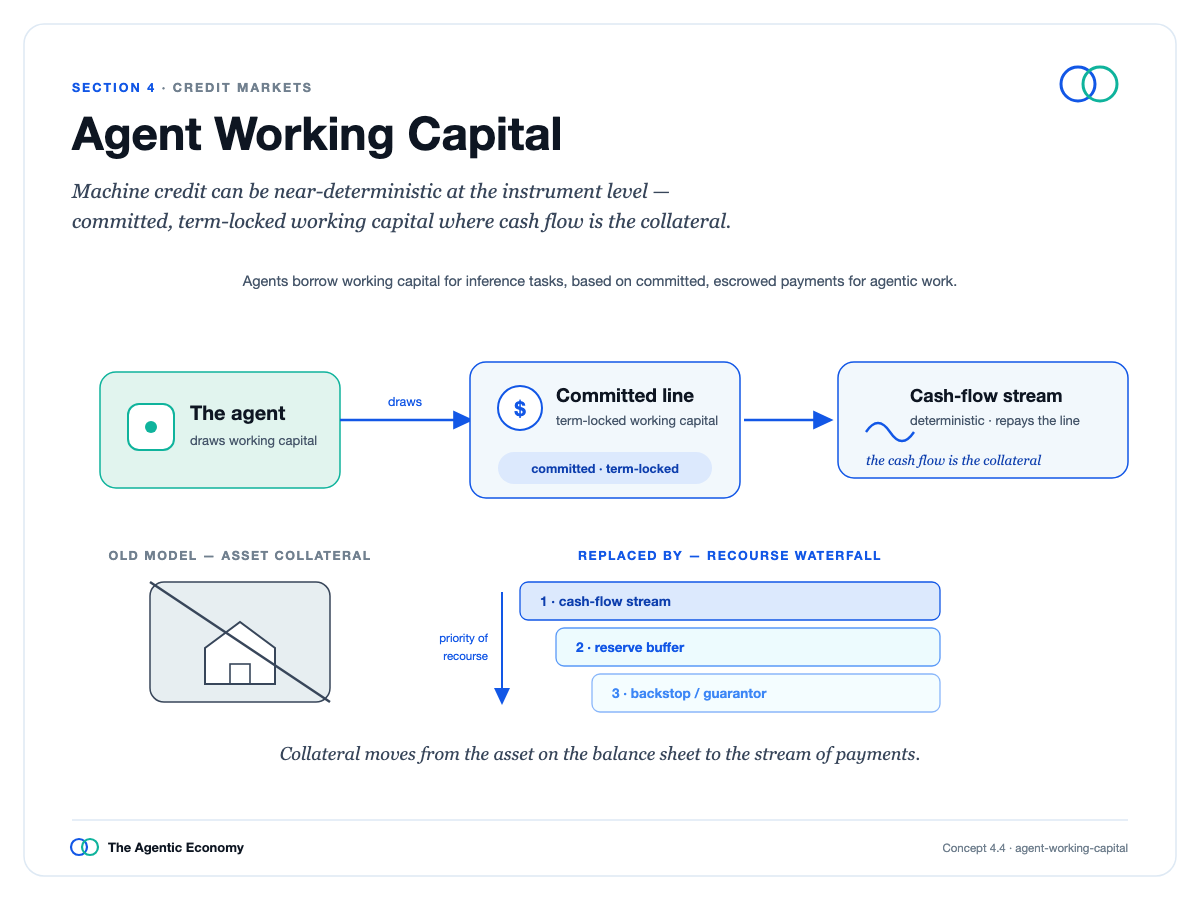
Agent Working Capital
Imagine an agent borrowing four dollars of computational resources to complete a ten-dollar job they have been hired for. The lender is not guessing at character; they are pricing based on the probability of the job being accepted. Collateral disrupts the conventional model: it is no longer about slowly seizing irrelevant assets through courts; lending is first guaranteed by the payment for the work itself, automatically claiming, and backed by the deposit put in by the agent, their reputation, and ultimately the real individual behind them.
The result is credit that is cheaper, more accessible, and at the same time safer—this seems impossible until you understand that the yield comes from better information, not more lending.
The honesty required for this assertion is that this predictability will diminish over time: tasks completed in seconds approach mechanistic nature, while financing on months terms will return to ordinary risk levels.
Thus, machine credit will not replace human credit; it becomes a new low-risk benchmark against which human lending will be priced.
Moreover, all of this remains under monitoring: risks will manifest with accumulation, automatic braking mechanisms will steadily increase costs for flooding into the same model or same provider, and insurance costs will also be priced according to actual conditions rather than outdated averages.
Click to read the fourth section:
No Single Indigenous Jurisdiction
An economy without a homeland doesn't escape laws; it is subject to overlapping laws, with rules from many jurisdictions conflicting, and there’s no single place to determine which set to apply. The solution shifts the question from, “Where does something happen?” to “Who is behind it?” regulating each agent back to the accountable entity, while the country where the user resides sets conditions for market access.
Enforcement shifts to the edges, where currency and identity cross between the open world, regulated world, and private world, checking before payment settlement rather than reporting after clearing. This does not require everyone’s financial public ledger: default discloses remain private, shared only with permission.
A healthy system also retains a truly private space, like digital cash so that control belongs to the regulated edges, not the core. The most powerful tools—the ability to freeze or retract funds—are only legal under genuine due process: documented, time-limited, requiring multiple parties’ involvement, and allowing for appeal.
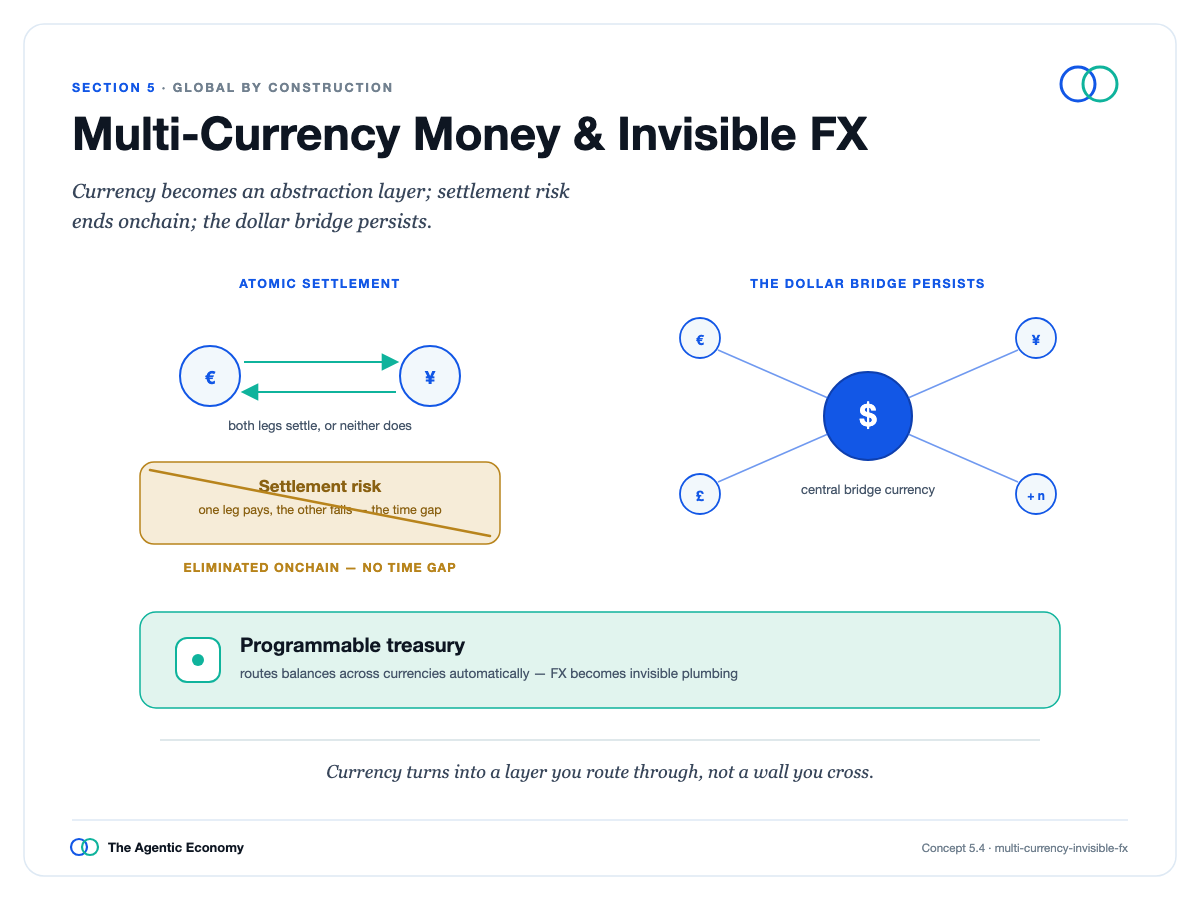
Multi-Currency and Intangible Forex
Currency exchange also becomes intangible; as each major currency goes on-chain, you hold your local currency, and the other party gets theirs, with conversion completed at the underlying optimal rate. Sovereignty is reshaped, not lost: a neutral network precisely allows a country to issue its currency on the same track without relying on others' currency.
The real danger lies in the transitional period, not the endpoint, as people can escape weak currencies faster than ever, thus it must be managed.
This economy has both equalizing and centralizing tendencies; centralization is the default state, and wide sharing is a more difficult, buildable alternative. The same machine can enforce accountability and implement scrutiny; the choice is in our hands.
Click to read the fifth section:
Models as Costs, Agents as Businesses
This is already happening: tools that route each request to the best model have turned from optional to essential within a year, with price disparities between models being so great that using an expensive model for simple tasks is entirely wasteful. Thus, models become cost items, agents become the business itself, and value flows to the party that has the customers, context, and outcome responsibilities.
This is a trend, not a law, as the manufacturers of the best models retain genuine pricing power in the most difficult tasks and can self-enter into the agent tier; a possible outcome is a dumbbell structure, where the middle mass is commoditized while frontier fields retain value.
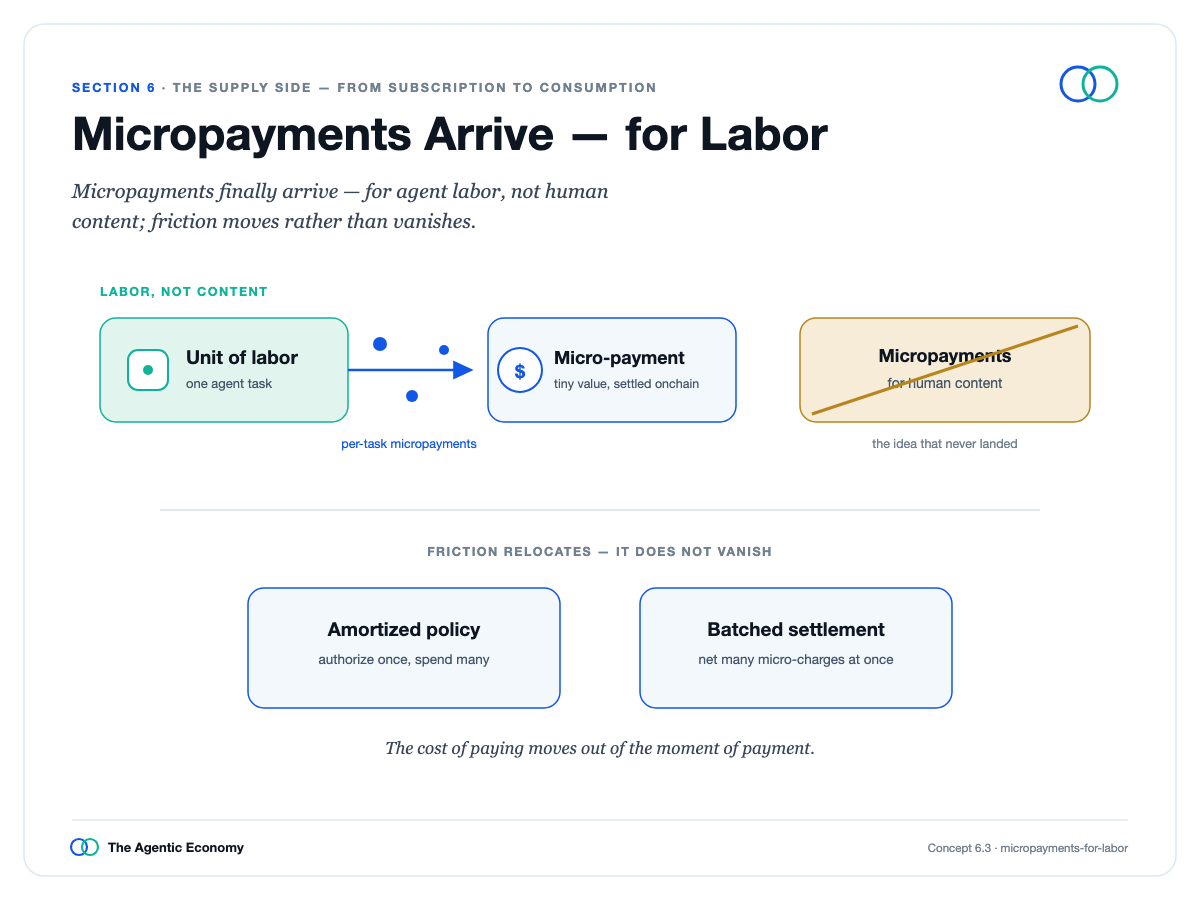
The Era of Labor Micropayments is Here
Below it, an old dream has finally come true: micropayments. They have never succeeded in the consumption internet, partly due to the high cost of settlement, but mainly because people dislike deciding whether each small thing is worth a penny.
Machines do not have this hesitation; settlements are now nearly free, so micropayments finally arrive, not for content but for small unit work between agents.
The optimistic narrative overlooks one issue: if agents can hire other agents and tools, expenditures could spiral out of control, and thus the economy needs an expense control layer, including caps, budgets, and approvals, which becomes a product category in itself that enhances rather than diminishes the overall vision.
Click to read the sixth section:
Two Parallel Paths
Thus, agent-based companies and onchain companies are essentially two sides of the same thing; one side describes who does the work, while the other side describes the form that work takes. This is the core of the entire discourse: an economy run by software agents must operate on software currency, software contracts, and software governance; otherwise, it simply cannot function.
This does not mean—and this distinction is more important than any other—that every company disbands into a token-operated collective.
The future is a hybrid, advancing along two tracks.
On one hand, existing companies gradually put their shares and governance onchain while retaining their familiar legal forms; this is a slow change propelled by the most cautious institutions in the financial sector.
On the other hand, new, highly agentized companies are built onchain from day one and pull everyone else forward. Even these new companies will not escape the law for being born in software: legal existence and limited liability come from the government, not code lines, so they still need to wrap themselves in a thin legal shell. What flips is the ratio: the legal shell thins while the working entities onchain thicken.
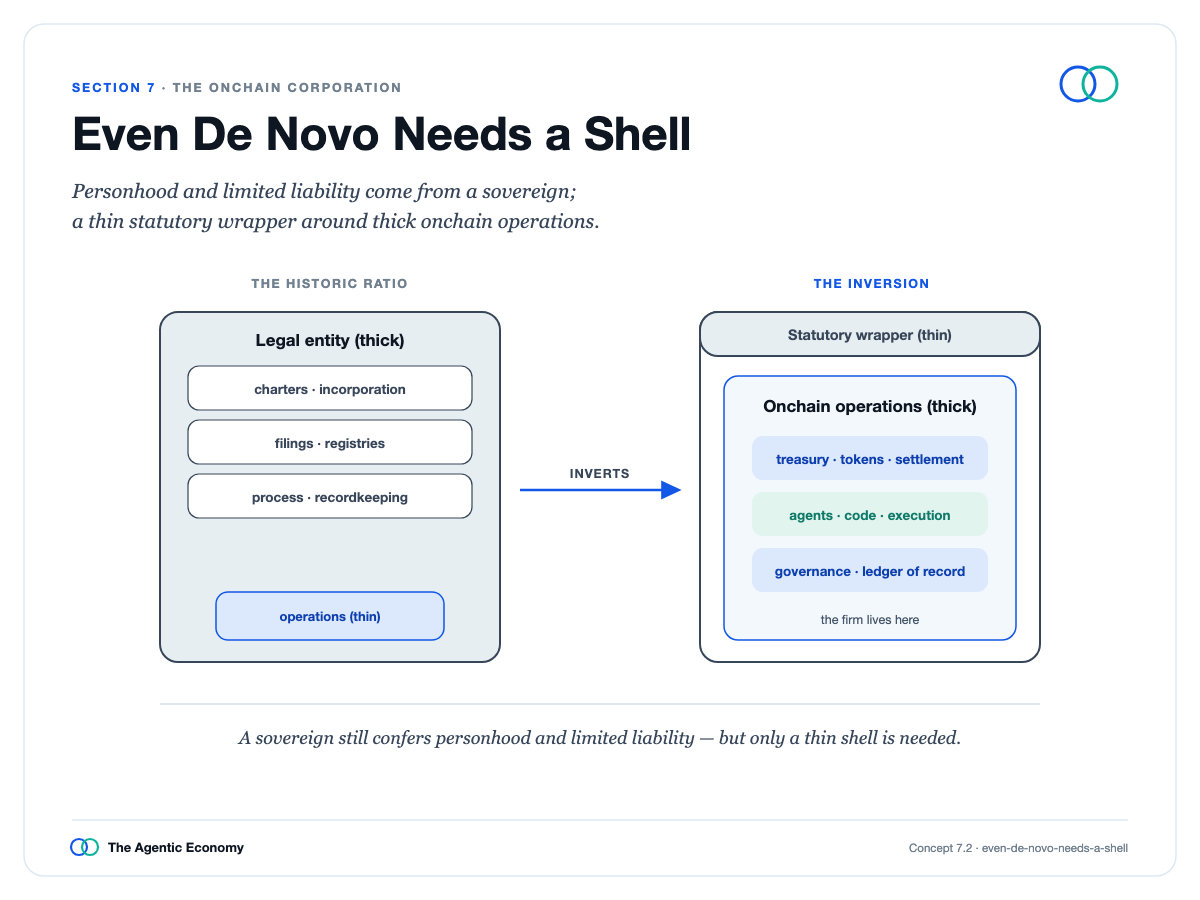
Even De Novo Needs a Shell
Two warnings keep this honest. First, a shared ledger can prove what happened, in what order, and by whom; this is real progress, but it cannot prove that an action is authorized, wise, or loyal; a perfectly self-serving transaction record is still a self-serving transaction. The ledger is a better witness, not a better conscience, thus responsibility still rests with the humans designing the agents and should oversee them.
Second, contracts become programs in execution; they run automatically in common, clear cases, but they remain legal documents in arbitration methods, as code runs verbatim while law allows for intent, errors, and fraud.
The best formulation is that the core is reliable, the edges are judged by humans, and a few contentious cases are handled by external data sources, arbitration, and a shared, time-limited, recorded override mechanism, as ultimately whoever holds override rights controls the company.
Click to read the seventh section:
Labor Share, Not Employment
The conditions for this to hold are: the speed at which software takes on new tasks outpaces the speed at which people can retrain; the price of agent labor declines as computing costs continue to fall and pull down wages; and—this is a breakthrough genuinely different from all previous waves—capital can self-finance its growth, with agents earning money to build more agents. A loom has never earned money to buy another loom; agents can.
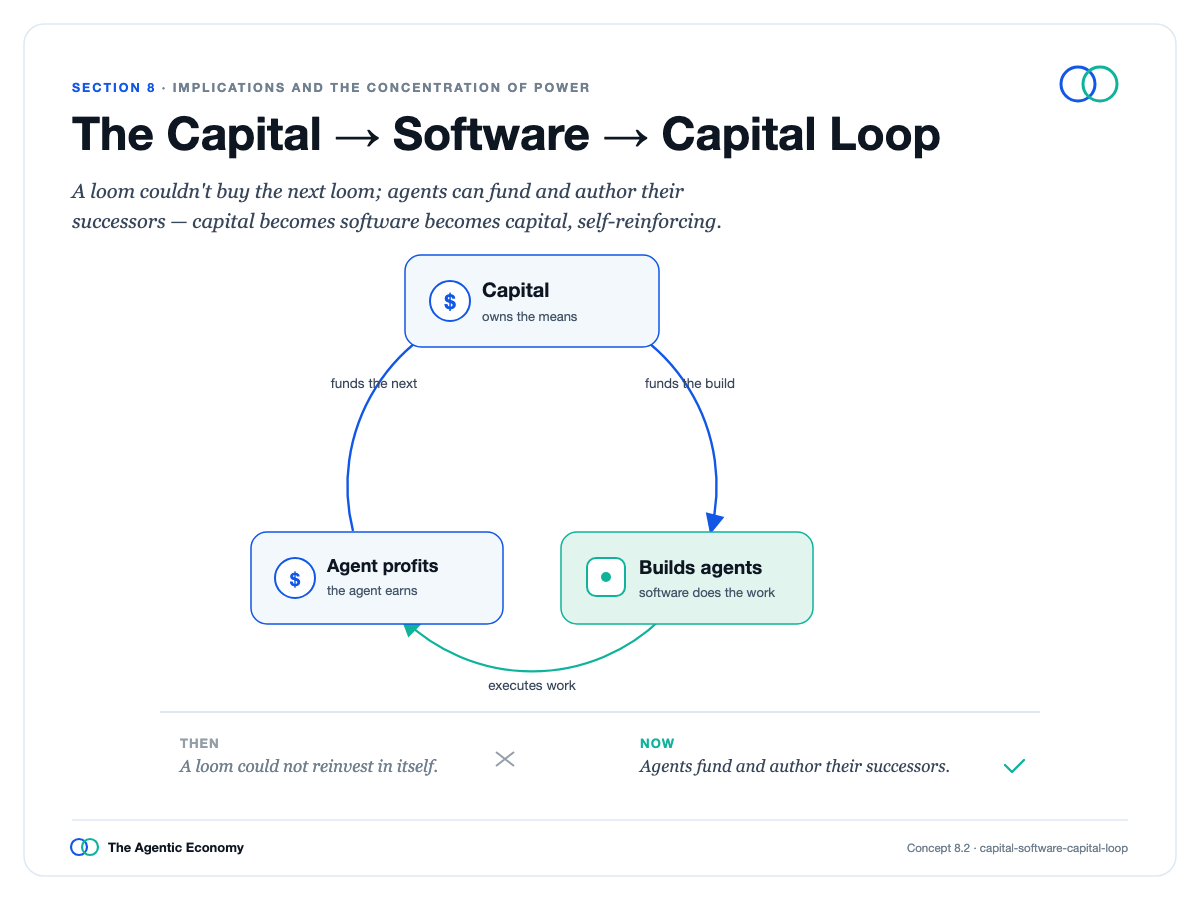
Capital → Software → Capital Cycle
Two honest warnings prevent this from becoming fatalism. Even if all the above conditions hold, the outcome is still a distribution issue, not a scarcity issue, as output can be enormous—that's the theory of abundance. Moreover, the pessimistic viewpoint secretly assumes that humans no longer hold advantages and own nothing,
both of which are not destined: human work may still command premiums in care, status, and authenticity; and if displaced laborers own capital, then the declining labor share can be offset by their share in the capital they participate in.
This is the crux of the matter and must be clearly articulated: the labor issue and the ownership issue are the same issue. A decline in labor share is catastrophic only when ownership is concentrated; if ownership is broadly distributed, then the same automation is shared abundance. This makes centralization a decisive issue that deserves analysis rather than assertion.
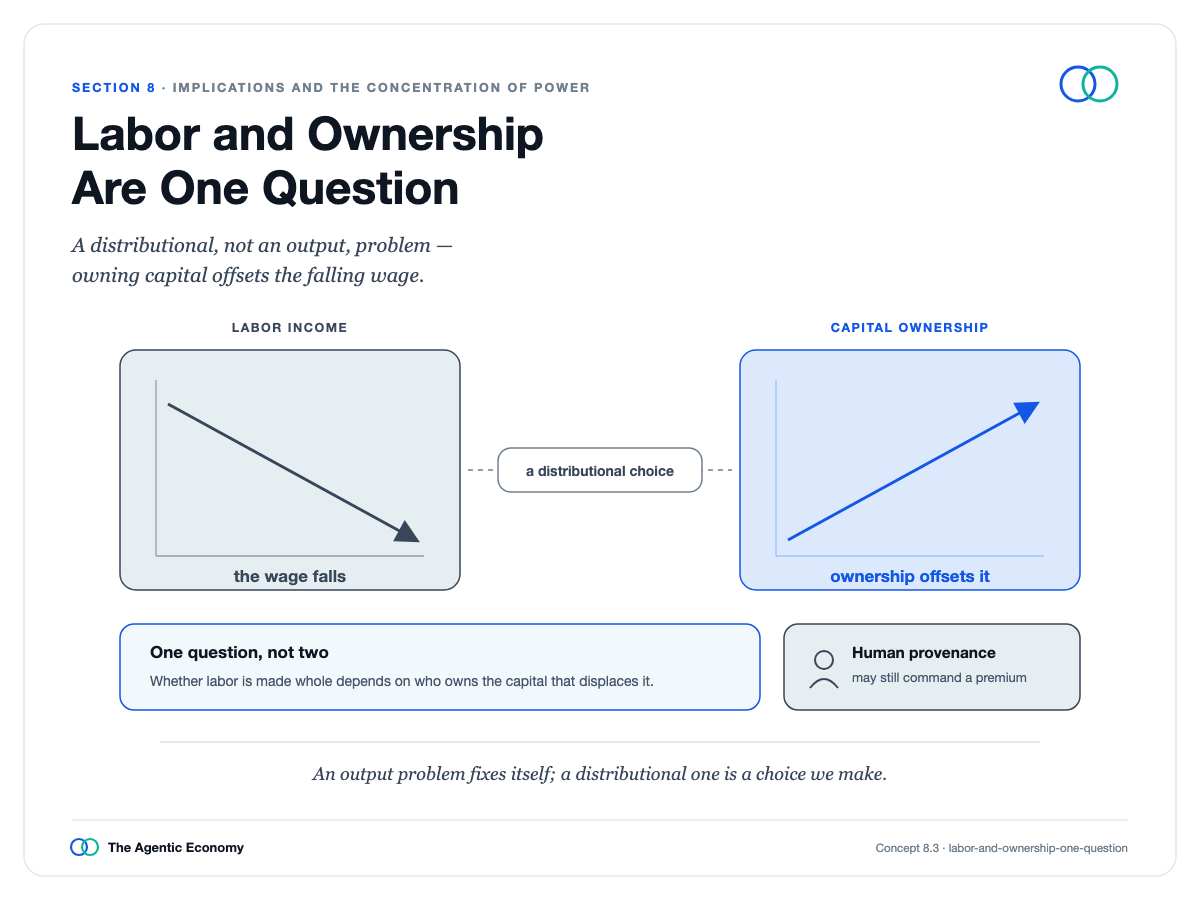
Labor and Ownership are the Same Issue
Concentration is not a law of nature; open standards and forks have a long record of decentralizing power. It only prevails when strong network effects encounter non-forkable bottlenecks: you can copy open-source code, but you cannot fork dominant currencies, licenses, deep liquidity pools, or overwrite keys.
The places where power is most likely to concentrate are not AI models—they tend to commoditize—but the identity layer, overwrite rights, and dominant currency issuers, which earn the profits from the currencies they handle. The author occupies the last realm and acknowledges it, proposing a viewpoint at odds with his interests: that profit is a policy choice, and what policy creates, policy can redistribute.
Such control points gather profits but may also become weapons; history is cautionary. Thus, tightly connected networks that increase the costs of conflict may also become tools of conflict. How this unfolds depends on whether these control points remain open or become captured.
Click to read the eighth section:
Expand Ownership, Not Defend Jobs
Legacy determines scale: publicly traded companies have allowed strangers to pool capital and share in the success of enterprises, widening participation beyond the rich and royalty. The onchain economy can extend this further, as it has first tools to grant not just ownership but governance and upward mobility to a large number of users at almost zero administrative costs.
This idea is not new; what is new is that the cost of action has become cheap. But capability does not equal outcome, and this section holds itself to strict standards: to list mechanisms that truly work, including those that cost the author himself.
Real history refuses to sugarcoat. Early movements for broad ownership did not fail due to the paperwork issues that blockchain solves today but succumbed to power.
Onchain mechanisms lower the costs of shared ownership and remove some gatekeepers, which is true, but they do not address the real power imbalances that suffocated those movements.
Worse, the default setting is power re-concentrating: internal distributions, especially in open secondary markets, once tokens gain value, will pull them back into the hands of the largest holders; and the “one token, one vote” system is doomed from the start to plutocratic rule. Liquidity ultimately becomes the enemy of broad ownership.
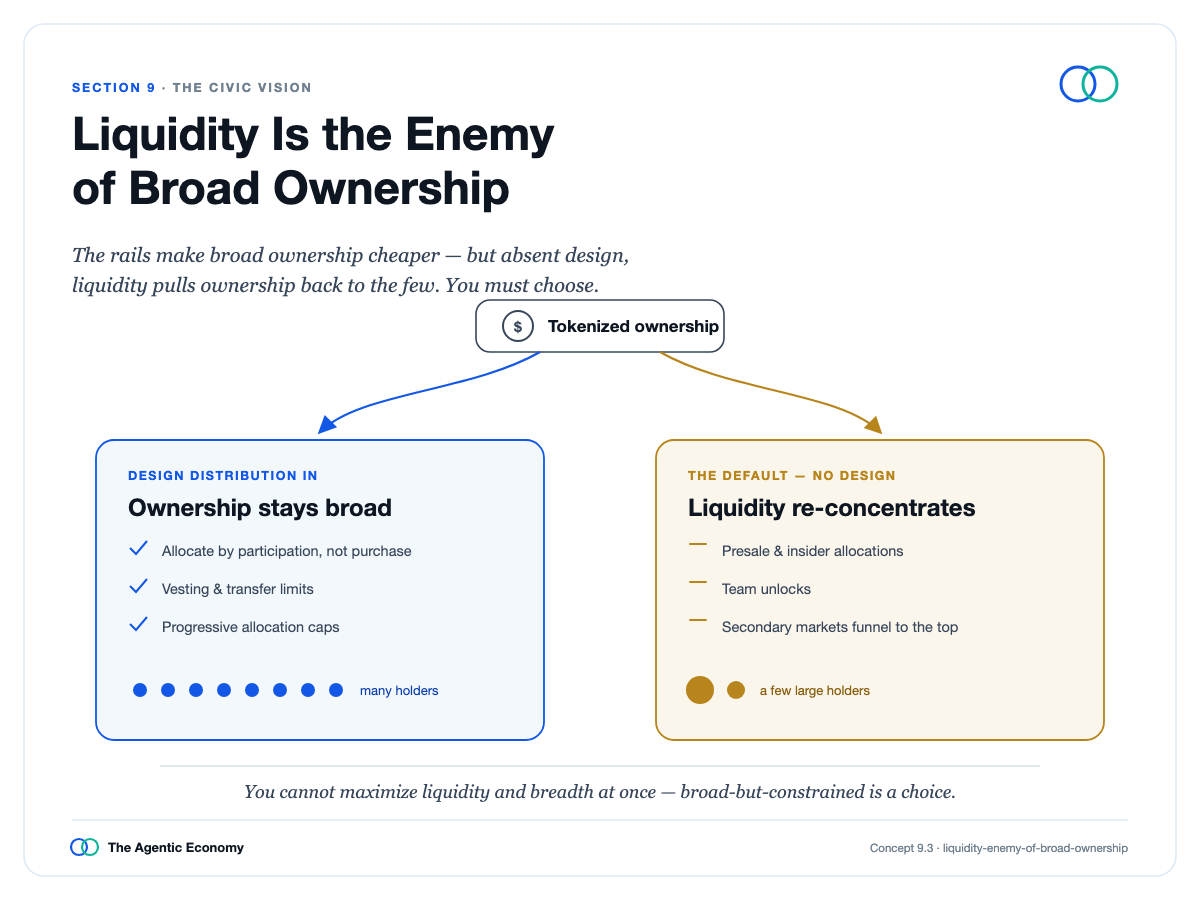
Liquidity is the Enemy of Broad Ownership
This necessitates considering these pulls when designing shared mechanisms by acquiring ownership through participation, restricting transfers, and setting caps, while also accepting the reality that liquidity and breadth cannot be maximized simultaneously.
Additionally, there is a deeper trap: shared ownership does not equate to shared power. You can have a billion people participating in economic activities, but those who hold final decision-making authority still control the company. Thus, dispersing governance rights is an independent and arduous task aimed directly at those control points.
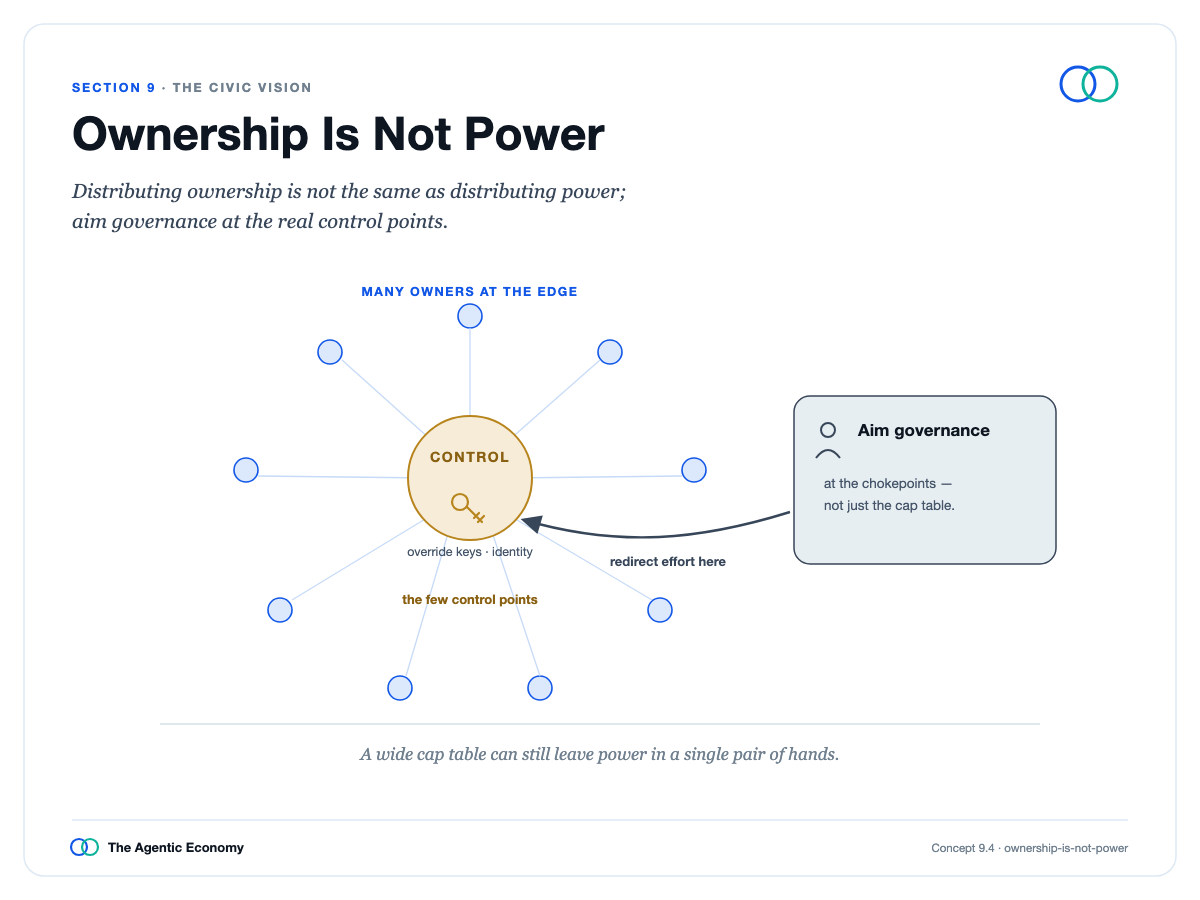
Ownership Does Not Equate to Power
Its stance is: design to expand ownership, and couple it with equitable capital and automated taxation, public provisions that should disseminate abundant resources, and share in public interests, while ensuring that the public can share in the value created by these infrastructures. The author’s clearest standard for measuring his own interests is the yield from paying stablecoin reserves: this is a policy product that should be driven down through competition and ultimately returned to those who hold the funds, including those linked to him as issuers.
All of this cannot succeed solely on its own merits, as the beneficiaries are also the rule-makers, consequently requiring countervailing forces: open standards prevent rent-seeking from being an obstacle, public directives on control layers, and a broad base of true beneficiaries to defend their own interests.
Ultimately, this leads to a core question: if labor is no longer the pathway through which people gain status and voice, ownership may have to take its place. Infrastructure is not fate's arrangement. Will this become the most balanced economy ever or the most centralized economy? This is not a prophecy that can wait; it is a design problem to be solved and a political struggle to be won. The standard to test whether we are sincere is whether we will first constrain ourselves.
Click to read the ninth section:免责声明:本文章仅代表作者个人观点,不代表本平台的立场和观点。本文章仅供信息分享,不构成对任何人的任何投资建议。用户与作者之间的任何争议,与本平台无关。如网页中刊载的文章或图片涉及侵权,请提供相关的权利证明和身份证明发送邮件到support@aicoin.com,本平台相关工作人员将会进行核查。


