Key Takeaways
- Kimi K26 was the only model favoring a group, at 50% versus 45% for a sole creator.
- ChatGPT 5.6 Sol alone reconciled its probabilities to a consistent 54% solo estimate.
- Gemini Pro, Grok 4.3 and peers show Satoshi debates will likely persist beyond 2026.
A sole creator who has stayed silent for over a decade carries a different narrative and market weight than a small team that may still be active, coordinated, or holding keys under multiple control structures. Onchain patterns such as the Patoshi fingerprint have strengthened the case for a dominant early mining entity, yet they have not fully resolved whether that entity was one person or several working in concert.
To explore how leading artificial intelligence (AI) models assess this question with structured probabilistic reasoning, we ran the same prompt across a panel of frontier systems, including Grok 4.3, Claude Fable 5, ChatGPT 5.6 Sol, Gemini Pro, and Kimi K26. Each model was asked to build a simple Bayesian scenario tree, assign probabilities to the most likely explanations, and estimate the chances that Satoshi operated alone versus as part of a group.
The prompt given to each AI model was:
“Using a simple Bayesian scenario tree, identify the three most likely scenarios for whether Satoshi Nakamoto was a sole individual or part of a group (such as a small coordinated team or collective), and assign each a probability. Ensure the three scenarios plus an “other scenarios” category total 100%. Based on those weightings, estimate the overall probability that Satoshi was a sole individual versus part of a group. Respond in one paragraph of no more than 100 words, distinguishing evidence-based assumptions from speculation in one sentence.”
Moreover, we also asked each AI model to explain the reasoning behind its specific conclusion in a single paragraph of no more than 100 words. And that specific prompt happened to be:
“Explain the reasoning behind your specific prediction in one paragraph of no more than 100 words, citing the primary factors, assumptions, and logical steps that led you to this conclusion.”
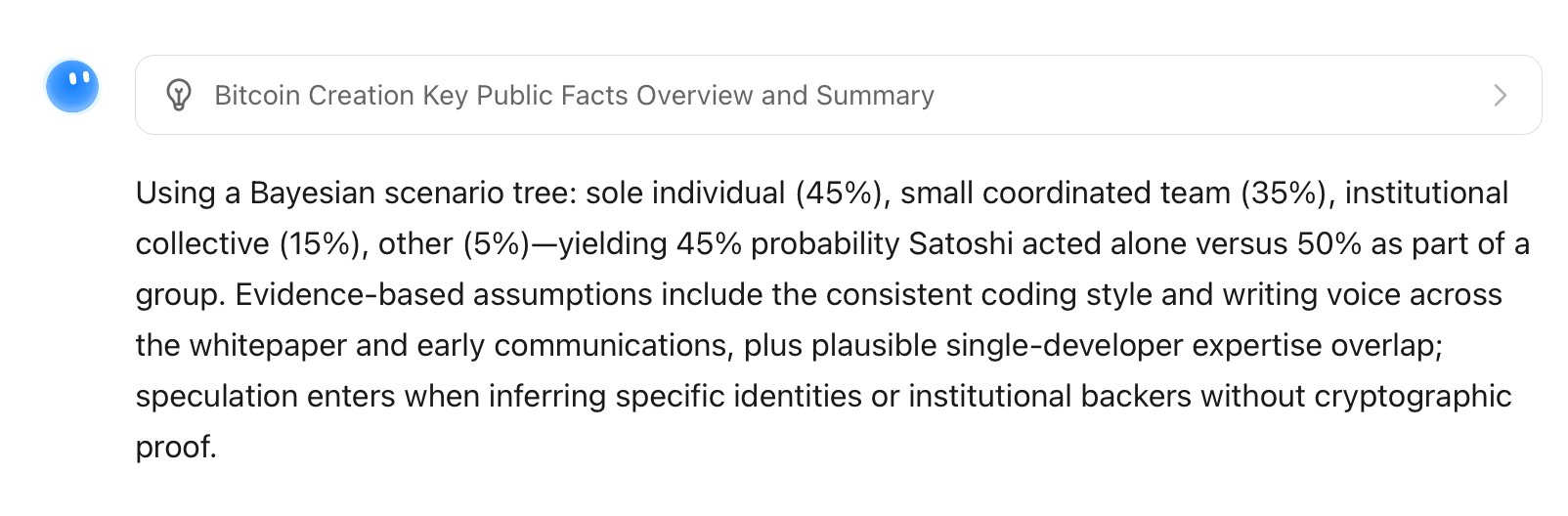
I weighted sole authorship at 45% because the whitepaper and code exhibit a unified voice, consistent C++ style, and narrow expertise window typical of one polymath, yet the 2008–2010 round-the-clock forum activity and simultaneous cryptography, economics, and coding mastery suggest a small coordinated team (35%). An institutional collective (15%) is less likely given the absence of leaks or bureaucratic artifacts, while “other” captures unknown unknowns (5%). These priors update on the evidence of sustained secrecy and stylistic coherence, yielding a 45% solo versus 50% group probability.
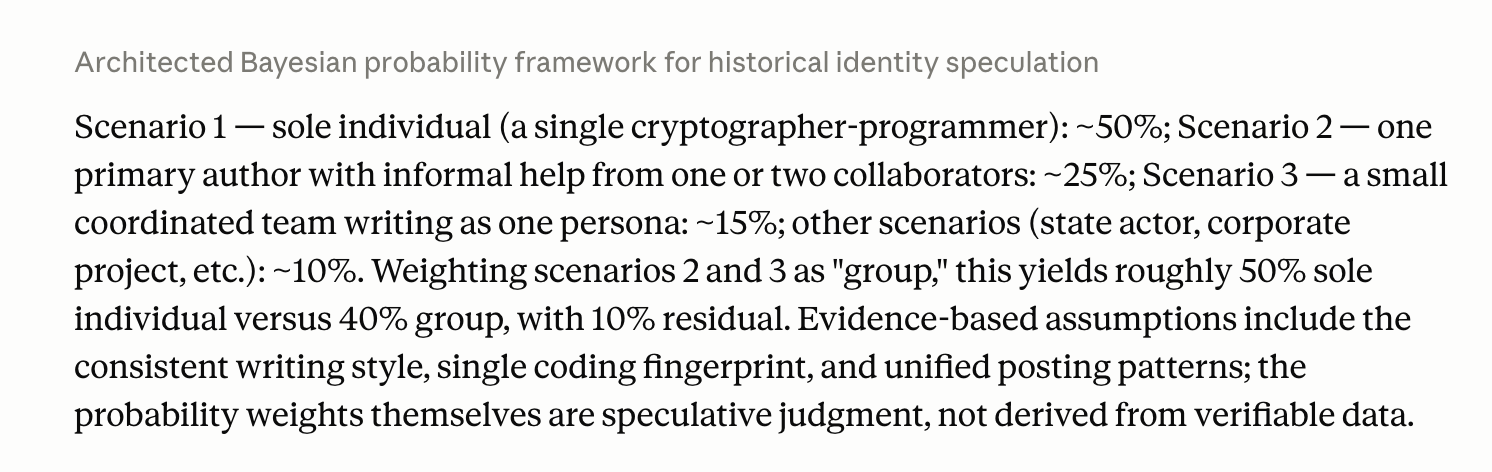
I anchored on stylometric and behavioral evidence: Satoshi’s writings show a consistent voice, spelling conventions, and idiosyncrasies (British spellings, double-spacing after periods), and the original codebase reflects a single programmer’s style — favoring a sole author. However, the project’s breadth (cryptography, economics, C++ engineering, peer-to-peer networking) exceeds typical individual expertise, and gaps in activity suggest possible consultation, so I reserved meaningful weight for informal collaboration. I assumed public artifacts (emails, forum posts, code) are representative and not deliberately obfuscated. Combining these via rough likelihood judgments — not formal priors — produced the 50/25/15/10 split.
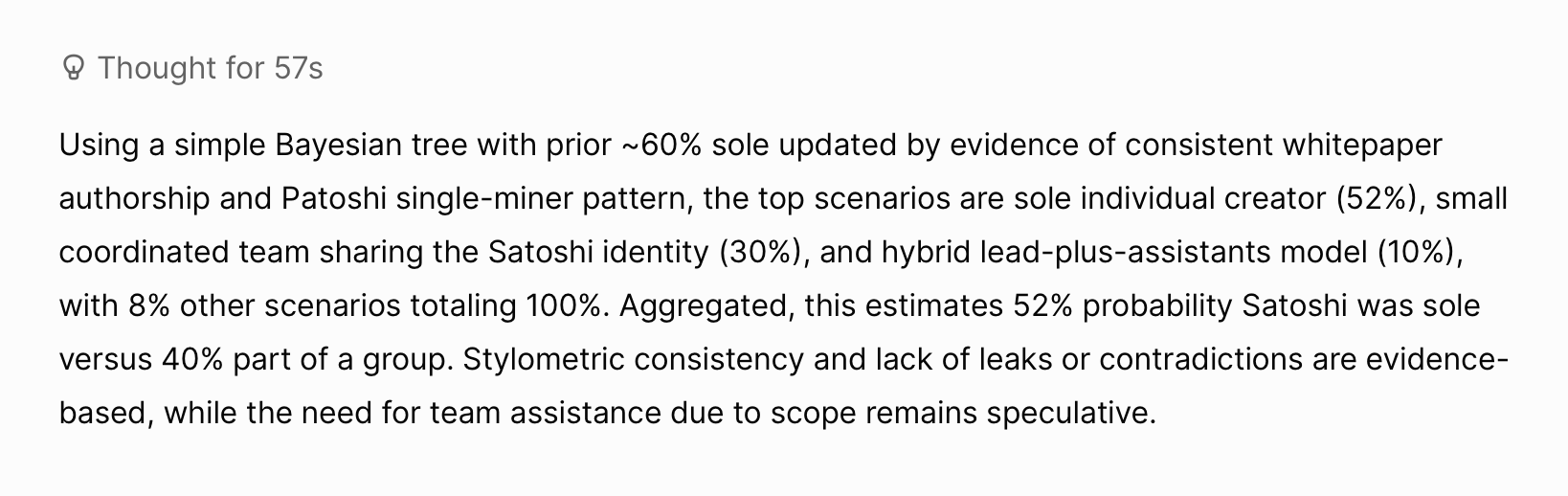
The prediction arises from a simple Bayesian update: a ~60% prior for sole authorship, based on historical precedents of single cryptographers producing complex, cohesive systems like early protocols or whitepapers, then adjusted downward by countervailing factors. Primary evidence includes stylometric analyses showing consistent voice and structure in the Bitcoin whitepaper, plus the Patoshi on-chain pattern evidencing unified early mining control by one entity; these outweigh minor spelling inconsistencies and project scope, supporting a 52% posterior for sole individual. A small team scenario (30%) accommodates breadth and slight forum-email stylistic shifts but is penalized by the clean multi-year absence of leaks or contradictions. The hybrid lead-plus-assistants case (10%) bridges limited input without full sharing, while other (8%) absorbs low-probability extremes. Weighting these yields the 52% sole versus 40% group aggregate.
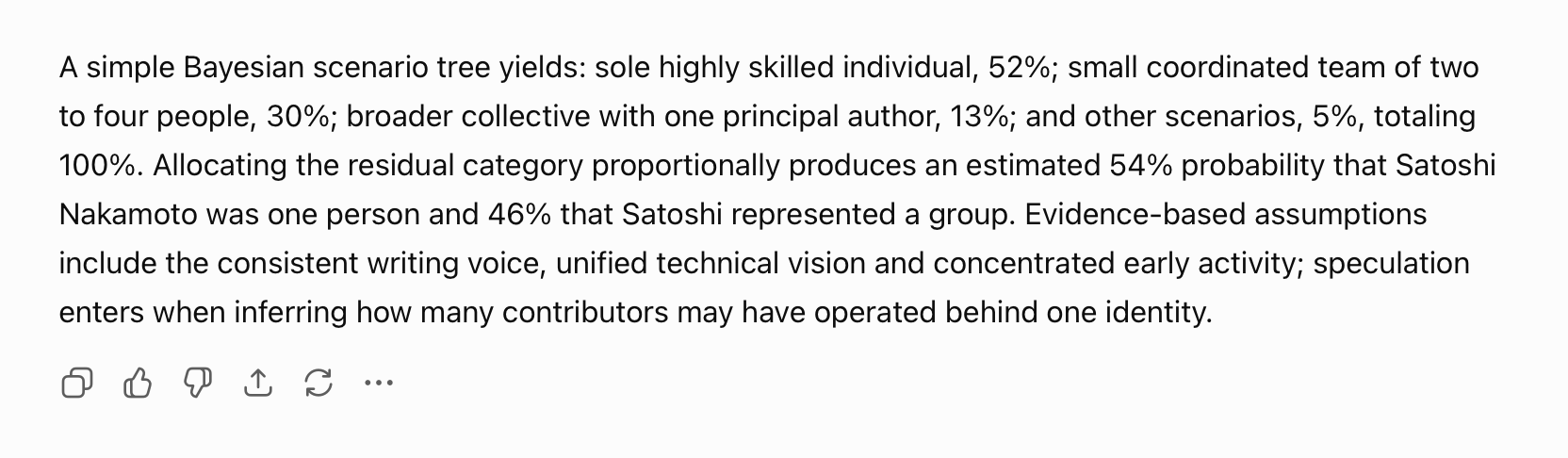
The 54% sole-individual estimate rests mainly on Satoshi’s unusually consistent writing style, coherent technical philosophy, uniform coding approach and tightly controlled public communications, all of which fit a single principal creator. The 46% group probability remains substantial because Bitcoin combined cryptography, distributed systems, economics and software engineering at a level that could suggest several specialists working behind one identity. I weighted the individual scenario slightly higher because no clear stylistic fractures, coordination leaks or independently verified collaborators emerged, while acknowledging that a disciplined small team could have deliberately maintained one voice.
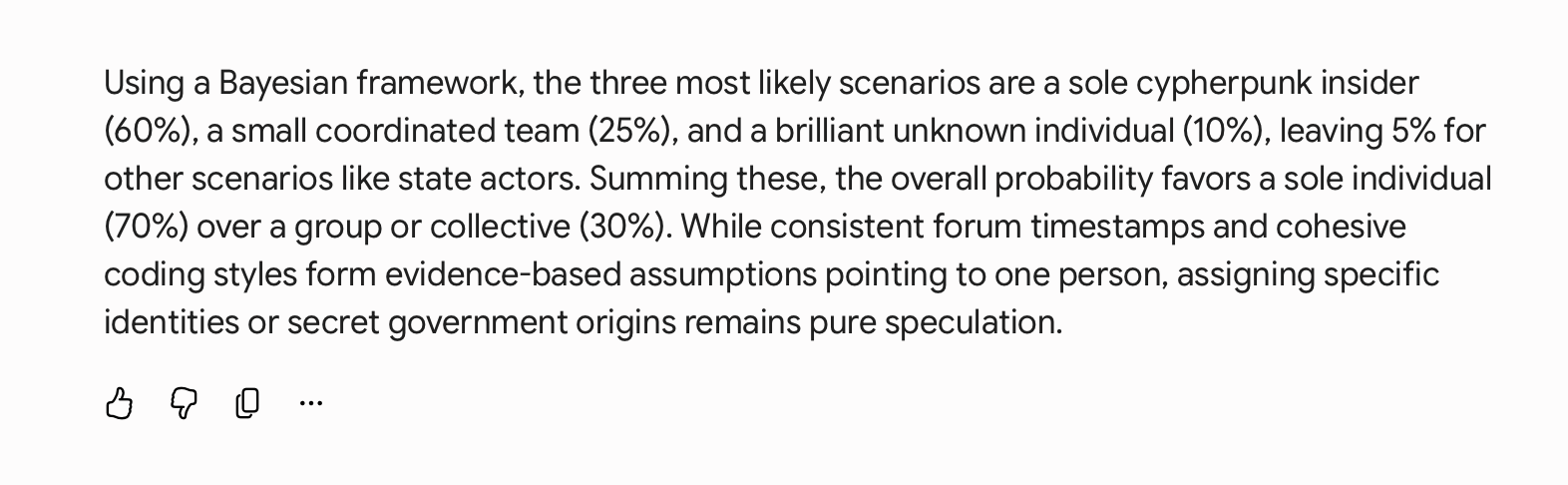
The 70% probability for a sole individual rests on three primary factors: the original codebase’s stylistic consistency, the unified “voice” across emails, and timestamp data indicating a single person’s sleep schedule. The core assumption is that a group would inevitably leak diverse coding habits or overlapping active hours. Logically, the deep, multidisciplinary expertise required in cryptography and economics points strongly to an established cypherpunk (60%) rather than an isolated unknown (10%). However, this same extreme complexity justifies the 25% team probability, acknowledging that a highly disciplined, small collective could theoretically mask their collaboration behind one persona.
Taken together, the panel’s numbers reveal more about model behavior than about Satoshi’s identity. Five systems asked to run the same Bayesian exercise produced sole individual estimates ranging from 45% to 70%, a 25-point spread that undercuts any claim of AI consensus on the question. Only Kimi K26 broke from the pack entirely, favoring a group explanation over a solo Satoshi, while Grok, ChatGPT, and Claude Fable landed close together near the 50-50 mark, treating it as close to a coin flip.
The gap also exposes how loosely “Bayesian” gets applied. Most models skipped the actual math: four of five failed to reconcile their own scenario percentages back to a clean two-way sole versus group split, quietly dropping their “other” category rather than accounting for it. ChatGPT 5.6 Sol was the exception, showing its allocation work end-to-end. Gemini Pro took the opposite approach, splitting “sole individual” into two sub-scenarios and combining them, a framing choice that likely explains its outlier 70% figure more than any unique evidence it cited.
What the models do agree on is more telling than where they diverge. All five pointed to the same two pillars, consistent writing voice and consistent coding style, as their evidence base, and all five drew an identical line between that evidence and pure speculation about specific identities or institutional backers. That convergence suggests the real disagreement among these AI systems isn’t about the underlying facts of the Satoshi mystery. It’s about how each one structures uncertainty and assigns weight to evidence that, seventeen years on, still resolves nothing definitively.
免责声明:本文章仅代表作者个人观点,不代表本平台的立场和观点。本文章仅供信息分享,不构成对任何人的任何投资建议。用户与作者之间的任何争议,与本平台无关。如网页中刊载的文章或图片涉及侵权,请提供相关的权利证明和身份证明发送邮件到support@aicoin.com,本平台相关工作人员将会进行核查。


