Why do hotspots always appear during the launch phase of a new chain?
Written by: Non-Small Number
Recently, a new hot topic has emerged in the crypto market—Robinhood Chain.
As the ecosystem gradually launches, some early participants have achieved remarkable returns due to their early involvement in related projects. Some users have gained tens of times or even higher multiples of growth through relatively small early investments as market enthusiasm rises, and these cases have quickly spread in the community, making Robinhood Chain a new focus of attention for many investors and researchers.
Of course, the blockchain industry has never lacked wealth stories. Over the past few years, with the rise of each new ecosystem, there have always been new projects, new communities, and new market opportunities. From the early DeFi ecosystem of Ethereum to the explosion of the Solana ecosystem, and then to Base quickly attracting developers and users, the development of new networks often experiences a phase of rapid attention gathering.
This time, the market's focus has shifted to Robinhood Chain.
So, what is special about this new chain? Why can it gain such high discussion in a short period?
A new ecosystem with a built-in financial user base
When mentioning Robinhood, many people’s first impression may be the American stock trading platform. In fact, Robinhood has developed into an important entrance connecting ordinary users with financial markets, covering multiple areas including stock, ETF, and crypto asset trading.
Unlike many blockchain projects that build user ecosystems from scratch, Robinhood's greatest advantage is not purely its technology, but the vast financial user base it already possesses.

In recent years, the blockchain industry has faced an important problem: technology continues to develop, but how to truly bring more ordinary users into the on-chain world has always been the direction of industry exploration.
Many public chains have excellent technical architectures but need to spend a lot of time building user recognition and ecological scale. In contrast, Robinhood Chain hopes to leverage the influence of existing financial platforms to gradually connect traditional users to the blockchain ecosystem.
This is also one of the important reasons the market is paying attention to Robinhood Chain.
Why do hotspots always appear during the startup phase of a new chain?
In the blockchain industry, a new ecosystem often attracts market attention when it first launches.
The reason is that the early stage often has strong uncertainty and more exploratory space. With a smaller ecological scale and limited project numbers, market participants can more easily discover new applications and directions that have not yet been fully noticed.
On the other hand, new ecosystems often easily form community consensus. When a large number of users, developers, and funds begin to focus on a certain network, representative projects may quickly become the focus of the entire ecosystem.
Many successful ecosystems have undergone similar phases in their development processes.
Early Ethereum gained a lot of attention due to DeFi applications, Solana expanded rapidly due to high-performance transactions and community culture, and Base attracted many users through community dissemination and application growth.
The development of a new ecosystem is essentially a process of redistributing market attention.
Why do memes often become the first traffic entry for new ecosystems?
Observing the past few cycles, one can find a very obvious phenomenon: many new chains initially gain a lot of attention, not because of complex technical applications, but because of certain community projects with strong dissemination capabilities.
Memes are an important representative of this.
Compared to financial protocols that require a deep understanding of technical logic, memes are more easily accepted by ordinary users. A simple cultural symbol, a set of community stories, or a method of dissemination can quickly gather a lot of discussion.
For a newly launched ecosystem, memes can help the network quickly acquire its first batch of users, increase community activity, and attract more external attention.
However, memes primarily serve as traffic entry points. Whether an ecosystem can develop in the long term ultimately depends on infrastructure construction, the number of applications, and real user demand.
Short-term enthusiasm can open market attention, but long-term value requires continuous ecosystem development.
Where does Robinhood Chain's real imagination space come from?
If one only focuses on short-term market performance, many may see Robinhood Chain as a new ecological craze.
But from a long-term perspective, its larger imaginative space may come from the onboarding of real-world assets, which is the RWA direction that the industry has been continuously focusing on in recent years.
In simple terms, RWA refers to the digital expression of real-world assets through blockchain technology, allowing traditional financial assets to have more on-chain application possibilities.

In the past, stocks, funds, and other financial assets primarily operated within traditional financial systems. Blockchain provides a new infrastructure, allowing these assets to potentially have more open and efficient trading and combination methods in the future.
This is also where Robinhood Chain differs from many ordinary public chains.
It has traditional financial users and trading scenarios behind it, rather than relying solely on the crypto community to develop from scratch.
If traditional financial users can enter the on-chain world more smoothly in the future, the blockchain industry may usher in a new growth direction.
The competition in the next phase may be the competition for user entry
In recent years, the blockchain industry has been solving a core problem: how to bring more real users into the ecosystem.
Technical performance, transaction speed, cost optimization—these are all important factors in public chain competition.
However, with the development of the industry, the importance of user entry is constantly increasing.
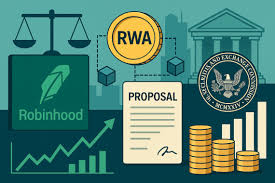
Many projects have advanced technologies but find it challenging to reach ordinary users. In contrast, Robinhood Chain's model provides a new idea.
It hopes to utilize the existing user base of financial platforms to bring more traditional users into the on-chain ecosystem.
If this direction can continue to develop, the future competition between blockchains may not only be about technology but also about competition among users, ecosystems, and applications.
What to observe beyond the hype
Although Robinhood Chain currently attracts a lot of attention, assessing whether an ecosystem can develop in the long term requires observing multiple aspects.
First is user growth. Whether an ecosystem has vitality mainly depends on whether there is a continuous increase in real users.
Secondly, is the developer ecosystem. Long-term successful blockchain networks require a large number of developers to continuously build applications.
Additionally, on-chain trading volume, the number of applications, and ecosystem activity are also important indicators for measuring network development.
The past developments of ecosystems such as Ethereum, Solana, and Base have all relied on a positive cycle formed between users, developers, and applications.
Whether Robinhood Chain can establish a similar ecological cycle will determine its future development space.
The door to a new ecosystem has opened
Every time a new chain appears, it brings new discussions, new opportunities, and new competition.
The emergence of Robinhood Chain represents not only the launch of another blockchain network but also a new exploration direction: whether traditional financial platforms can become an important entry point connecting ordinary users and the blockchain world.
Currently, Robinhood Chain is still in the early stages, and whether it can become an important ecosystem will take time to verify.
However, it is certain that the future direction of blockchain development may require not only stronger technology but also better user entry, richer application scenarios, and products that can truly serve the public.
And Robinhood Chain is becoming an important case to observe this trend.
免责声明:本文章仅代表作者个人观点,不代表本平台的立场和观点。本文章仅供信息分享,不构成对任何人的任何投资建议。用户与作者之间的任何争议,与本平台无关。如网页中刊载的文章或图片涉及侵权,请提供相关的权利证明和身份证明发送邮件到support@aicoin.com,本平台相关工作人员将会进行核查。


