Author: Claude, Deep Tide TechFlow
Deep Tide Guide: Data from the AI routing platform OpenRouter shows that the proportion of tokens used by American companies from Chinese AI models skyrocketed from less than 5% at the beginning of 2025 to 46% in April 2026, maintaining above 30% weekly since February 8. DeepSeek has become the largest single supplier on the platform with a 17.6% share, surpassing Google, Anthropic, and OpenAI. Price is the core driver: DeepSeek V4 Flash costs only $0.14 per million tokens, which is less than one thirty-sixth the price of GPT-5.5. The AI startup Lindy has switched 100% of its traffic from Claude to DeepSeek, resulting in a 90% drop in inference costs.
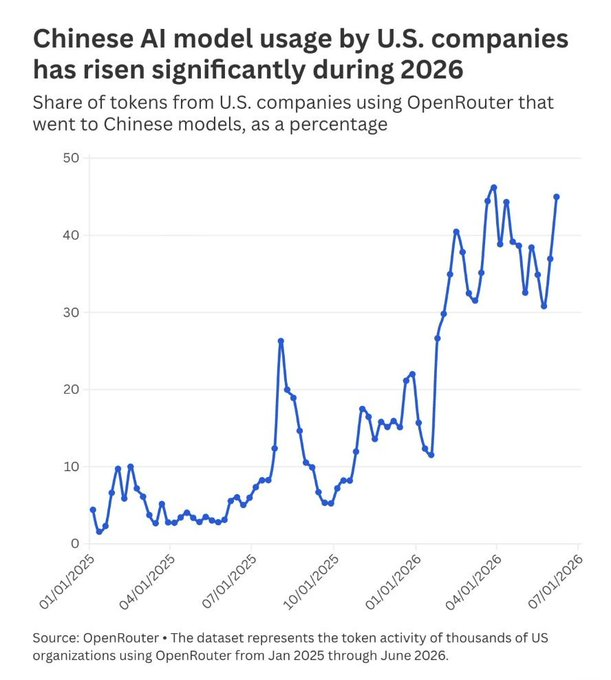
A year and a half ago, American companies hardly touched Chinese AI models. Now, nearly half of the usage flows towards China.
According to a CNBC report on July 7, data from the AI routing platform OpenRouter indicates that the share of tokens used by American companies on the platform from Chinese AI models surged from an average of 4.5% in the first half of 2025 to a peak of 46% in April 2026.
Since February 8, this proportion has consistently remained above 30% each week. Meanwhile, the share of American models plummeted from approximately 70% in June 2025 to about 30% in June 2026.
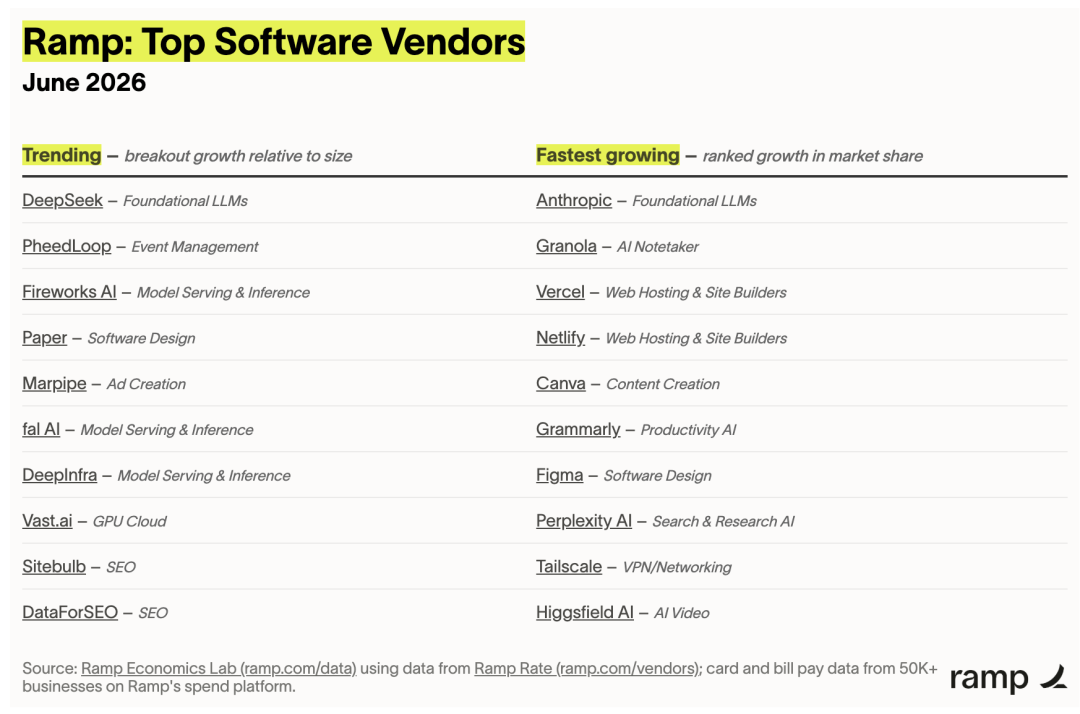
This is not a small-scale experiment for developers. Data from Ramp, an enterprise expense management platform, shows that in June, DeepSeek has reached the top of the “trending software vendors” list, with American companies directly paying DeepSeek to send data to its API services. Palantir CEO Alex Karp publicly criticized the pricing model of American AI labs in a CNBC interview on July 1, stating that corporate clients “are paying for tokens that do not generate value.”
Price Gap: 60% to 90% Cheaper, Maximum Discrepancy of 36 Times
Price is the core variable driving this migration.
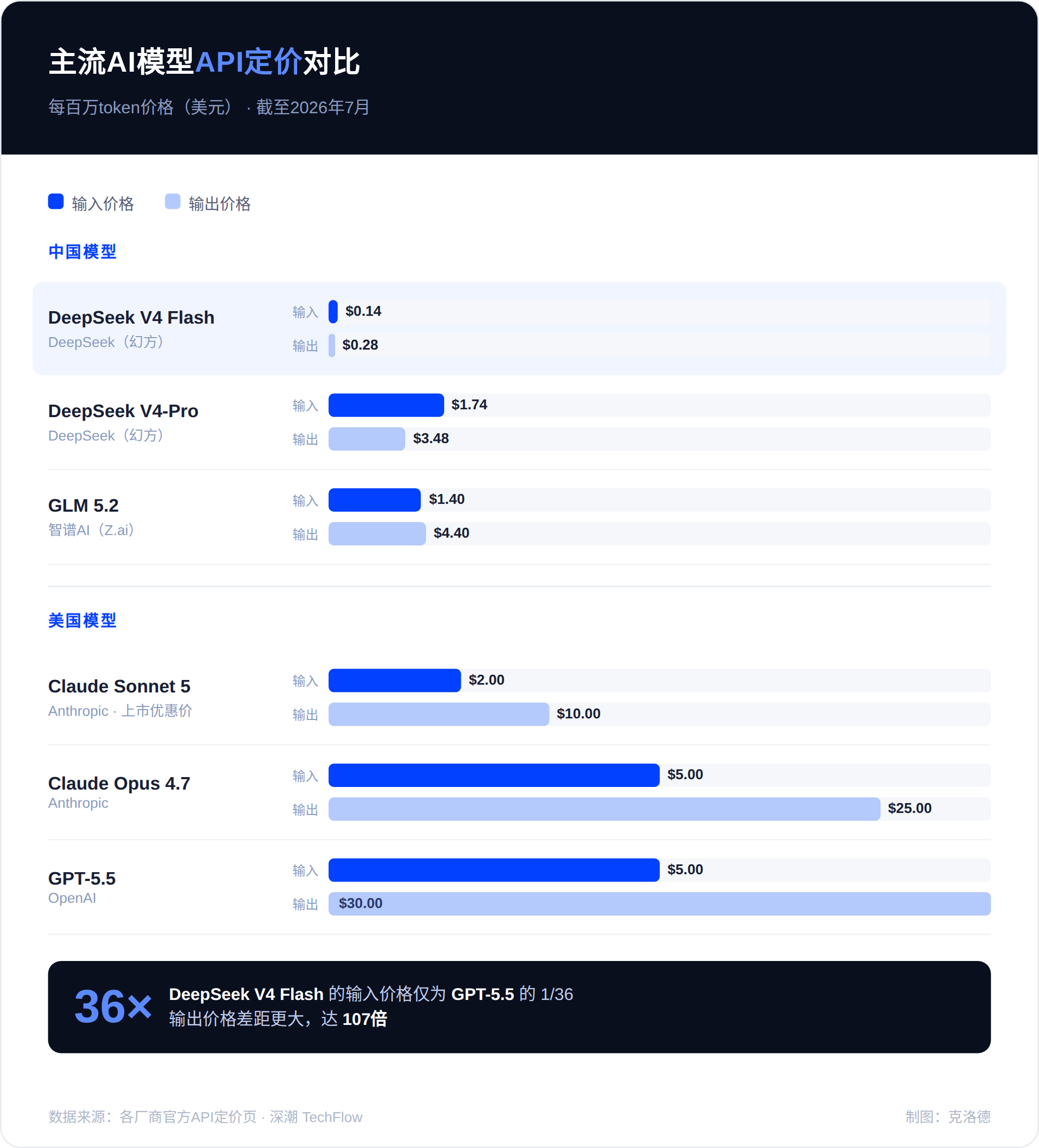
According to OpenRouter data analyst Justin Summerville speaking to CNBC, the price of Chinese open-source models is 60% to 90% cheaper than the top products from Anthropic and OpenAI. Specifically, DeepSeek V4 Flash charges only $0.14 per million input tokens, while GPT-5.5 costs $5, with a difference of about 36 times. The disparity is even greater on the output side: DeepSeek V4 Flash charges $0.28 per million output tokens, while GPT-5.5 charges $30, a difference of over 100 times.
According to VentureBeat, even DeepSeek's flagship V4-Pro (costing $1.74 per million input tokens) is priced at about one-seventh of GPT-5.5 and about one-sixth of Claude Opus 4.7. After enabling caching, the gap further widens, with the cost of DeepSeek V4-Pro dropping to one-tenth of GPT-5.5.
Harpreet Arora, head of Vercel AI infrastructure, told CNBC that after the release of GLM 5.2 from Zhipu AI in June, it set a record for the fastest adoption on the Vercel platform in 2026, with a weekly average token usage increasing about 27 times and the number of clients using it increasing about 80 times. Arora's judgment is straightforward: “Price is in play. When the task does not require the best model, teams start routing to the cheapest, adequate one.”
Lindy Abandons Claude Completely for DeepSeek, Inference Cost Drops 90%
The AI startup Lindy is the most representative case in this migration.
This 25-person AI company had previously relied entirely on Anthropic's Claude model. CEO Flo Crivello announced on the X platform that the company has switched 100% of its traffic to DeepSeek v4, hosted within the United States by American supplier Atlas Cloud. Crivello told CNBC that after switching, “the cost curve directly plummeted,” saving the company millions of dollars, with inference costs dropping by about 90%.
According to The New Stack, Lindy's previous AI inference costs had exceeded personnel costs, which Crivello said was “critical to the company’s survival.” He stated that he would be willing to switch back if Anthropic lowered prices. But until then, the company had no other choice.
Lindy is not an isolated case. According to CNBC, Uber burnt through its entire AI budget for the year in just four months in 2026, mainly consuming it on Claude Code. GitHub also faced uncontrolled costs due to the agent model of the AI programming assistant Copilot, forcing it to switch from a fixed monthly fee to pay-as-you-go billing.
DeepSeek Tops Ramp Enterprise Spending List, Transition from “Trial” to “Procurement”
OpenRouter shows the flow of tokens at the developer level. Ramp's data reveals a more significant signal: Chinese AI models are entering the formal procurement processes of American enterprises.
According to Ramp's June report, DeepSeek topped the “trending software suppliers” list for the first time, based on real transaction data from over 50,000 American enterprises, measuring the explosive growth of initial procurement. Ramp’s chief economist Ara Kharazian pointed out that American companies are no longer just downloading DeepSeek’s open-source models for self-deployment but are beginning to pay DeepSeek directly to send and receive data through its API.
Kharazian views cost consciousness as the primary catalyst for this wave of adoption. DeepSeek briefly reached a corporate penetration rate of 0.3% when it launched R1 in January 2025, before falling back to 0.1%. The driving force behind this resurgence is more substantive: DeepSeek made the discounts on the V4-Pro model permanent in May, reducing caching input pricing to approximately $0.0035 per million tokens.
American Model Share Halved in a Year, Market Splitting into “Commodity Tier” and “High-End Tier”
From a platform-wide perspective, the speed of this share migration is alarming.
According to OfficeChai citing OpenRouter data, in June 2025, American models (Google, OpenAI, and Anthropic combined) accounted for about 70% of the token share on OpenRouter. By June 2026, this number had dropped to about 30%. DeepSeek became the largest single supplier on the platform with a 17.6% token share, while Alibaba’s Tongyi Qwen ranked second with 13.9%. Chinese models collectively accounted for about 44% of the token traffic among the top ten models.
OpenRouter itself is also rapidly expanding.
According to data cited by Bloomberg, the weekly token processing volume on the platform increased from about 50 trillion in April 2025 to over 200 trillion in April 2026, a quadrupling. The percentage of programming workloads surged from 11% at the beginning of 2025 to over 50% by mid-2026, with Chinese models showing particularly outstanding cost-effectiveness for programming tasks.
However, token share does not equate to revenue share. Although Claude from Anthropic has seen its token share squeezed to approximately 13%, its pricing per token is far higher than that of Chinese open-source models, leading to an actual revenue share much greater than what the token share reflects. The market is splitting into two tiers: the high-end tier dominated by American closed-source models that monetize through capability premiums; and the commodity tier occupied by Chinese open-source models that win through price and scale.
Corporate AI Cost Crisis Spreads, Palantir CEO Publicly Criticizes Token Pricing
Cost pressure has spread from startups to large enterprises.
Palantir CEO Alex Karp publicly criticized the token pricing models of OpenAI and Anthropic in a CNBC Squawk Box episode on July 1. Karp stated that American enterprises are paying for “tokens that do not generate value,” and that their intellectual property and competitive advantages are flowing to AI labs. The day before the interview, Palantir released nine “AI Sovereignty” declarations, criticizing “tokenmaxxing” (mass token consumption in pursuit of AI usage) as leading to “false progress.”
Karp's remarks reflect real corporate pain points. As AI workflows shift from simple dialogue to “agent” models (models autonomously planning, calling tools, and executing multi-step tasks), the token consumption for a single task has increased by 10 to 30 times. OpenAI CEO Sam Altman has recently also acknowledged that AI costs have become a “huge issue” for corporate clients.
The Linux Foundation has established the Tokenomics Foundation, supported by companies like Google, Microsoft, IBM, and Salesforce, aiming to create open standards for AI token costs. This in itself indicates that companies currently lack a unified method to measure AI spending.
For American enterprises, the result is quite ironic: While the government aims to limit Chinese AI development, it may inadvertently be pushing its enterprise clients toward Chinese models.
免责声明:本文章仅代表作者个人观点,不代表本平台的立场和观点。本文章仅供信息分享,不构成对任何人的任何投资建议。用户与作者之间的任何争议,与本平台无关。如网页中刊载的文章或图片涉及侵权,请提供相关的权利证明和身份证明发送邮件到support@aicoin.com,本平台相关工作人员将会进行核查。


