On July 13, 2026, the South Korean stock market experienced a single-day instability amid panic, with sources reporting that the KOSPI index dropped about 9.07% during trading, reaching approximately 6800 points. The concurrently pressured chip sector became a major disaster area: SK Hynix's stock price fell about 14.5% that day, while Samsung Electronics declined about 11%, with both leading companies significantly dragging down the index. Behind the sharp price decline, an on-chain perspective offers a more penetrating sample—an address associated with smart money, yixie10, which had previously accumulated profits of over 6.5 million dollars in AI-related sectors, currently holds about 10,000 Hynix ADRs with a position value of approximately 13.19 million dollars, incurring an unrealized loss of about 1.914 million dollars. According to a single source, before the official trading of ADRs, it had initially planned to take profits through a TWAP strategy, expecting profits of about 320,000 dollars, but canceled the plan halfway through transactions, leading to a greater passive drawdown during this round of declines. Specific data on this address's profits, losses, and holdings has not been verified through multiple sources. In contrast to the collective slump of South Korean chip stocks, on the same day, TSMC announced revenue for June 2026 of 442.68 billion New Taiwan dollars, a year-on-year increase of 67.9% and a quarter-on-quarter growth of 6.2%, demonstrating strong expansion capability in the current cycle, while existing public data has yet to disclose the proportion of AI or high-performance computing business within this figure. In the face of the stock market crash and industry pressures, South Korean President Lee Jae-myung proposed focusing support on three major projects: chips, artificial intelligence data centers, and physical AI. Although no budget or timeline has been provided, a comparison of TSMC's revenue curve and South Korean policy statements shows that the AI chip industry chain is exhibiting a pattern where the fundamentals accelerate expansion while stock prices and capital confidence are under pressure and diverging.
South Korean Stock Market Plummets, Chip Stocks Hit Hard
At the same time that policy signals of support were being released, the South Korean secondary market saw extreme reversals. According to AiCoin data (single source), on July 13, 2026, the KOSPI index dropped about 9.07% during trading, reaching around 6800 points. This nearly double-digit single-day decline far exceeds the usual volatility range, directly pushing market sentiment into a panic zone. During this sharp intra-day plunge, selling pressure surged, risk appetite rapidly contracted, and investor expectations regarding the overall strain on the South Korean stock market were passively adjusted upwards.
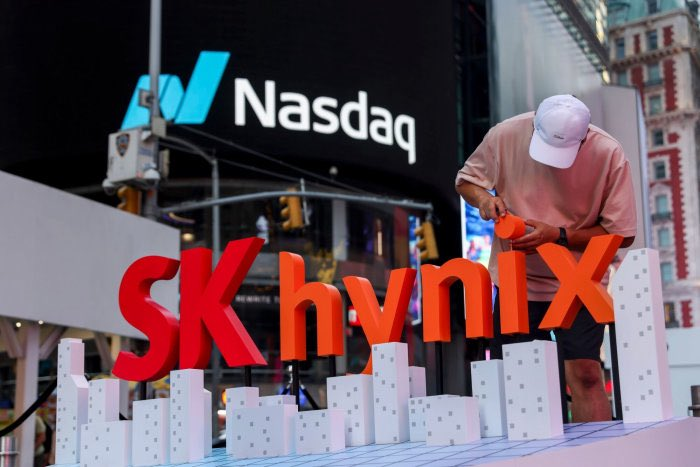
Structurally, the impact of this round of declines was most concentrated in the chip sector. According to AiCoin data (single source), on the same day, SK Hynix's stock price fell about 14.5%, and Samsung Electronics dropped about 11%, with both declines significantly exceeding that of the KOSPI index itself. As SK Hynix and Samsung Electronics are representative chip companies in South Korea, their weight and barometer role are prominent. This excessive decline not only amplified the drop at the index level but also reinforced the market's perception that "the chip sector is under heavier pressure." Currently, public materials have not provided a clear "trigger" for this violent decline; neither external macro variables nor internal industry factors have been identified by authoritative information, making the short-term market seem to be forced to reprice against new uncertainties, with chip stocks becoming a concentrated outlet for this emotional release and risk reassessment.
yixie10 Previously Profited 6.5 Million but Missed on Hynix ADRs
According to an on-chain analysis address from a single source, yixie10 is labeled as "smart money" because it has accumulated profits exceeding 6.5 million dollars in the current AI-related sector. This indicates that before the sentiment reversal in South Korean chip stocks, it had repeatedly positioned itself at low levels in AI tracks and realized gains at high levels, significantly outperforming the broader market on paper, which amplified interpretations of subsequent position adjustments as "sentiment signals."
The same public document further revealed that yixie10's transition to Hynix ADRs was not smooth sailing. Before the official trading of Hynix ADRs, yixie10 had set up a TWAP plan for batch profit-taking, projected to secure about 320,000 dollars in profit based on then-current prices. However, this plan was manually canceled halfway through execution, prematurely ending its selling rhythm. With subsequent stock prices plummeting, this address still holds about 10,000 Hynix ADRs with a position value of approximately 13.19 million dollars, incurring an unrealized loss of about 1.914 million dollars, showing that even previously profitable "smart money" in the AI sector can experience timing misjudgments on a single asset under a high-volatility environment. It should be emphasized that all profits and losses along with holding data regarding yixie10 currently stem solely from one public source, and have not been cross-verified through multiple channels. Readers should regard this as a case sample rather than a comprehensive depiction of overall capital behavior when interpreting this on-chain and account information.
TSMC Revenue Surges 67.9% Against the Trend
In stark contrast to the significant declines faced by South Korean chip stocks, the latest revenue data released by TSMC clearly shows a "counter-trend" performance. The company announced that June 2026 revenue amounted to 442.68 billion New Taiwan dollars, a quarter-on-quarter increase of 6.2% from May's 416.98 billion New Taiwan dollars, and a year-on-year increase of up to 67.9%. In the context of global semiconductor companies experiencing cycle fluctuations, such a near 70% annual growth indicates that TSMC's current capacity utilization rate and order visibility remain at relatively high levels.
On the same day, with SK Hynix's stock price down about 14.5% and Samsung Electronics down about 11% (according to a single source), combined with the previously mentioned Hynix ADR holding with unrealized losses, it can be observed that the global AI chip supply chain has faced notable divergence at different stages: South Korea is more exposed to storage and some logic chip price and demand fluctuations, while TSMC is delivering impressive revenue results on the foundry side. However, it is crucial to emphasize that existing public materials have not broken down the specific proportion of AI chip or high-performance computing business within TSMC's revenue, making it difficult for outsiders to assess how much of this round of growth directly stems from AI momentum. Therefore, a more prudent approach is to view this data set as a signal sample reflecting discrepancies within the supply chain rather than making a simplistic one-sided judgment on future market trends.
Lee Jae-myung Makes Bold Bets on Chips and AI
At a time when there is a clear divergence in stock prices and order rhythms, South Korean President Lee Jae-myung publicly stated that the government will focus its support on three major areas: the chip industry itself, artificial intelligence data centers, and projects related to physical artificial intelligence. His statement came remarkably closely to the phase of large fluctuations in the South Korean stock market and pressures on chip stocks, which can easily be interpreted as a policy signal aimed at stabilizing the domestic chip and AI industry while the market panic has not yet dissipated, intending to emphasize to enterprises and investors that the government will continue to increase resource allocation around computing power, data centers, and new forms of AI.
However, from the currently available public information, this statement remains at the level of direction and has not disclosed any corresponding budget size, specific timelines, or execution paths. It is impossible for outsiders to judge whether it will be direct subsidies, tax incentives, or primarily infrastructure investments, making it challenging to translate into quantifiable profit increments or valuation reassessment bases. At this stage, a more cautious approach is to see Lee Jae-myung's speech as an act of confidence reassurance in the industry during stock market volatility, rather than simply interpreting it as a bullish projection on short-term performance or stock prices. Future analysis awaits more detailed policy documents and budgeting arrangements to evaluate its substantial impact on the South Korean chip and AI landscape.
Observational Indicators in the Divergence of the AI Chip Sector
According to AiCoin data, on July 13, 2026, the South Korean KOSPI index fell about 9.07%, with SK Hynix and Samsung Electronics dropping approximately 14.5% and 11%, which sharply contrasted with TSMC's robust performance of a year-on-year revenue increase of 67.9% on the same day. Additionally, the on-chain address yixie10, which previously recorded over 6.5 million dollars in profits in the AI sector, has incurred approximately 1.914 million dollars in unrealized losses on about 10,000 Hynix ADRs (according to a single public document), together illustrating a scenario in the current AI chip track where, on one hand, the fundamentals remain highly prosperous while, on the other hand, stock prices and positions experience significant drawdowns with high volatility and strong differentiation. For traders, a direct takeaway is that even previously successful smart money might suffer substantial unrealized losses due to timing misjudgments, rather than simply "lying down to win" in a booming sector. It is essential to closely monitor three types of variables: first, demand guidance and capital expenditure rhythms in upcoming financial reports from major South Korean chip companies, to verify whether the recent stock price declines were due to excessive emotions or a fundamental turning point; second, whether TSMC's revenue and order structures can maintain current momentum in the coming months, thus consolidating its position in the global AI computing chain; third, the adjustment paths of on-chain addresses like yixie10 with respect to Hynix ADRs and broader AI assets, to observe how so-called smart money manages risks and reallocates after incurring losses. Given that South Korean policy statements still remain at the directional level, it is crucial to maintain a differentiated perspective between national, corporate, and industry chain segments, using multi-source data and time series for observation, rather than simply representing the entire AI sector with a singular market spike or plunge.
Join our community to discuss together and become stronger!
AiCoin exclusive Hyperliquid benefits: https://app.hyperliquid.xyz/join/AICOIN88
AiCoin exclusive Aster benefits: https://www.asterdex.com/zh-CN/referral/9C50e2
On-chain Telegram community: https://t.me/AiCoinWhaleData
On-chain community: https://www.aicoin.com/link/chat?cid=N6OVMor5g
AiCoin on-chain Twitter: https://x.com/aicoinwhaledata
免责声明:本文章仅代表作者个人观点,不代表本平台的立场和观点。本文章仅供信息分享,不构成对任何人的任何投资建议。用户与作者之间的任何争议,与本平台无关。如网页中刊载的文章或图片涉及侵权,请提供相关的权利证明和身份证明发送邮件到support@aicoin.com,本平台相关工作人员将会进行核查。