
Author: Zhou, ChainCatcher
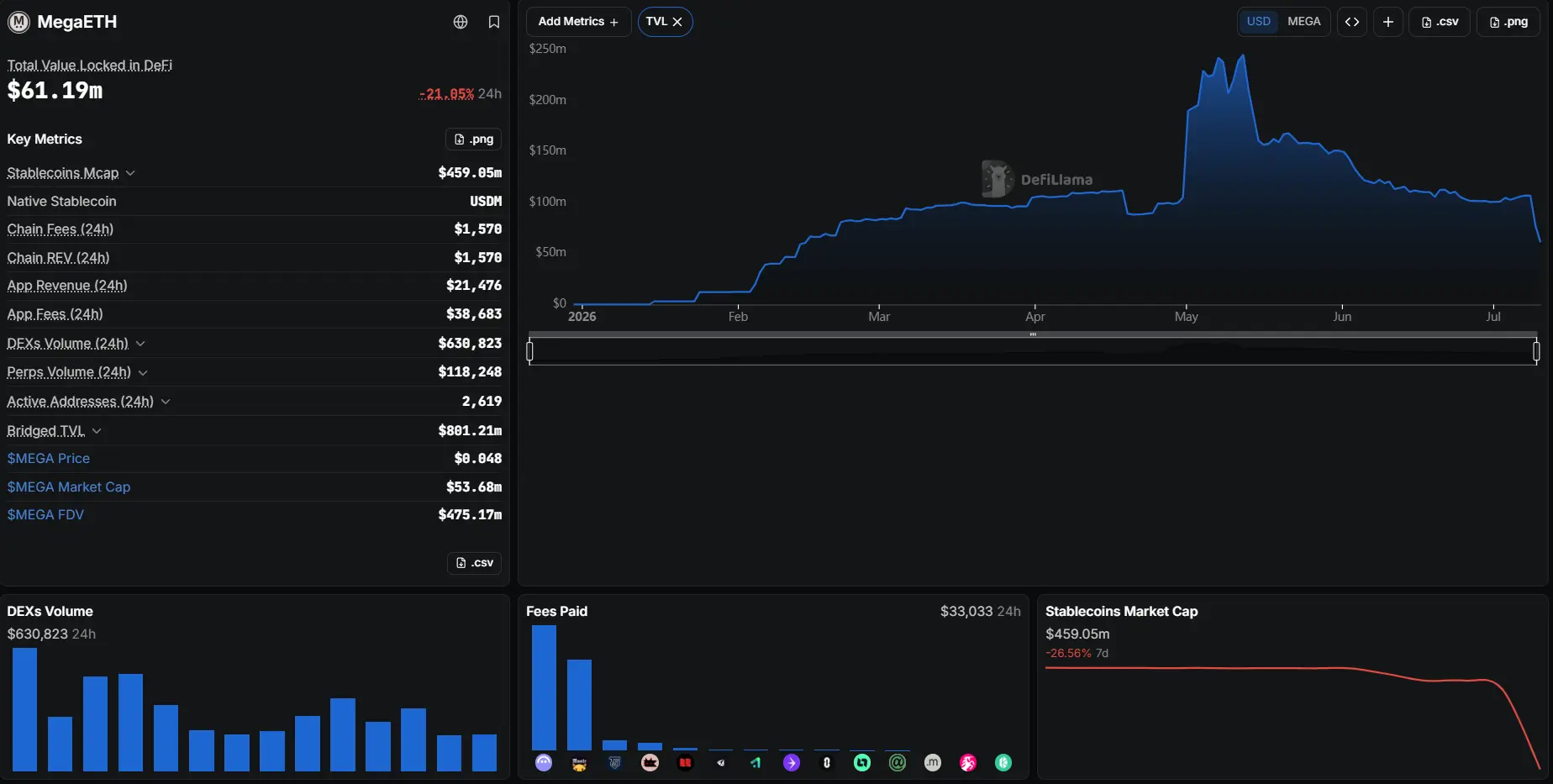
According to the latest data fromDefiLlama, MegaETH's total TVL experienced severe fluctuations from July 9 to 10, briefly dropping to just over 30 million dollars, with a 24-hour decline of nearly 60%, evaporating about 70% from the peak in May. On-chain leading protocol Aave V3 withdrew 80% of liquidity in a single day.
In terms of market performance, the price of MEGA plummeted to around 0.048 dollars, with a market cap of only about 54 million dollars, and an FDV of around 480 million dollars.
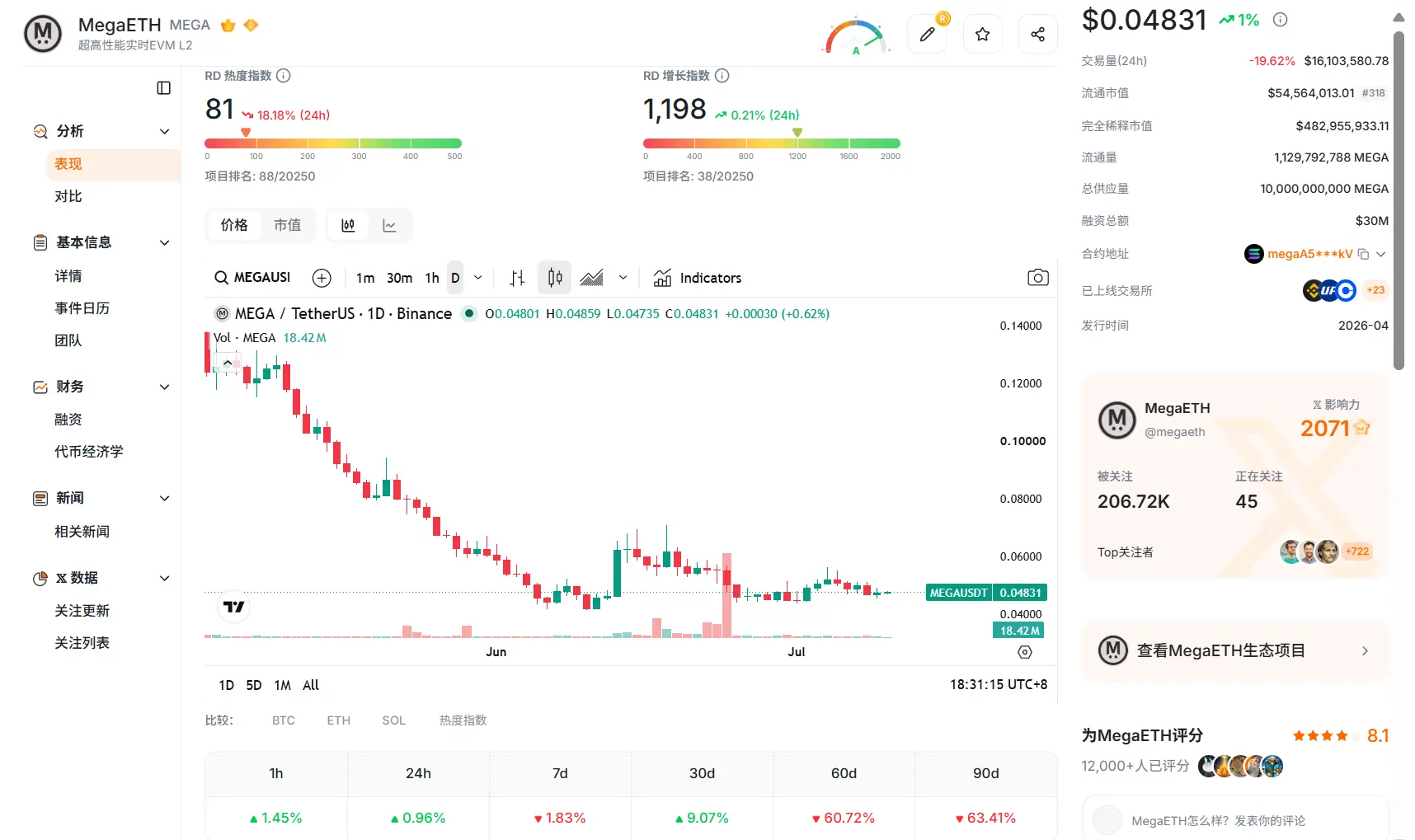
MegaETH was once one of the most anticipated new public chains in this round; it captured market trends right upon its launch, backed by a luxurious roster of VCs and KOLs eager for new investments. The token's FDV once soared to around 2 billion dollars. In May of this year, its DeFi TVL reached 245 million dollars, briefly making it the 11th largest in public chain TVL rankings.
From being a highly regarded star public chain to experiencing a drastic withdrawal in TVL in a short period, MegaETH only took a few months. As the financial foundation supporting its valuation weakened, has its price already reached an appropriate level? Or, after the paper prosperity fades, does its valuation still lack support?
TVL Highly Dependent on a Single Protocol and Cyclical Strategy
In MegaETH's ecosystem, at its peak, Aave contributed about 90% of the chain’s TVL. Currently, the totalTVL fluctuates around 6000 million dollars, with Aave still accounting for about 65%.
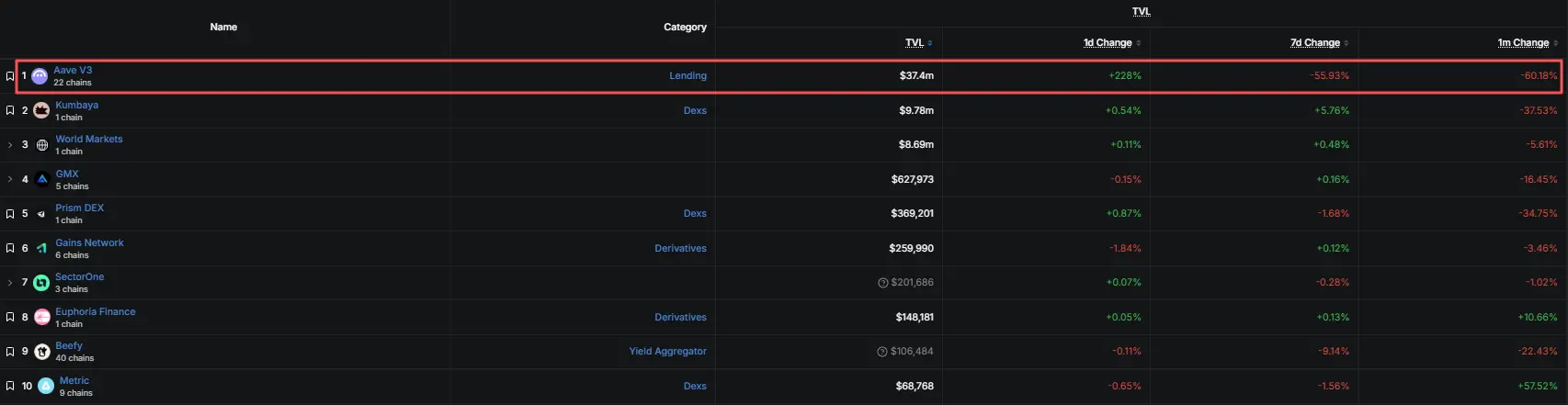
In fact, more than two months ago, the largest source of TVL for MegaETH was still attributed to another party. On the day of the token's listing, MegaETH's native DEX protocol Kumbaya accounted for 59.03 million dollars of the total chain TVL of 98.43 million dollars, making up about 60%.
At the same time, projects such as Aave V3, GMX, and Chainlink Scale went live, after which the TVL leader gradually became Aave.
Risk assessment agency LlamaRisk pointed out earlier that MegaETH's TVL is highly dependent on Aave, while the stablecoin structure is also heavily concentrated on USDm and USDe. In their view, the proportion of external assets entering MegaETH through third-party and specific asset channels is high when excluding native assets, and the sources of funds, asset types, and protocol methods are relatively concentrated, raising doubts about stability.
Specifically, in terms of strategies, the market generally questions that a large portion of this volume comes from the stablecoin cyclical strategies related to Ethena, which repeatedly collateralize, borrow, and re-collateralize stablecoins to achieve significant gains through stacking leverage.
This means that when the yield of USDe falls below the borrowing cost of Aave, this arbitrage mechanism will lose its profit margins, and the cyclical positions will begin to unwind, leading to capital withdrawal.
Whether incentivized during the launch phase or from yield differential in cyclical strategies, such funds are essentially seeking profits, and once expected yields vanish, they will exit. This is common behavior in DeFi and cannot be regarded as unexpected.
What truly raises market alertness is when this highly proportional capital is withdrawn, what remains on the MegaETH chain, and whether these remaining elements can support its current valuation.
Valuation and Fundamentals: Three Layers of Misalignment
The First Layer of Misalignment: Between Valuation and Actual Usage
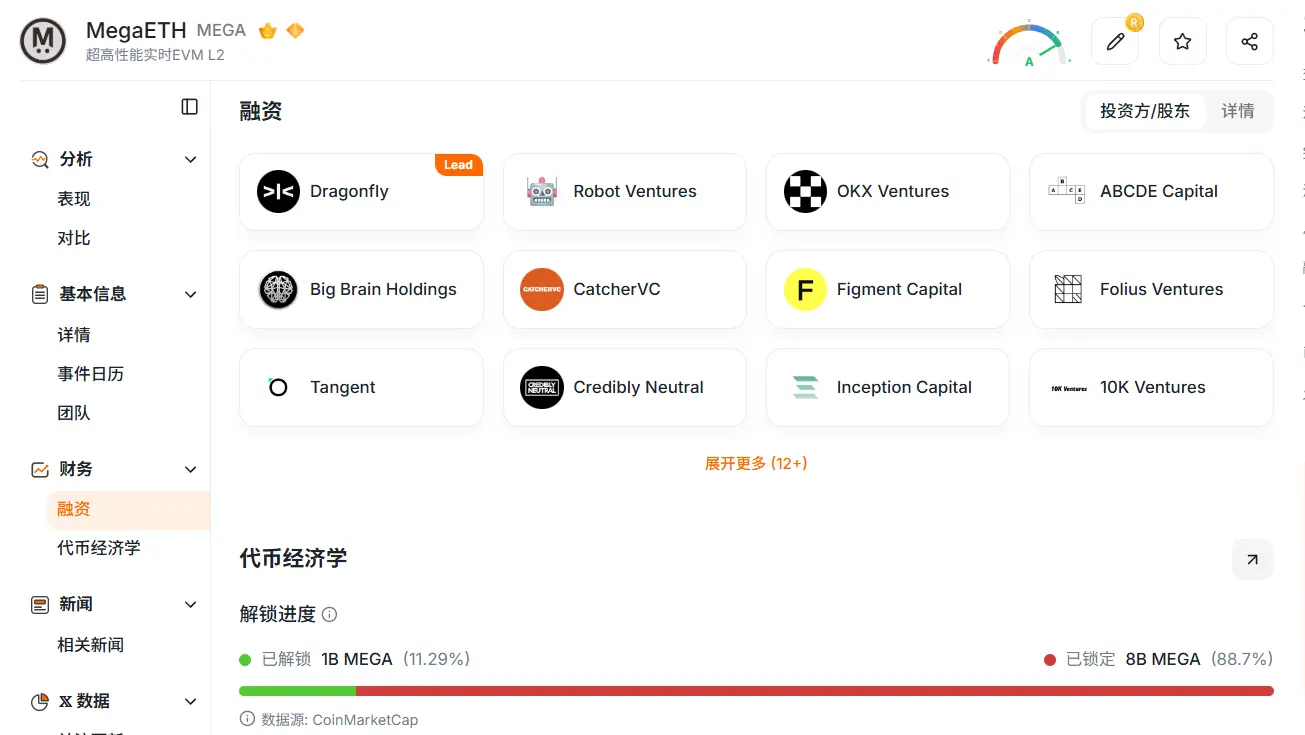
As of the time of writing,MEGA has a market cap of about 54 million dollars, with an FDV of around 470 million dollars. According to RootData, currently, 88.7% of MEGA tokens are not in circulation, and many holders are unable to exit due to a one-year lock-up arrangement, indicating that there is still a batch of potential selling pressure in the future.
Furthermore, let’s examine how much the current valuation corresponds to actual usage. Data shows that the true income of MegaETH’s entire chain protocol over 30 days is less than 900,000 dollars, annualizing to about 10 million dollars, with only 2,619 active addresses daily.
On average, each active address carries about 180,000 dollars of FDV, while the actual protocol income contributed by each address per month is less than 350 dollars.
Clearly, the price is not anchored to the current real economic activity level, but rather to the market's imagination of its future, and this expectation is gradually collapsing.
The Second Layer of Misalignment: Between Token Narrative and Ecosystem Quality
The market buys MEGA, which represents a story of a high-performance DeFi public chain. However, from the income structure, there is some disparity.
DefiLlama data shows that the highest income protocol on MegaETH is Monster, a physical collectible card game, with 30-day income of about 670,000 dollars, accounting for nearly 80% of the entire chain’s protocol revenue.
Meanwhile, Aave, which is at the forefront of DeFi narrative and accounted for about 90% of the TVL at its peak, only generated about 90,000 dollars in the same period.
The same misalignment is evident in stablecoins as well. The native stablecoin USDM on the MegaETH chain has an outstanding amount of about 460 million dollars, with daily trading on DEXs being only about 630,000 dollars, and perpetual contracts having daily trading of only about 120,000 dollars. Furthermore, this amount is also declining, with USDM’s market cap dropping over 26% in under 7 days, indicating that real capital is leaving at a faster rate than TVL.
A long-term participant @OlricOnlyfornft pointed out that MegaETH had a strong early community, but the team has long focused on technology and applications, with insufficient communication with the community. Several impressive projects eventually migrated to other chains, and currently, there are not many applications that can be clearly identified as success stories, with only a few still persisting in building.
This viewpoint may not be sufficient to form a definitive conclusion, but it indicates that after the market heat has faded, MegaETH still needs clearer application samples to prove the quality of its ecosystem.
The Third Layer of Misalignment: Between Short-term Expectations and Long-term Realization
MegaETH captured excessive expectations at the time of its launch: TGE, blue-chip integrations, KOL new investments, and surging TVL all constituted the early valuation anchor. However, a few months later, the capability to deliver on-chain has yet to keep pace.
In February of this year, Uniswap deployed v2, v3, and v4 entirely on MegaETH, yet as of the time of writing, Uniswap's TVL on MegaETH has fallen below 20,000 dollars, evaporating approximately 97% in the past week. Recently, Aave V3's TVL surged by over 240% in a single day, but over a 7-day period, it still dropped more than 50%.

The significant influx and outflow of capital indicate that this portion of TVL is driven by arbitrage funds rather than stable, genuine demand.
It's worth noting that MEGA's situation is not isolated. Similarly overvalued star new public chains like Monad have also experienced declines. MON is currently about 0.022 dollars, having fallen more than 50% from its peak in November 2025, with a current market cap of about 269 million dollars.
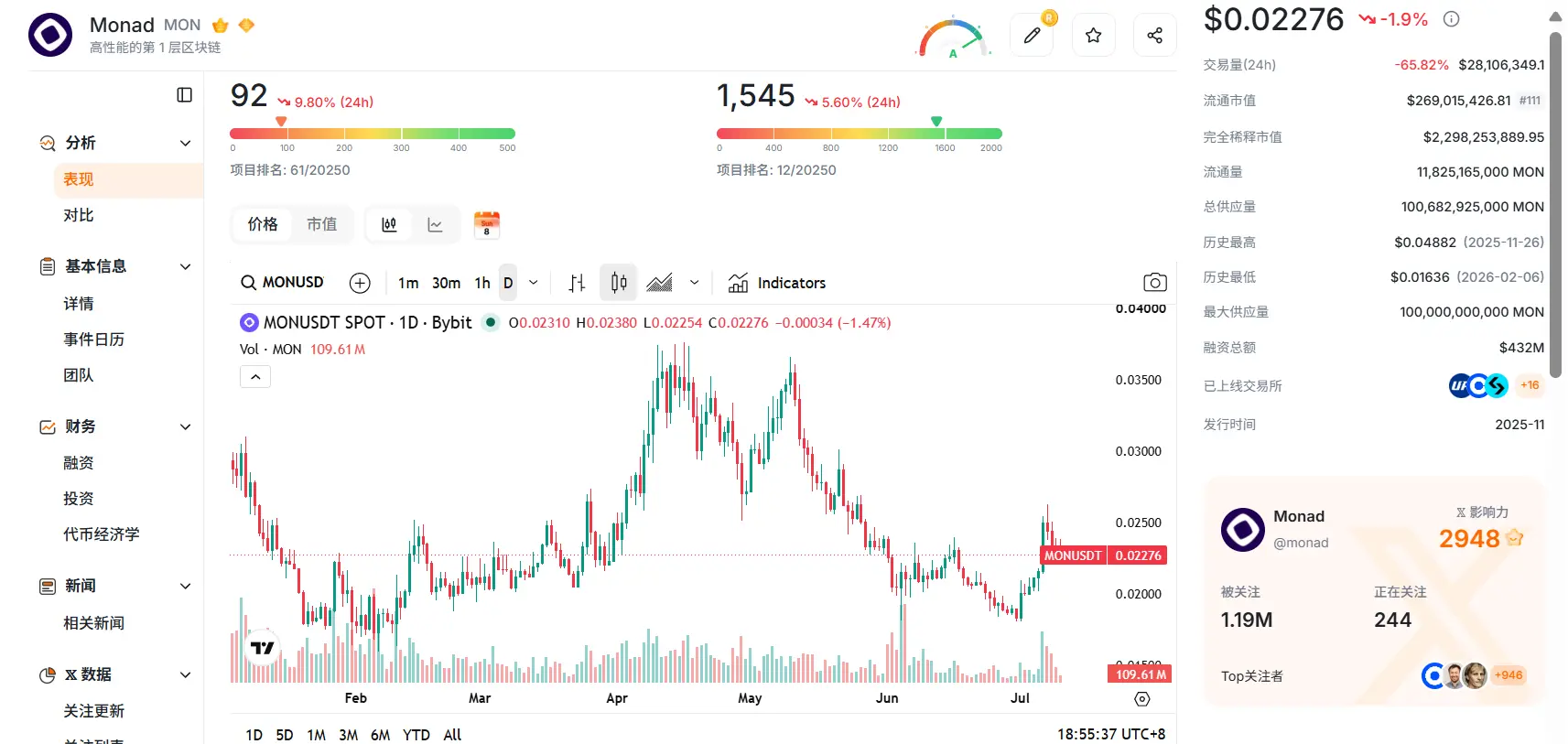
Although Monad's recent TVL has seen some recovery due to capital inflow from lending protocols, the market's reaction has been tepid. This aligns with MegaETH's situation, indicating that the market is increasingly skeptical of perceived TVL and star narratives, instead seeking genuine value support.
In other words, this adjustment may not be solely a singular failure of MegaETH, but rather a reflection of the market starting to diminish the premium on apparent TVL and high-flying narratives, instead requiring clearer indicators of trading, revenue, and ecosystem support.
Moreover, competition in the public chain sector is still intensifying, with new players, including Robinhood, constantly entering the market and diverting attention and funds.
For MEGA, although the decline has been substantial, any potential rebound is more likely to result from a short-term recovery in market sentiment rather than a genuine improvement in the fundamentals.
As Paper Prosperity Fades, MEGA Awaits a Value Pivot
Looking at these layers of misalignment together, the conclusion is becoming clearer.
When the on-paper prosperity supported by incentives and arbitrage funds retreats, the current market cap of MEGA lacks a solid value pivot in relation to its actual on-chain fundamentals.
Market sentiment has also apparently shifted towards caution. One viewpoint suggests that this is a normal return to valuation after the incentive funds recede. With the cessation of point incentives and the disappearance of arbitrage yield differentials, capital exiting is the inevitable result. MegaETH merely leveraged this strategy more heavily, leading to particularly severe retractions.
At the community level, many users continue to question the team's communication and transparency, noting that Discord has closed community discussions, and Telegram is only open to users holding large amounts of tokens, with the team's public presence being far less than before the launch.
However, these statements mostly represent one-sided accounts by users and have not yet been officially confirmed. As of the time of writing, the MegaETH team has not publicly responded to related concerns.
For MEGA, whether viewed as a process returning to fundamentals or an evident misalignment of valuation and fundamentals, the subsequent focal point rests on one matter: whether the team can convert short-term liquidity into real usage and realize the massive funds raised into tangible ecological outcomes.
Until these realizations occur, apart from short-term rebounds driven by market sentiment, there don't seem to be solid reasons for valuation to stabilize again.
免责声明:本文章仅代表作者个人观点,不代表本平台的立场和观点。本文章仅供信息分享,不构成对任何人的任何投资建议。用户与作者之间的任何争议,与本平台无关。如网页中刊载的文章或图片涉及侵权,请提供相关的权利证明和身份证明发送邮件到support@aicoin.com,本平台相关工作人员将会进行核查。


