Who follows who after the上市 of SK Hynix ADR — A personal judgment through case studies
Today a friend asked me, if SK Hynix ADR surges significantly at night, will Korean stocks directly follow the next day? If the ADR premium reaches over a dozen points, should we wait for the U.S. market to drop back, or wait for Korea to catch up? I will try to answer this.
PS: ADR refers to packaging overseas stocks into a stock that can be traded in the United States.
I initially wanted to calculate the premium directly, but after looking back at the past performance of Korean companies after listing in the U.S., I realized this issue cannot be explained solely by the same company’s stocks being priced the same.
So I found three similar cases to analyze the correlation.
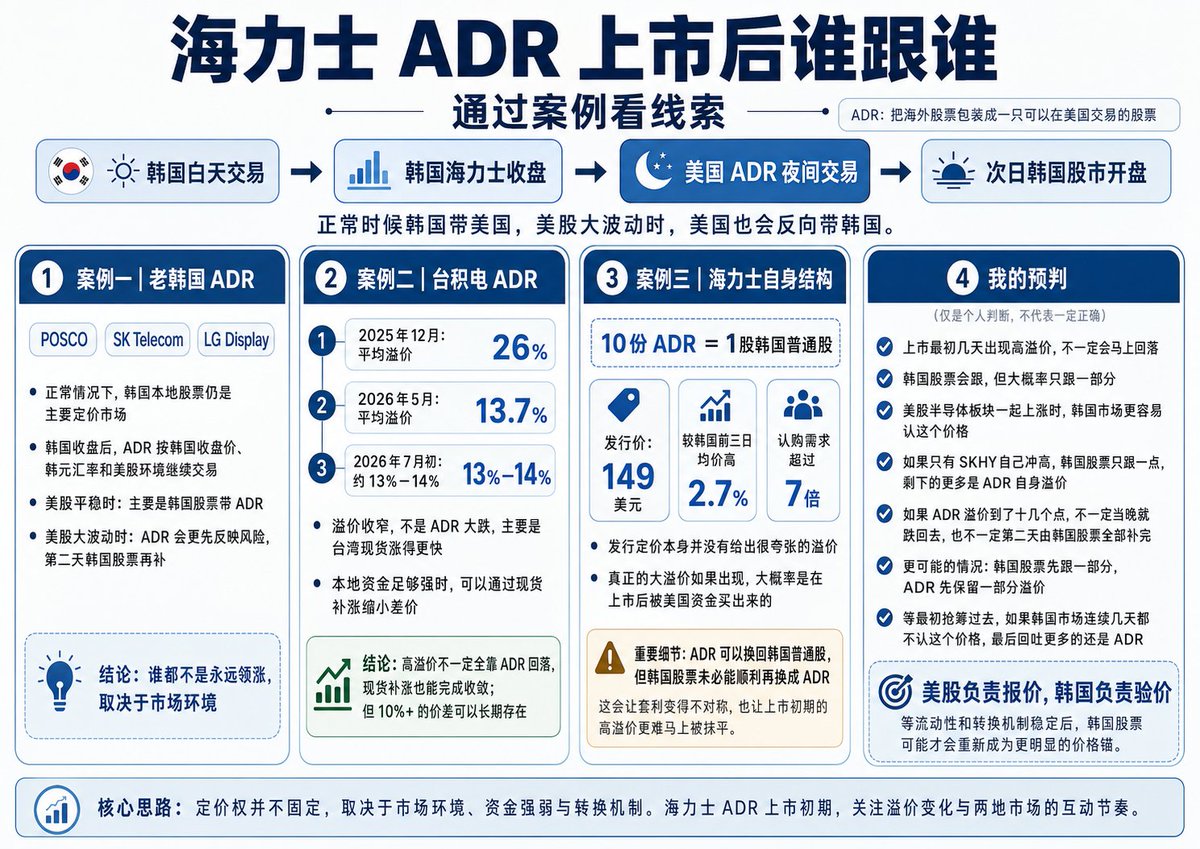
The first is POSCO, SK Telecom, and LG Display, which have been trading as Korean ADRs for many years.
Under normal circumstances, Korean local stocks are still the primary pricing market.
During the day, Korea trades first, and at night, ADRs continue to move based on the Korean closing price, the won exchange rate, and the U.S. stock market environment. Previous research on Korean ADRs has shown that when the U.S. stock market is stable, Korean stocks primarily drive the ADRs, but when the U.S. market is highly volatile, this relationship reverses.
Especially during the 2008 financial crisis, ADRs actually reflected the risks of the U.S. market first, and Korean stocks adjusted the next day. So these old Korean ADR cases do not suggest a permanent follow-the-leader relationship.
Normally, Korea leads the U.S.; when the U.S. has major events, then the U.S. leads Korea.
The second case is TSMC.
TSMC is not a Korean company, but it is closer to SK Hynix; both are locally listed in Asia, have ADRs in the U.S., and U.S. capital is willing to buy them separately.
In December 2025, TSMC’s ADR average premium once reached 26%. By May 2026, the average premium had dropped to 13.7%, and by early July, it remained roughly around 13% to 14%.
The narrowing of the premium was not due to a significant drop in the ADR, but because Taiwanese stocks rose faster. This year, TSMC’s Taiwanese stock increased by over 50%, while the ADR in the U.S. rose less than 40%, as local capital actively drove up the price.
This case also shows that after a high premium appears in ADRs, it doesn't necessarily mean that the problem will be resolved purely through a drop in ADRs. As long as the local market has enough strength, it can also narrow the price gap through spot transactions.
However, even after a continuous narrowing, TSMC's ADR still had a premium of over 10%, indicating that ADRs with conversion limitations may have long-term price differences that won't simply disappear just because both sides represent the same company.
The third case is SK Hynix's own issuance structure.
10 ADRs correspond to 1 share of Korean common stock, with an issue price of $149, which is only 2.7% higher than the average price of Korean stocks over the previous three trading days, but subscription demand exceeded seven times the issuance volume.
This means that the issuance pricing itself did not provide an exaggerated premium. If a real large premium appears, it is likely to be bought up by U.S. capital after listing.
Moreover, this time SK Hynix has an important detail.
The prospectus states that ADRs can be converted back to Korean common stock, but after conversion, it may not be possible to deposit the Korean stock back in to get ADRs again. This can make arbitrage asymmetric. When ADRs are cheap, you can buy ADRs and then convert them into Korean stocks.
But when ADRs are expensive, trying to buy Korean stocks and then convert them to ADRs for sale may not go smoothly. Therefore, the initial ADR premium after SK Hynix's listing may be harder to eliminate immediately compared to older ADRs like POSCO and SK Telecom.
Looking at these cases together, my forecast for SK Hynix post-listing is:
(This is just a personal judgment, not necessarily correct)
In the first few days after listing, if a high premium occurs, it may not drop back immediately, especially if there is still capital entering the market that did not receive enough allocations previously. This situation is very similar to the previous case of SpaceX.
Korean stocks will follow, but most likely only partially. The overall rise of the U.S. semiconductor sector will be more easily recognized by the Korean market, while SK Hynix's own aggressive capital raising might not be as well-recognized by the Korean market.
If SK Hynix rises a lot, and Micron and the semiconductor index are also rising, then the next day Korean SK Hynix is more likely to catch up. If only SK Hynix itself rises, Korean stocks will only follow a little, and the rest will basically be the premium of the ADR itself.
In other words, if the ADR premium reaches over a dozen points, I would not bet that it will drop back that night, nor would I bet that Korean stocks will make up all those points the next day. The more likely situation is that Korean stocks will first follow partially, and ADRs will retain some premium first.
Once the initial capital rush is over, if the Korean market does not recognize this price for several consecutive days, it is highly probable that the final retreat will be due to the ADRs.
So in the initial days after SK Hynix's listing, the U.S. market will set the price, and Korea will validate the price. Once the liquidity and conversion mechanisms stabilize on both sides, Korean stocks may then become a more obvious price anchor again.
@Gate Crypto, U.S. stocks, Hong Kong stocks, Korean stocks, gold, CFDs, one-stop trading for prediction markets
免责声明:本文章仅代表作者个人观点,不代表本平台的立场和观点。本文章仅供信息分享,不构成对任何人的任何投资建议。用户与作者之间的任何争议,与本平台无关。如网页中刊载的文章或图片涉及侵权,请提供相关的权利证明和身份证明发送邮件到support@aicoin.com,本平台相关工作人员将会进行核查。


