Six months ago, the CEO of Goldman Sachs said that prediction markets were "very interesting," and now employees can be fired for even minor infractions.
Written by: ChandlerZ, Foresight News
On July 9, Bloomberg reported that Goldman Sachs has updated its internal personal trading policy, prohibiting employees from participating in event contracts involving specific companies (including whether Goldman Sachs itself will reorganize or initiate acquisitions in a given quarter), election outcomes, financial market performance (including Bitcoin prices), macroeconomic data, geopolitical events (including ceasefire timelines in active conflicts), and regulatory outcomes of pending merger cases. Betting on sports and entertainment remains allowed.
Regarding penalties, employees who violate rules twice may face termination or account closure. If a transaction is deemed improper, Goldman Sachs reserves the right to recover profits exceeding $200 or donate the funds to charity. A Goldman Sachs spokesperson stated that the company does not comment on specific policy details but noted that trading using Material Non-Public Information (MNPI) is prohibited in all markets where Goldman Sachs operates.
In January, Goldman Sachs CEO David Solomon publicly stated that prediction market platforms were "very interesting" and revealed that he had met with the heads of two leading platforms in the field. Six months later, his company has closed this door for employees.
According to a survey report by CNBC on 50 companies, there are significant differences in the response strategies of Wall Street institutions. Hedge funds Point72 Asset Management and Balyasny Asset Management have implemented more thorough measures than Goldman Sachs, directly prohibiting any personal account trading activities in prediction markets without any category exemptions. JPMorgan merely advised employees to "exercise caution" without issuing a formal ban. Bank of America is pushing new trading restrictions to its employees. Morgan Stanley has incorporated relevant terms into its employee code of conduct.
Chrome Web Store Cuts Off Distribution Channels
Google's Chrome Web Store recently updated its developer program policies, which will take effect on August 1, 2026. This update explicitly lists prediction markets as a prohibited category, banning extensions that facilitate or support real-money trading on prediction outcomes.
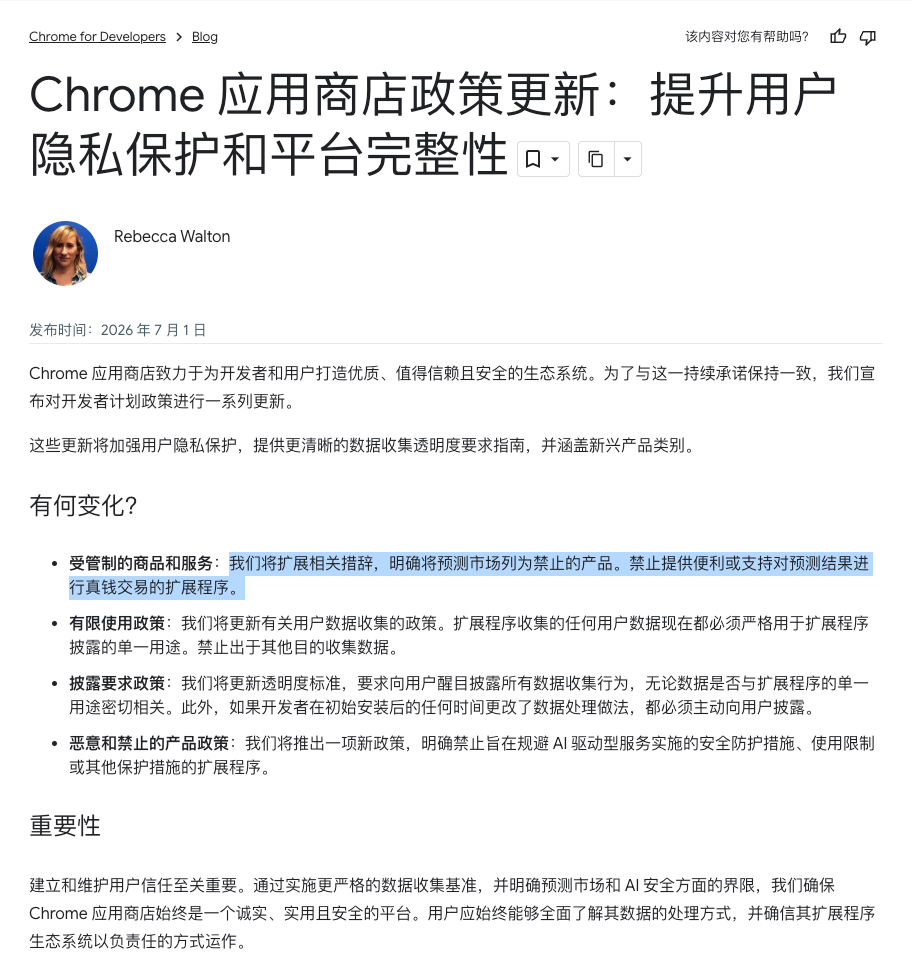
Additionally, the new policy requires that user data collected by extensions must be strictly used for the declared disclosure purposes, prohibiting any alternate use; it also adds a ban on extensions aimed at circumventing the security measures of AI-driven services. Google stated that developers are advised to review the compliance of their existing extensions as soon as possible. After August 1, if any extensions are found to be non-compliant with relevant policies, the Chrome Web Store may take enforcement actions.
Google's ban does not affect prediction market platforms themselves; Polymarket and Kalshi's web and mobile versions remain unaffected. However, Chrome extensions are one of the access points for some users to prediction markets, and blocking this channel effectively sets a barrier at the browser level. This policy adjustment also includes stricter user data collection transparency requirements, stipulating that data collected by extensions can only be used for stated purposes, and any changes in data processing methods must be actively communicated to users.
A Chain Reaction Triggered by a Google Employee
The immediate trigger for Goldman Sachs' ban was a law enforcement case in May this year. The U.S. Commodity Futures Trading Commission (CFTC) announced that Google software engineer Michele Spagnuolo was suspected of illegally trading prediction contracts on Polymarket to profit $1.2 million and was charged with fraud and money laundering. The contract involved was "Who will be the most searched person in 2025?" In the complaint, the CFTC seeks damages, restitution, civil penalties, trading and registration bans, as well as a permanent injunction against further violations of the Commodity Exchange Act and CFTC regulations. Yesterday, the U.S. Attorney's Office for the Southern District of New York announced a criminal indictment against Michele Spagnuolo in the same court.
Additionally, according to The Wall Street Journal, Michele Spagnuolo placed bets on the year's most popular search figures using Google Year in Search data, accessible only to a few employees, on Polymarket, betting through the account "AlphaRaccoon" in 25 transactions. His predictions accurately included Kendrick Lamar and d4vd in the top five.
This marks the first case of insider trading involving a private company in the history of prediction markets. Prior discussions of insider trading in prediction markets largely focused on political events (such as elections), and the Spagnuolo case is the first to prove that corporate employees can benefit from using internal company information in prediction markets.
For Wall Street institutions that routinely handle large amounts of non-public financial information, these risks are particularly pronounced. If a trader knows upcoming financial report data, merger plans, or regulatory decisions, and places bets on related contracts on Polymarket or Kalshi, the nature of this is no different from insider trading in traditional securities markets, yet the current regulatory framework and identity verification mechanisms for prediction markets are far less mature than those in securities markets.
Financial Tool or Casino
The actions of Goldman Sachs and Google come against the backdrop of multiple pressures on the prediction market industry. On June 26, the CFTC announced a broad investigation into Polymarket, involving fabricated trading videos, false winning records, and undisclosed paid promotional activities. On the same day, consumer advocacy groups filed a lawsuit against Polymarket and its CEO and CMO in Washington, D.C. The CFTC has already filed federal lawsuits against nine states in a battle for jurisdiction over prediction markets, while 17 Democratic senators are attempting to block the CFTC from using federal funds to sue state governments.
Furthermore, Argentina ordered a nationwide closure of Polymarket in March this year, becoming one of over 30 countries to impose access restrictions on prediction markets globally. This ruling also forced Google and Apple to remove Polymarket's app from their app stores in Argentina.
According to Dune data, as of June 22, the monthly nominal trading volume for prediction markets reached a historical high of $291.38 billion. Additionally, Kalshi is seeking a new round of funding at a $40 billion valuation, and the parent company of the New York Stock Exchange, ICE, invested $2 billion in Polymarket, with capital still flowing in.
Prediction markets lack a widely accepted identity definition to date. U.S. CFTC Chair Selig insists that they are federally regulated financial derivatives, leading to lawsuits against nine states attempting to regulate prediction markets through gambling laws. Analysis by The Wall Street Journal shows that over 70% of accounts on Polymarket are in a state of loss, with only 0.1% of accounts accounting for 67% of total profits, resembling the distribution characteristics of a casino.
However, it is evident that restrictions are coming from multiple directions simultaneously, including federal law enforcement investigations, political pressure from Congress, jurisdictional battles over state gambling laws, internal compliance restrictions from Wall Street, and distribution channel blockages by tech platforms, all accelerating the encirclement of prediction markets.
免责声明:本文章仅代表作者个人观点,不代表本平台的立场和观点。本文章仅供信息分享,不构成对任何人的任何投资建议。用户与作者之间的任何争议,与本平台无关。如网页中刊载的文章或图片涉及侵权,请提供相关的权利证明和身份证明发送邮件到support@aicoin.com,本平台相关工作人员将会进行核查。


