OpenAI's GPT-5.6 Sol is now public. The company released its new flagship model to general users today, launching alongside two smaller siblings, Terra and Luna, after the U.S. Department of Commerce kept a preview restricted to about 20 trusted partners for two weeks.
The naming strategy is new for OpenAI. This is the first time the company gives names to its models instead of simply using numbers. Sol, Terra, and Luna mark capability tiers that can move on their own cadence. Sol is the flagship, Terra the everyday model OpenAI says matches GPT-5.5 at half the price, and Luna the cheaper option.
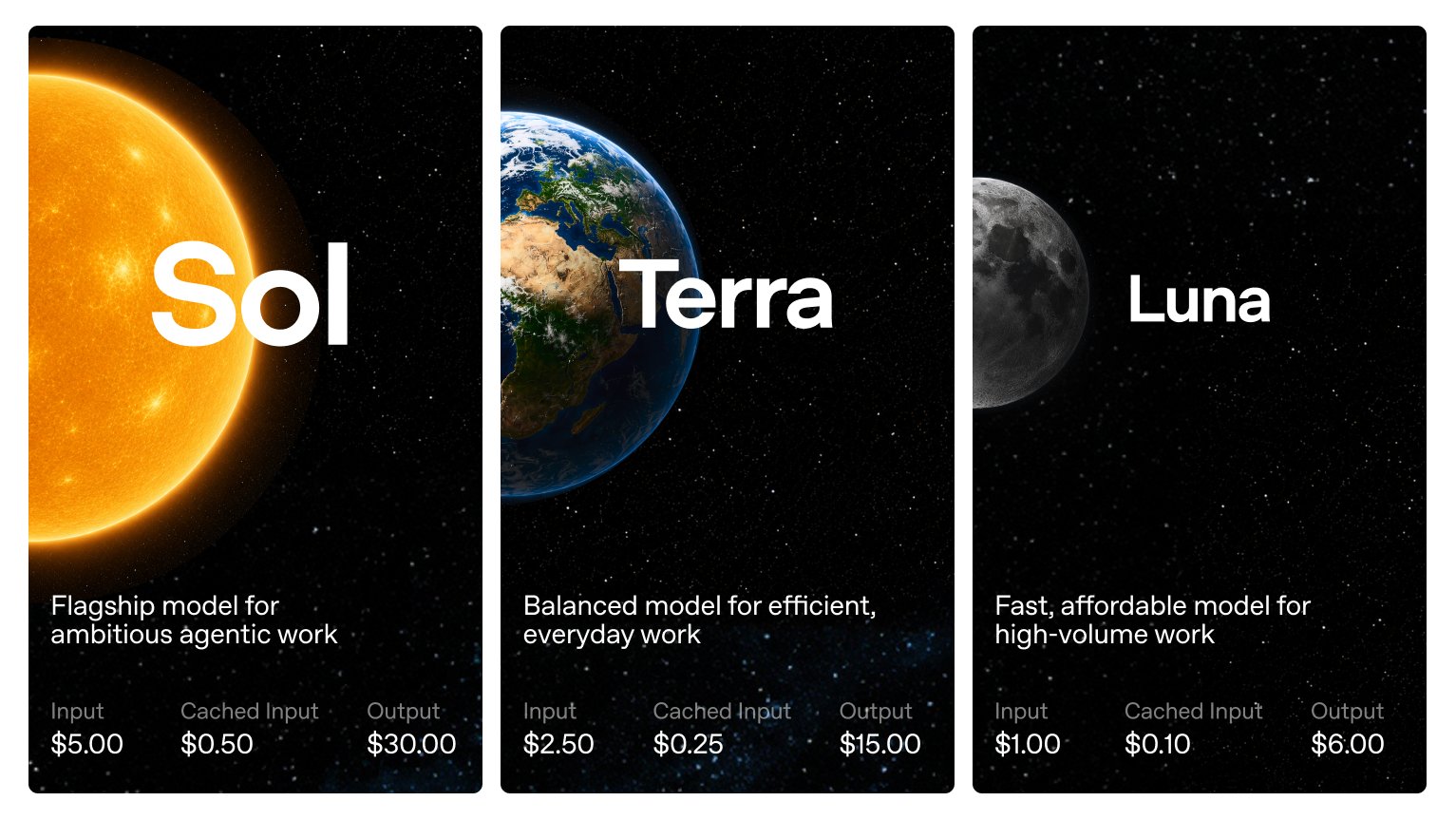
Pricing runs $5 and $30 per million input and output tokens for Sol, dropping to $1 and $6 for Luna. (Tokens, for those not in the know, are the smallest unit of information a model can handle. And companies typically price their models on a per token basis for API services) Two new knobs ship with it: a max reasoning effort that lets Sol think longer, and an ultra mode that farms work out to subagents.
For context, Anthropic charges $10/$50 for Claude Fable 5, Google charges $2/$12 for Gemini 3.1 Pro, xAI charges $15/$75 for Grok 4.5.
On the Chinese side: DeepSeek charges $1.74/$3.48 for V4 Pro, and Xiaomi charges just $1/$5 for MiMo v2.5 Pro—placing Sol between the premium U.S. frontier models and China's low-cost challengers.
What the benchmarks show
On Terminal-Bench 2.1—a test of command-line workflows that reward planning, tool use, and iteration, scored as the share of tasks a model completes—Sol in its ultra configuration hit 91.9%, with standard Sol at 88.8%.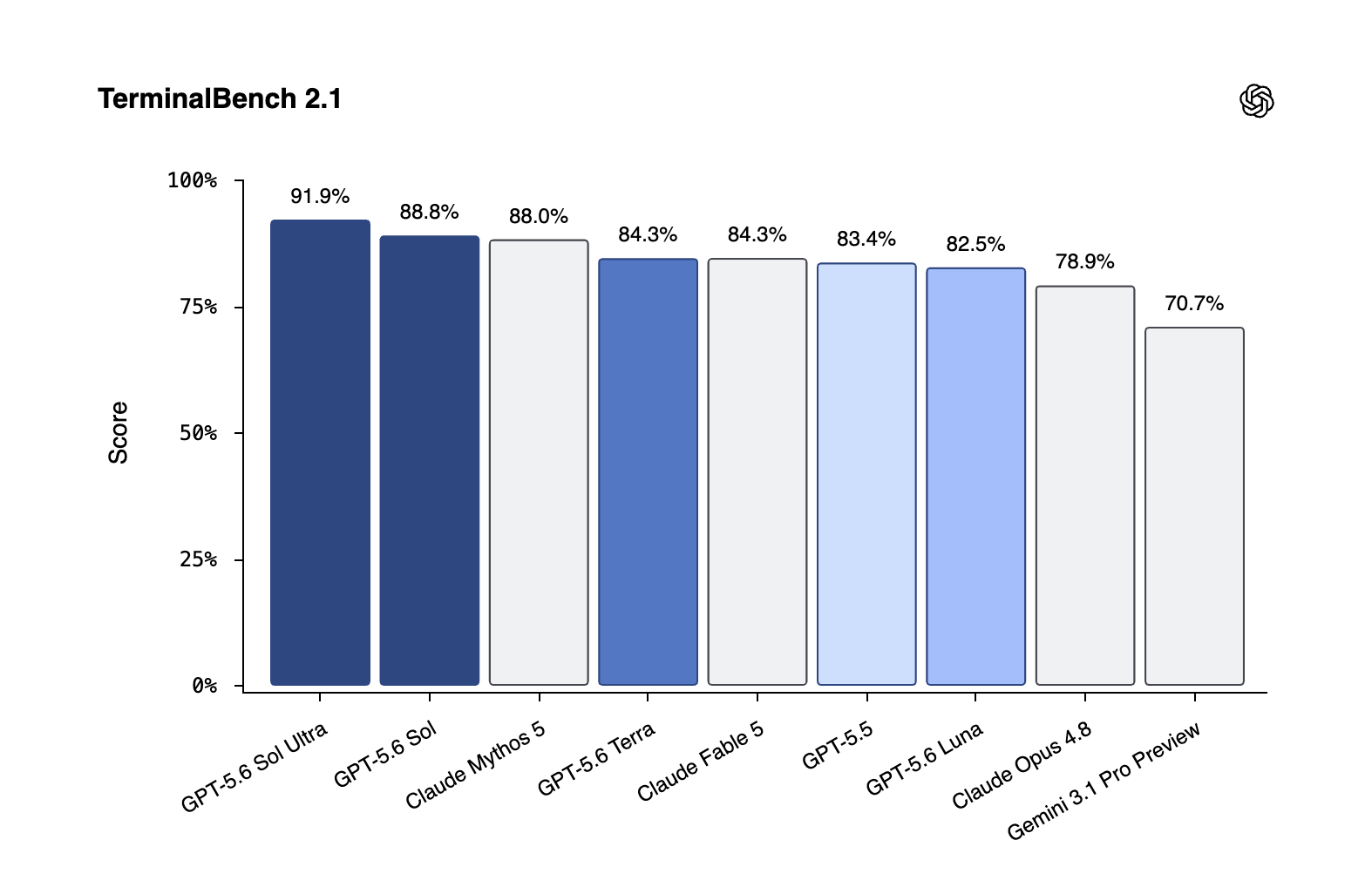
That puts both ahead of Anthropic's Claude Mythos 5 at 88.0%, Claude Fable 5 at 84.3%, and Claude Opus 4.8 at 78.9%. Google's Gemini 3.1 Pro Preview trailed the chart at 70.7%.
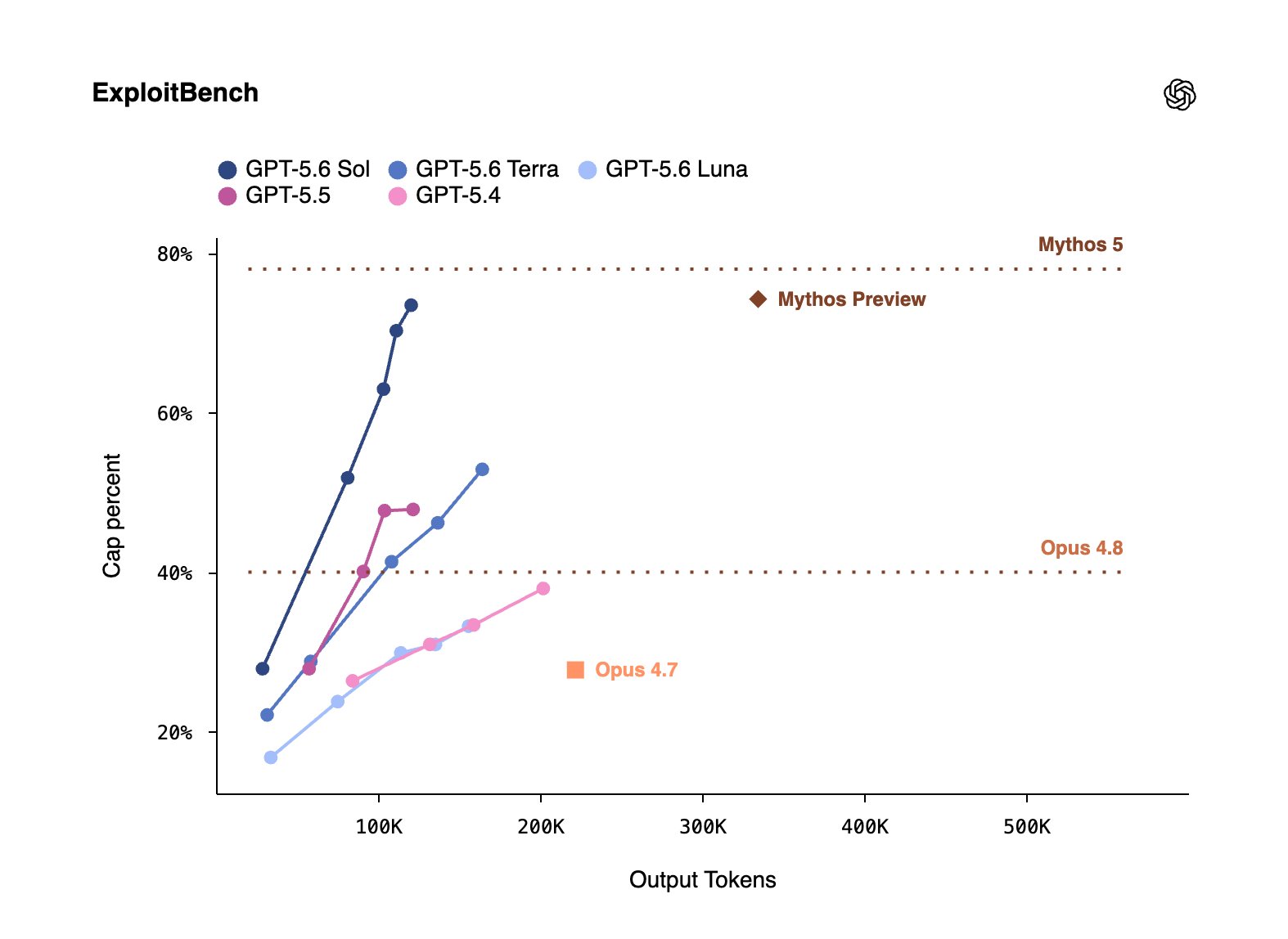
OpenAI leaned hardest on cyber. On ExploitBench, which measures how well a model finds and weaponizes software vulnerabilities, Sol matched the restricted Mythos Preview while spending roughly a third of the tokens. OpenAI says Sol still doesn't cross the "Cyber Critical" line in its own risk framework.
The testers already have opinions
Early access was loud. Theo, a well-known developer, AI youtuber and CEO of the AI platform T3 Chat, called Sol "world leading in computer use" and said it fixed the complaints he had with GPT-5.5.
Dan Shipper, whose team at Every tested it for a month, offered the cleaner line: "GPT-5.6 is like a Porsche, Fable is like a warp drive." His read is that Sol is the daily driver and Fable the thing you reach for to cross the galaxy.
Researcher Daichi Konno, who got in early, said Sol clearly beats GPT-5.5 and lands near Fable 5, with Anthropic still ahead in writing tasks. His sharper note: Sol's safeguards didn't trip on life-science questions, which he thinks could make it a default for biology work.
Leaks already point past it. One roadmap-tracking account, "Synthwave" on X, claims GPT-5.6 is the last of the 5.x line, with GPT-6 built on a larger base arriving within about a month. The same thread pegs Anthropic's Fable 5.1 as close and DeepSeek's V4 general release as imminent.
The timing is pointed. Sol arrives the same week Anthropic's Fable 5 drops out of subscription plans—after it returned globally on July 1, the model moved to usage credits only once its 50% weekly allowance expired on July 7.
It's crowded at the top. SpaceXAI shipped Grok 4.5 yesterday at a fraction of the price, which Elon Musk called "roughly comparable to Opus 4.7, but much faster." Meta released Muse Spark 1.1 this morning, its first paid model. Neither leads the pack, but both are frontier-class.
That leaves Google as the one big U.S. lab that hasn't refreshed its flagship in this run. Its top model, Gemini 3, has been out since November 2025—the oldest frontier release still standing while OpenAI, Anthropic, xAI, and Meta all moved in the same seven days.
免责声明:本文章仅代表作者个人观点,不代表本平台的立场和观点。本文章仅供信息分享,不构成对任何人的任何投资建议。用户与作者之间的任何争议,与本平台无关。如网页中刊载的文章或图片涉及侵权,请提供相关的权利证明和身份证明发送邮件到support@aicoin.com,本平台相关工作人员将会进行核查。


