Original author: Xu Chao
Original source: Wall Street Journal
The hawkish stance of the Governor of the Bank of Korea, combined with a technical bear market, is pushing the South Korean capital market into a tricky crossroads. The simultaneous fermentation of triple pressures - the expectation of interest rate hikes, continuous outflow of foreign capital, and structural risks from leveraged ETFs - is making this market, once highly sought after due to the semiconductor boom, face a severe test.
On the 9th, Bank of Korea Governor Shin Hyun-sung clearly stated that due to the trifecta of excessive inflation, improved economic growth, and rising financial stability risks, "it is necessary to raise the benchmark interest rate at an appropriate time." The market widely expects that the meeting of the Bank of Korea's Monetary Policy Committee on the 16th will announce an interest rate hike, which would be the first increase since August 2021. After the news broke, the KOSPI index initially rose over 4% in early trading, but then sharply reversed, reflecting the divergence and anxiety among investors.
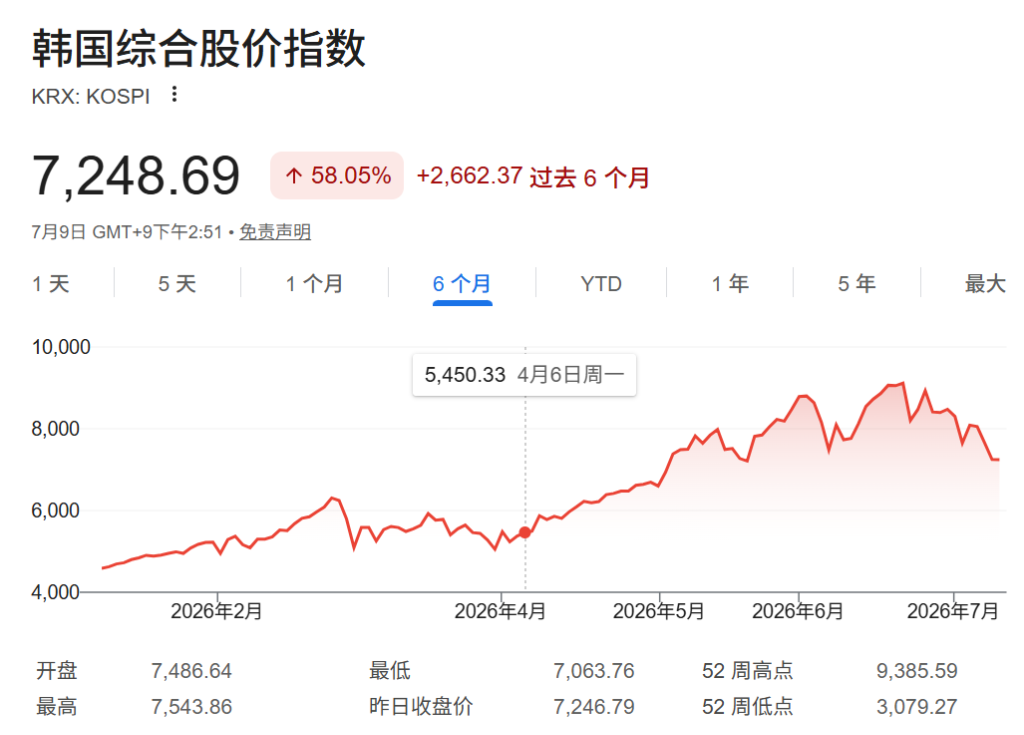
The current macroeconomic background is not optimistic. The KOSPI has fallen over 20% from its June peak, entering a technical bear market. On July 7, the market triggered a pause in programmatic selling and熔断 mechanisms in a single day, with Samsung Electronics and SK Hynix leading the decline. In the first half of the year, foreign capital net sold 148 trillion won in the KOSPI. Against this backdrop, whether the landing of interest rate hikes is a boost to policy signals or an additional pressure on a fragile market is what investors are seeking to answer.
Shin Hyun-sung continuously releases hawkish signals, interest rate hike path gradually clarifies
Since taking office in May, Shin Hyun-sung has repeatedly emphasized the necessity of raising interest rates, with wording becoming progressively clearer. In his speech on the anniversary of the Bank of Korea's establishment on the 12th of last month, he stated, "We should prioritize price stability and expedite interest rate hikes." On the 17th, he reiterated that policies will be actively introduced to stabilize prices.
At the National Assembly's Finance and Economy Planning Committee hearing on the 9th, Shin Hyun-sung cited inflation as the core reason for raising interest rates, specifically pointing out the sources of price pressure — not only the oil price transmission driven by the situation in the Middle East but also the huge performance bonuses from semiconductor companies and the wealth effect brought about by the significant rise in the KOSPI, both of which together lifted consumer demand, with "the inflation rate expected to remain high for a considerable period of time."
The Bank of Korea also stated in its business report submitted to the National Assembly that, "Considering the changes in policy conditions such as excessive inflation, improved growth momentum, and rising financial stability risks, it is necessary to raise the benchmark interest rate at an appropriate time." This is a formal endorsement of the governor's statement from the institutional level of the central bank.
Inflation breaks 3% for two consecutive months, demand-side pressure takes over from supply-side
At the data level, the urgency for interest rate hikes is clear. In June, South Korea's consumer price index rose by 3.2% year-on-year, far exceeding the central bank's target of 2%, with the living price index, reflecting the cost of daily life, rising even higher to 3.4%. In the first two months of this year, the price rise was around 2%, but it broke 3% from May due to the escalating situation in the Middle East, and has since remained high.
Shin Hyun-sung pointed out that inflation in the first half of the year was primarily driven by international oil price transmission, constituting a supply-side shock. However, he particularly emphasized that the driving force of inflation is undergoing a structural transformation — the distribution of huge performance bonuses by large semiconductor companies like Samsung Electronics and SK Hynix and the significant rise in the KOSPI are driving demand-side consumption pressures. This transformation means that even if energy prices decline, the persistence of price pressures will be stronger.
The Bank of Korea predicts that the downward pressure from international oil prices will be offset by expanding demand-side inflation, stating, "The consumer price index will continue to remain high."
Citi expects two interest rate hikes this year, and two more next year
Regarding the outcome of the meeting on the 16th, the market has basically reached a consensus. Citi Group economist Jin-Wook Kim expects the Bank of Korea to raise the benchmark interest rate from 2.50% to 2.75% by 25 basis points at next week's meeting, hinting at a gradual pace of interest rate hikes.
Citi's baseline forecast is: one rate hike in July and October of this year, followed by another two hikes in January and April next year. Jin-Wook Kim indicated that he expects Shin Hyun-sung to suggest a gradual increase of 25 basis points every quarter in the second half of 2026 while maintaining a data-dependent stance for the first half of 2027 without providing specific forward guidance.
Citi also expects that the central bank may emphasize that growth forecasts for 2026 face upward risks, citing an upward revision of GDP for the first quarter and resilient economic activity in the second quarter.
This path indicates that the upcoming interest rate hike is not an isolated event, but the starting point of a multi-step tightening cycle. For the currently pressured stock market, the process of interest rate normalization will constitute a continuous valuation pressure.
Stock market deeply trapped in bear market, triple risks fermenting simultaneously
Before the expectation of interest rate hikes materializes, the South Korean stock market has already experienced a sharp adjustment. The KOSPI has fallen more than 20% from its June peak, entering a technical bear market, triggering sidecar and熔断 mechanisms repeatedly on July 7, and closing at 7246.79 points.
The outflow of foreign capital is the primary source of pressure. In the first half of the year, foreign capital net sold 148 trillion won in the KOSPI, with the last two trading days net selling over 13 trillion won each day, with selling pressure concentrated on Samsung Electronics and SK Hynix. The logic behind foreign capital withdrawal is clear: the KOSPI rose nearly 60% from April to June, while the won depreciated from 1200 to 1566 during the same period, hitting a 16-year low - the exchange losses faced by dollar asset holders upon settlement naturally led to profit-taking pressure.
Leveraged ETFs present a second layer of risk. 14 single-stock leveraged ETFs tracking Samsung Electronics and SK Hynix were launched at the end of May, and on July 7, they all plummeted by 12% to 13%. Among these 14 products, 13 fell below the issuance price of 20,000 won, with the total trading volume of 16 single-stock leveraged and inverse ETFs on that day reaching 13.1 trillion won, accounting for over one-third of the total ETF trading volume in the entire market. As Samsung Electronics and SK Hynix collectively account for over half of the KOSPI's market value, the daily rebalance induced hedging sell-offs from leveraged ETFs created additional selling pressure on the underlying stocks, exacerbating the decline of the overall market.
Concentration risk is a structural hazard specifically pointed out by the Bank of Korea itself. In a written response submitted to the National Assembly, the central bank warned that single-stock leveraged ETFs could lead to excessive fund concentration in a few stocks and exacerbate market volatility through daily rebalancing.
Limited policy space, "semiconductor paradox" remains unresolved
What perplexes the market is the deep divergence between fundamentals and stock prices. Samsung Electronics reported an operating profit of 89.4 trillion won in the second quarter, with semiconductor demand structurally strengthening due to ongoing global AI infrastructure investments. However, the best performance in history coincides with the most intense sell-off in history.
The Bank of Korea has assessed this situation, believing that the semiconductor market is showing a stronger upward trend than past cycles, but simultaneously pointed out that uncertainties in AI profit prospects, actual investment contraction by large technology companies, and energy bottlenecks are all potential risks.
The limitations of policy tools are equally evident. Raising interest rates can help curb inflation and support the won, but for a market already in a technical bear market, rising interest rates will directly suppress valuations. The stock market stabilization fund established by the South Korean government is approximately 10 trillion won, which is dwarfed by the net foreign sell-off of 148 trillion won in the first half of the year.
South Korean Deputy Prime Minister and Minister of Economy and Finance Koo Yoon-chul stated that the government fully understands the concerns about leveraged ETFs exacerbating market volatility, and relevant departments are discussing how to minimize this volatility, but specific measures have yet to be announced. Officials from the Financial Supervisory Service of South Korea also stated that regulators are assessing alternative options, such as tightening product trading requirements, but "any regulatory adjustments need to comprehensively consider the impact on the broader market."
The decision on interest rate hikes on the 16th is already highly probable. The real variable lies in whether, once the tightening cycle begins, the won can stabilize, foreign capital can stop flowing out, and leveraged products can achieve a soft landing — the answers to these three questions will largely determine whether the South Korean stock market can find a foothold out of the bear market.
免责声明:本文章仅代表作者个人观点,不代表本平台的立场和观点。本文章仅供信息分享,不构成对任何人的任何投资建议。用户与作者之间的任何争议,与本平台无关。如网页中刊载的文章或图片涉及侵权,请提供相关的权利证明和身份证明发送邮件到support@aicoin.com,本平台相关工作人员将会进行核查。


