Author: Claude, Deep Tide TechFlow
Deep Tide Introduction: Bank of America cited EPFR data reporting a net outflow of $3.2 billion from global energy funds for the week ending July 1, marking the largest single-week withdrawal since July 2024 and the second largest in at least a decade. The four-week average flipped from a record net inflow of $2.5 billion two months ago to a record net outflow of $1.8 billion. The ceasefire agreement has driven Brent back to around $72, and ExxonMobil has fallen 23% from its peak. The war market has effectively closed, and the bets being made now hinge on whether the ceasefire will hold.
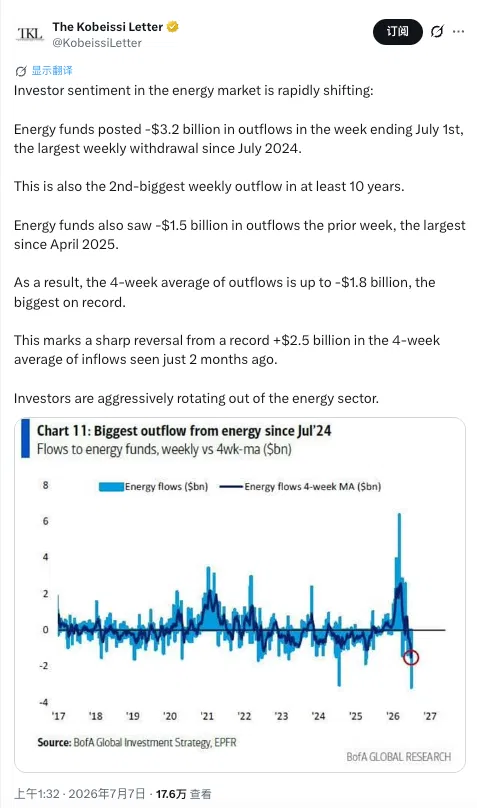
Money that poured into the energy sector during the Iran war is now being withdrawn at a record pace.
According to Bank of America Global Research citing EPFR data, for the week ending July 1, global energy funds saw a net outflow of $3.2 billion, marking the largest single-week withdrawal since July 2024 and the second largest in over a decade. The previous week had already seen an outflow of $1.5 billion. The four-week moving average dropped to negative $1.8 billion, the lowest on record. Just two months ago, this average was positive $2.5 billion, also a historical record. Market tracking account The Kobeissi Letter posted on July 7 that investors are "aggressively withdrawing from the energy sector."
It took just two months to shift from record inflows to record outflows, with the turning point being the ceasefire agreement in mid-June.
Energy leads the decline, but the entire fund flow report indicates a risk aversion
Looking at energy alone would underestimate the information in this report. In the same week, U.S. stock funds saw a net outflow of $17.2 billion, the largest since March 2026; materials funds had outflows of $6.8 billion, also the largest since March; gold funds have seen losses for the seventh consecutive week, creating the longest withdrawal record since March 2024; crypto funds withdrew $2 billion, the largest single-week outflow since November 2025.
Where is the money going? Investment-grade bond funds attracted $17.2 billion in a single week, high-yield bonds saw inflows of $3.4 billion, a new high in over a year, money market funds brought in $55 billion, and bond funds have net inflows for 62 consecutive weeks.
The picture being assembled indicates a comprehensive risk aversion, with energy merely being the hardest hit sector. Some of the selling pressure on energy funds comes from overall risk reduction sell-offs; if risk appetite warms up, part of this money could flow back. Whether the funds betting on oil prices return depends on the supply landscape.
The ceasefire has reverted oil prices to their original state, and Saudi Arabia is still cutting prices to gain market share
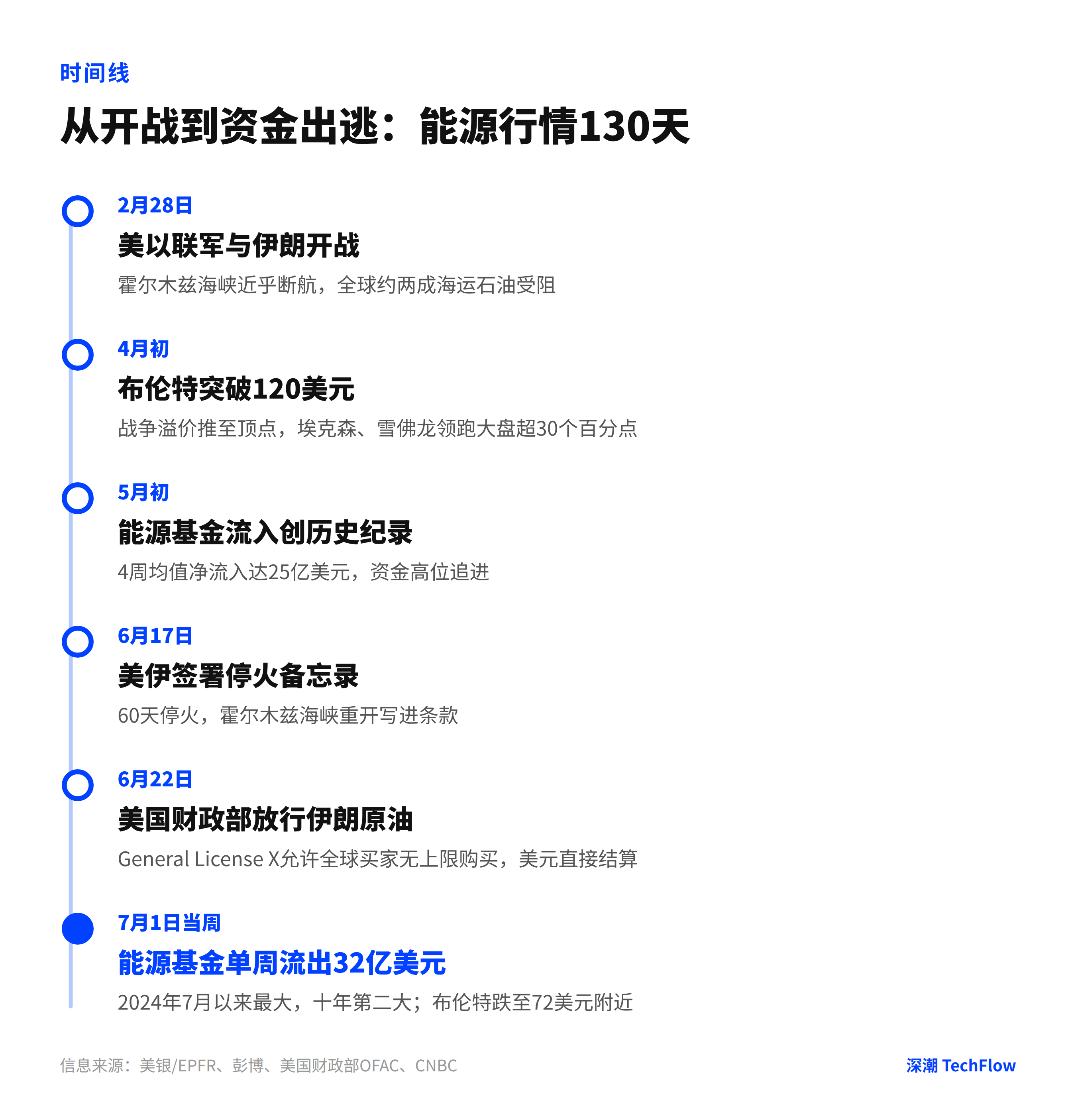
On February 28, U.S. and Israeli forces entered into conflict with Iran, nearly halting shipping in the Strait of Hormuz, and Brent prices once broke above $120. On June 17, a ceasefire memorandum was signed between the U.S. and Iran, reopening the strait as part of the terms. On June 22, the U.S. Treasury released "General License X," allowing global buyers to purchase Iranian crude oil without limits and settle directly in U.S. dollars within 60 days. The two pillars of the war premium, supply disruption and sanctions, were successively lifted within two weeks.
Bad news from the supply side did not stop. According to Bloomberg data, Persian Gulf crude oil exports have returned to 75% of pre-war levels, and Saudi Arabia's Ras Tanura port has resumed loading. OPEC+ has approved an increase in production of 188,000 barrels per day next month, continuing to lift production restrictions. Saudi Aramco has cut the official price of Arab Light crude oil sold to Asia in August by $11, bringing it down to a discount of $1.50 compared to regional benchmarks; the last two times a discount was seen were during the price wars of 2015 and 2020.
As of July 7, Brent hovered between $72 and $73, nearing its lowest point since the end of February, down about 40% from wartime highs. Citigroup has lowered its third-quarter Brent forecast to $75, expecting an average of $65 for 2027. For bulls, there is no catalyst for a rebound on the supply side in the short term; the only variable is the stability of the ceasefire itself.
Exxon falls 23%, the war premium has nearly evaporated in two weeks
The collapse in oil prices has directly hit energy stocks. ExxonMobil has fallen from a high of $176.41 to below $140, a decline of over 23%; Chevron has fallen about 21% from a high of $214.71. In the first quarter, these two stocks led the market by over 30 percentage points, but now most of the gains have been surrendered back. The energy ETF leader XLE topped on May 19 and has given back 12% within a month.
Worse trouble lies ahead. The second-quarter earnings reports, starting at the end of July, face completely different oil price assumptions than two months ago. In the first quarter, Exxon absorbed about $4.6 billion in losses due to derivative timing losses and physical assets losses in the Middle East, while Chevron also had about $2.9 billion in similar projects. If oil prices remain at the current level, some hedging losses may reverse, but revenue will confront the reality of pricing just above $70.
For those still holding on, the main support currently is dividends and buybacks. Exxon has a quarterly dividend of $1.03 and plans to repurchase $20 billion within the year. Chevron has a quarterly dividend of $1.78 and is pushing for $3 to $4 billion in cost reductions. These can cushion the decline but cannot support valuations at the level of war premiums.
Investment banks still predict $90, while the opposing side says the sell-off misfired
Institutional predictions show a clear stratification. Morgan Stanley has set its third-quarter Brent forecast at $90 and $80 for the fourth quarter, while maintaining overweight ratings on Exxon and Chevron. Goldman Sachs cut its fourth-quarter forecast from $90 to $80, expecting an average of $75 for 2027. The EIA predicts prices will fall below $80 in the third quarter, around $70 by year-end. Citigroup is the most pessimistic. A Reuters survey of 33 analysts in June provided a consensus Brent average of $90.44 for 2026, implying that oil prices in the second half of the year should be higher than current levels, directly conflicting with the direction of fund flows.
Another perspective suggests that this round of selling misfired. A 24/7 Wall St. column pointed out that investors pressed the sell button for the entire energy sector, but AI data centers are generating the strongest structural power demand growth in decades. Utilities, nuclear power, and distributed generation companies have been mistakenly grouped with oil stocks and sold off, potentially hiding opportunities within these wrongly punished targets.
Risks are also prominently visible. On July 7, a Qatari LNG transport vessel was hit near Oman's waters, and Brent rebounded to $73 that day. The current ceasefire is merely a 60-day memorandum, and General License X will expire in late August; U.S.-Iran negotiations have repeatedly broken down this year.
Shorting energy profits from peace dividends, betting on the ceasefire holding; those buying the dip are gambling on the opposite. The next three key points to watch are the end-of-July second-quarter earnings reports, the mid-August ceasefire renewal window, and the late-August expiration of GL X.
免责声明:本文章仅代表作者个人观点,不代表本平台的立场和观点。本文章仅供信息分享,不构成对任何人的任何投资建议。用户与作者之间的任何争议,与本平台无关。如网页中刊载的文章或图片涉及侵权,请提供相关的权利证明和身份证明发送邮件到support@aicoin.com,本平台相关工作人员将会进行核查。


