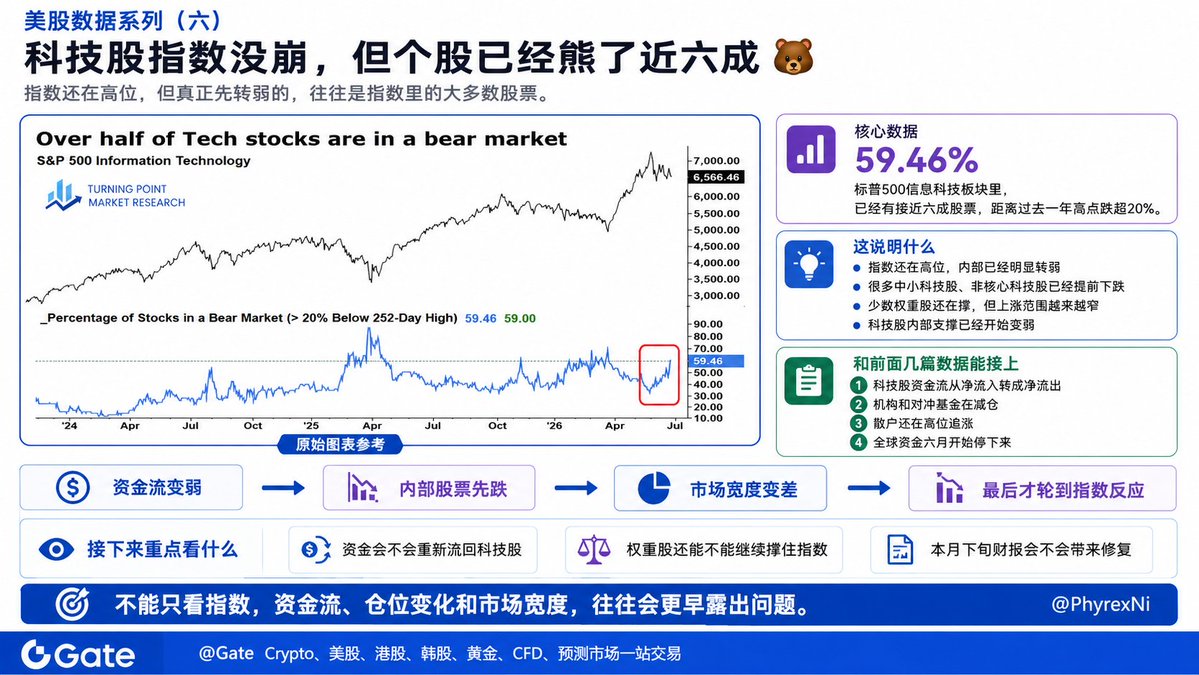
U.S. Stock Data Series (6): The tech stock index hasn't collapsed, but individual stocks have already bear-marketed by nearly sixty percent
In previous articles, I talked about the capital flow in tech stocks, institutional positions, hedge funds reducing positions, retail investors chasing gains, and global capital stagnating since June. Today's data just happens to connect with earlier content.
The latest data shows that in the S&P 500 information technology sector, 59.46% of stocks have fallen more than 20% from their highs over the past year. In simpler terms, the tech stock index still looks high, but nearly sixty percent of the stocks inside have already entered a technical bear market.
This is also what makes U.S. stocks most easily misjudged at present. Many people are focused on the Nasdaq, QQQ, Nvidia, Microsoft, Apple, Broadcom, and other major stocks, thinking that tech stocks are still strong, at most just normal corrections. But if you break down the index, many small and medium tech stocks, non-core tech stocks, and even some stocks that rose with the AI sentiment earlier have already fallen.
The index can still hold up, indicating that a few major stocks are still holding strong, but the breadth of the rise is getting narrower and narrower.
Combining the recent data I released, looking at each data point individually may just show a phenomenon, but viewed together, they represent that the internal support of tech stocks has begun to weaken. Of course, this doesn't mean that U.S. stocks are about to collapse; rather, besides leading tech and semiconductors, most small and medium tech stocks are already unable to withstand the pressure.
This is also closely related to the Federal Reserve's monetary policy. The prosperity of AI is not a banquet for all; after FOMO, only a few can continue to thrive in a high-interest-rate environment, while most might languish for a while, waiting for liquidity to recover.
The focus going forward is whether capital will flow back into tech stocks. If it does, stocks that have fallen will still have a chance to rebound, and the market can take a breath. But if capital continues to flow out, institutions keep reducing positions, and retail investors continue to buy at high levels, the pressure will eventually slowly transfer to the index itself.
This is also what I’ve always said: we cannot just look at the index. The index is the result that is displayed in the end; capital flow, position changes, and market breadth are exposed much earlier. Many risks won’t wait until the day the index crashes to appear; often, there is a significant drop within before the index reacts.
Additionally, major stocks currently appear to be quite strong; leading tech and semiconductors have not completely collapsed, so I personally won't conclude that U.S. stocks are already failing. Next, I will look at capital flow and wait for the earnings reports later this month.
If capital flows back in, the issue may just be an internal correction. If capital continues to flow out, caution is advised, as the index still at high levels may just be supported by a few major stocks.
@Gate Crypto, U.S. stocks, Hong Kong stocks, South Korean stocks, gold, CFDs, one-stop trading for prediction markets
免责声明:本文章仅代表作者个人观点,不代表本平台的立场和观点。本文章仅供信息分享,不构成对任何人的任何投资建议。用户与作者之间的任何争议,与本平台无关。如网页中刊载的文章或图片涉及侵权,请提供相关的权利证明和身份证明发送邮件到support@aicoin.com,本平台相关工作人员将会进行核查。


