Original|Odaily Planet Daily (@OdailyChina)
Author|Wenser(@wenser 2010)
How much can the President of the United States earn in a year?
Before Trump, this figure was usually $400,000, which is the statutory basic annual salary for the president; there is also an additional allowance of $50,000 per year, a $100,000 tax-exempt travel allowance, and a $19,000 entertainment expense subsidy. The surrounding benefits of power also include the presidential motorcade, Marine One helicopter, Air Force One aircraft, and free residence rights in the White House.
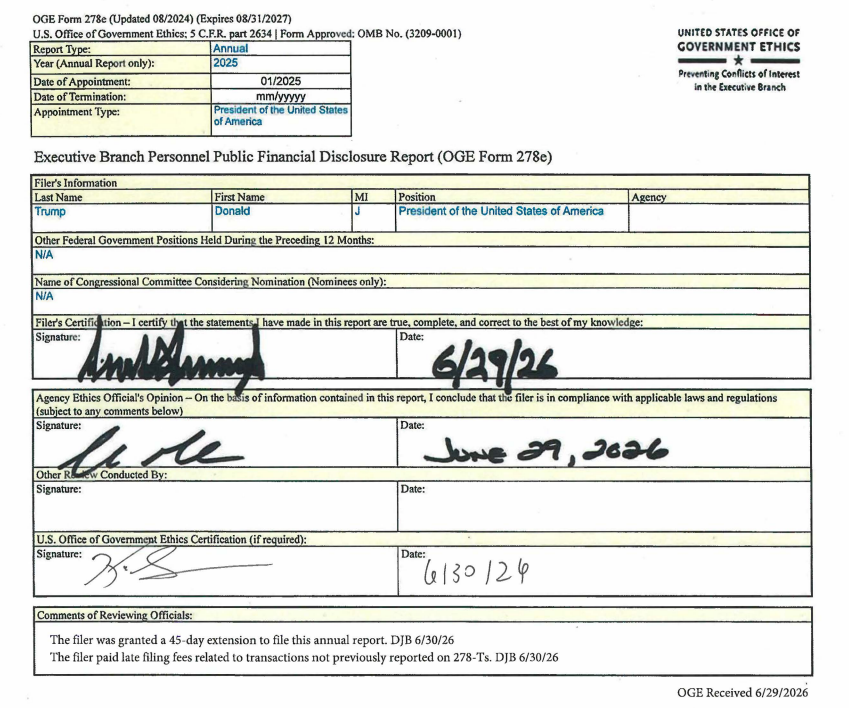
However, "usually" has never been used to describe Trump—recently, according to the annual financial disclosure documents released by the U.S. Office of Government Ethics, Trump's personal income in 2025 exceeded $2.2 billion, setting a record for the highest annual income for a U.S. president during their term.
This 927-page document clearly outlines Trump's business empire centered on power.
Trump's "Monetization Manual": Earning $1.4 billion from cryptocurrency, holding over $100 million in BTC and ETH
For Trump, who has served as President of the United States twice, the $400,000 basic annual salary is long gone; he has refused the presidential salary twice.
He has ventured into the business world leveraging his "brand image" and "family business," finding paths of wealth beyond real estate.
Trump's "Income Curve": Personal wealth multiplied by 2.8 in two years, cryptocurrency becomes a treasure trove
According to Forbes billionaire list data, in 2024, Trump's personal net worth was still $2.3 billion; at that time, his annual income was around $600 million, and he carried substantial debt—one was a $500 million fine owed to New York state for fraud, and another was $88 million owed to "sexual assault case victim" Carroll due to sexual assault scandals and defamation.
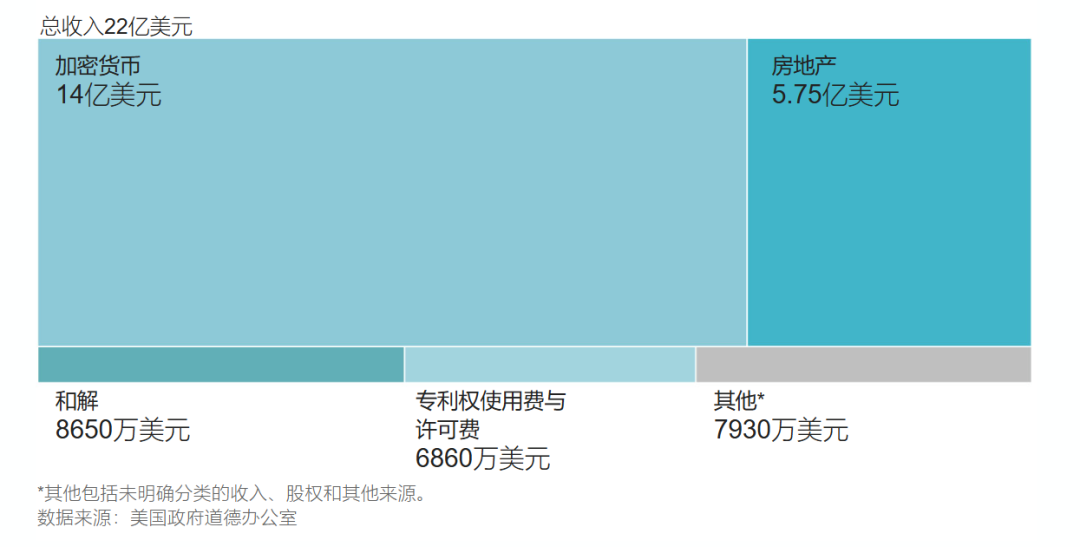
As of 2026, Trump's current personal net worth is $6.5 billion. In 2025, Trump's personal annual income was $2.2 billion, of which "the family's new business" in cryptocurrency generated $1.4 billion, accounting for about 64%; "the family's old business" in real estate earned $575 million, accounting for about 26%; the remaining 10% of income mainly came from lawsuit settlements ($86.5 million), brand licensing fees ($68.6 million), and other income from stock investments ($79.3 million).
Odaily Planet Daily will focus on uncovering the Trump family's "crypto wealth secret" and "Trump-style industrial chain."
Trump's "Crypto Details": I am unaware and didn't avoid it
"Great President, Sir" recently expressed ignorance of his "cryptocurrency earnings" during a media interview, stating: "I have always been making money; I am a businessman and a very good businessman. I earned a considerable amount of money..... I have others manage that money. I have not even spoken to them—I don't even know who they are... My son Eric (Trump's second son) is responsible for this. I have not discussed such matters with him... Not knowing these things is not illegal... There is no law requiring you to avoid every decision that may pertain to you while managing a country. That's simply unrealistic."
For some reason, this Versailles-style bragging of "Huh? I made money again?" coming from Trump is unsurprising.
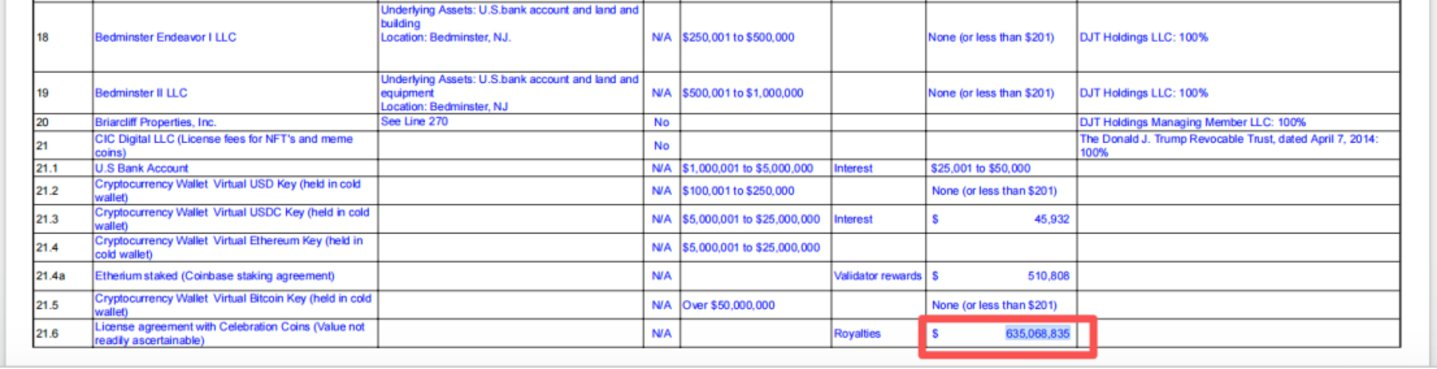
According to the latest personal financial disclosure documents, Trump's personal assets include over $100 million in BTC and ETH, as well as a few altcoins like LINK, AAVE, ENA, MOVE, and ONDO; Trump also earned nearly $800 million from the cryptocurrency project World Liberty Financial co-founded with his son (which includes $527 million from token sales and $263 million from equity transfers, including income from stablecoin company Stablecoin Holdco LLC and WLFI company shares); from the sale of TRUMP Meme Coins, he earned about $635 million, and received over $80 million from a legal settlement with a media company.
Reuters previously estimated that since Trump's return to the presidency in January 2025, the Trump family's crypto business has generated at least $2.3 billion in profits from investors.
What are the sources of income in the cryptocurrency world?
One success requires countless failures; in the cannibalistic cryptocurrency market, every dollar Trump earns is backed by the blood and sacrifices of retail and institutional investors.
Trump's "Personal American Dream": I am a stock market genius
Aside from cryptocurrency, income from the stock market is also a significant aspect of Trump's wealth narrative.
According to financial document information, in 2025, Trump reported over 22,000 stock trades, with an average of 87 trades per day, making him a bona fide "high-frequency trader." As Trump mentioned earlier, the White House's explanation is that "these trades are executed by a professional investment team managing the Trump trust account, not directly handled by Trump himself."
Looking closely at Trump's stock holdings reveals notable points.
- In terms of specific assets, Trump's eight stock accounts hold over 4,000 stocks, predominantly concentrated in major U.S. tech giants like Google (Alphabet), Apple, Broadcom, Meta, Microsoft, NVIDIA, Tesla, Amazon, with holding amounts ranging from $5 million to $25 million. Additionally, index products like the S&P 500 ETF and tech sector ETFs are also included.
- In terms of trading operations, Trump's stock investments are not of a "value investing style," but rather resemble "swing trading." Over the past year, his stock accounts bought and sold Microsoft shares 84 times; Google shares even more frequently, reaching 97 times. Strangely, on August 18 of last year, Trump's stock account almost simultaneously bought the aforementioned eight tech stocks, along with popular targets across several sectors such as Visa, Mastercard, JPMorgan, UnitedHealth, Eli Lilly, spanning payments, technology, investment banking, insurance, and healthcare.
- As for long-held assets, Trump's account bought gold ETFs and silver ETFs five times within a year, but never sold; U.S. treasuries and a Vanguard fund tracking dividend growth are also part of the portfolio.
Let us ponder what transpired in the "over-the-counter world" while these trades occurred.
Last year, Trump's accounts frequently engaged in intensive trading before and after significant U.S. policy announcements: In April of last year, Trump announced tariffs on "Liberation Day" for global trade partners, which triggered a "global tariff war"; U.S.-China tariffs even soared over 100%. At that time, Trump's account executed hundreds of stock trades over consecutive days; shortly after, Trump first staged the "TACO drama," initially stating, "Now is a good time to buy," then announced a delay in imposing tariffs, leading to a substantial rebound in U.S. stocks; furthermore, from late August to October last year, Trump's account bought at least $82 million in corporate bonds and municipal bonds across multiple industries, many of which evidently benefited from U.S. policy adjustments.
Just yesterday, the U.S. launched an attack on Iran again, causing crude oil prices to rise and U.S. stocks to fall; a suspicious address appeared to have invested $21 million betting on "long crude oil, short NASDAQ," generating over $500,000 in unrealized gains, provoking much speculation.
All signs suggest that "TACO" is rife with insider trading and covert collusion.
"TACO" Conspiracy Theory: Insider Trading and Symbolic Gestures
For a long time, the conflicts between Trump's business transactions and U.S. national interests have been a focus of public attention and a core controversy. Several Democratic senators have previously raised objections, calling for measures and investigations by relevant departments, but due to Trump's presidential identity, most controversies ultimately faded away or were temporarily set aside.
But looking back now, many of Trump's irregular actions may actually be profit-driven.
In January 2025, just days before Trump officially took office, an investment company linked to the UAE government acquired 49% of WLFI for $500 million; shortly thereafter, despite strong opposition from some U.S. national security officials, the Trump administration reached a computer chip export agreement with the UAE related to artificial intelligence.
Furthermore, his family business, the Trump Organization, has earned millions to tens of millions of dollars from real estate projects in countries such as Saudi Arabia, Qatar, Romania, and Vietnam; these countries subsequently received concessions in trade, military, and technology from the U.S.
This also involves the Trump family's "real estate business" and brand stronghold built on Trump's powerful celebrity aura.
Brand Value: Named After President Trump
Looking through Trump's personal financial report, one noticeable item includes many companies starting with "DT Marks"—DT Marks Dubai, DT Marks Doha, DT Marks Abu Dhabi, DT Marks Hyderabad, DT Marks Gurugram... It seems that the world's real estate business is related to the Trump family.
However, in reality, these companies are merely "shell companies"—most have no actual assets, and as for "valuation," it is even more difficult to discuss; their only value lies in "bearing the TRUMP name and enjoying Trump's brand premium." In other words, Trump, through "surname authorization," leveraged 20 "DT Marks" affiliated companies, earning nearly $60 million in just one year in 2025, of which DT Marks Dubai generated $10.36 million and DT Marks Abu Dhabi generated $9.24 million.
Unlike Obama, who sells memoirs, gives global speeches, and takes photos with entrepreneurs after leaving office, Trump has long maximized the commercial value of "president" coupled with his surname "Trump."
The Era of Politics and Business and the Mutual Pursuit of the Businessman President
For 250 years, compared to the political power represented by the identity of "President of the United States," the ability of presidents to make money has never attracted widespread attention.
When Biden left office, his net worth was about $10 million; Obama's personal net worth at the end of 2025 was also just under $70 million; the Obama couple's total income in 2013 was only $481,100, which was nearly $130,000 less than 2012 due to "poor book sales," and they had to bear as much as 20.4% in personal income tax.
From Washington to Trump, the 47 presidents have only seen salary increases five times, specifically—$25,000 during Washington's presidency (reportedly donated entirely to the nation); in 1873, former President Grant's salary increased to $50,000; 36 years later, former President Taft's income reached $75,000; in 1949, former President Truman's salary broke $100,000; 20 years later, former President Nixon's salary finally rose to $200,000; in 1999, at Clinton's request, the U.S. presidential salary increased to $400,000, but due to U.S. laws stipulating that "salary increases can only take effect after the next president takes office," Bush ultimately became "the first U.S. president to earn a $400,000 salary."
Now, just in the first year of his second term, Trump has single-handedly raised his annual income to the tens of billions. Clearly, this is not reliant on a fixed salary. Is the era moving forward? Managing national fortunes? Monetizing power? All three are evident. This is the dual vision and grasp set apart by Trump from his predecessors: seeing through the essence of the world's rules and using them to the fullest advantage.
Recommended Reading
United States: Salary only increased once every 45 years
免责声明:本文章仅代表作者个人观点,不代表本平台的立场和观点。本文章仅供信息分享,不构成对任何人的任何投资建议。用户与作者之间的任何争议,与本平台无关。如网页中刊载的文章或图片涉及侵权,请提供相关的权利证明和身份证明发送邮件到support@aicoin.com,本平台相关工作人员将会进行核查。


