Written by: Rita
Trends Guide
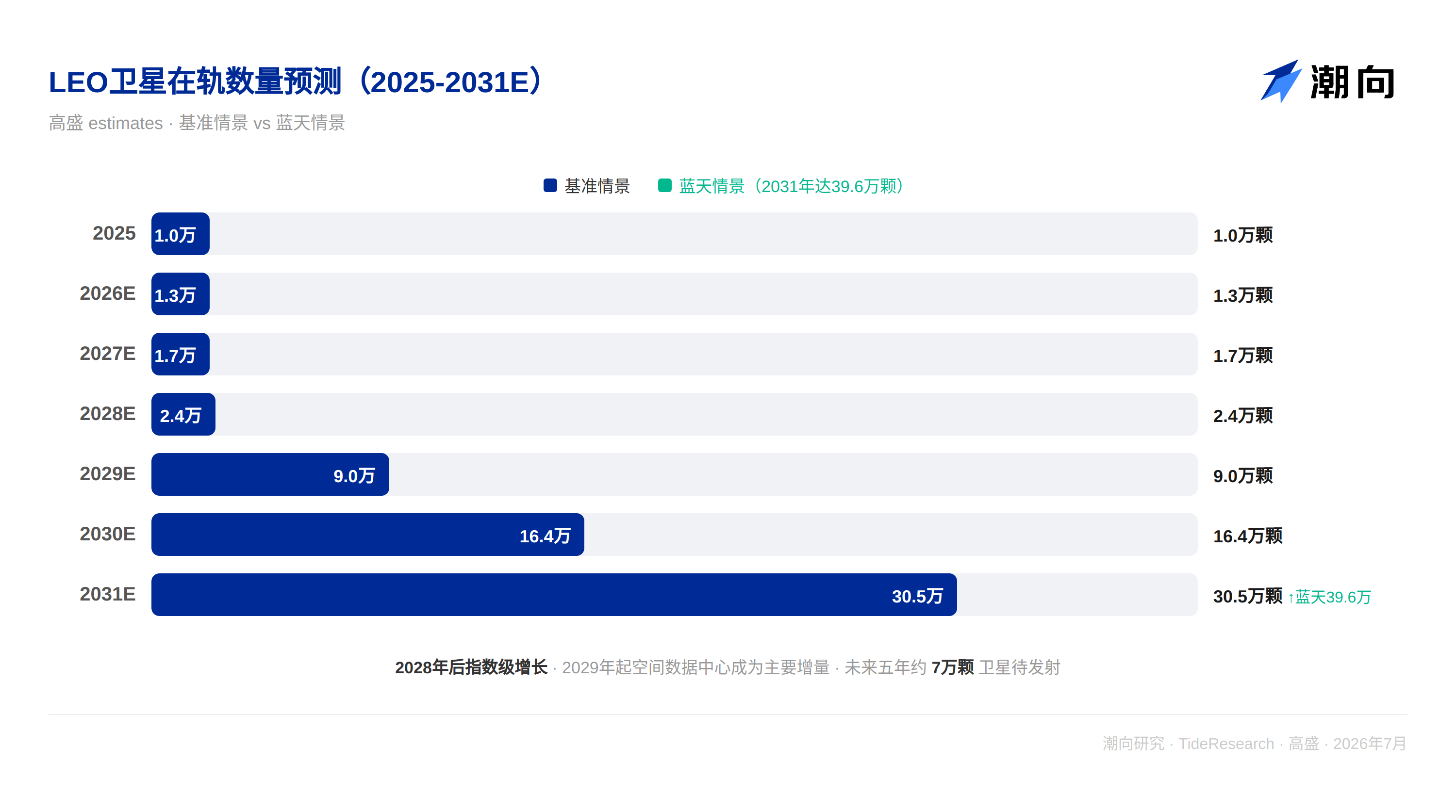
Goldman Sachs updated its global low Earth orbit satellite industry forecast on July 8, indicating that by 2025, the number of LEO satellites in orbit will reach 10,000. Goldman Sachs estimates this will rise to 24,000 by 2028 and surge to 305,000 by 2031, with a potential of reaching 396,000 in a blue sky scenario by 2031. Driving factors include the acceleration of rocket launch frequency, the maturity of reusable technology, and the commercialization of new application scenarios such as space data centers. Global operators like SpaceX and Amazon are accelerating deployment to secure orbital resources. Goldman Sachs believes that LEO satellites are transitioning from "the story of Starlink" into a broader industry opportunity, with around 70,000 satellites to be launched in the next five years.
The Number of Satellites is Growing at an Exponential Rate
Goldman Sachs data shows that by 2025, the number of LEO satellites in orbit will reach approximately 10,000. They are expected to reach 13,000 in 2026 and 17,000 in 2027. The true breakout point will be after 2028, with Goldman Sachs predicting 24,000 by 2028 and 305,000 by 2031.
In Goldman Sachs' blue sky scenario, the number of LEO satellites in orbit by 2031 could reach 396,000, which is about 90,000 more than the baseline scenario. The core assumption is that China’s large-scale deployment will be realized. China has submitted applications for over 200,000 mid-to-low Earth orbit satellites to the International Telecommunication Union. Although the technical feasibility is yet to be validated, Goldman Sachs believes that new application scenarios like space data centers could accelerate the commercialization process.
From the application perspective, almost all LEO satellites will be used for satellite internet before 2028. Starting in 2029, space data centers will become the main source of incremental growth, with Goldman Sachs estimating that by 2031, space data centers will account for 79% of the total number of LEO satellites, while satellite internet's share will drop to 21%.
Rockets: The Key Bottleneck for Accelerated Deployment
Goldman Sachs identifies three driving factors. The first is the accelerated launch frequency. By 2025, Starlink will launch every three days; in April 2026, SpaceX completed two launches in 19 hours, indicating there is still room for efficiency improvement.
The second is the increase in rocket payload capacity. The current mainstream reusable rockets have a LEO carrying capacity of about 17.5 tons, while the next-generation rockets could reach 100 to 150 tons.
The third is breakthroughs in reusable technology. For China's LEO satellites, domestic successful development of reusable rockets will significantly accelerate deployment. In February 2026, Long March 10 successfully completed the first-stage soft landing test at sea; Blue Arrow Aerospace and Interstellar Glory also plan to conduct their first launches in 2026. The effect of reusable rockets on reducing launch costs is exponential; once the launch cost per kilogram drops sufficiently low, the business model for satellite constellations will shift from "burning money" to "printing money."
Global Operators Competing: SpaceX, Amazon, and China Satellite Network
SpaceX's Starlink holds an absolute leading position, launching satellites on average every three days by 2025. Goldman Sachs has initiated coverage on SpaceX, giving it a buy rating and a target price of $205. Among the U.S. stocks covered by Goldman Sachs, Amazon’s Project Leo is catching up; the FCC approved its additional deployment of 4,500 satellites in February 2026, planning for a total of about 7,700 satellites, with over 20 launches planned in 2026. Boeing is also positioned in the LEO satellite manufacturing and launch services sector. Kratos focuses on satellite ground systems and space defense solutions. Eutelsat's OneWeb is also advancing its LEO constellation upgrade.
In China, the GW constellation plans 12,992 satellites, G60 (SpaceSail) plans 15,000 satellites, and the Honghu constellation plans 10,000 satellites. China has submitted a frequency application to the ITU for over 200,000 satellites, essentially strategically positioning itself for orbital resources.
Supply Chain Opportunities: U.S. Stocks, A Shares, and Hong Kong Stocks All Benefit
Goldman Sachs believes that the global LEO satellite supply chain is encountering a historic opportunity.
Regarding U.S. stocks, Goldman Sachs covers SpaceX as a core beneficiary of the launch side, with Starlink deployment being its largest source of internal demand. Amazon’s Project Leo creates a complete closed loop from user terminals to cloud services. Boeing and Kratos benefit in the satellite manufacturing and ground system segments respectively. These stocks cover the entire chain from launch to satellite manufacturing to ground terminals.
In the A-share market, Tongyu Communication receives a buy rating with a target price of 79 yuan, covering the demand for ground equipment of China's three major low Earth orbit satellite constellations.
In the Hong Kong stock market, ZTE Corporation is a key supplier of ground equipment for LEO satellites, benefiting from the continued advancement of China’s satellite internet networking.
Goldman Sachs believes that from RF chips, phased array antennas, to space-grade materials, the Asian supply chain is supporting the global satellite deployment hardware base, yet is valued at a 60% discount compared to global peers. With 70,000 satellites expected to be launched in the next five years, the manufacturing industry has entered a capacity expansion cycle for deliveries.
Trends Perspective
The core logic of Goldman Sachs' report is that LEO satellites are transitioning from "the story of Starlink" to "the story of the entire industry." In 2025, over 4,400 satellites will be launched globally, representing a year-on-year increase of 65%. Approximately 70,000 satellites are expected to be launched in the next five years. This scale means that every segment, including satellite manufacturing, rocket launches, ground terminals, and chip devices, will see continuous order-driven growth.
For investors, the core characteristics of this track are "long cycle, high barrier, strong certainty." A 14-year deployment cycle means it is not a short-term topic. The licenses for satellite operators are limited, and capital requirements are extremely high, making the industry landscape relatively stable. Iterations in technology such as reusable rockets are continually reducing entry costs, expanding the profit margins of the entire industry.
In U.S. stocks, focus on SpaceX and Amazon; in A-shares, pay attention to Tongyu Communication; in Hong Kong stocks, focus on ZTE Corporation. These stocks cover the three segments of launching, operating, and ground equipment, making them core beneficiaries of China's and the global LEO satellite deployment.

Disclaimer
This article is a compilation and interpretation of third-party brokerage research reports (Goldman Sachs, July 8, 2026) by Trends Research. The ratings, target prices, profit forecasts, and related judgments quoted in the article are solely the views of the brokerage analysts and represent the position of their respective institutions, not the views of Trends Research, nor do they constitute any investment advice.
The market has risks, and decisions should be made independently. This article should not be used as a basis for buying or selling any securities.
免责声明:本文章仅代表作者个人观点,不代表本平台的立场和观点。本文章仅供信息分享,不构成对任何人的任何投资建议。用户与作者之间的任何争议,与本平台无关。如网页中刊载的文章或图片涉及侵权,请提供相关的权利证明和身份证明发送邮件到support@aicoin.com,本平台相关工作人员将会进行核查。


