The Federal Reserve Chairman Kevin Walsh did not announce an interest rate cut, and when discussing inflation, he stated that inflation expectations and inflation risks have receded in recent weeks. He also reiterated that the Federal Reserve will stick to the 2% inflation target.
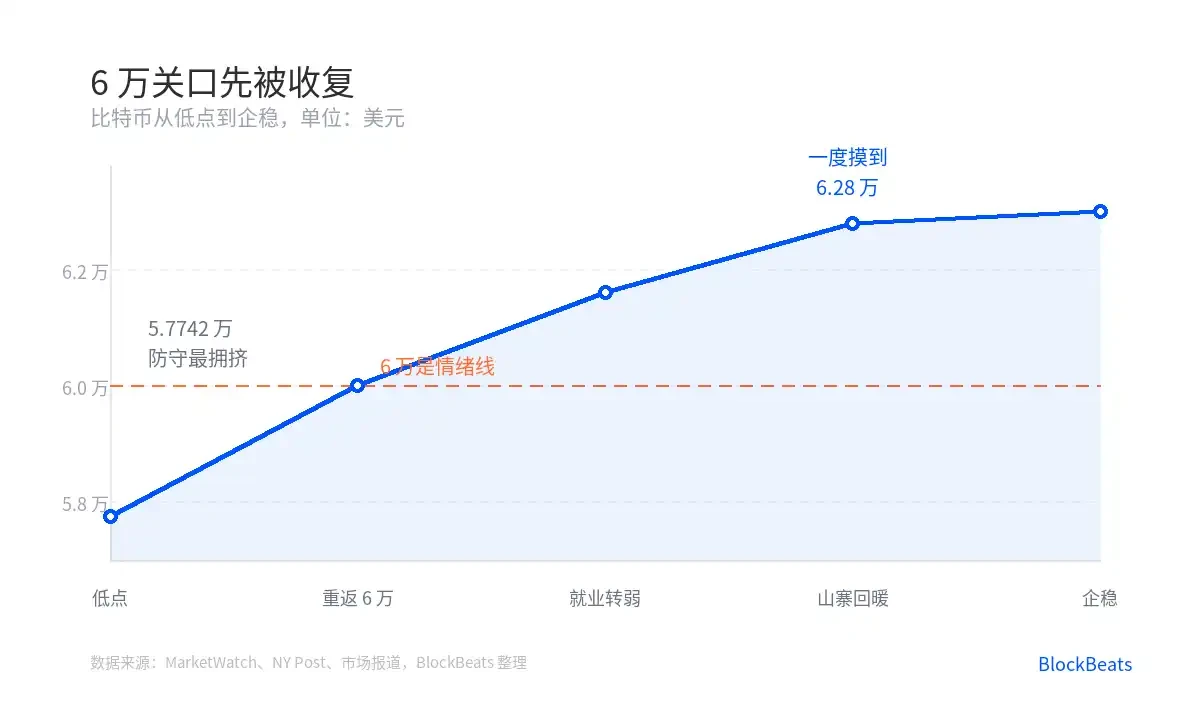
The latter part of the sentence is not dovish, but the market initially focused on the former. Bitcoin quickly rebounded from a low and approached $60,000 again. Subsequently, U.S. employment data weakened, expectations for interest rate hikes continued to cool off, and the market transitioned from "repairing" to "relay."
In recent weeks, what the market feared most was that the Federal Reserve would continue to keep interest rates high or even raise tightening expectations again. For Bitcoin, the harder the interest rate expectations, the narrower the valuation space for risk assets, and the easier it is for leveraged positions to be forced out first.
After Walsh downplayed inflation risks, the market first repriced the "interest rate pressure." After the employment data weakened, this direction was pushed further. Bitcoin returned from around $57,742 to above $60,000, with the price movement appearing quick, essentially reflecting the market pulling back the previous round of panic trading.
On Deribit, traders concentrated on buying $50,000 put options. The open interest in gold perpetual futures hit a new high. A death cross appeared in the technical indicators. Several signals stacked together indicate that the market is insuring against a decline.
This is different from a normal pullback. In a normal pullback, sellers just want to exit. In a panic defense, traders will simultaneously buy puts, buy safe-haven assets, and reduce leverage. When prices hit key points, liquidations will amplify volatility.
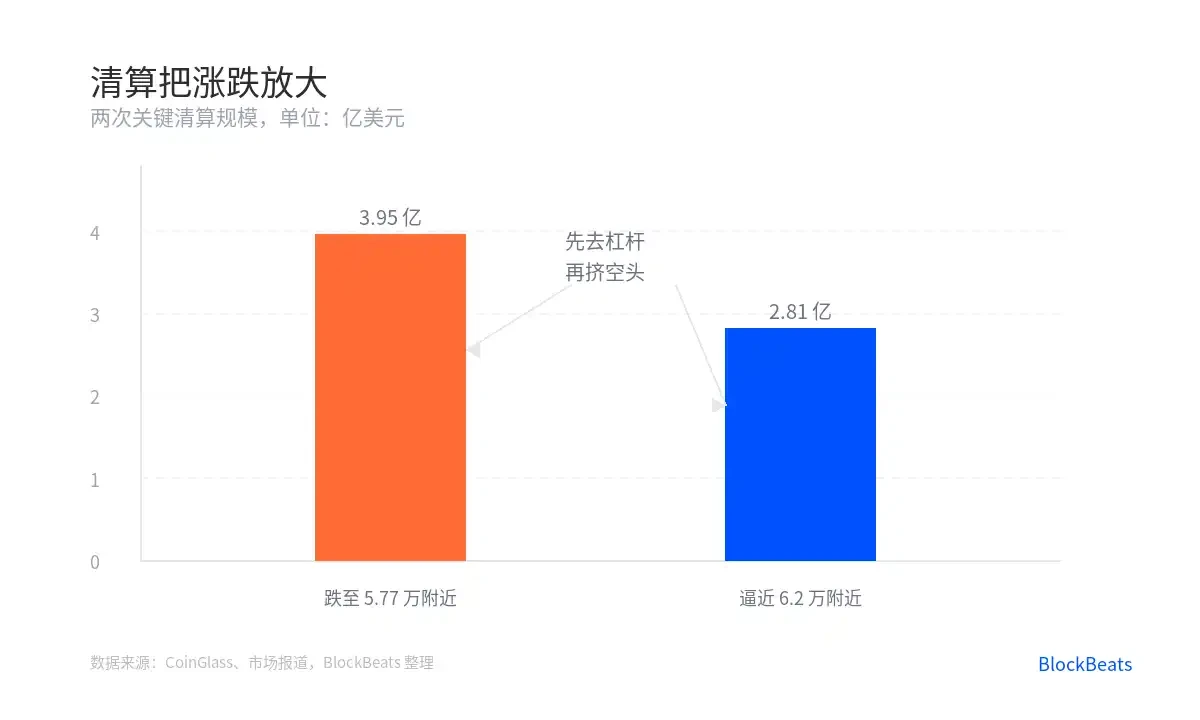
CoinGlass data shows that when Bitcoin fell to around $57,700, about $395 million was liquidated. This figure indicates that the price drop is no longer just driven by sell orders, but by forced exits of leveraged positions.
After the forced exits, the market is actually more likely to rebound.
The reason is straightforward. The previous round of declines cleared some long leverage and pushed defensive sentiment to a high level. When macro news marginally turns loose, prices only need to return to key thresholds to make bears start to feel nervous. Short covering essentially means buying. The higher the price goes, the more it forces more short positions to retreat.
This is the second layer of thrust. When Ethereum and Solana lead, Bitcoin briefly approached $62,000, and about $281 million in bearish bets were liquidated.
Therefore, this round of rebounds cannot be attributed solely to Walsh's statement. A more accurate breakdown is in three segments.
The first segment is that inflation risks are downplayed, easing market concerns about the Federal Reserve's path. The second segment is that employment data weakens, continuing to press down interest rate hike expectations. The third segment is that bearish positions are forced to cover, pushing spot prices up faster.
If you only look at the first segment, the market can easily be interpreted as "macro favorable." If you only look at the third segment, it may mistakenly be thought of as purely a technical rebound. The real structure lies in both occurring within the same timeframe. The macro provided a reason for prices to rise, and positions provided the speed for prices to rise.
The reaction of altcoins also indicates that this is not just a single cryptocurrency market.
After Bitcoin stood back above $60,000, Ethereum, Solana, and Dogecoin rose simultaneously. Subsequently, Ethereum led among major cryptocurrencies, with an approximate increase of 12% in the past week. As capital began to spill from Bitcoin into Ethereum and Solana, the market's trading became no longer just about "whether Bitcoin can hold."
CoinMarketCap's altcoin season index rose to 52/100, the highest in three months. This position is delicate. It has just crossed the midpoint, indicating that risk appetite has indeed returned, but it has not yet reached the stage of full altcoin frenzy.
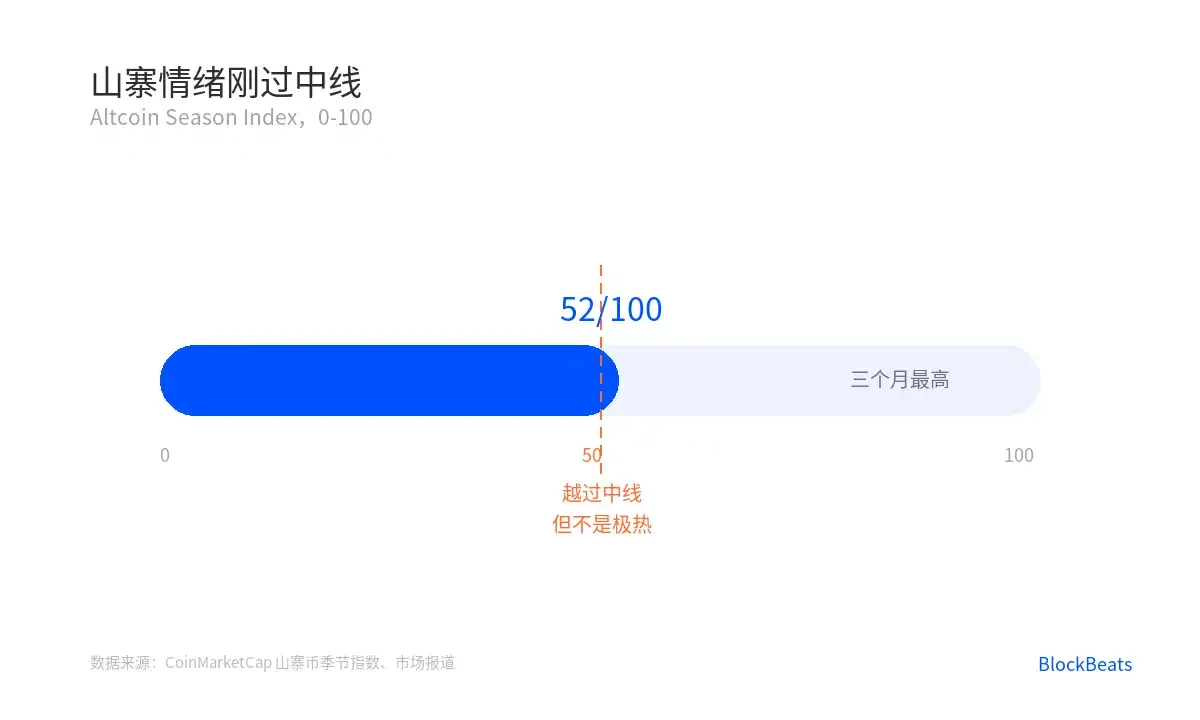
This is also the first thing that needs attention. The warming altcoin sentiment does not mean that the altcoin season has been confirmed.
The true altcoin season usually requires broader capital diffusion. Right now, it resembles a situation where the market bought back liquid large-cap tokens after Bitcoin stopped declining. Ethereum and Solana managed to rise, while some smaller coins remain weak; this differentiation itself is a signal.
The second thing is that the options market does not fully believe in the rebound.
The put-call skew for BTC and ETH still shows that traders are willing to pay a higher price for protection against declines. Prices have already rebounded, but insurance is not cheap. This detail is colder than the spot prices.
If traders truly believe that the trend has turned, the premiums on put options typically fall back faster. The current state resembles a scenario where the spot market has pulled prices back, but the derivatives market has not yet put away the umbrella.
The third thing is that short squeezes cannot extend indefinitely.
Short covering will bring buying pressure, but this buying pressure is one-time. It can push prices out of a congested low, but cannot solely support an entire trend. Once liquidations are finished, the market will need new spot buying pressure to sustain the move.
Therefore, what to watch next is not whether Bitcoin stood above a particular round number, but who is still buying after crossing it. The liquidity of spot ETFs, stablecoins, and the intensity of follow-up gains for Ethereum and Solana will convey more information than the single-day price increase.
The fourth thing is that macro variables remain the same knife.
This round of increases has benefited from falling inflation risks and weakening employment. On the flip side, if subsequent data points to inflation stickiness again, or if the Federal Reserve's language turns hawkish again, the market will also reverse price using the same logic. Bitcoin is not an asset detached from the macro; it simply reacts faster to changes in macro expectations.
Prices have bounced back from excessive defense, but true confirmation will wait for the options market to be willing to take off the insurance.
免责声明:本文章仅代表作者个人观点,不代表本平台的立场和观点。本文章仅供信息分享,不构成对任何人的任何投资建议。用户与作者之间的任何争议,与本平台无关。如网页中刊载的文章或图片涉及侵权,请提供相关的权利证明和身份证明发送邮件到support@aicoin.com,本平台相关工作人员将会进行核查。


