Key Takeaways
- Vitalik Buterin’s Lean Ethereum roadmap, posted over the weekend, targets a 3-4 year rebuild with quantum resistance as a top priority.
- The plan swaps transaction re-execution for STARK-based proofs and aims for one- or two-round finality.
- A July 6 follow-up adds daily validator re-anonymization, while critics question the multi-year timeline.
Buterin published the roadmap on X recently, days after Ethereum researchers gathered in Berlin to hash out the protocol’s long-term direction. He noted that ‘Lean Ethereum’ is the third major iteration of the network, following the original proof-of-work chain and the 2022 Merge to proof-of- stake, and said almost every major piece of the protocol will be replaced during the phased rollout. Buterin added:
“Privacy is no longer an afterthought; it is a first-class goal. When designing Frames, the mempool, additions to the state tree, we explicitly ask the question “okay, how do quantum-safe, intermediary-free privacy protocol transactions go through this, and what is the overhead?”
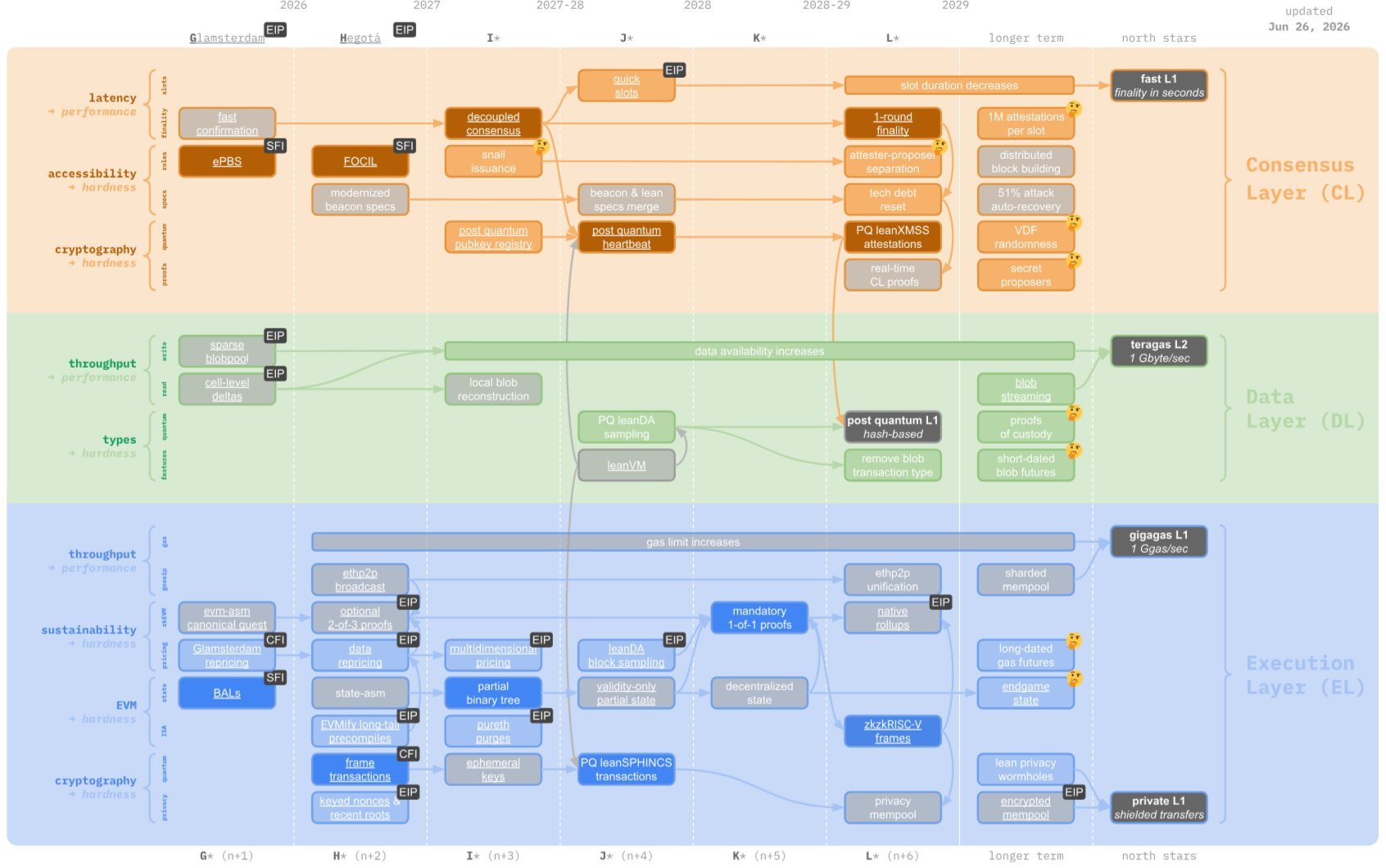
Vitalik’s suggested roadmap to rebuild Ethereum over the next 36-48 months.
The roadmap touches nearly every layer of the stack. Direct transaction re-execution, the way nodes currently verify the chain, would give way to recursive verification built on scalable transparent arguments of knowledge (STARKs), a form of cryptographic proof that lets computers check computations without redoing them. The consensus mechanism would be reworked toward one- or two-round finality, and gas pricing would become multidimensional, charging separately for different kinds of network resources.
Buterin also floated moving the execution environment beyond the Ethereum Virtual Machine ( EVM) to alternatives such as RISC-V or a purpose-built leanISA, alongside a migration to new state architectures. By 2030, he envisions the network holding roughly 2 terabytes of dynamic state plus around 100 terabytes in a newer, more scalable design, with migration to the new structures optional but financially incentivized.
Quantum resistance has moved sharply up the priority list. Buterin noted that work on quantum-safe blob designs has already run for several months, and the roadmap targets every quantum-vulnerable component for eventual replacement. Rather than treating privacy as an application-layer add-on, future upgrades will be judged on whether they support quantum-safe, intermediary-free privacy at the protocol level.
In a follow-up post, Buterin outlined a path to make the lean consensus chain “aggressively more lean” while adding strong validator privacy.
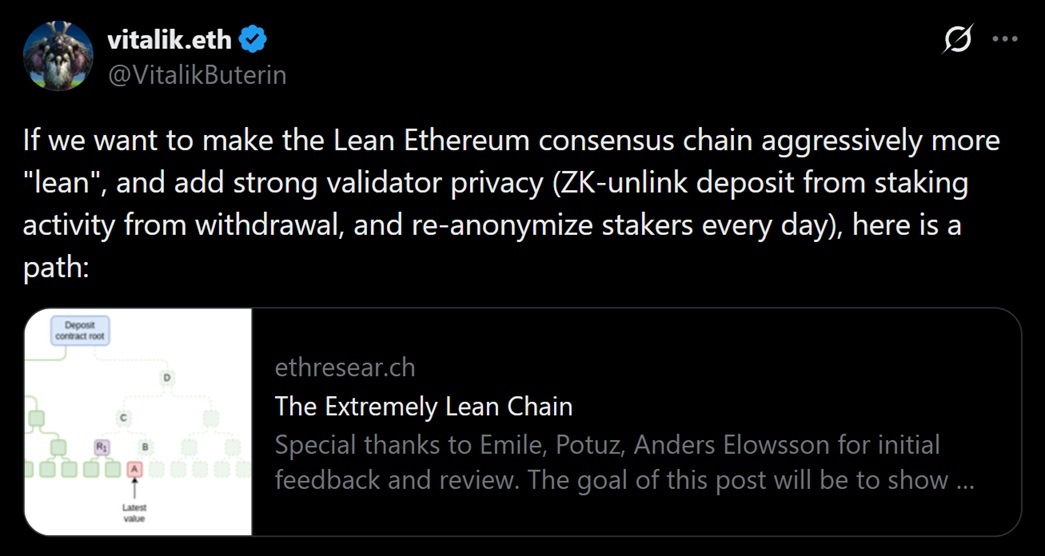
Image source: X
The design would use zero-knowledge (ZK) proofs to unlink a validator’s deposit from its staking activity and withdrawals, and would re-anonymize stakers every day. The proposal builds on privacy work the desk has covered this year, from Buterin’s push to end the network’s relay dependence ahead of the Hegota upgrade to his endorsement of per-dapp addresses in the Kohaku wallet.
The rebuild lands at a lean moment for Ethereum itself. The Ethereum Foundation said on June 22 it would cut its budget by 40% and its staff by roughly 20%, eliminating 54 roles. ETH changed hands near $1,760 when the roadmap was published, down more than 60% from its August 2025 peak near $4,954.
The plan has also drawn pushback, with critics questioning whether a three-to-four-year window is realistic for replacing consensus, execution, and state layers at once, pointing to Ethereum’s history of slipped deadlines.
免责声明:本文章仅代表作者个人观点,不代表本平台的立场和观点。本文章仅供信息分享,不构成对任何人的任何投资建议。用户与作者之间的任何争议,与本平台无关。如网页中刊载的文章或图片涉及侵权,请提供相关的权利证明和身份证明发送邮件到support@aicoin.com,本平台相关工作人员将会进行核查。


