What is volatility decay, and why do leveraged ETFs experience higher decay?
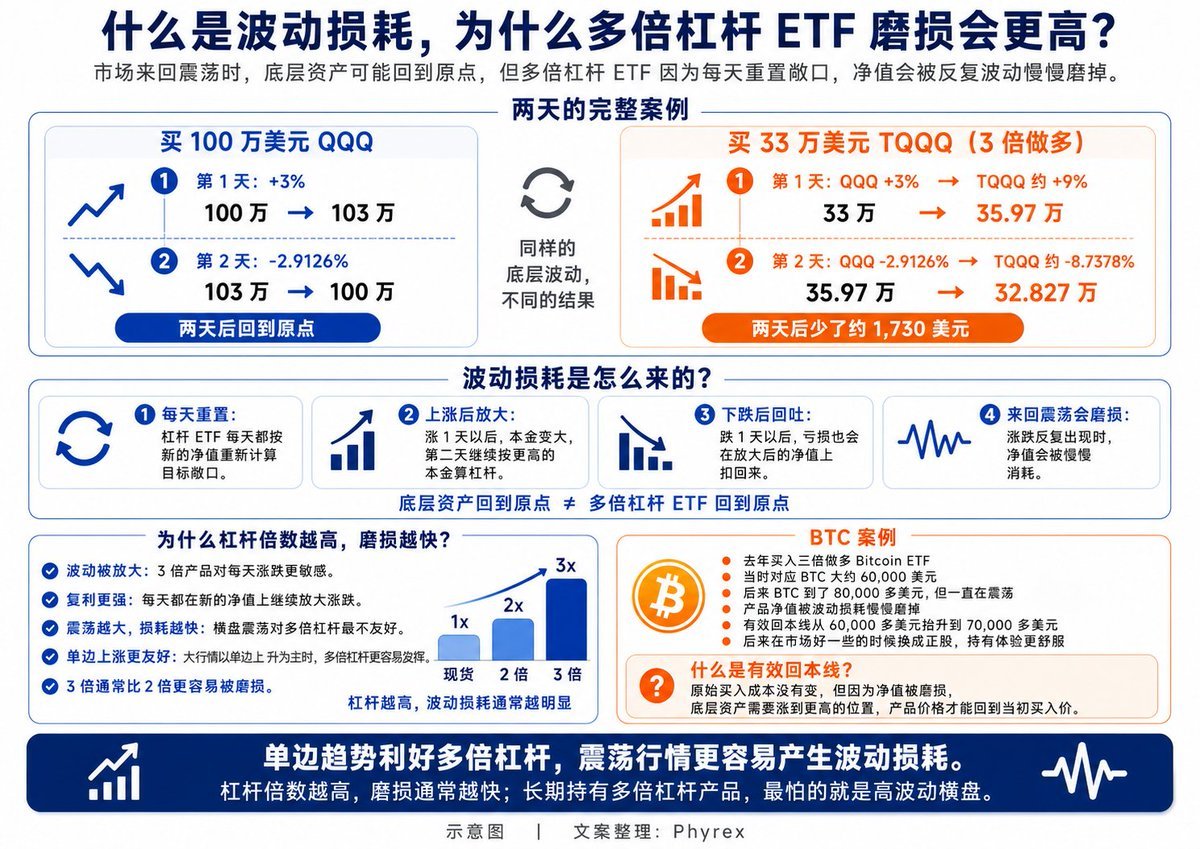
In simple terms, volatility decay means that after the market oscillates back and forth, the underlying index may return to its original point, but leveraged ETFs, because they must recalculate their multiples based on new net values every day, will slowly lose value due to the oscillation.
Take the recently popular $TQQQ as an example. If $QQQ rises 3% on the first day and drops 2.9126% on the second day, the two days combined just return to the original point. Buying $1 million of QQQ, after two days it remains $1 million.
However, TQQQ tracks 3 times the daily price movements of QQQ. On the first day, QQQ rises 3%, TQQQ rises approximately 9%. On the second day, when QQQ falls 2.9126%, TQQQ falls approximately 8.7378%.
If you buy $330,000 of TQQQ, it rises to $359,700 on the first day, but after falling on the second day, it is left with about $328,270.
While QQQ returns to its original point, TQQQ has lost about $1,730, and this part constitutes volatility decay.
When the market is consistently rising, TQQQ performs robustly because each day's rise is magnified by a larger principal. In a market with back-and-forth oscillation, every drop will also deduct from the amplified net value, and after several repetitions, even if the underlying index hardly moves, the net value of the leveraged ETF will have worn down.
Therefore, when purchasing leveraged U.S. stocks, like TQQQ, it is best to consider that the major trend is predominantly bullish to achieve maximum returns. However, if the market is primarily oscillating, not to mention declining, it could lead to significant discomfort.
It is difficult to describe such leveraged ETFs as "good" or "bad"; it largely depends on the user's understanding of the market. If one believes that the majority of current situations are characterized by single-direction increases, the returns from leveraged ETFs will be better. As I write this, I recall that some friends might ask about the distinction between leveraged ETFs and contracts; I will write about that later.
I actually did not know about this matter before; coincidentally, my neighbor Kan Ge @tktang88 bought a three-times long Bitcoin ETF last year. At that time, his purchase price was around $60,000. Back then, Bitcoin had already reached over $80,000 but was just oscillating, which made him quite uncomfortable. It was only after he explained to me what volatility decay is that I remembered it.
A key point he mentioned was that his cost (the technical term is "effective break-even line") had increased from over $60,000 to over $70,000, which was due to volatility decay. Later, he waited for the market to improve a bit and directly switched to the underlying stock, which made him feel more comfortable.
@Gate Crypto, U.S. stocks, Hong Kong stocks, South Korean stocks, gold, CFD, one-stop trading in the prediction market
免责声明:本文章仅代表作者个人观点,不代表本平台的立场和观点。本文章仅供信息分享,不构成对任何人的任何投资建议。用户与作者之间的任何争议,与本平台无关。如网页中刊载的文章或图片涉及侵权,请提供相关的权利证明和身份证明发送邮件到support@aicoin.com,本平台相关工作人员将会进行核查。


