Key Takeaways:
- M2 rose $247.8 billion in May 2026 to $23.05 trillion, up $623 billion since January, FRED data shows.
- The Mises Institute says 2026 money-supply growth hit a multi-year high as the Fed “pumps new QE.”
- WGC data shows central banks added 41 tonnes of gold in May as debasement hedges gain favor.
The Federal Reserve’s H.6 money stock release, published yesterday, put seasonally adjusted M2 at $23,052.3 billion for May, up from $22,804.5 billion in April (a one-month jump of $247.8 billion). M2 is the broadest commonly cited measure of U.S. money, covering cash, checking deposits, savings deposits and retail money market funds.
The gauge has now risen every month this year, climbing from $22,429.3 billion in January, an expansion of roughly $623 billion in four months. For scale, that four-month increase alone approaches the annual economic output of a mid-sized European country.
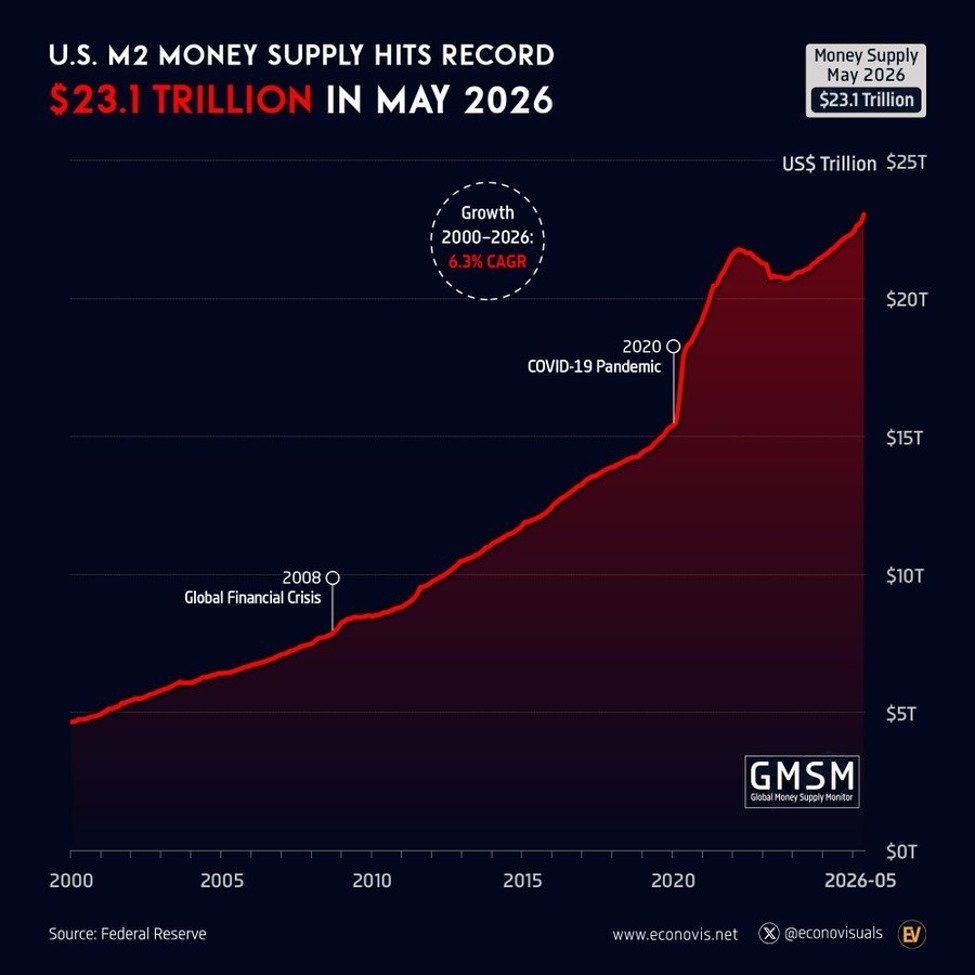
Chart showing US M2 money supply hitting a record $23.1 trillion, up $698.6 billion since January, per Fed data
The milestone has sharpened a debate about what the growth means, given that the Mises Institute (an Austrian-economics think tank and longtime Fed critic) recently wrote that money-supply growth in 2026 has risen to a multi-year high as the central bank “pumps new QE,” a reference to quantitative easing (QE), which is the practice of expanding the Fed’s balance sheet by purchasing securities.
The Fed itself publishes the figures without commentary, and mainstream economists note that money supply normally grows alongside the economy. M2 spent 2022 and 2023 contracting, the sharpest decline since the Great Depression era, before resuming growth. Consequently, part of the current climb represents a return to trend rather than pure stimulus. The pace of that climb, however, is what has hard-money advocates on alert.
For bitcoin investors, the $23 trillion print is less a data point than a thesis since the leading cryptocurrency’s supply is capped at 21 million coins, and its most durable investment narrative (à la protection against currency debasement) strengthens each time the money stock sets a record. Many analysts argue bitcoin’s multi-year cycles have historically tracked global liquidity expansions, though past correlation offers no guarantee of repetition.
Central banks themselves are behaving like debasement hedgers. The World Gold Council reported official institutions added a net 41 tonnes of gold in May, extending a four-year streak of roughly 1,000 tonnes in annual purchases, with a record 45% of reserve managers planning further buying.
Image source: World Gold Council
Devere Group chief executive Nigel Green has argued the resulting gold rally has sparked fresh doubts about the Federal Reserve’s next move, telling investors the metal’s strength signals fading confidence in fiat stability. Moreover, the infrastructure around hard assets is expanding in step, with Coinbase now offering 24/7 U.S. trading in gold and silver futures, a product decision that reflects how demand for inflation hedges has migrated onto crypto-native platforms.
The next H.6 release, covering June, is set to arrive in late July and will show whether the streak of monthly increases extends to six. Markets are also watching the Fed’s policy path, as softer U.S. labor data has strengthened bets on easier policy into the fall, which would likely accelerate money growth further.
免责声明:本文章仅代表作者个人观点,不代表本平台的立场和观点。本文章仅供信息分享,不构成对任何人的任何投资建议。用户与作者之间的任何争议,与本平台无关。如网页中刊载的文章或图片涉及侵权,请提供相关的权利证明和身份证明发送邮件到support@aicoin.com,本平台相关工作人员将会进行核查。


