Key Takeaways:
- Jon Atack warns traders to avoid bitcoin transfers in August 2026 near block 961,632.
- BIP-110 miner signaling sits at just 0.79% as of July 1, 2026.
- Luke Dashjr says upgraded nodes face no reorg risk once BIP-110 locks in.
Atack posted the warning on X on June 29, 2026. He said he plans to run both a custom version of Bitcoin Core and Bitcoin Knots 110 side by side to watch how the network behaves before the rules take effect.
BIP-110 is a temporary soft fork proposal aimed at what promoters call “spam.” It limits arbitrary data in transactions, including large OP_RETURN outputs and inscriptions.
New outputs would be capped at 34 bytes, with OP_RETURN allowed up to 83 bytes. Data pushes and witness elements would be capped at 256 bytes. UTXOs created before activation stay exempt, and the rule expires automatically after roughly a year.
Mandatory signaling begins around block 961,632, projected for early August 2026. As of July 2, signaling sits at about 0.76% in the current difficulty period. Knots-based nodes make up an estimated 8% to 22% of the network, depending on the metric used, but miner hashpower backing the change has remained extremely thin.
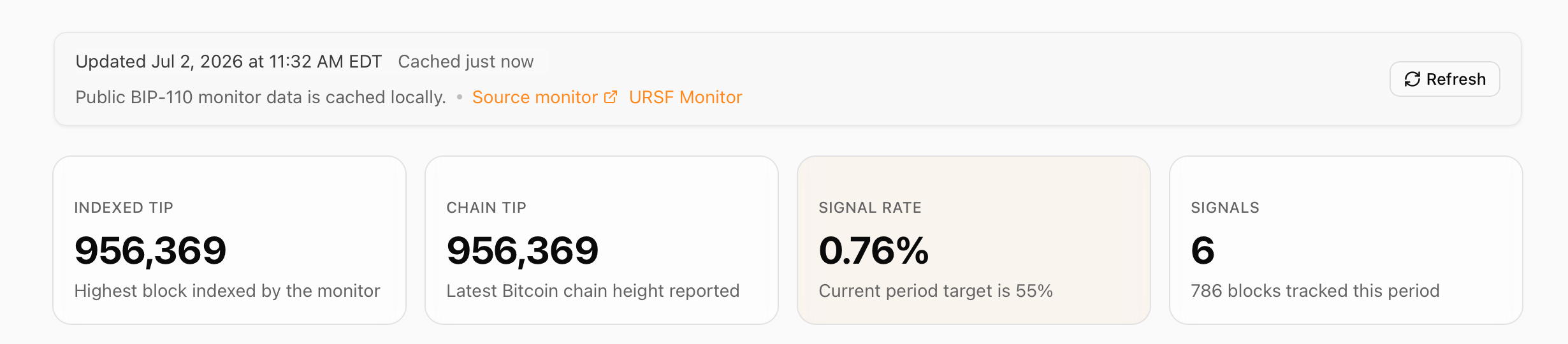
Image source: bip110.org/monitor
Bitcoin’s block height sits in the mid-956,000s as of July 2, putting the mandatory window roughly 5,000 blocks away.
Because BIP-110 enforcement runs through nodes rather than miners alone, a lag in hash power could produce short reorgs, slower blocks on the enforcing side, or mempool divergence once the mandatory signaling period starts. Luke Dashjr replied to Atack’s thread, arguing there is no reorg risk for users who have already upgraded to BIP-110.
Other replies pushed back, questioning why users should sideline funds at all, and some called for active testing or opposition instead of neutrality. “Fu** avoid transacting. Need to be putting large OP_RETURN and Inscriptions in every block for 144 blocks,” one X user wrote. It is very likely that many OP_RETURN and Inscription proponents will do just that.
Atack’s plan mirrors a method available to any technical user. Running a standard Bitcoin Core node alongside a Knots node with separate data directories lets an operator watch both chain tips at once. When a miner produces a block that skips BIP-110 signaling, the Core node accepts it while the Knots node rejects it, creating two live views of the chain on one machine.
Operators can track a possible chain split using standard RPC calls like getblockchaininfo and getchaintips, comparing block heights, mempool contents, and rejected-block log entries between the two nodes in real time.
For holders who want to reduce exposure during the window, a few practical steps stand out.
- Move funds off exchanges into self-custody before the mandatory signaling period begins.
- Defer large or time-sensitive transfers until confirmations stabilize after the deadline.
- Wait for extra confirmations, six to ten instead of the usual one to three, if a transaction cannot wait. Exchanges and infrastructure providers may increase confirmation counts for deposits.
- If funds are on an exchange, the operator may or may not acknowledge a chain split and the token that could transpire from it. It’s quite likely exchanges will be announcing preliminary plans for a chain split possibility before the deadline.
If BIP-110 locks in, full data-limiting rules follow roughly 2,016 blocks after the mandatory signaling period ends, pushing full activation into mid-to-late August or early September. The rule then runs for about a year before expiring on its own.
Atack characterized his position as neutral, presenting the dual- node approach as a means of observation rather than a forecast of which chain will ultimately prevail. Whether BIP-110 follows a similar course should begin to emerge through signaling data over the coming weeks. It should be noted that with the BIP-110 event, a chain split remains only a possibility and is not widely expected.
By contrast, the August eCash fork is an intentional split that will produce two separate chains and two coins, though eCash will be recognized as an alternative asset rather than BTC.
免责声明:本文章仅代表作者个人观点,不代表本平台的立场和观点。本文章仅供信息分享,不构成对任何人的任何投资建议。用户与作者之间的任何争议,与本平台无关。如网页中刊载的文章或图片涉及侵权,请提供相关的权利证明和身份证明发送邮件到support@aicoin.com,本平台相关工作人员将会进行核查。


