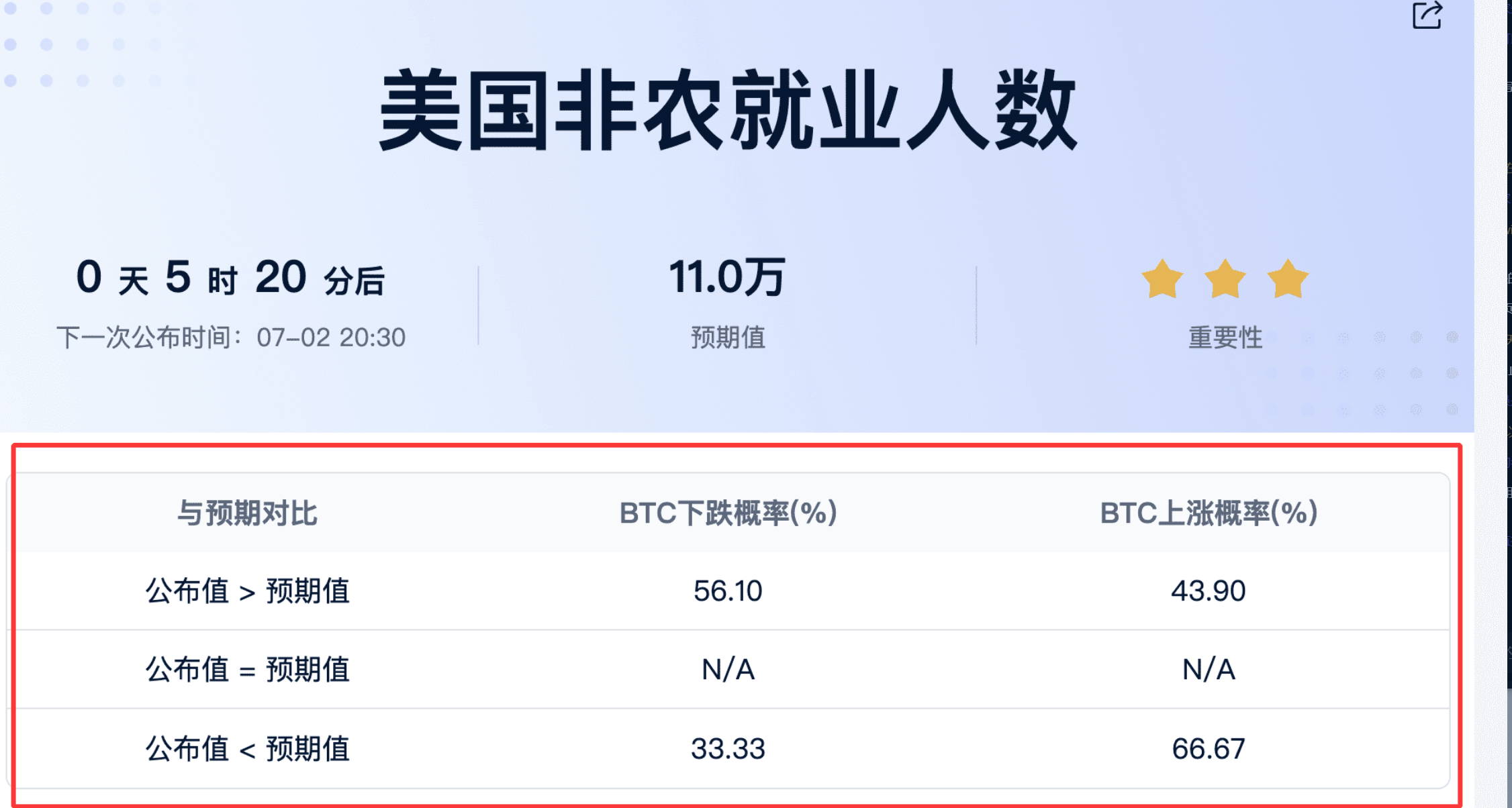
On July 2, the non-farm employment data for June released by the U.S. Bureau of Labor Statistics threw cold water on the narrative of “strong employment and continued rate hikes”: the number of jobs increased by only about 57,000, far below the market expectation of around 115,000. Even more startlingly, the May non-farm figure was revised down from 172,000 to 129,000, effectively telling the market that the previous months' hot labor market was systematically overestimated and the pace of economic cooling exceeded previous consensus. Once the data was released, federal funds futures immediately rewrote the probabilities, with the implied likelihood of a rate hike this month plummeting from about 33% to around 20%. Interest rate traders expressed with real money that the space for continued hawkishness was shrinking. Simultaneously, traditional safe-haven and interest rate-sensitive assets began to be repriced—gold rose by about 2%, silver increased by around 4%, the two-year U.S. Treasury yield fell by about 6 basis points to 4.11%, and the ten-year yield also retreated by about 2 basis points to 4.46%. The entire yield curve gently bent downward, indicating that future nominal rates and discount factors are being recalibrated. As the expectation of “higher rates for longer” loosens, high-beta assets pressed by high discount rates naturally gain some breathing room, and all dollar-denominated, interest-rate-sensitive risk assets are reexamined. Bitcoin, Ethereum, and others re-emerge in the macro trading framework, with the market beginning to ask: after gold was the first to react to the weak non-farm data, can they truly take on the baton thrown by macro funds during this window opened by the downward revision of rate hike expectations?
Non-farm data disappointment: 33% rate hike bets drop to 20%
At the moment the non-farm data was released in June, the macro narrative was directly interrupted. New jobs increased by only about 57,000, nearly half of the market expectation of 115,000, and the May non-farm data was also revised down from 172,000 to 129,000, which effectively pulled down the previous narrative of “employment still being hot.” For macro traders who rely on data, this is not simply a “one-month miss,” but a clear indication that the robust labor market, previously used as a basis for rate increases, has actually been overestimated, and the true employment engine began to cool much earlier. Bitget's Chief Analyst Lewis Huang thus emphasized that this non-farm report has a "directive significance" for the current financial market—it provides a new anchor on a factual level: employment is no longer an unshakeable support, and the risk of economic slowdown is now visible for the first time in hard data.
The anchor has changed, and pricing must follow. Before the non-farm data was released, the implied probability of a rate hike this month in federal funds futures was still around 33%. Once the data came out, this number was quickly cut down to about 20%, and the two-year U.S. Treasury yield fell in tandem, with the entire curve acknowledging with real prices that the chances for another short-term hike are no longer sufficient to support “higher rates for longer.” This stands in stark contrast to the previous hawkish stance represented by Kevin Warsh—his tough attitude was once a key psychological support for the market’s willingness to wager on continued rate hikes, but now it is diluted by the disappointing employment reality and Daly-style “gradualism” remarks. The macro story has shifted from “fearing too few rate hikes, fearing inflation rebound” to “fearing overhiking, fearing economic stall,” where the pricing benchmark for risk assets also changes accordingly: whoever can absorb the funds withdrawing from rate hike trades in a growth downturn and peak interest rate environment will be eligible to become the new recipient of macro funds.
Yield fall: Dollar rate anchor starts to loosen
Once the non-farm data was released, the real first “vote” was not from the stock market, but from the U.S. Treasury curve. While federal funds futures were cutting the probability of a rate hike this month from about 33% down to around 20%, the two-year U.S. Treasury yield concurrently dropped by about 6 basis points to 4.11%, and the ten-year yield also retreated by about 2 basis points to 4.46%. The magnitude is not exaggerated but sufficient to make the point: the short end, most sensitive to the Fed’s recent path, is starting to loosen, indicating that the market no longer firmly believes that "one more hike" is the default option, and the dollar rate anchor has slightly adjusted from “higher for longer” to “possibly peaking.”
The fall in short-end yields has directly eased the pressure of the dollar interest rate environment on global risk assets and dollar credit. Over the past year, risk-free short-end rates above 4% have locked a large amount of liquidity in dollar cash and coupon assets; when the front end of this yield curve drops even by just a few basis points, the marginal funding equation starts to change: the opportunity cost of sticking with dollar assets rises, enhancing the drive to seek higher risk premiums externally. The decline in discount rates creates another slower but more lethal chain reaction—long-duration tech stocks, which are already viewed as “long-term growth stories,” as well as high-volatility assets like BTC and ETH, have their valuation framework fundamentally based on a high discount rate to discount future cash flows, network effects, or expectations. When this discount rate is collectively adjusted down by the market, the same story can support higher price ranges. Today’s retreat in the yield curve is creating space for BTC and ETH to play the role of high-beta risks and macro hedge assets again.
Gold takes the lead: How risk aversion sentiment transmits to crypto
Upon the release of the non-farm data, the real first responder was not the stock market but gold and silver. After the data disappointment, during the same time window in which the probability of a rate hike dropped from about 33% to around 20%, and the two-year U.S. Treasury yield fell to 4.11%, while the ten-year fell to 4.46%, gold prices increased by about 2%, and silver rose by about 4%. Bitget’s Lewis Huang referred to this non-farm report as having a strong “directive significance”: the earlier hawkish tone from Kevin Warsh had once pressed the market under the narrative of “higher rates for longer,” but now the weak non-farm numbers combined with this round of hawkish statements, in fact, retract the tail risk of “continuing rate hikes,” shifting the focus from “fearing runaway inflation” to “fearing economic stall and policy missteps.” In this narrative, gold is once again seen as the primary response tool for hedging against economic and policy uncertainties, and the Fed's Daly-style “gradualism” rhetoric only serves to make this hedging demand appear more reasonable.
As gold takes off first, the narrative of “digital gold” is naturally brought out for reevaluation. For some macro funds, gold is the traditional hedge; BTC, on the other hand, is a higher-beta, higher-volatility macro option. The path often goes like this: disappointing non-farm data → down-adjusted rate hike expectations, falling yields → rate products and gold get the initial buying, extending duration; once the yield curve stabilizes, risk budgets are released, and some funds wanting to bet on “policy missteps” or “liquidity return” will tentatively increase allocations to assets like BTC and ETH outside of gold and rate products. In this sequence, crypto is not the first line of defense but rather a second layer of hedging and a blend of risk assets, and its price reflects more the willingness of marginal funds to pay a premium for the “digital gold” narrative after gold has risen and rates have fallen.
Fed's internal divisions: How much time window does gradualism give to crypto?
After the non-farm data disappointment and the probability of a rate hike being slashed from about 33% to around 20%, signals from the Fed itself have not been consistent. Kevin Warsh has been labeled as a “hawkish hardliner” by the market, while Daly has publicly emphasized the need to “strive for better inflation data” whenever possible, expressing a desire not to respond hastily amid rapid changes in the world, and claiming to be a “gradualist” who prefers to take it slow. The significant miss in non-farm data and the previous value being revised down has made the position of “let's wait for more data” suddenly more persuasive, but this persuasiveness is not built on a clear path but rather on the acknowledgment of uncertainty: internally, some advocate continuing to pressure inflation while others suggest first monitoring growth. This division is being directly translated into a fan-shaped expansion of policy paths and volatility premiums in the futures and options markets.
For crypto funds, this gradualism is not a simple positive signal but a time window that can be leveraged. The urgency for short-term rate hikes has decreased, with the two-year U.S. Treasury yield dropping to 4.11% and the ten-year stabilizing around 4.46%, meaning the concerns of leveraged funds regarding dollar financing costs are temporarily suppressed, and the overall positions for going long on BTC and ETH do not need to reserve too much buffer for “immediate additional hikes.” However, internal disagreements pressure macro traders to remain defensive: prefer to extend duration, allowing crypto exposures to cover the longer policy observation period, while also structurally increasing hedging—less emphasis on high-leveraged perpetual contracts and more focus on options strategies and cross-asset hedging, managing risks by placing rate products and on-chain assets in the same portfolio. Under the framework of “gradual rate hikes + data dependence,” what’s truly being extended is the pace of strategic adjustments: funds can fine-tune positions around each significant data release, rather than having a single meeting completely rewrite the script. This slower policy rhythm represents a limited window for BTC and ETH to strive to take over part of the macro hedging narrative from gold.
Data and expectation game: The next step for the crypto market
With the June non-farm data adding only about 57,000 jobs and the May figure being revised down from 172,000 to 129,000, the macro narrative shifts from “higher rates for longer” back to a “balance of economic cooling and falling inflation.” The pricing of a rate hike in federal funds futures has fallen from about 33% to around 20%, the two-year yield has dropped to 4.11%, and the ten-year to 4.46%, alongside gold rising by about 2% and silver by about 4%, forming a typical combination of “downward adjustment in rate expectations + rising risk aversion.” The overall pressure on global risk assets has marginally eased. For the crypto market, this is not an emotion reversal driven by a single data point, but a new observational framework: each subsequent employment and inflation data, along with comments from Fed officials, particularly those who identify as “gradualists” like Daly, will continually recalibrate whether the interest rate anchor continues to decline or is forced to adjust upward. If employment data continues to weaken and signals of economic slowdown accumulate, the yield curve may further decline, and gold and U.S. Treasuries will continue to attract safe-haven funds. BTC and ETH will either act as “long-duration, high-beta” macro hedge supplements, benefiting from the drop in discount rates, or be viewed as liquidity outlets during a sharp deterioration in risk sentiment, facing short-term pressure; if employment and inflation show a temporary rebound and rate hike expectations resurface, U.S. Treasury yields may rise again, and gold may give back some gains, with BTC and ETH possibly again playing more of a “global risk asset index” role, enduring valuation compression alongside rising rates. The real determinant of whether they can take a larger share of macro allocations from gold and Treasuries in this cycle lies in whether the interest rate anchor stabilizes downward or is forced to turn upward in the upcoming data windows.
Join our community to discuss and become stronger together!
AiCoin exclusive Hyperliquid benefits: https://app.hyperliquid.xyz/join/AICOIN88
AiCoin exclusive Aster benefits: https://www.asterdex.com/zh-CN/referral/9C50e2
On-chain Telegram community: https://t.me/AiCoinWhaleData
On-chain community: https://www.aicoin.com/link/chat?cid=N6OVMor5g
AiCoin on-chain Twitter: https://x.com/aicoinwhaledata
免责声明:本文章仅代表作者个人观点,不代表本平台的立场和观点。本文章仅供信息分享,不构成对任何人的任何投资建议。用户与作者之间的任何争议,与本平台无关。如网页中刊载的文章或图片涉及侵权,请提供相关的权利证明和身份证明发送邮件到support@aicoin.com,本平台相关工作人员将会进行核查。