Author: Nancy, PANews
On the eve of the Q2 financial report release, Robinhood announced the launch of its L2 chain, Robinhood Chain, and simultaneously introduced several crypto products such as tokenized stocks, on-chain lending, and AI trading, while accelerating its global business expansion. Following the announcement, the market reacted positively, with Robinhood's stock price rising 8.35% to $108.6 that day, hitting a six-month high.
In the highly monopolistic L2 sector, supported by Robinhood's vast user base and mature financial services, Robinhood Chain quickly gathered a group of leading crypto protocols, sparking an unexpected community controversy.
Launching its own L2 mainnet, building a multi-product on-chain financial entry
After multiple warm-up tweets, Robinhood held the "The World is Flat" conference in London on July 2, announcing its latest strategic layout focusing on on-chain finance, AI trading, and global expansion, further showcasing its ambition to build global financial infrastructure.
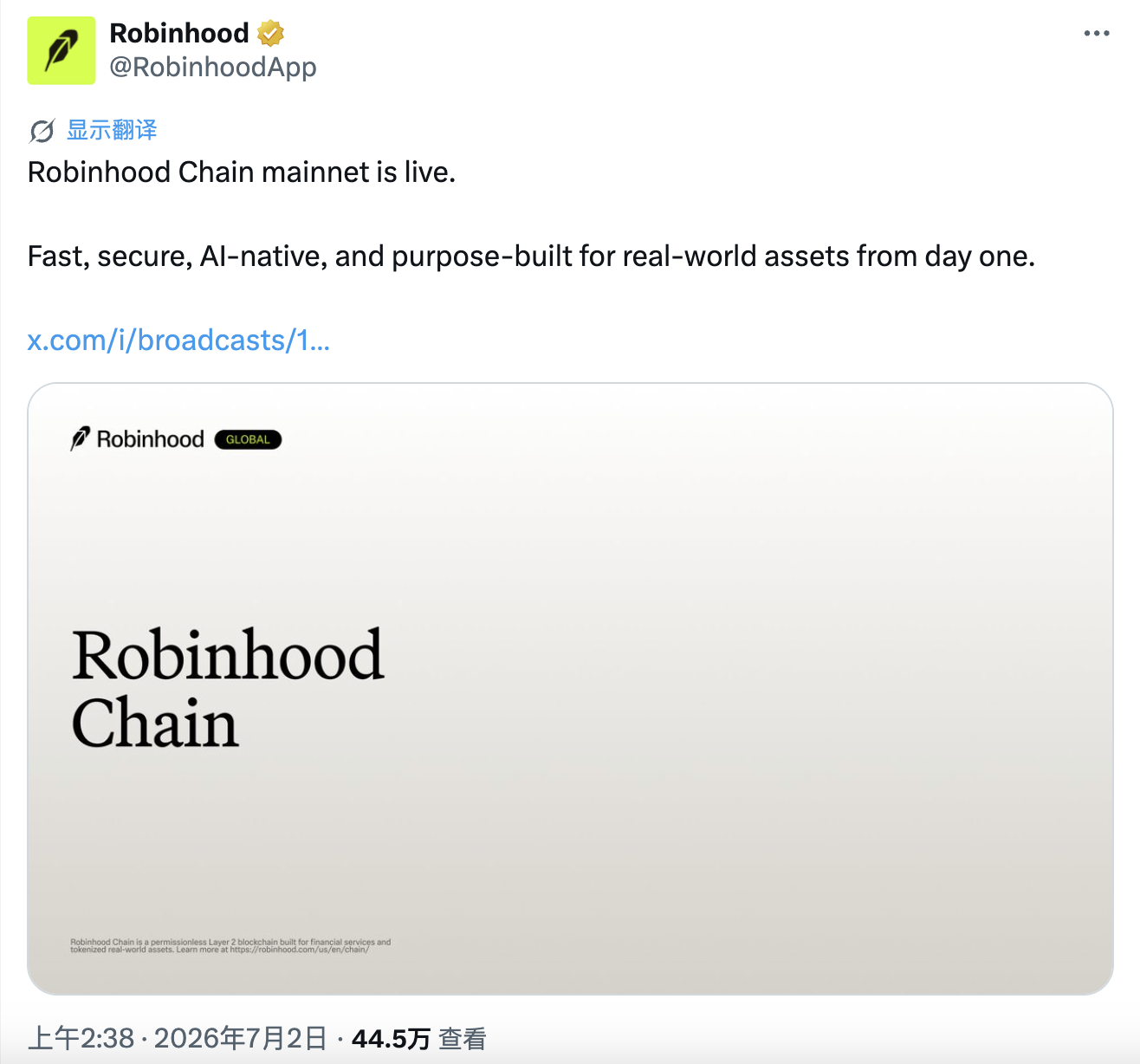
At this conference, the most market attention was on its Layer 2 chain, Robinhood Chain. This chain is built on Arbitrum Orbit and officially launched its public mainnet after months of testing, directly connecting Robinhood’s on-chain users and providing developers with a plug-and-play DeFi development environment. According to the official description, Robinhood Chain is positioned as focused on institutional-grade applications, AI-native architecture, and specifically optimized blockchain infrastructure for real-world assets (RWA).
Surrounding this chain, Robinhood simultaneously expanded its on-chain product matrix, covering trading and yield scenarios.
In the tokenized stock area, Robinhood Wallet has added relevant features, covering over 120 countries and regions worldwide. Users can trade via DEXs such as Uniswap, Rialto, Lighter, 1inch, and Arcus on the Robinhood Chain, and can further participate in lending as collateral in DeFi scenarios or enter liquidity pools to earn yields. This feature was previously only available in the European market, and the expansion to the global market is driven by the rapidly growing demand for tokenized assets and the ongoing competition between traditional and crypto trading platforms.
In the on-chain perpetual contract field, Robinhood Wallet has also launched related features, providing investors with a new channel to participate in the trading of stocks, commodities, and other assets outside traditional market hours. To enhance user participation, Robinhood is also offering 90 days of zero fees and gas subsidies, as well as points incentives during the initial phase.
In terms of yield products, Robinhood Earn, aimed at U.S. users, is gradually opening up. This is its first decentralized lending product within the main application. Users can deposit the USD stablecoin USDG into a self-custody wallet and expect to earn an annualized yield of about 7%. This product is supported by Morphos’ underlying lending infrastructure and has received backing from several DeFi protocols such as Steakhouse, Ethena, Spark, and Maple, while also incorporating insurance mechanisms to reduce risk exposure.
Meanwhile, Robinhood is extending its AI trading capabilities to on-chain trading scenarios, launching the crypto version of Agentic Accounts. Eligible U.S. users can access AI models and set risk control parameters and funding boundaries, allowing AI to autonomously execute market scans and trading strategies. Previously, Robinhood had introduced similar tools in its stock and options businesses.
This series of expansion moves is set against the backdrop of continued pressure on Robinhood's crypto business. In the first quarter, its crypto revenue fell 47% year-on-year to $134 million, and the nominal trading volume in crypto dropped 48% year-on-year to $24 billion. Faced with slowing growth in its crypto business, Robinhood needs to find new growth engines urgently.
In terms of globalization, the company has reached approximately 28 million users and continues to push forward its overseas market expansion, including the official launch in the Canadian market, the Singapore subsidiary obtaining MAS capital market services license, plans to launch commodity, ETF, and forex perpetual contracts in Europe, and the upcoming launch of crypto trading services in the UK.
Bringing together crypto protocols, dYdX’s "new start" raises questions
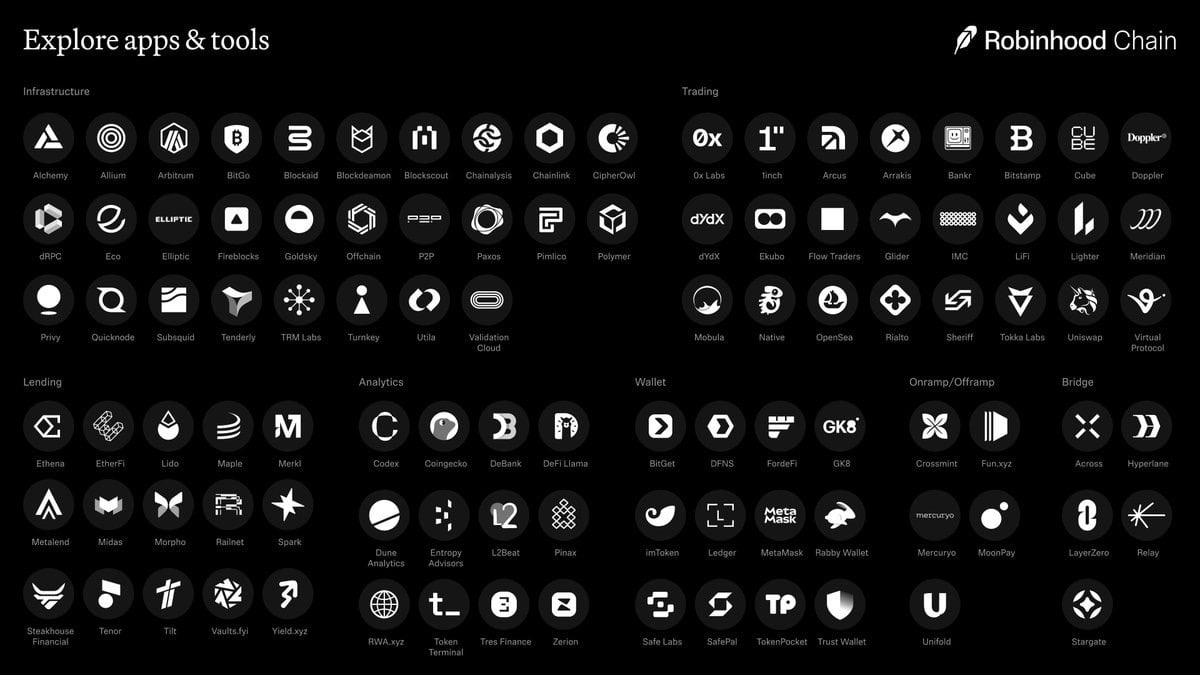
With a vast user base, leading crypto protocols such as Uniswap, 1inch, Lighter, Morpho, Chainlink, BitGo, Ethena, and EtherFi have announced their integration with Robinhood Chain, covering various core areas such as trading, liquidity, lending, oracles, custody, and cross-chain.
However, in this ecosystem integration, the new DEX Arcus launched by dYdX has sparked controversy.
On July 2, the dYdX Foundation announced a partnership with Robinhood, planning to launch a decentralized trading platform Arcus based on Robinhood Chain. This platform will support trading of 95 tokenized stocks, perpetual contracts, and mainstream crypto assets, and plans to further support using tokenized stocks and crypto assets as collateral for perpetual contracts, while also opening up Pre-IPO equity trading for popular private companies like OpenAI. Currently, Arcus has launched the Bea beta version, which is expected to officially launch later in 2026.
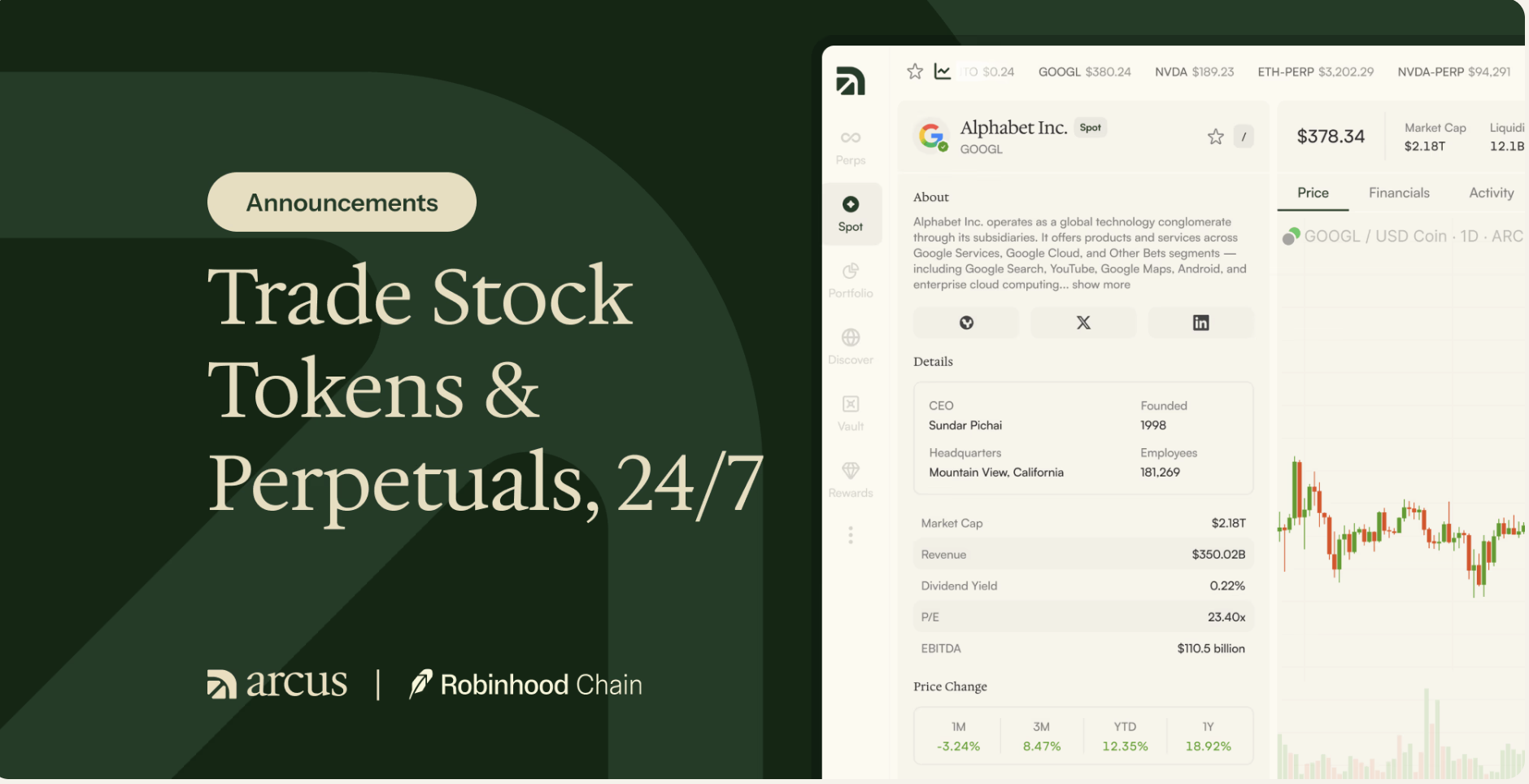
What has triggered community discussion is that Arcus, as a new product launched by the dYdX team, has not been built on the dYdX Chain but instead deployed on Robinhood Chain, operating as a separate product and infrastructure.
In response, dYdX founder Antonio explained in an open letter that the team gradually realized during the operation of the dYdX Chain that building a decentralized public chain means constantly weighing performance, user experience, and decentralization, while competitors are continually capturing market share with faster execution speeds, simpler product experiences, and greater liquidity. Taking into account the accumulated experiences from previous generations of dYdX products, months of user feedback, and the current core pain points of DEX, the team ultimately decided to launch Arcus.
Antonio revealed that the choice of Robinhood Chain was largely based on considerations of users and liquidity, as Robinhood has about 27.7 million funded accounts, which can provide a ready-made user base and liquidity for Arcus. Additionally, Arcus has also received strategic investment from Robinhood Crypto, further deepening the cooperation between the two.
However, this news quickly sparked dissatisfaction within the dYdX community. Many community members believe that the original core team of dYdX starting a new brand signifies that development resources, product focus, and market attention may shift towards Arcus, posing a risk of overshadowing or even replacing the brand value of dYdX. Furthermore, considering that dYdX had previously launched one of the largest airdrops in the industry, and the potential expectations for token issuance from Arcus, this would attract traders and liquidity to migrate to the new platform, leading to a drop in trading volume and activity on dYdX Chain, further diluting the value of DYDX tokens.
In response, the dYdX Foundation emphasized that its responsibilities in supporting the dYdX protocol and community governance will not change. The dYdX Chain remains unaffected, with normal operations for trading, deposits, withdrawals, staking, and governance, with the governance and staking mechanisms of DYDX tokens unchanged, and staking rewards continuing to be distributed in USDC, while the assets of community treasury, reward treasury, and others remain fully controlled by DYDX holders through governance.
At the same time, Antonio also stated that as the founder of dYdX and the largest holder of DYDX tokens, his interests are highly aligned with those of the dYdX community. "My interests are more deeply bound to dYdX than anyone else." He also promised that if Arcus issues tokens in the future, a portion will be reserved for the dYdX community distribution; moreover, Arcus will also prioritize access for dYdX traders.
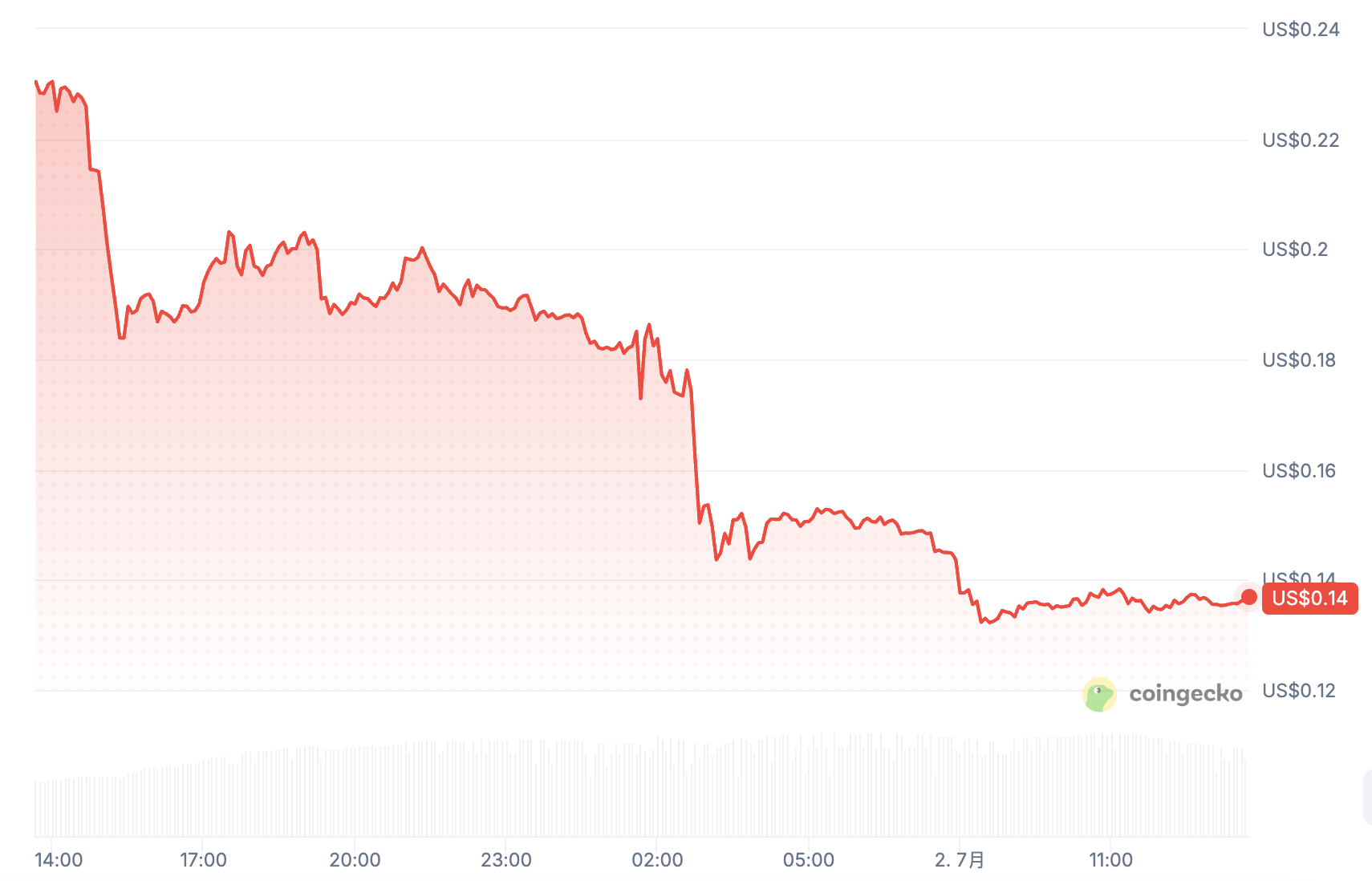
However, these responses do not seem to have alleviated market concerns. Following the announcement of the new product, the DYDX token saw an intraday drop of approximately 40.7%.
Overall, Robinhood’s ambitions extend far beyond simply providing a blockchain infrastructure. Leveraging its vast user traffic, matured brokerage business, and global compliance layout, Robinhood is attempting to use Robinhood Chain to expand its business boundaries, accelerate its transformation from an internet brokerage to the next generation of global financial gateways. Whether this ambition can become reality remains to be seen in the market.
免责声明:本文章仅代表作者个人观点,不代表本平台的立场和观点。本文章仅供信息分享,不构成对任何人的任何投资建议。用户与作者之间的任何争议,与本平台无关。如网页中刊载的文章或图片涉及侵权,请提供相关的权利证明和身份证明发送邮件到support@aicoin.com,本平台相关工作人员将会进行核查。


