When you are reincarnated as a "cryptocurrency magnate," your life might...

"While others are busy sending resumes after graduation, I am busy analyzing K-lines, and it’s just...."
This was something he said at the graduation farewell dinner. After saying it, he held up his phone and shook it; the screen displayed his holding interface, with 500,000 USDT neatly arranged, glowing green. Some classmates' hands holding their glasses froze halfway, while others had already started shouting "Boss."
He had just graduated, and his family gave him 500,000 USDT—a so-called startup fund. The elder's exact words were: "Take it and buy a decent commercial property, rent it out and collect rent, don’t mess around." He agreed verbally but immediately transferred the USDT into an exchange.
His social media bio read: Stanford dropout (actually graduated from a local university), Web3 OG (actually entered the space three months ago), focused on primary markets (actually only knows how to buy contracts). His avatar was a selfie wearing sunglasses sitting in a Mercedes, the three-pointed star logo on the steering wheel clearly visible.
On the day of graduation, while others posted photos in graduation gowns holding bouquets on social media, he posted a screenshot of his holdings with the caption: "My family said they would give me 5 million to practice with. I said no need, 500,000 is enough, and by the end of the year, I’ll still have a house." The comments section exploded; some shouted "Take me with you," some cursed "Showing off wealth," and some privately messaged him asking what coins to buy. His unified reply was: "Different understandings, no need to forcibly merge."
That was the last period of his life that could be called "sailing smoothly."
The market actually favored him. In the first week after entering the scene, BTC climbed from 62,000 to 68,000. He opened a 20x long position and earned 30% in three days. The day he turned 500,000 into 650,000, he booked the most expensive bottle service at a nightclub in the city, ordered three bottles of Armand de Brignac, and took a picture of the bill to send in the group: "This meal is on me; from now on, hanging out with me means every meal will be at this standard."
Someone whispered: "Isn’t this just gambling?”
He heard it and walked over, holding his glass, and patted the other person’s shoulder: "Brother, your understanding is still in the Stone Age. This is called asset allocation, called hedging against inflation—ah, forget it, you wouldn’t understand."
That night, he drank until four in the morning, and the designated driver took him home; he vomited one shoe's worth in the car. The driver glanced at him, wanting to say something but stopping short. He waved his hand, saying it was fine, went home, collapsed onto the bed, and his phone was still lit—the exchange app was open, orders were hanging, and all the take profit and stop loss settings were empty.
The next day he woke up to find BTC dropped back to 64,000, giving back half of his profits, but he didn’t care: "Normal pullback; just washing the market, after it washes, it will keep pushing up."
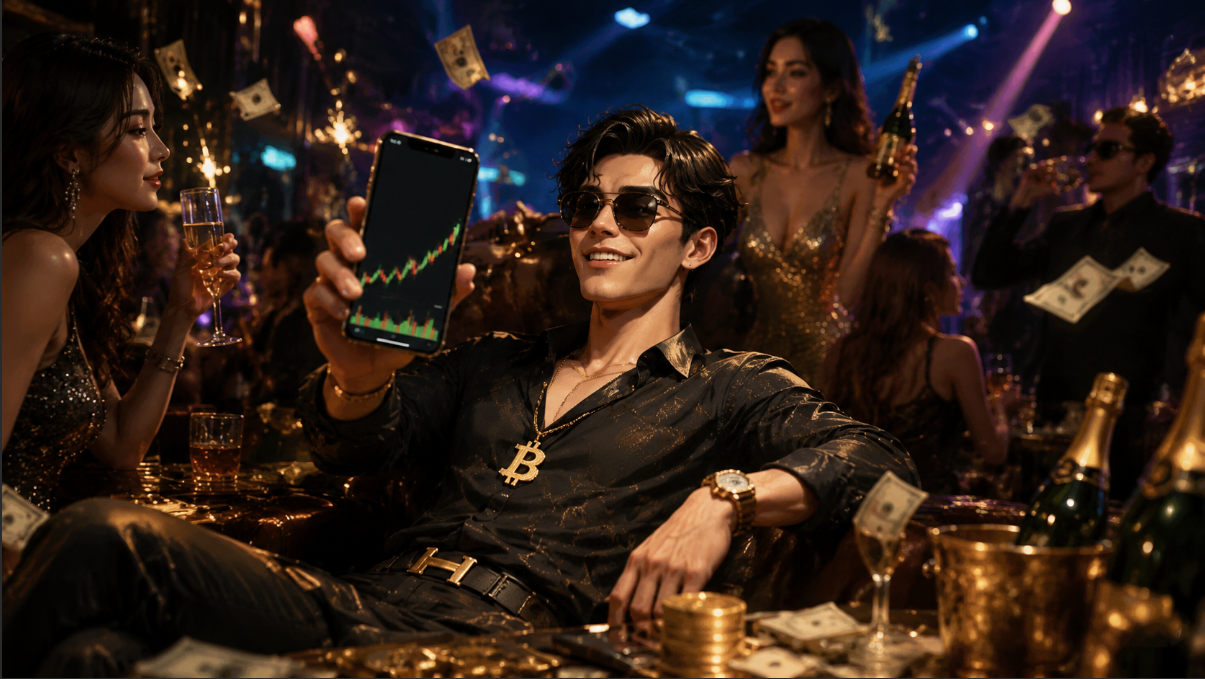
He began to feel like he was the chosen one.
He stumbled across an account called "Cryptocurrency Fortune God" online, with a bio reading "Win rate 100%, focused on hundred-fold coins, only takes those with fate." The homepage was full of screenshots showing returns of 3x and 5x, dazzling him. He stared at it for half an hour, heart racing, and messaged: "Teacher, how to get in?"
The reply came instantly: "V me 3 ETH, join the VIP silent group, I will personally guide you, guaranteed to multiply five times in a month."
He hesitated for five seconds—three seconds doubting it was a scam, two seconds thinking what if it wasn’t—but finally transferred the 3 ETH. Once it arrived, he was added to a group called "Core Disciples of the Fortune God," with hundreds of people in it, all muted, only the Fortune God spoke.
"Welcome new family members, tonight we will get in on a dog coin; institutions have entered the market, expected to multiply a hundred times; follow along with all your holdings, just trust me."
He replied with a "1" in the group.
The dog coin was called "MoonPup," the contract address was a string of random characters, and he didn’t even check the blockchain for holding distribution—didn’t know how to check, nor did he think to check. The Fortune God instructed: "Buy in at launch; target is 100 times; any pullback in between is a buying opportunity."
He poured all the remaining USDT in his account—about 580,000—into it.
MoonPup indeed surged. In ten minutes it rose 30%, in half an hour it jumped 120%. He stared at the screen, hands trembling, took a screenshot and sent it to the group: "Do you see? This is the information gap; realization of cognition." No one in the group replied, but he didn’t care.
It peaked at 3x, with floating profits reaching 1.7 million. He thought the best decision of his life was not buying that commercial property. "What’s a couple of points a year for a property? I finish that in a day."
He privately messaged the Fortune God: "Teacher, should I sell?"
The Fortune God did not reply.
Three minutes later, MoonPup plummeted. It dropped 40% in one minute, 70% in three minutes, and after five minutes the contract address was marked as "suspected scam run," with the liquidity pool drained, leaving only a few thousand dollars.
He frantically clicked sell, each time showing "Transaction failed." He tried a dozen times, his phone vibrating until his fingers went numb. Finally, he gave up, staring blankly at the pile of virtual coins in his wallet that were now worthless.
Balance: 4.2 USDT.
He went searching for the Fortune God, but the account had been deleted. When checking the group, the name had changed to "New Group Entry of the Fortune God," and the last message read: "Family, don’t panic; today is a wash, tomorrow it will rebound; trust the teacher." He tried to send a message: "Is anyone there?" The message failed to send—he had been muted.
That night he didn’t eat, lying in bed staring at the ceiling, his phone by his pillow, picking it up every ten seconds to check, hoping MoonPup would suddenly rebound—an illusion, he knew, but couldn’t control it.
At three in the morning, the Federal Reserve's CPI data was released, higher than expected, and BTC plummeted by 4%.
He suddenly sat up—remembering that he still had a BTC long position open, 125x, fully leveraged, without a stop loss. That was placed before buying MoonPup, as the Fortune God had said, "BTC is bullish long-term, just hold it."
Opening the exchange app, his finger slid wildly, the two seconds while the page loaded felt like two years.
A popup appeared: "Account equity: 0.00 USDT. Liquidation price: 65421. Current price: 65380."
He clicked "Cancel Order," clicked three times, the loading icon spinning and spinning, and finally, a red prompt appeared: "Network busy, please try again later."
Refreshing again, the order had disappeared. Along with the last shred of hope, it vanished.
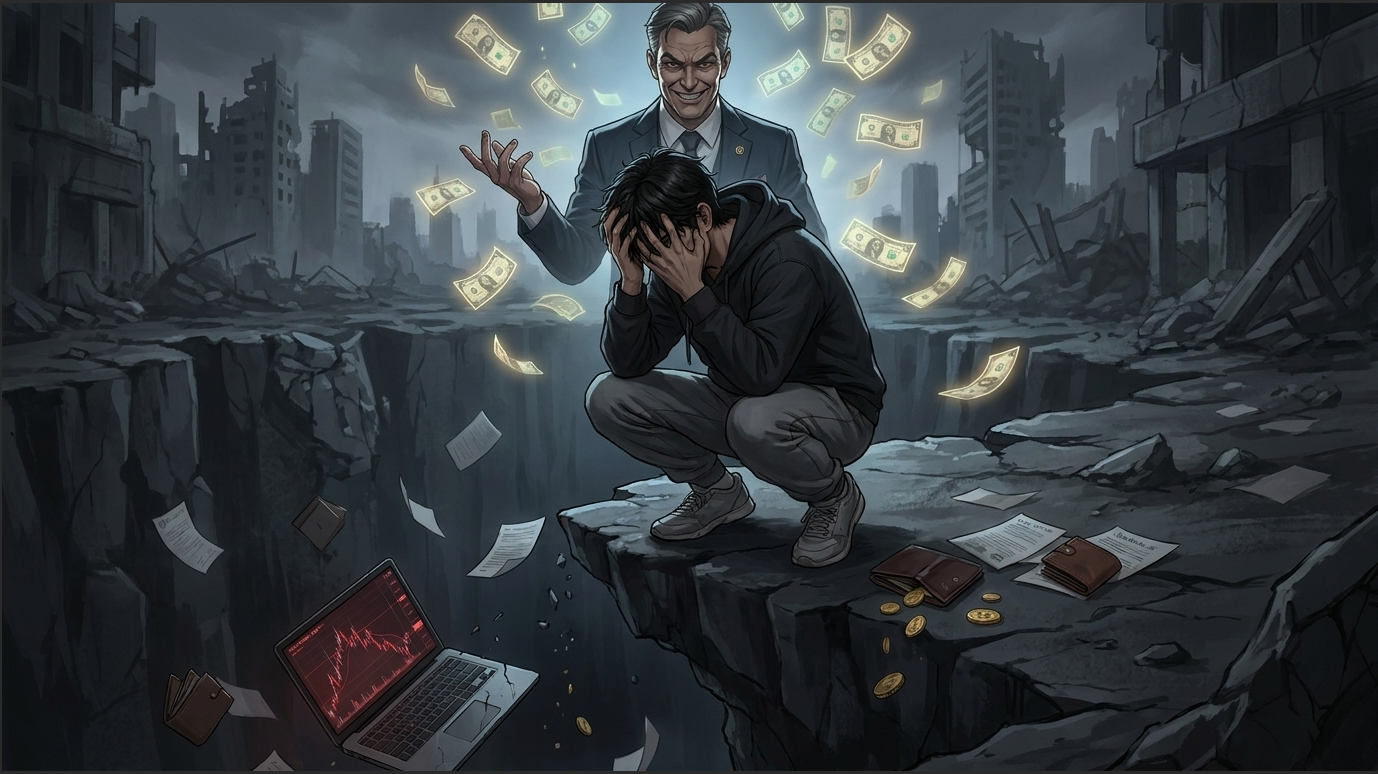
He sat on the bed, the phone sliding off to the blanket, the screen still lit, K-line charts still bouncing, green and red intersecting, like a cold and indifferent life monitor. Outside the window, the sky brightened, sanitation workers swept the streets, the sound of brooms scraping the ground echoing.
He started deleting posts. Screenshot of 500,000, deleted. Photo of Armand de Brignac, deleted. "By the end of the year, I’ll have a house," deleted. Each deletion prompted a confirmation, and he clicked "confirm" over twenty times. His homepage was left with only a horizontal line, as if nothing had ever happened.
On the third day, the bank called about his credit card, overdrawn by 120,000—charged from those three bottles of Armand de Brignac at the nightclub, back then he had said, "What does this little money matter?" The customer service voice was polite: "Sir, your bill is overdue, please handle it as soon as possible." He hung up the phone and picked up the key to his Mercedes.
He found an online company that offered "pawn cars for loans, same-day disbursement," and when he drove over, he discovered it was hidden in a residential building. The other party looked at the car, then at him, and smiled: "Rich second generation? Is this car your parents'?"
He said: "It's mine."
The other party didn’t expose him, gave him 150,000 in cash, with a monthly interest of 8%, and they signed a contract. He used the money to pay off his credit card, leaving him with 30,000, then reopened the exchange. But he didn’t place an order; he stared at the deposit address for a long time before finally uninstalling the app.
A week later, the pawn shop company called, saying the car had been sold because he was late again. He shouted on the phone: "I didn’t even get the sale money! You tricked me!" The other party laughed: "The contract is black and white; if you’re late, the rights to dispose of the collateral belong to us; sue if you want."
He didn’t sue. He didn’t dare let his family know.
Two weeks later, he couldn’t hold on any longer and began sending resumes. Three months were blank on his resume, and when the HR called to ask: "What were you doing during these three months?" He said: "There were some family matters."
A sales company scheduled an interview, offering a base salary of 8,000. He wore his only clean suit, and the HR, wearing glasses, looked from the resume to him: "You studied finance?"
He said yes.
HR said: "Then what were you doing during that three-month gap? Our industry has a high demand for integrity."
He was silent for a long time. Sunlight streamed in from the window, casting on a small stain on the conference table, reminiscent of dried coffee stains. He realized he hadn’t had coffee in a long time; the last he had cost 48, and now he wouldn’t even buy one for a few bucks at the convenience store.
He opened his mouth, his voice very soft: "Paying tuition to society."
HR frowned: "What?"
He looked up and smiled a little—his lips quivered: "I was investing previously and lost money. Now I want to find a steady job."
HR nodded and wrote a few words on the resume: "Wait for a notification."
He walked out of the office building; the sun was bright, and he squinted standing by the road. His phone vibrated—notification: the previous "Cryptocurrency Fortune God" has changed their number and resumed activity, with the bio still declaring "Win rate 100%," and three new groups opened, each filled to capacity.
He stared at it for a long time, then clicked "not interested."
Then he stuffed his phone into his pocket and walked into the subway station. When the beeping sound at the entrance rang out, he felt a moment of confusion—as he had never taken the subway before, driving everywhere. Now he couldn’t even afford a shared bike, his account balance at 2.6 yuan.
The subway arrived, and he squeezed on, with no seats available, holding onto the handrail. The reflection of his face in the window—his hair had grown long, he hadn’t shaved, dark circles under his eyes, his tie crooked.
He was a different person now. The one who was opening Armand de Brignac in the nightclub died in the liquidation order at three in the morning. The person standing here now was just an ordinary person, in debt, without a car, who didn’t dare go home.
When he got off the train, he blended into the crowd, quickly getting swallowed up. No one recognized him, no one remembered him.
Only in the deepest part of his phone's photo album, there still remained that screenshot he couldn’t bear to delete—showing 500,000 USDT in holdings, glowing green numbers, like a dream.
He didn’t delete it.
Maybe he forgot.
Or maybe he didn’t want to forget.
Afraid that if he forgot, he might make the same mistake again.

Half a month later, a small cross-border e-commerce company took him in, offering a monthly salary of 6,500, one day off, and the minimum base for social insurance.
On his first day at work, he sat at his desk, facing a second-hand monitor with a yellowed edge, an Excel spreadsheet sprawled out before him, filled with dense SKU codes and purchase prices. The colleague at the adjacent desk was typing without looking up; the entire office was filled with the buzzing of the air conditioner and the clacking of keyboards. He stared at that monitor for a long time—the last time he stared at a screen so intently was while watching K-line charts waiting for liquidation.
He took a deep breath and started entering data.
Days passed like this. Every day from nine to six, eating a fifteen yuan lunch downstairs, then squeezing back on the subway for forty minutes to his rental. He quit smoking because a pack of cigarettes costing twenty yuan was two meals. He uninstalled all unnecessary apps, keeping just one.
On the 15th of each month, a text message would ring, indicating 6,500 had arrived. He took out his accounting book, marking off his expenditures: rent 1,800, utilities 200, transportation 300, meals 1,500, leaving 2,700, which he transferred into a separate exchange account.
He didn’t look at that account, didn’t touch it, just saved it up.
By the third month, he had over 8,000 in the account. He stared at that number for a long time, redownloaded the exchange app. But this time he didn’t open the contract interface; he didn’t look at that red and green bouncing K-line chart, he went straight to the wealth management section.
He chose the simplest demand deposit—funds could be deposited and withdrawn at any time, earning interest daily. He put all that over 8,000 into it, then closed the app, locked his screen, and set the phone on the table.
When he woke up the next morning and opened it, he took a glance—he had earned a few dimes. A few dimes, which used to be enough to buy thousands of bottles of Armand de Brignac in the nightclub. But he stared at those few dimes for a long time, the corners of his mouth twitching.
That was the first profit he earned after losing 500,000.
From then on, he put all the money he saved each month into the wealth management account, only choosing the simplest demand and short-term fixed deposits. The earnings weren’t much, with an annualized rate of only a few percentage points, but steady; he could see a little more in the account every day when he woke up.
During hard market times, while colleagues complained about BTC dropping again in the break room, he held a thermal cup sipping tea without joining in. He recalled that early morning when the 125x long position was liquidated; outside was the same gray sky. But now the money in his account rested steadily in the wealth management pool, earning interest daily, like a slowly growing tree.
On an afternoon three years later, he sat at his desk preparing the quarterly report when his phone vibrated—a bank text, his account balance had surpassed six figures. He took a quick glance, placed the phone back, and continued typing.
On his way home, he passed a real estate agency with ads for small apartments in the window, the total price was low, and the down payment was just right. He stood in front of the window for five minutes; the glass reflected his face—his hair cut short, his beard clean-shaven, dark circles still present, but his eyes were different.
He didn’t post on social media to show off like he used to. He just went home, turned on his computer, and made an asset configuration in his wealth management account—part continuing to earn interest in demand deposits, part transferred to longer-term financial products. At the moment the page transitioned successfully, a line of small text popped up:
"OKX Earn—let every coin work for you."
He stared at that line for a few seconds, then closed the page, stood up, and went to the kitchen to boil a bowl of noodles.
When the noodles were served at the table, he thought of that early morning three years ago when the red popup had flashed “Account equity: 0.00 USDT.” Back then, he thought it was the end for him. But life hadn’t ended; as long as he was alive, as long as he could work, save, and take it slow, he could gradually find his way back.
He lowered his head to take a bite of noodles, steam fogging up his glasses.
Everyone makes a mistake once. What matters is not to avoid mistakes, but to learn to start again in a slower, steadier way after making one.

Stable and secure financial management starts with OKX.
🎁 Exclusive registration benefits from AiCoin are here!
Register for OKX through the exclusive AiCoin link for a permanent 20% rebate
👉 Register for OKX now:
https://jump.do/zh-Hans/xlink?checkProxy=true&proxyId=2
📢 Join the AiCoin community, follow more new tokens and earning information
Official Telegram community:
AiCoin Chinese Twitter:
OKX benefits group:
https://aicoin.com/link/chat?cid=l61eM4owQ
The content of this article represents the author's personal views and does not reflect the stance of this platform. The views, conclusions, and suggestions in the text are for investor reference only and do not constitute any investment advice related to this platform. The market carries risks; investments should be made with caution.
免责声明:本文章仅代表作者个人观点,不代表本平台的立场和观点。本文章仅供信息分享,不构成对任何人的任何投资建议。用户与作者之间的任何争议,与本平台无关。如网页中刊载的文章或图片涉及侵权,请提供相关的权利证明和身份证明发送邮件到support@aicoin.com,本平台相关工作人员将会进行核查。