Key Takeaways:
- Bolivia floated its dollar rate on June 26, causing a 40% devaluation to stabilize foreign reserves.
- Past fixed rates caused severe dollar shortages, pushing locals to expand stablecoin proxy markets.
- Minister Espinoza cut currency interventions, next forcing other business sectors to generate dollars.
The Ministry of Economy has issued a new resolution that corrects a situation that had been hampering the Bolivian economy for years.
On June 26, the Ministry published Resolution 245, opening the Bolivian market to a system of free flotation on the dollar exchange rate. The exchange rate had been fixed at 6.96 Bolivian bolivianos per dollar since November 2011. The new exchange rate opened at 9.73 Bolivian bolivianos on Monday, an implied devaluation of nearly 40%.
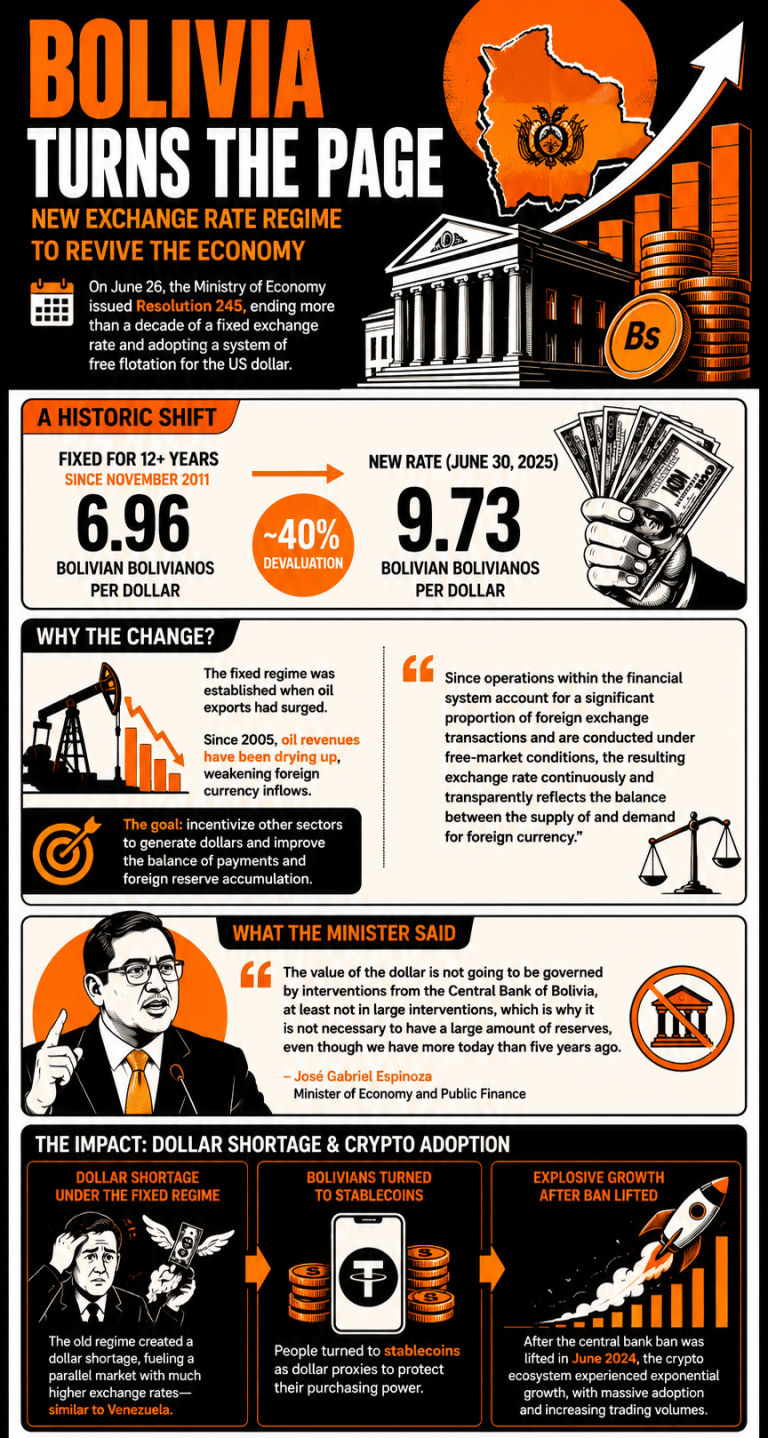
In the resolution, the ministry acknowledges that this regime was established when oil exports had surged, but that since 2005, these revenues have been drying up, underscoring the need to incentivize other economic sectors to generate their own dollars and improve the balance of payments and foreign reserve accumulation.
In the same way, the document acknowledges that “since operations within the financial system account for a significant proportion of foreign exchange transactions and are conducted under free-market conditions, the resulting exchange rate continuously and transparently reflects the balance between the supply of and demand for foreign currency.”
Economy Minister José Gabriel Espinoza stressed that this would benefit the country’s economy. “The value of the dollar is not going to be governed by interventions from the Central Bank of Bolivia, at least not in large interventions, which is why it is not necessary to have a large amount of reserves, even though we have more today than five years ago,” he said in a recent interview.
The former regime had created a dollar shortage in the Bolivian economy, leading to a parallel market where dollars were offered at much higher exchange rates than the official rate, similar to what happened in Venezuela.
This, in consequence, led Bolivians to lean into stablecoins as dollar proxies to protect their purchasing power, even as the national banking system was barred from facilitating crypto-linked operations. After the central bank ban was lifted in June 2024, the ecosystem experienced exponential growth, leading to massive adoption and increasing trading volumes.
免责声明:本文章仅代表作者个人观点,不代表本平台的立场和观点。本文章仅供信息分享,不构成对任何人的任何投资建议。用户与作者之间的任何争议,与本平台无关。如网页中刊载的文章或图片涉及侵权,请提供相关的权利证明和身份证明发送邮件到[email protected],本平台相关工作人员将会进行核查。


