Author: Rasheed Saleuddin
Translation: Deep Tide TechFlow
Deep Tide Introduction: Last summer, the frenzy surrounding the Digital Asset Trust (DAT) ended in a horrific collapse, with early investors losing as much as 99%. A year later, the same scam returned under a new guise—this time they packaged it as SpaceX stock and HYPE tokens. The cycle of greed and fear never stops, and retail investors continue to pay for the feasts of insider traders.
Last Tuesday, Triller Group (who?) announced that it would become the world's first SpaceX Trust Company. That is, it would use the newly raised funds to buy and hold SpaceX stock. This is its business model: holding SpaceX. This news sent Triller's market value soaring from $15 million to $63 million.
Matt Levine noticed this, and I was also drawn to it. This announcement followed a rebranding of the "venerable" trust company LGHL—they had previously bought crypto assets SOL and SUI, and now they want to buy HYPE tokens. Because, well, it's all about the hype.
We've seen this movie. Just last summer. The ending was so grim that you might think it would never happen again. Worse yet, this is clearly one of the most brazen scams, even I could see it coming in advance.
The sequel has already been released. Because global speculators need their "spiritual opium," and the insider traders who push prices higher are happy to provide it. Supply meets demand. When will they ever learn?
The Originator Made the Wrong Headlines
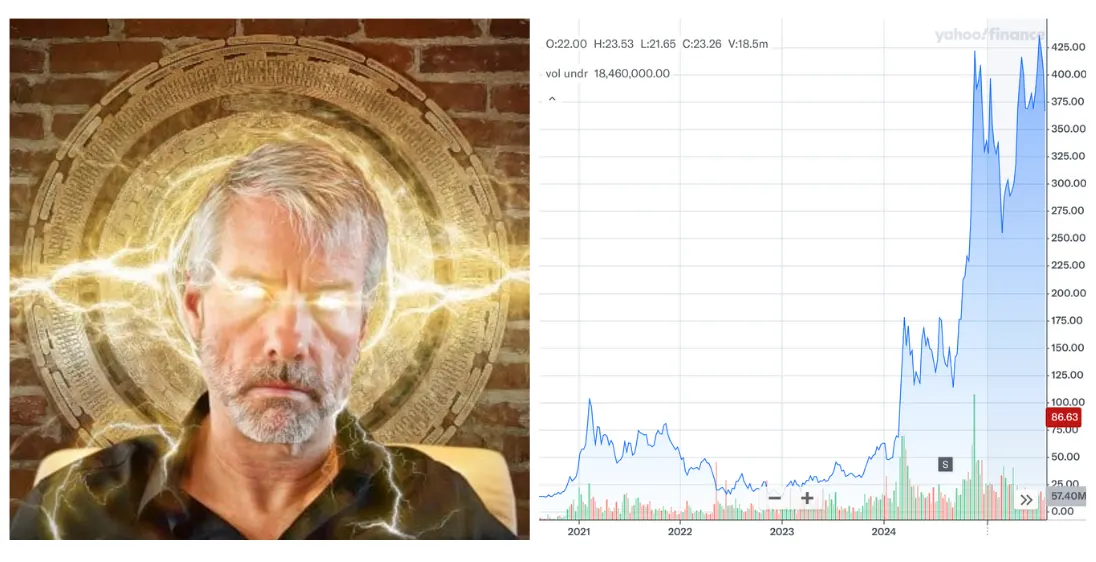
MicroStrategy/Strategy (MSTR) CEO Michael Saylor pioneered the concept of "Bitcoin Yield." Through alchemy, a bitcoin held by the company somehow becomes more valuable than one held by someone not named Michael Saylor.
The market agreed with his claim for a long and awkward period.
Not long ago, MSTR's trading price was 200% of the Bitcoin's value on its balance sheet (net asset value NAV). You spent two dollars to buy one dollar's worth of bitcoin. Saint Saylor was referred to as the reincarnation of Satoshi Nakamoto, crazily accumulating all the bitcoin he could buy, issuing expensive stocks and more complex financial instruments to new believers. The stock price seemed to be set to rise to infinity.
Trend Followers
The premium on Strategy's stock attracted competitors, just like premiums always attract competition. I recorded this scene last May:
SPACs became bitcoin buyers. Loss-making operating companies abandoned their original businesses to raise funds to purchase BTC, ETH, and even more obscure crypto assets.
Spoiler alert: their performance was not as good as MSTR's. And MSTR itself was not a success either.
A year later, the situation is as follows:
Strategy (MSTR): down 79% from peak. This is the combined result of BTC's 45% drop during the same period and the NAV premium compressing from 2x to 1x. Leverage magnified both the rise and the fall; that's how leverage works.
TwentyOne (XXI): reached 5 times NAV at its peak. Notably, it still trades above 1x NAV, although it's down 85% from its peak. Even some insiders have been trapped.
Metaplanet: down 87% a year ago, then another 50% after the collapse.
Nakamoto (NAKA) (formerly KindlyMD): down 87% since October, previously down 95% from its historical high. If you invested $100,000 in this stock a year ago, you now have only $650 left.
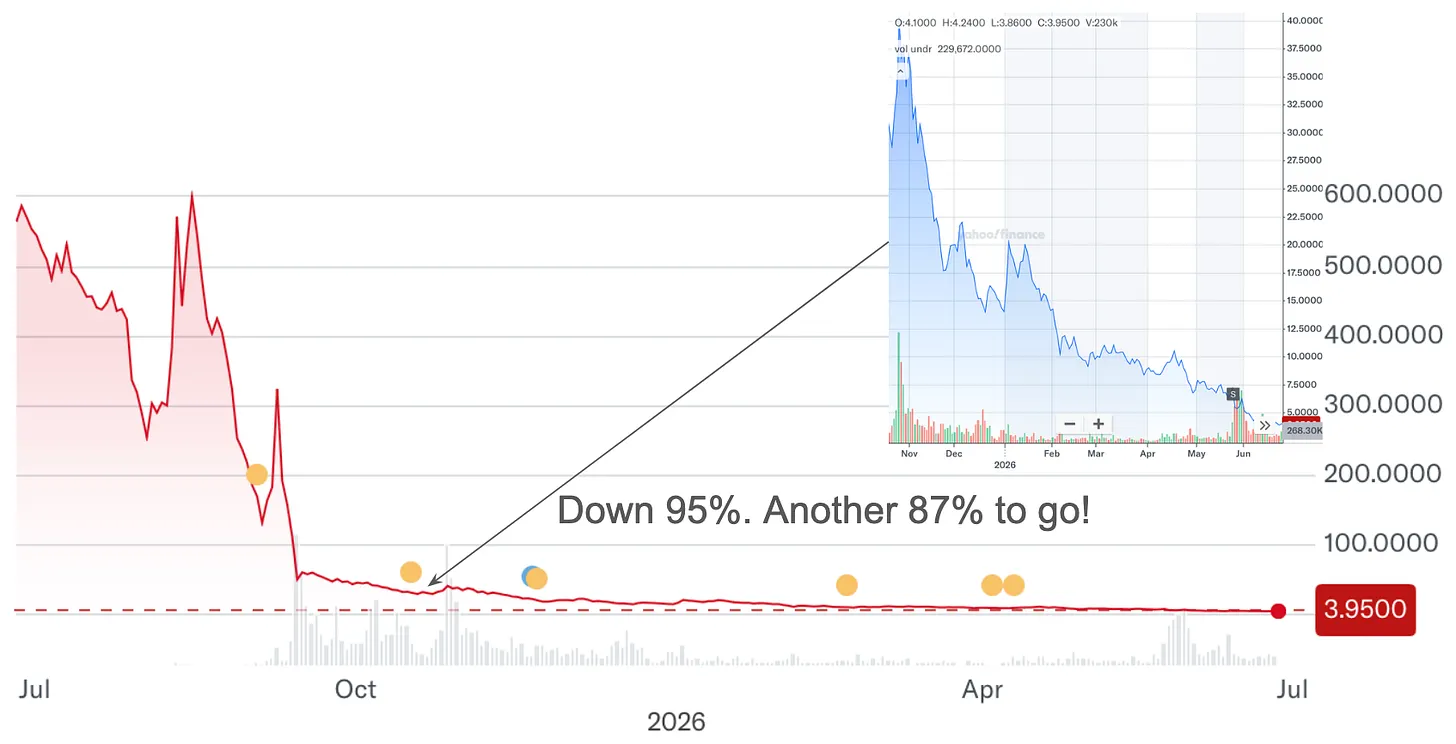
From $100,000 down to $650. Enough for a (very) nice dinner. Those speculators who thought "how much lower could it go," did not fare much better than the initial believers. The answer to "how much lower could it go" is often "quite a lot."
Why This Was Destined to Happen
Bitcoin ETFs exist. They only charge 9 basis points. Bitcoin itself also exists. You can hold it yourself. Trading DAT at a premium has no structural reason, only the greater fool theory, momentum trading, and a particular kind of financial nihilism—those retail speculators who believe the system is rigged concluded: since that's the case, why not play this manipulated game with maximum aggression.
If you believe traditional investment systems don't work for you, the expected value of speculation looks different. FOMO, dopamine, gamification, and GameStop: each on its own is a controllable psychological state. Together, they form an important part of today's market structure.
It goes without saying that insider traders are always incentivized to meet demand. They can profit regardless of which direction the stock price moves; that's another thing worth remembering.
About Tulips
The sad conclusion here is that no one cares when the market is irrational. This is very unfortunate because the collapse of DAT is the best fable of the consequences of fear and greed. It should be the core case for all bubble reports. This is the tulip mania, but real and recently happened.
The 1637 dialogue "Between Waermondt and Gaergoedt" tells of two fictional Dutch weavers watching the tulip price collapse in real-time, and one line transcends nearly four centuries and reads like it was written last month:
"It has come to the point that what was previously thrown away in baskets onto manure piles is now sold for a great price. I thought I was rich enough. I thought I would never have to weave again."
Wrapping dung didn't help then either. A flower that sold for 22 ducats in 1637 had a trading price of 400 ducats at its peak a year earlier. Then the liquidation came:
"I really wish this country never had flowers!"
I wonder how many retail investors, like those who now hold that initial $100,000 down to $650, wish they had never heard of Metaplanet, Nakamoto, or the term "Bitcoin Yield."
One More Thing
I hold some bitcoins. My venture capital fund holds crypto investments. I am not against digital assets. What I oppose is the particular frenzy that involves packaging digital assets into companies, charging privilege fees, issuing debt with leverage, and marketing the results as financial innovation.
I thought this frenzy was killed by the DAT crash in 2025. But the scamming of a golden age goes on (thanks, Shrubstack).
History always repeats itself. Always. Pumping and dumping is not a flaw in the system; for those who operate it, that's the product. Speculators provide the demand, insider traders provide the product. Until we witness the mother of all tulip crashes.
Pumping and dumping is the goal itself.
免责声明:本文章仅代表作者个人观点,不代表本平台的立场和观点。本文章仅供信息分享,不构成对任何人的任何投资建议。用户与作者之间的任何争议,与本平台无关。如网页中刊载的文章或图片涉及侵权,请提供相关的权利证明和身份证明发送邮件到support@aicoin.com,本平台相关工作人员将会进行核查。


