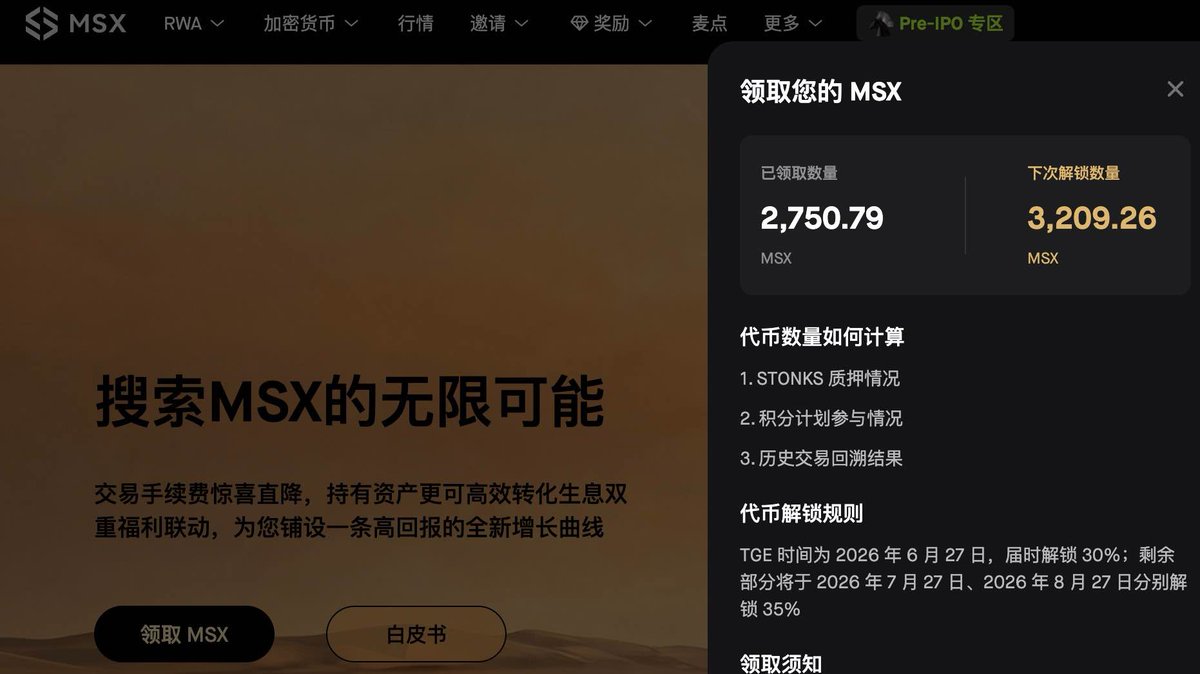
Finally, after much anticipation and calls, #MSX has finally TGE'd. Congratulations to all partners, hurry up and check the airdrop profits. I just looked, the first batch unlocked 2750, with a few small accounts, totaling about 10,000, overall quite satisfactory! 🧐
Today I took a closer look at the MSX white paper, consistent with my early prediction of why I chose to invest in it. When judging whether a project is worth investing in, I basically never listen to grand narratives; I only focus on two core points: can the platform continue to make money? Can the money earned truly reach the hands of token holders?
First, let's talk about the niche that MSX is entering: blockchain brokerage (the core is RWA US stock tokenization and Pre-IPO).
In just over a year since launch, the cumulative trading volume has exceeded 30 billion US dollars, with over 180,000 users. This demonstrates that there is a massive daily turnover in fees and clearing income converting into real cash flow for the platform. As the sole token of the entire ecosystem, $MSX naturally enjoys the value support brought by this trading volume.
As the saying goes, where there is trading volume, there is a future. Look at Hyperliquid; it also grew from small to large in this way!
📝 How does it differ from traditional exchange platform tokens?
Traditional crypto exchange platform tokens' ups and downs are closely tied to the bull and bear markets in the crypto sphere. Once a bear market arrives, the liquidity of altcoins dries up, and the platform tokens follow suit and decline.
However, MSX plays with asset on-chain, taking a completely different path. The US stock market is supported by traditional financial logic, with longer cycles, bullish longer than bearish. Even when the crypto market is in a downtime, AI sectors like NVIDIA, Micron, and space sectors like SpaceX, RKLB still have high-frequency rotations. As long as there are people wanting to use U to trade US stocks or engage in new listings like SpaceX, the demand and necessity for MSX will always exist.
This cross-border arbitrage + all-weather trading attribute often makes its risk-resilience better.
📊 Finally, let's break down the token economic model.
Total supply of 1 billion, $MSX distribution is as follows:
• Ecosystem and user incentives 35% (350 million)
• Team 15% (150 million) - locked for 12 months, then linear release over 36 months
• Strategic investors 15% (150 million) - locked for 12 months, then linear release over 24 months
• Compliance reserves 15% (150 million)
• Genesis airdrop 10% (100 million) - 30% unlocked at TGE, 35% unlocked in the 2nd and 3rd months
• Market making and liquidity 10% (100 million) - fully unlocked at TGE
The most critical point of this model lies in the control of actual circulation in the first 12 months.
The team and institutions directly lock for 1 year, which greatly eliminates the possibility of major holders and project parties frantically dumping in the early stages of launch. Initially, the real selling pressure mainly comes from 10% airdrop (distributed over 3 months) and 5% operational activities. Overall, the early pressure before TGE is relatively controllable!
The entire token release logic belongs to a tight early phase and a loose later phase for long-term incentives. Moreover, the team's and institutions' 1-year lock indicates the team's strong confidence, which also gives us holders more confidence. I look forward to the performance after launch! 👀
🎯 What actual rights can holding $MSX provide?
No matter how good the token model is, if it’s just held without use, it’s just points. This time, MSX has launched a seven-part rights system; let me summarize the key points for you:
1️⃣ Save money (fee deduction):
Using $MSX to deduct fees, RWA spot trades get a 25% discount, and contracts get a 10% discount. For high-frequency traders or those with large capital, the savings are pure profit.
2️⃣ Make money (Pre-IPO unicorn new listings):
Unlisted equity in companies like SpaceX is a game traditionally played by Silicon Valley billion-dollar funds and top VCs. At MSX, holding $MSX increases your level, giving you the qualification for Pre-IPO product subscription and higher allocation weighting.
This equates to directly distributing the premium dividends of the primary market to token holders, with immense potential. Those who have previously invested in SpaceX and CBRS should have a deep impression and benefited greatly!
3️⃣ Earn passively (staking interest):
The platform offers active staking with annual rewards of up to 10%. It allows maintaining liquidity while still earning interest, making it suitable for long-term investors.
4️⃣ Soft power and tiered services:
After upgrading VIP level, you get exclusive account managers, in-depth macro research reports from the Mai Tong Research Institute (free professional investment research), customized X Card brand member gift boxes, etc.
🧐 In summary, #MSX is not a simple speculation tool but a ticket for deep participation in this cross-border RWA ecosystem and a layer for value capture.
MSX has passed the Beta validation period, with a total trading volume of 30 billion USD, indicating that the "blockchain brokerage" structural route has been successfully established.
As the platform continues to expand the RWA ecosystem (from US stocks, ETFs to options and other broader global asset chain on-chain), $MSX will become the most core fuel within the entire ecosystem. User growth, explosive trading volume, and the rush for scarce Pre-IPO shares will ultimately feed back into the value system of $MSX, and what I look forward to the most is the future listing of options.
If you, like me, believe in the big financial trend of "asset on-chain, brokerage on-chain" for the next decade, then $MSX is a target worth long-term attention.
Lastly, a reminder: all investments carry risks, DYOR 🙏
免责声明:本文章仅代表作者个人观点,不代表本平台的立场和观点。本文章仅供信息分享,不构成对任何人的任何投资建议。用户与作者之间的任何争议,与本平台无关。如网页中刊载的文章或图片涉及侵权,请提供相关的权利证明和身份证明发送邮件到support@aicoin.com,本平台相关工作人员将会进行核查。


