Hold RMB or hold USD? Are you bullish on China or bearish on China??
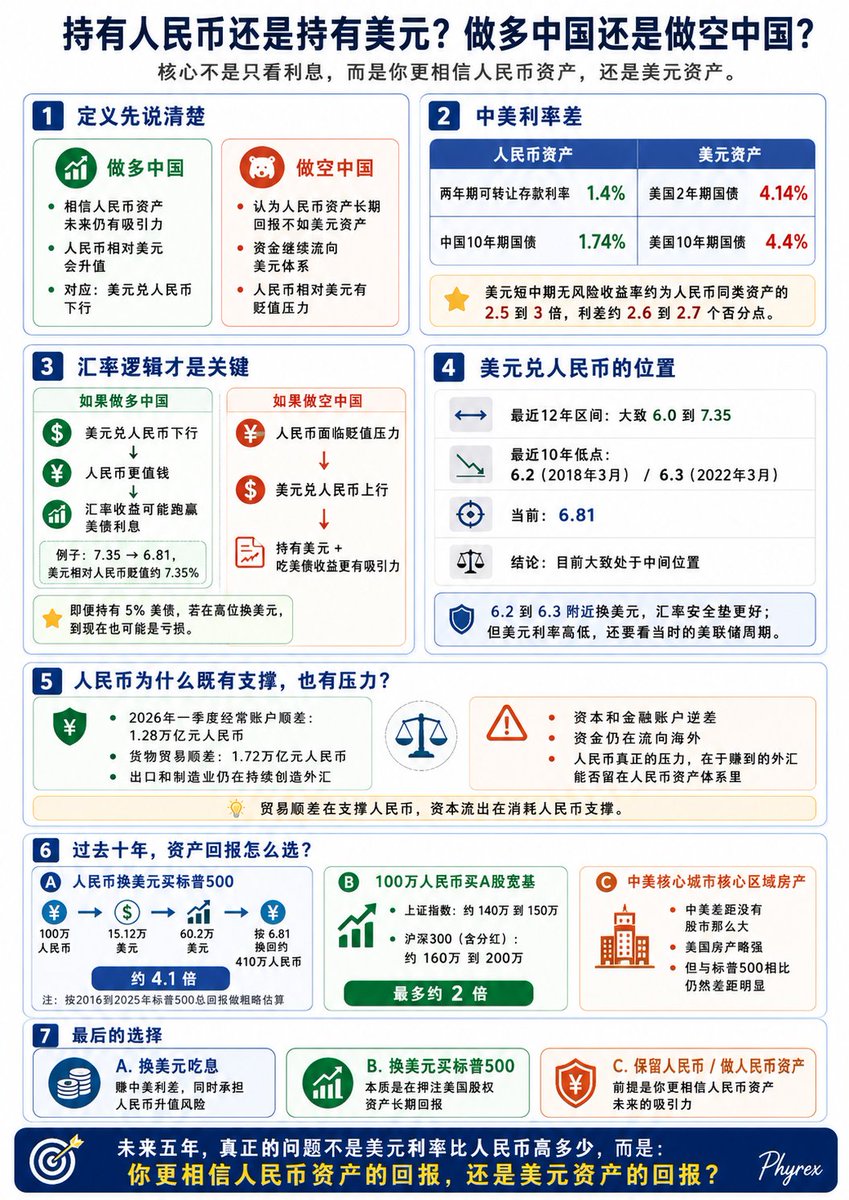
To start with, being bullish on China means believing that RMB assets will still have attractiveness in the future and that RMB will appreciate against USD. Being bearish on China means believing that the long-term returns of RMB assets are less than those of USD assets, and that capital will continue to flow into the USD system, putting depreciation pressure on RMB against USD.
Currently, the interest rate for RMB time deposits is already very low, with the two-year transferable deposit interest rate at 1.4% (China Merchants Bank), while the yield on Chinese ten-year government bonds is about 1.74%.
Currently, the yield on US two-year government bonds is 4.14%, and the yield on ten-year government bonds is 4.4%.
If we purely look at interest rates, it is certain that the yield on USD is higher with the same amount of capital. The short to medium-term risk-free yield of USD is about 2.5 to 3 times that of similar RMB assets, with an interest rate spread of approximately 2.6 to 2.7 percentage points.
So is it more suitable to convert RMB to USD to earn interest? The most important thing here is not the “interest” itself, but rather whether one is preparing to be bullish on China or bearish on China! Or in other words, whether to be bullish on RMB or bearish on RMB.
The practical significance of being bullish on China is that the exchange rate of USD to RMB is continuing to decline, and RMB will be more valuable against USD. Even if the interest on US bonds is higher, the potential gains from RMB in terms of exchange rate might be more.
For example, in this cycle, the highest exchange rate of USD to RMB was 7.35, meaning 7.35 RMB could exchange for 1 USD, while the current exchange rate is 6.81, meaning 6.81 RMB can now exchange for 1 USD, indicating that USD has depreciated by 7.35% against RMB.
This is quite obvious; even if holding US bonds with a 5% high yield, compared to RMB, if one exchanged RMB for USD at a peak, it would now be a “loss”.
But what if one is bearish on China? Being bearish on China implies that China's development may remain in a Japan-style low-growth, low-confidence, low-asset-return environment for a long time.
This suggests that RMB may head toward depreciation against USD, thus converting to USD and earning the returns on US bonds would be amplifying gains for individual assets.
In other words
Looking at historical data from the past twelve years, the lowest point of USD to RMB exchange rate is 6, and the highest point is 7.35, but if we narrow the time frame to the last ten years, the lowest exchange rates were approximately 6.2 and 6.3, seen in March 2018 and March 2022, respectively. In this context, the current 6.81 is roughly in the middle position.
If we assume that being bullish on China holds, then according to historical data, converting RMB to USD around 6.2 would be equivalent to buying USD at a low price, but such a period may coincide with the low point of the US Federal Funds Rate, indicating that the interest may not even be higher than that of RMB.
However, from a return perspective, it may likely indicate a new round of exchange rate misalignment.
I do not know how China’s next trajectory will unfold, but I believe that given China’s current scale, the probability of falling into a hard recession is low. China still has a strong support, namely, trade and current account surpluses.
In the first quarter of 2026, China’s current account surplus reached 1.28 trillion RMB, of which the goods trade surplus was 1.72 trillion RMB, while the capital and financial account showed a deficit of the same scale, indicating that on one side, the trade surplus supports RMB, while on the other side, there are pressures from capital outflows.
In simple terms, China's goods trade surplus is still significant, with exports and manufacturing continuing to create foreign exchange, which strongly supports RMB. But on the other hand, the capital and financial account shows a deficit, and funds are still flowing overseas. Thus, the real pressure on RMB is whether the foreign exchange that China earns can remain within the RMB asset system.
Therefore, the options of being bullish or bearish on China are not straightforward.
Even if choosing to be bullish on China, it does not mean one cannot also choose to be bullish on the US, or in other words, whether being bullish on the US is safer, or being bullish on China is safer?
This question is more difficult to answer and yet easier to answer.
It is difficult to answer because no one knows whether tomorrow or unexpected events will come first, nor can one determine with 100% certainty whether the US will perform better or China will perform better over the next period of time.
However, looking from the stock market perspective, it is a different matter and easier to answer.
Assume that ten years ago you had 1 million RMB.
On June 24, 2016, the USD to RMB exchange rate was approximately 6.615, meaning 6.615 RMB could buy 1 USD. If at that time, 1 million RMB was converted to USD to buy the S&P 500, the total return of the S&P 500 from 2016 to 2025 over ten years would be nearly 298%, meaning the principal would become approximately 3.98 times.
1 million RMB at that exchange rate could convert to about 151,200 USD, and investing in the S&P 500 for ten years with compounding returns would yield 3.98 times, resulting in 602,000 USD, which when converted back to RMB at 6.81 would equal 4.1 million RMB.
This means that the principal would multiply by 4.1 times when investing in the S&P 500.
What about holding RMB and investing it in A-shares?
In June 2016, the Shanghai Composite Index was around 2800 points, and now it is about 4100 points. Looking solely at the index price, the ten-year increase of the Shanghai Composite Index is about 40%. If 1 million RMB had been invested in the Shanghai Composite Index, it would be rough to say it has now become about 1.4 million to 1.5 million RMB.
If investing in the CSI 300, the performance would be slightly better than the Shanghai Composite Index. In mid-2016, the CSI 300 was a bit above 3000 points, and now it is around 4900 points, with the index price increase being roughly 60%. If dividends are taken into account, it might be in the range of 70% to 90%.
This means if 1 million RMB had been invested in the broad-based A-share index, it may now have transformed into approximately 1.6 million to 2 million RMB.
This means that investing in the broad-based A-share index would result in at most a doubling of the principal.
What if one does not trade stocks but only buys real estate? Comparing the core areas of major cities in the US and China, I won’t provide data, as the gap between the US and China is not very obvious. US property might be slightly more valuable, but overall, the appreciation of assets compared to the S&P 500 is still vastly different.
Of course, all this is based on data from the past ten years and does not guarantee that the next ten years will be alike, but this does not hinder our investment philosophy. If over the next five years —
You choose to be bearish on China, believe in the bearishness of RMB assets, and think that USD against RMB will rise again in the future, then converting RMB to USD, whether to earn USD interest or to benefit from exchange rate changes, may be more attractive than merely holding RMB.
If you choose to be bullish on China, believing that the Chinese market is better compared to the US market and that RMB is more valuable than USD, then holding RMB or investing in RMB assets is the right choice.
If you choose to be bullish on the US, then converting RMB assets to USD and then investing in the S&P 500 or NASDAQ 100 index may yield higher returns.
Summary
If you are simply converting RMB to USD to earn interest, you are essentially earning the interest rate differential between China and the US, while also bearing the risk of RMB appreciation.
If converting RMB to USD to buy the S&P 500, you are essentially betting on the long-term returns of US equity assets.
Being bullish on China means believing that RMB assets will have attractiveness in the future, and that RMB will not depreciate significantly, and may even appreciate.
Being bearish on China means believing that China may have long-term low growth, low confidence, and low asset returns, while capital continues to flow into the USD system, with the interest, stock market, and asset returns of USD assets being more attractive.
So in the next five years, do you believe in the returns of RMB assets or in the returns of USD assets??
#Bitget is here, just for VIPs! Crypto, US stocks, CFDs, global opportunities all in one place
免责声明:本文章仅代表作者个人观点,不代表本平台的立场和观点。本文章仅供信息分享,不构成对任何人的任何投资建议。用户与作者之间的任何争议,与本平台无关。如网页中刊载的文章或图片涉及侵权,请提供相关的权利证明和身份证明发送邮件到support@aicoin.com,本平台相关工作人员将会进行核查。


