Author: Rita
Tide Guide Reading
On June 23, Morgan Stanley released an in-depth report on TSMC's supply chain. Core judgment: Based on the latest supply chain survey, it raised its forecast for global CoWoS advanced packaging demand in 2027, stating that TSMC's AI-related revenue will reach $86.3 billion in 2027, a 218% increase from $27.1 billion in 2026. NVIDIA remains the core driver, but AMD's CPUs and Google's TPUs have become new growth engines. Most importantly, even if TSMC expands CoWoS capacity to 200,000 wafers per month, it may still not meet the global demand gap of 2.69 million wafers.
TSMC's AI Revenue Sees Explosive Growth
Looking at the numbers directly, Morgan Stanley predicts that TSMC's AI-related revenue will reach $86.3 billion in 2027, compared to $27.1 billion in 2026, marking a 218% increase. This is an exponential leap, not linear growth.
Breaking down the $86.3 billion composition, GPU revenue is $28 billion, custom AI chip revenue is $18 billion, CoWoS advanced packaging revenue is $40 billion, and AI server CPU revenue is $300 million. TSMC's role in the AI chip industry chain is not just wafer manufacturing; advanced packaging has become an equally important source of revenue.
By 2028, this number will continue to climb to $106.6 billion. In just three years, TSMC's AI business scale has nearly tripled. The construction of the entire AI infrastructure is far from saturation, and TSMC, as a shovelist company, is still in the capacity ramp-up phase.
But can capacity really keep up?
NVIDIA's demand for TSMC's CoWoS capacity is still the absolute main force. Morgan Stanley estimates that the total consumption of CoWoS by NVIDIA's Rubin and Blackwell GPUs and the newly launched Vera CPUs will reach 1.222 million wafers in 2027, representing a 57% year-on-year growth.
But what truly surprised Morgan Stanley was AMD. AMD's total CoWoS consumption is expected to surge by 308%, increasing from 120,000 wafers in 2026 to 530,000 wafers in 2027. The driving force behind this growth is AMD's Venice CPUs and MI400 series GPUs' full support for agent-based AI. The CPU market is being rapidly penetrated by AI, not just GPUs.
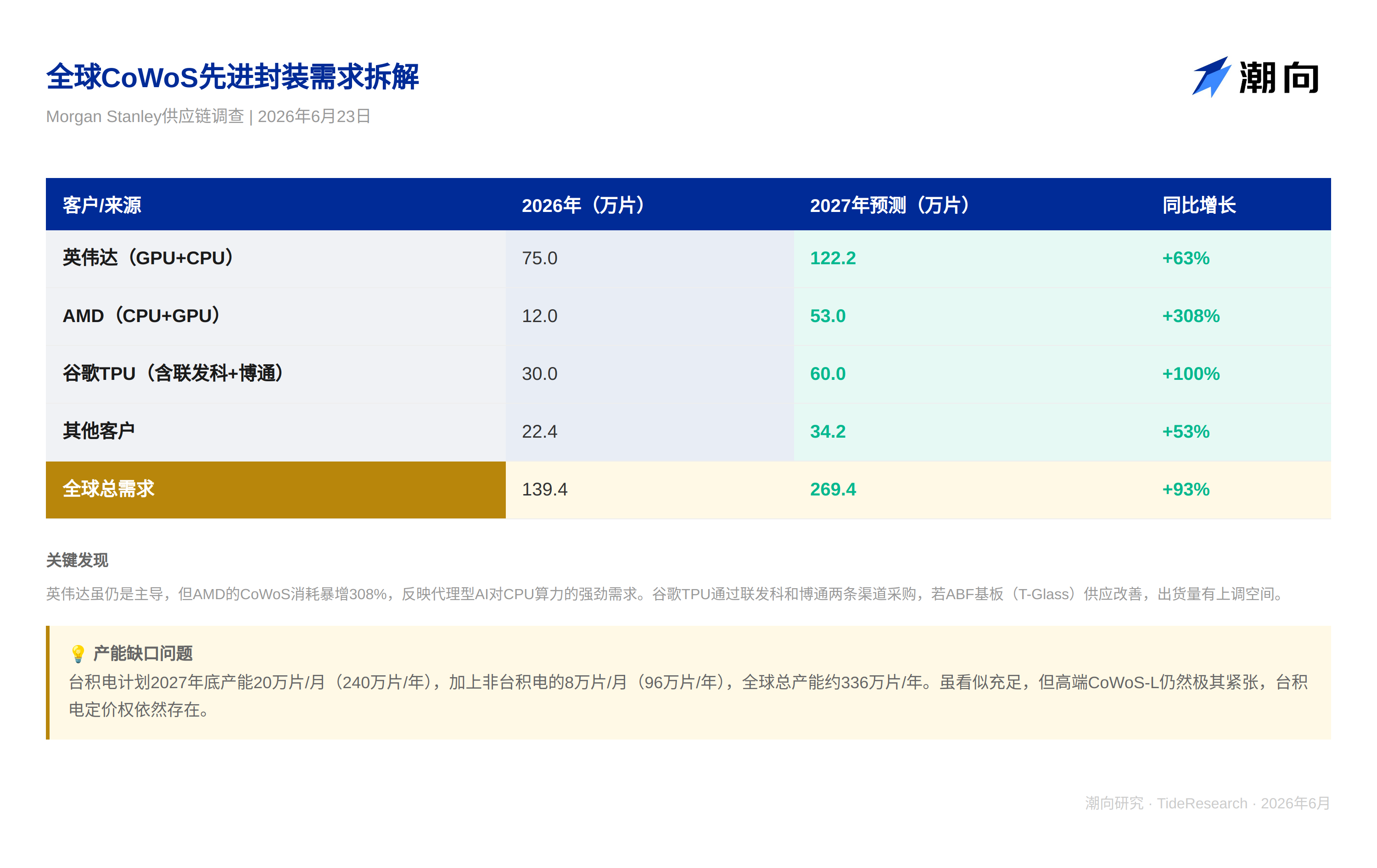
This change is significant. Last year, the market was still discussing the monopoly position of GPUs, but this year Morgan Stanley clearly sees that data centers are simultaneously expanding GPU and CPU procurement. NVIDIA's CPUs are also consuming capacity, while AMD's CPU consumption has surged. The demand for CPU computing power in AI inference is far beyond expectations.
Google TPU Quietly Becomes the Second Major Player
Besides NVIDIA and AMD, Morgan Stanley also specifically emphasized the demand for Google's TPUs. Google procures CoWoS advanced packaging through two channels: first, MediaTek as a design service partner, and second, Broadcom's participation. These two companies design and manufacture TPU chips for Google, requiring large amounts of CoWoS capacity.
Morgan Stanley believes that if the supply of ABF substrates improves, the shipment volume of TPUs that MediaTek helps Google procure has significant upward adjustment potential, and the current forecast may still be conservative. Google's ambition for AI chips has not yet been fully unleashed.
The CoWoS Capacity Gap Cannot Be Filled
Now, back to the critical issue: capacity.
Global CoWoS demand is 1.394 million wafers in 2026, and is expected to jump to 2.694 million wafers in 2027, a 93% increase. TSMC plans to expand CoWoS capacity to 200,000 wafers per month by the end of 2027, and non-TSMC capacity is also expected to expand to 80,000 wafers per month. Combined, the global capacity will be about 280,000 wafers per month, equivalent to an annual capacity of 3.36 million wafers.
It seems sufficient, but the problem is that 2.694 million wafers is an estimate of global demand, and Morgan Stanley's survey may not have captured all demand signals completely. Furthermore, the distribution of high-end CoWoS-L and CoWoS-S is also critical. CoWoS-L, which NVIDIA needs, is the most advanced and extremely tight, which happens to be TSMC's strength.
Although total capacity seems sufficient, at the highest end of advanced packaging, TSMC is still in a state of supply not meeting demand. This gives TSMC pricing power and explains why Morgan Stanley's rating for TSMC is "overweight."
Emerging Demand Catalysts Keep Coming
Morgan Stanley listed three recent catalysts. First is the improvement in ABF substrate supply, especially the release of T-Glass capacity procured by MediaTek, which will directly boost Google TPU shipments. Second is the validation of emerging CPU demand; both NVIDIA's Vera and AMD's Venice have begun large-scale shipping, which will continue to drive CoWoS consumption. Third is the mass production of NVIDIA's next-generation product, Rubin Ultra, which is expected to see significant shipments in the second half of the year.
These catalysts together mean that TSMC's CoWoS business will not lack orders in 2027; the key is whether capacity can keep up. From this perspective, TSMC's capital expenditure cycle is far from over.
New Winners in the Supply Chain
The report highlights several companies that are worth paying attention to. MediaTek is listed as a preferred stock because it is the main design partner for Google TPUs and directly benefits from the growth of AI demand. ASE Technology and Jingyuan Electronics are also reaffirmed as overweight; they serve AMD's Venice CPU supply chain and NVIDIA's GPU supply chain, respectively.
TSMC itself remains the core beneficiary, but Morgan Stanley's view is that the entire AI supply chain is benefiting, not just the chip design end.
TSMC's AI revenue growth is indeed remarkable; doubling to $86.3 billion in 2027 is not a dream. But this growth depends on whether capacity can indeed be built, and most critically, advanced packaging capacity will not become a new bottleneck. Morgan Stanley believes it won't, but also clearly points out that the differentiation in the supply chain is intensifying, and the line between winners and losers is being redrawn.

Disclaimer
This article is a compilation and interpretation of third-party brokerage research reports by Tide Research. The ratings, target prices, earnings forecasts, and related judgments quoted in the text are solely the views of Morgan Stanley analysts, representing the stance of their institution, and do not represent the views of Tide Research, nor constitute any investment advice.
Please be aware of three points while reading: First, the target price is an analyst's expectation for the future of about 12 months, it is a forecast, not a commitment, and it will be adjusted repeatedly with performance and market conditions. Second, sell-side research reports are naturally biased towards bullish views, and some of the covered companies have investment banking relationships with the brokerage. Third, the value of research reports lies in the main line logic and its premise assumptions, rather than a single target price. Focus on logic, not just on prices.
The market has risks, decisions must be independent. This article should not be used as a basis for buying or selling any securities.
Data source: Morgan Stanley Research Report (Charlie Chan et al., June 23, 2026) · Public Market Data
Tide Research · June 2026
免责声明:本文章仅代表作者个人观点,不代表本平台的立场和观点。本文章仅供信息分享,不构成对任何人的任何投资建议。用户与作者之间的任何争议,与本平台无关。如网页中刊载的文章或图片涉及侵权,请提供相关的权利证明和身份证明发送邮件到support@aicoin.com,本平台相关工作人员将会进行核查。


