Author: Rita
Tide Research Overview
Bernstein released its quarterly review of the semiconductor industry on June 23. Core points: AI has become the "one game" in the semiconductor sector, with strong fundamentals, but valuations and congestion are at historical highs. The report also recommends NVDA and AVGO (rated "outperform"), arguing that while they have underperformed this year, they are the most core beneficiaries in the AI supply chain, and their current valuations are "absurdly cheap." It raised AMD's rating but remains cautious about QCOM due to pressure in its mobile business.
AI Demand Drives Record Gains in Semiconductor Sector
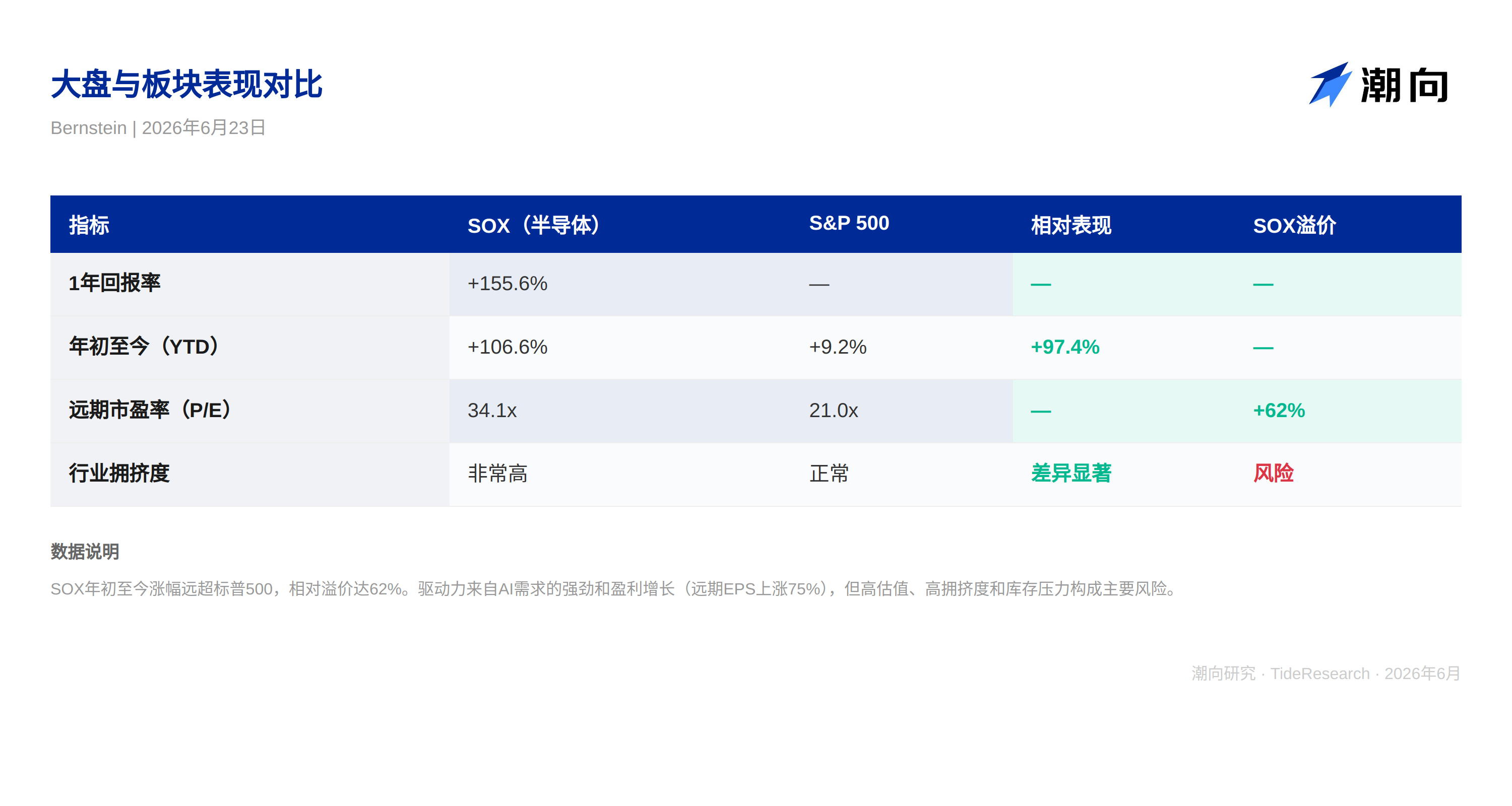
The Philadelphia Semiconductor Index (SOX) has increased by 155.6% over the past year and 106.6% year-to-date. In the same period, the S&P 500 has only risen 9.2%. The premium of SOX over the S&P 500 has reached 62%.
This gain is driven by fundamentals rather than a bubble. Bernstein's data shows that the forward EPS of SOX has risen by 75% since the beginning of the year, while the expansion of the valuation itself is only a small part of it.
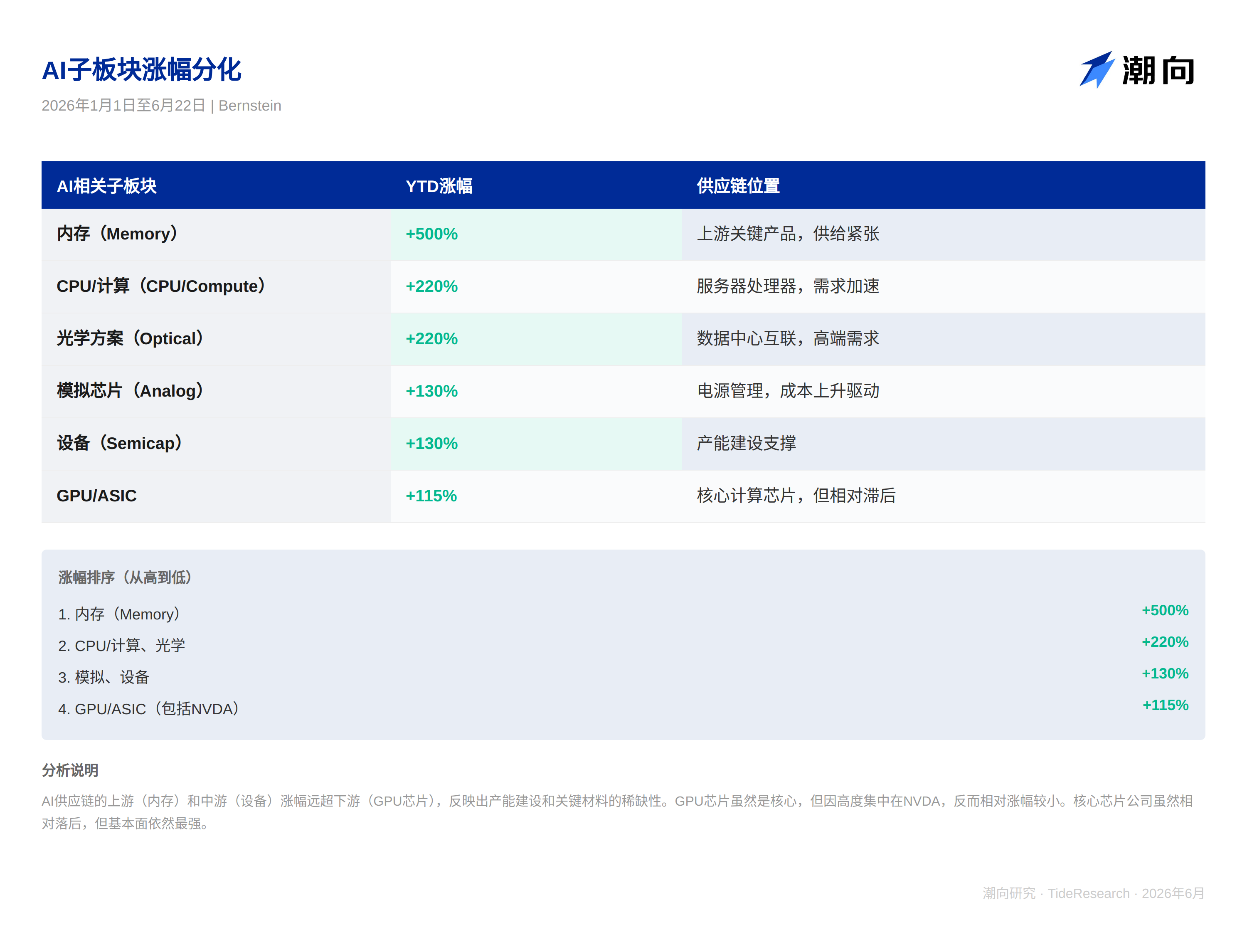
The divergence within the semiconductor sector has reached an exaggerated level. From the beginning of the year to June 22, memory chips rose by 500%, CPUs and optical solutions each rose by 220%, while GPUs and ASICs only rose by 115%. The entire AI supply chain is profitable, but the profits and degree of profitability are not uniform. The upstream and downstream beneficiaries are the most advantaged, as building new production lines requires memory and semiconductor equipment, with supply relatively tight. GPUs only increased by 115%, despite NVDA holding the vast majority of the market share in AI chips.
Real Purchasing Power Under High Valuations
The forward P/E of SOX is now 34.1 times, while the S&P 500 is at 21.0 times, with a premium of 62%. This sounds expensive, but it depends on the specific companies, among which NVDA's expected adjusted EPS for 2026 is $9.19, and for 2027, it is $12.52. According to Bernstein's target price of $315, the P/E for 2027 is 25 times, while the sector's overall forward P/E is 34 times. NVDA is not the most expensive; it is relatively cheap.
Bernstein's analyst Stacy Rasgon used a term: "absurdly cheap."
His reasoning is straightforward: NVDA's Blackwell chip series is expected to reach a revenue scale of $1 trillion by 2027. AVGO's situation is similar, with a target price of $550; however, if it reaches the $10 billion AI-related revenue target by 2030, the current valuation appears very cheap.
This is why Bernstein rates both companies as "outperform." Although they have underperformed this year, they are the most core links in the AI demand chain. In comparison, Apple's forward P/E is around 28 times, and Microsoft's is 30 times, while NVDA is at 25 times. Additionally, considering the continuity of the two generations of products, Blackwell and Rubin, as well as AVGO's monopoly position in switch chips, these valuation discounts appear extremely unreasonable. Capital has overlooked a core fact: without NVDA and AVGO's chips, the entire AI infrastructure would grind to a halt.
The Dual Story of CPUs and QCOM's Single Dilemma
AMD was recently upgraded by Bernstein to "outperform." What was the reason for the upgrade? Because AMD has opportunities not only in AI/GPU but also in the CPU proxy AI trend. CPU shipments are beginning to improve quarter-on-quarter in Q1 2026, slightly above personal computer shipments. Bernstein believes that AMD’s fundamentals are sufficient to support a target of $20 in earnings per share by 2028, and the current stock price still has room to rise relative to this target.
QCOM, on the other hand, is caught in a single dilemma. Smartphone shipments dropped by 3% year-on-year in Q1 2026, and rising memory chip prices mean increased costs for smartphones, negatively impacting the pricing power of chip suppliers. Bernstein admits that the previous downgrade of QCOM was a "poor decision," but still maintains a "market-perform" rating. The problem is that the weakness in consumer electronics has become established, making it difficult for QCOM to find new growth engines. Even if analysts can provide a new story for data centers in the future, compared to AMD's dual drivers and the structural position of chip manufacturers, QCOM's story lacks persuasiveness.
Real Considerations for Sub-Sectors
Semiconductor equipment (AMAT, LRCX, KLAC) continues to be viewed positively, with strong demand for capacity building; all three companies are rated "outperform," with target price increases between 30% to 70%.
The situation for analog chips (ADI, TXN) is more complex. They are indeed in a recovery cycle, achieving double-digit growth for over a year, but the proportion of data center business remains small, around 10%. TXN and ADI's P/E ratios between 30 and 40 times appear quite expensive. Bernstein has given both a "market-perform" rating, opting to wait and see.
The Risks of Congestion and Inventory
Bernstein's industry sentiment indicators show that the level of congestion in the semiconductor sector is at historical highs. Inventory days have risen again, far above the upper limit of the historical normal range; while channel inventories have decreased, they are still above average levels. What does this mean? It means that if there are any signs of weakness in downstream demand, the entire supply chain will face pressure to actively reduce inventory. PCs and consumer segments have already shown signs of weakness, and smartphones have actually declined year-on-year. Once inventory pressure spreads to data center procurement, the threat of a price war will materialize. At this point, companies near the bottleneck (NVDA, AVGO) will see their pricing power severely weakened.
The strength of AI demand is beyond doubt, but the current high valuations in the semiconductor sector have priced in these good news. NVDA and AVGO are relatively cheap, but it is premised on the belief that they can meet analysts' targets. AMD's story is attractive, but execution risks are also present. QCOM has become the forgotten character, with no clear catalysts. Bernstein's position is selectively bullish; at this time, the importance of stock picking has exceeded merely being right about the direction.
Disclaimer
This article is a compilation and interpretation of third-party broker research reports by Tide Research. The ratings, target prices, earnings forecasts, and relevant judgments quoted in the text reflect the views of Bernstein analysts and represent only their institution's stance, not those of Tide Research, and do not constitute any investment advice.
Please note three points when reading: 1. Target prices are analysts' expectations for the next approximately 12 months, predictions rather than commitments, and will be repeatedly adjusted according to performance and market conditions. 2. Sell-side research reports tend to be bullish, and some covered companies have investment banking relationships with the brokerage. 3. The value of research reports lies in the mainline logic and underlying assumptions, rather than a specific target price. Focus on the logic, not just the price.
Markets are risky; decisions should be made independently. This article should not be used as a basis for buying or selling any securities.
Data source: Bernstein Research Report (Stacy A. Rasgon et al., June 23, 2026) · Public market data
Tide Research · TideResearch · June 2026
免责声明:本文章仅代表作者个人观点,不代表本平台的立场和观点。本文章仅供信息分享,不构成对任何人的任何投资建议。用户与作者之间的任何争议,与本平台无关。如网页中刊载的文章或图片涉及侵权,请提供相关的权利证明和身份证明发送邮件到support@aicoin.com,本平台相关工作人员将会进行核查。


