Meta forms a team to develop a prediction market APP called Arena.
Written by: Maher, Foresight News
The world's largest social technology giant, Meta, officially enters the prediction market sector.
On June 23, Meta Platforms CEO Mark Zuckerberg recently instructed the company to form a small team to develop a prediction market style smartphone application named "Arena" to compete with Polymarket and Kalshi.
Point System Start
According to insiders revealed to The New York Times, Arena is currently in an early experimental phase, with a relatively high internal priority, but there is still uncertainty about whether it will eventually be launched. The application will operate as an independent product and will not be deeply integrated with core social apps like Facebook, Instagram, WhatsApp, or Messenger; users will need to download it separately to use.

Users can predict outcomes related to political elections, sporting events, entertainment incidents, and global affairs. The initial version does not involve real money betting, but instead adopts a points system similar to video games, allowing users to accumulate points, rankings, and achievements through accurate predictions. This design is highly similar to Meta's Forecast application launched in 2020—at that time, Forecast also employed a points mechanism, enabling users to crowdsource predictions on global events like the COVID-19 pandemic, but the application was shut down in 2022.
Insiders also revealed that although the initial focus is on the points system, the company has not completely ruled out the possibility of introducing real money betting in the future.
Meta plans to leverage its more than 3.56 billion daily active users to quickly kickstart user growth for Arena through cross-platform traffic. This is also a typical approach in recent years where it has tried independent apps (such as the AI-driven Meta Photos). However, independent apps in the past have faced significant challenges related to user discovery and conversion for downloads.
Prediction Market Industry Explosion
The launch of Arena coincides with the prediction market industry entering a phase of rapid growth. According to The New York Times citing data, by 2025, the combined online trading volume of the top platforms, Polymarket and Kalshi, is estimated to be about $50 billion; by 2026, this number has quickly surpassed $130 billion.
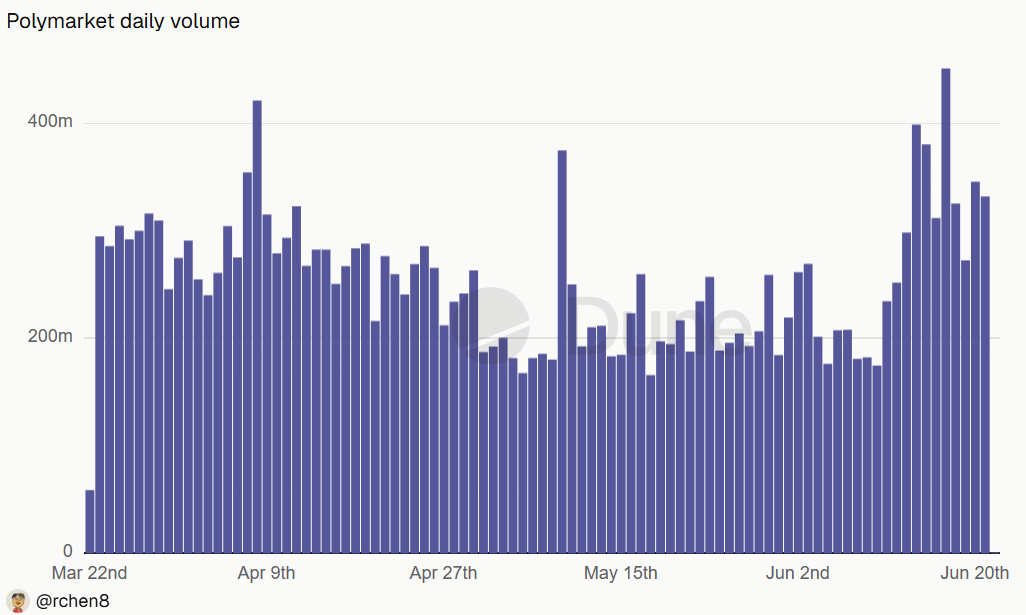
Currently, Polymarket's valuation has risen to around $20 billion, with its monthly active traders exceeding 600,000 at one point, and the daily trading volume exceeding $200 million in the most recent month.
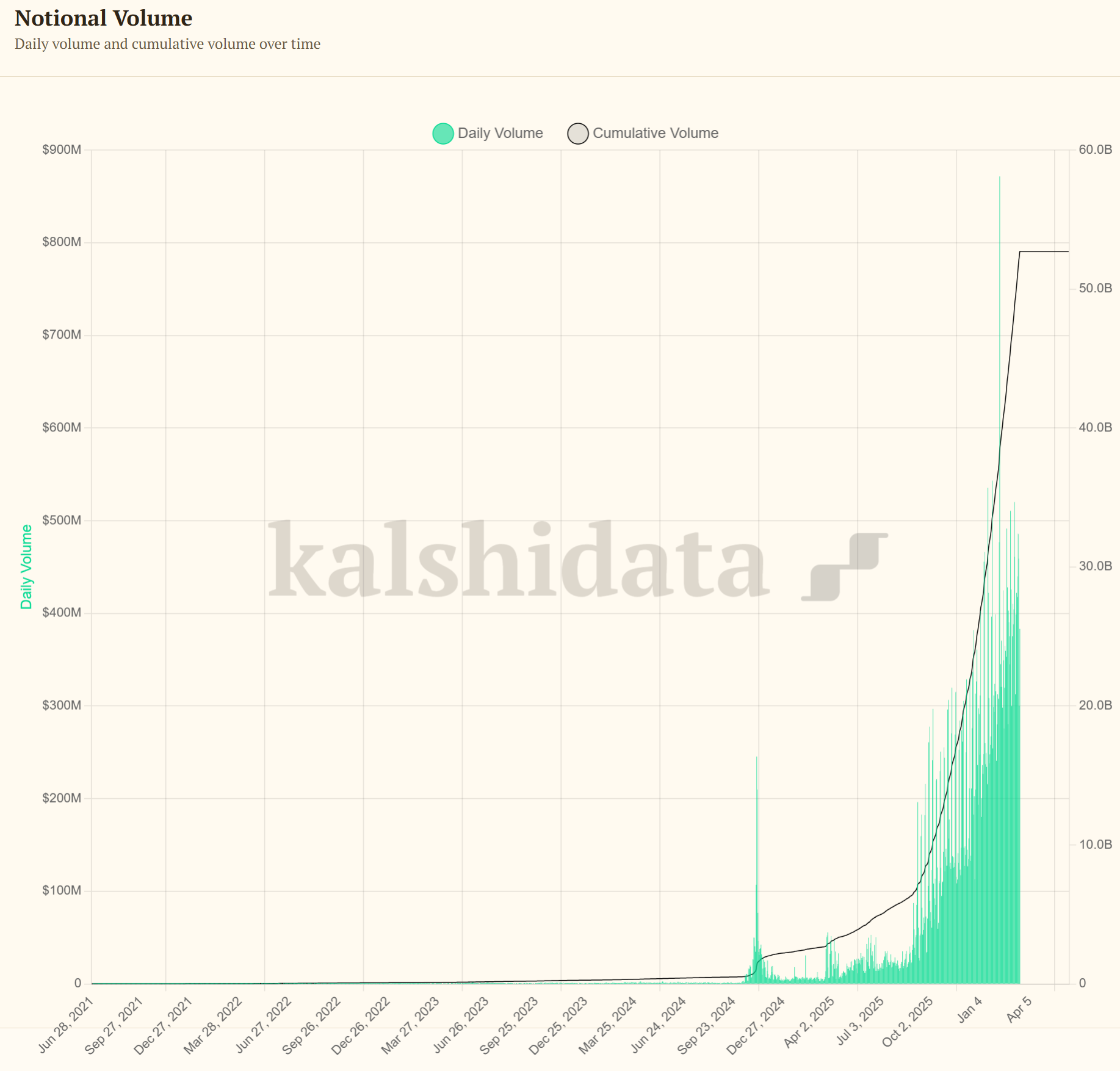
Kalshi's valuation has climbed to $22 billion and is currently engaging in IPO discussions. As of June 22, Kalshi's total trading volume has reached $52.7 billion, with an average daily trading volume of $29.27 million.
The revenue model for prediction market platforms is clear: they charge fees on each settled market transaction (typical rates are in the 2%-5% range). With a trading volume in the hundreds of billions, a single platform has significant annual revenue potential. According to the latest data, Kalshi's projected annual revenue is nearly $2 billion.
Even with the initial points system, Arena can generate revenue through virtual goods, leaderboard privileges, sponsored markets, or subscriptions. Once conditions are ripe to switch to a real money model, the platform's cut will directly translate into scaled cash flow. Meta's investment capabilities in compliance, payment infrastructure, and legal resources far exceed that of startup platforms.
Moreover, user prediction behavior on Arena will generate highly valuable interest graphs and belief data—for example, attention levels towards specific political issues, sports stars, or technological events. This data can feed back into Meta's core advertising system to achieve more precise targeted delivery or develop event-driven sponsorship products. Traditional betting giants like DraftKings and FanDuel, crypto exchanges like Gemini, and players like Trump Media Technology Group have all entered or plan to enter the prediction market space. Meta's proactive positioning can capture early user interest and liquidity advantage.
Making money is one aspect, but the underlying strategy is also noteworthy.
Zuckerberg's decision aligns with his consistent strategy of "following users." Over the past decade, Meta has repeatedly achieved growth through rapidly cloning or internally incubating popular social formats—from the Stories feature replicating Snapchat, to Reels competing with TikTok. Now, prediction markets have become one of the fastest-growing "destinations" and cultural phenomena online, and Zuckerberg clearly does not want to miss this opportunity.
A deeper reason is the changing content form of core apps. As Facebook and Instagram shift towards short videos and algorithmic recommendations, the internal space for testing new features has been compressed. Meta executives believe this drives the company to develop more independent apps to test emerging social behaviors. Arena is the latest experimental project under this strategy, alongside AI-related independent apps like Meta Photos.
The advantage of user base is Meta's most vital moat. With 3.56 billion daily active users, Arena can bypass traditional cold start issues by drawing direct traffic from the existing ecosystem. This is particularly critical in the prediction market field, where early liquidity and participation determine market depth and accuracy.
Additionally, the prediction market's high-frequency interactive nature (repeatedly checking updates, discussing, sharing predictions) is expected to significantly enhance overall user stay time and engagement within the Meta ecosystem, aligning closely with the fundamental logic of Meta's advertising business.
Real Challenges
This is not Meta's first attempt at a prediction market. The Forecast launched in 2020 was an early experiment in points-based crowd predictions but was ultimately shut down in 2022 for various reasons. Arena can be seen as an upgraded version of this concept.
However, regulatory risks are an unavoidable hurdle.
The U.S. CFTC has tightened scrutiny on event contracts, with cases of insider trading already emerging. The real money version will need to face compliance pressures from various state gambling laws and consumer protection regulations. Kalshi and Polymarket face lawsuits and bans in multiple regions.
Although Arena's initial points system may avoid some risks, long-term commercialization still cannot bypass this hurdle.
Furthermore, Meta's previous independent app conversion rates have not been ideal, and user discovery and retention remain core challenges. Senator Richard has publicly criticized that Meta's move perpetuates its "profit through addiction mechanisms" business model.
免责声明:本文章仅代表作者个人观点,不代表本平台的立场和观点。本文章仅供信息分享,不构成对任何人的任何投资建议。用户与作者之间的任何争议,与本平台无关。如网页中刊载的文章或图片涉及侵权,请提供相关的权利证明和身份证明发送邮件到support@aicoin.com,本平台相关工作人员将会进行核查。


