Solana has dominated the on-chain spot market, driven primarily by the PropAMM architecture. However, in the Perp market, HyperLiquid has formed an overwhelming dominance with over 70% of OI and trading volume share.
Author: Kokii
TLDR
- Solana has dominated the on-chain spot market (total chain DEX share ~30%, price spreads approaching CEX), primarily driven by PropAMM architecture. However, in the Perp market, HyperLiquid has formed an overwhelming dominance with over 70% of OI and trading volume share.
- The root of the gap is not speed, but unpredictability of ordering: Solana’s Leader scheduling mechanism fails to provide market makers with certainty guarantees of "cancelling orders is better than eating orders," forcing MM to actively widen spreads and reduce depth, creating a vicious cycle of liquidity.
- Solana is countering on two levels: protocol layer (Alpenglow will ultimately reduce confirmation time to 150ms, MCP will break the single Leader monopoly, BAM/ACE will give application layer sorting programmability), application layer (Phoenix’s asymmetric CU scheduling, Bulk’s sidechain risk engine, JTX’s retail - professional channel).
- However, Solana’s long-term advantage lies not in replicating HyperLiquid, but in what HyperLiquid cannot do: DeFi composability, oracle pool models that naturally adapt to long-tail/RWA Perps, and transforming the enormous spot retail flow into an ecological flywheel of Perp participants. This is the structural ceiling of a dedicated chain architecture, and Solana’s long-term moat.
1. Contrast: Spot King, Contract Lagging
Solana DEX trading volume has long occupied 30% share of the total on-chain DEX volume, exceeding $100 billion in a single month, surpassing Ethereum and the total of L2 several times.
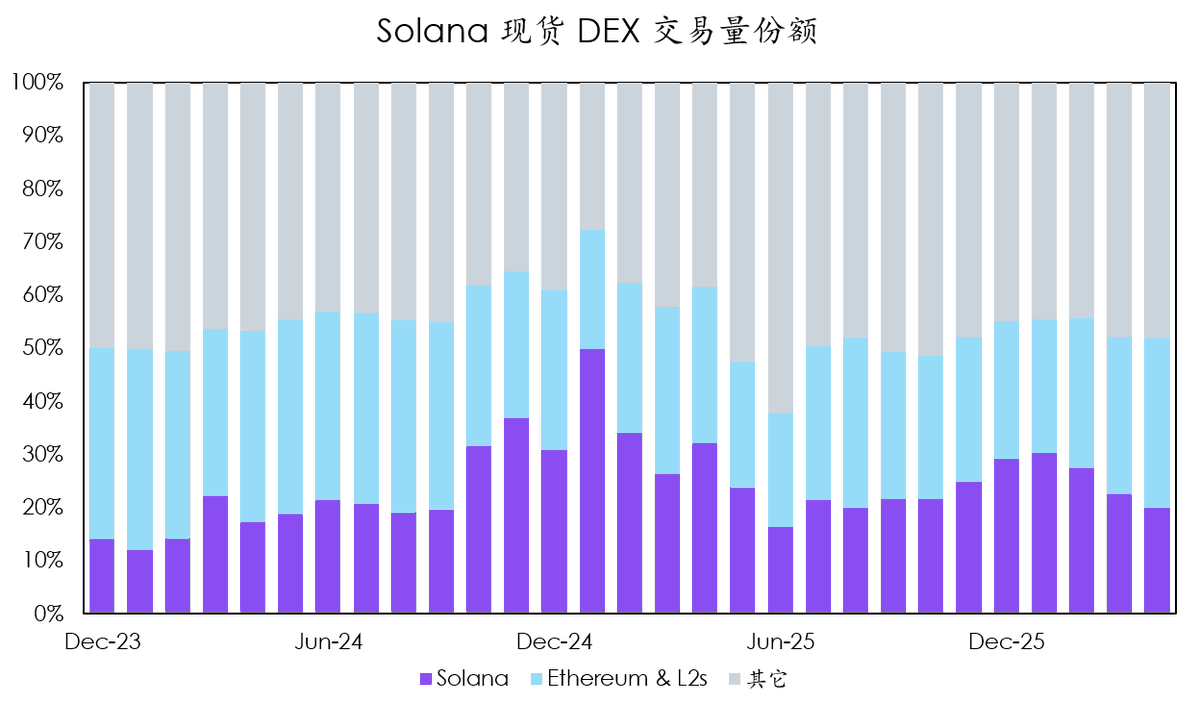
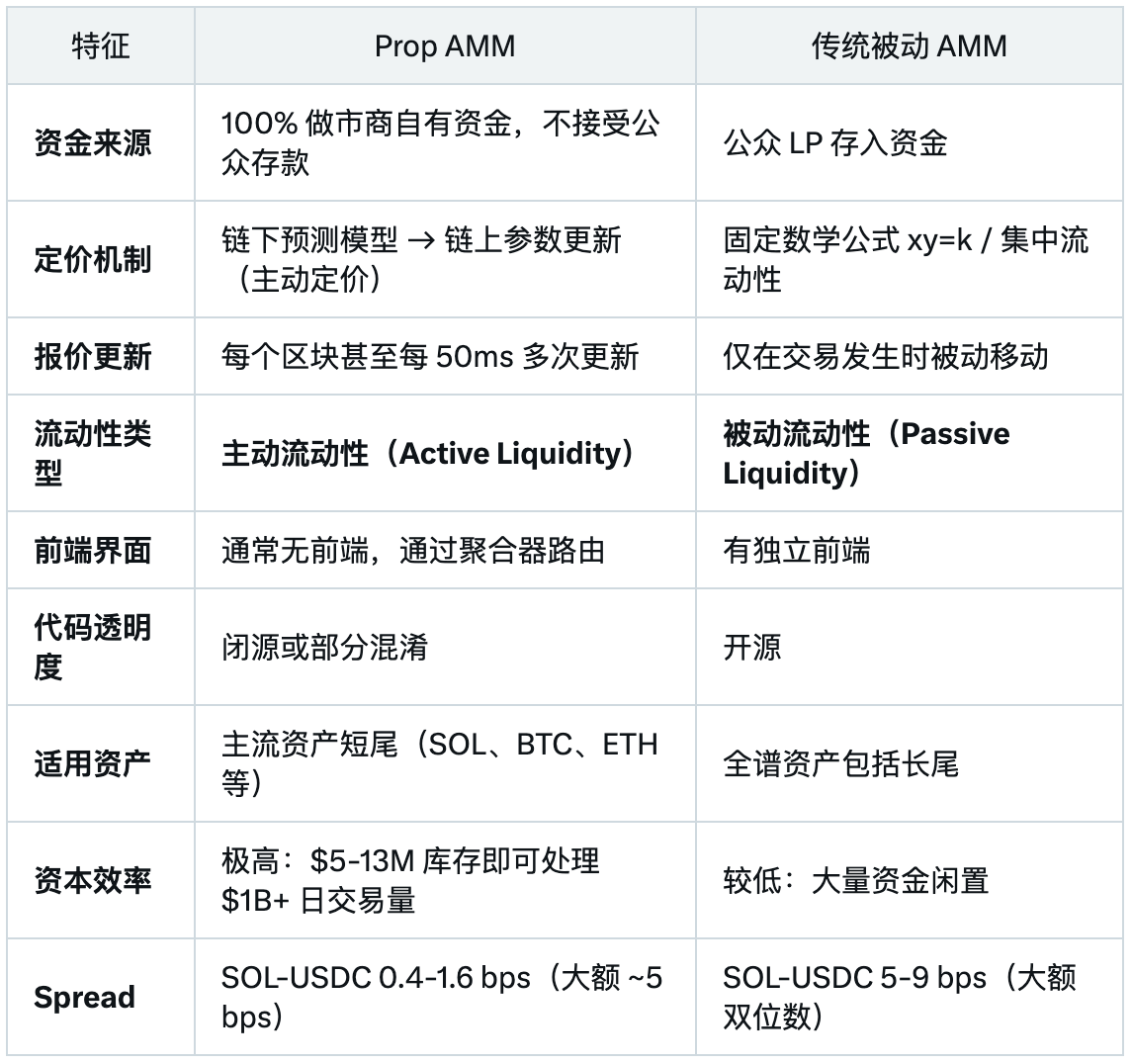
In price discovery efficiency, the price spread between mainstream assets (like SOL-USDC, BTC-USDC) and CEXs like Binance and OKX has become very small, with effective spreads for large trades as low as 0.4-1.6 bps, significantly better than the traditional AMM level of 5-9 bps.
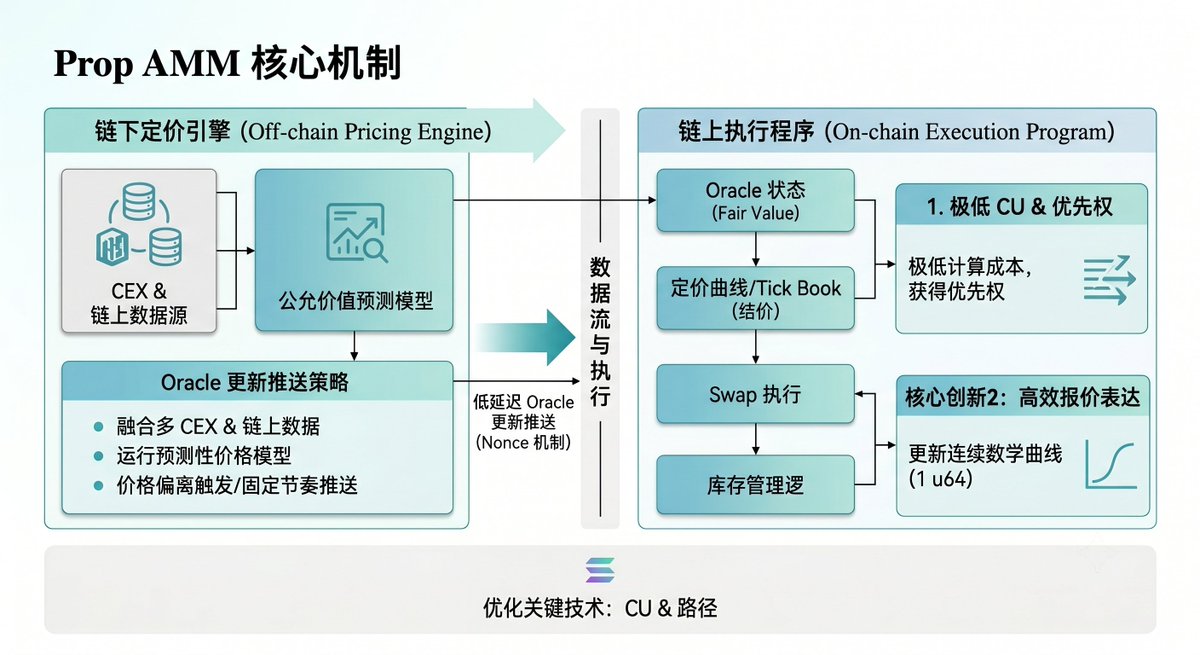
The core mechanism driving this result is PropAMM (Proprietary Automated Market Maker), with over 50% of current spot trading on Solana occurring on PropAMM: professional market makers like Wintermute / Jump directly encode closed-source pricing strategies into on-chain contracts, pushing quotes to the chain through oracles at high frequency, transforming market making logic from "passive liquidity provisioning" to "actively pushing the latest market prices."
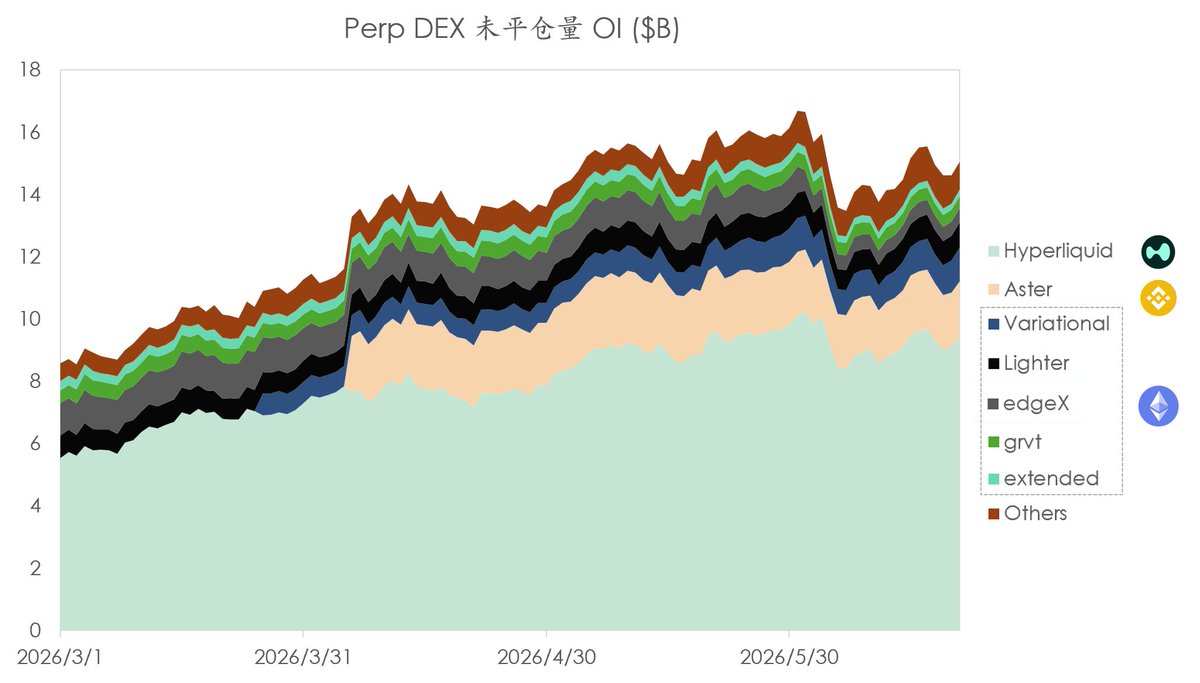
In contrast, the trading volume (Volume) of Solana Perp DEX and the market share of open interest (OI) pale by comparison. HyperLiquid dominates about 70% of the on-chain Perp market, while Aster (BNB ecosystem), Variational, Lighter, and edgeX (ETH ecosystem) are all striving to catch up. In contrast, Solana, which is considered suitable for Perp trading with its "centralized, high-performance" nature, has lagged in this cycle of Perp, suffering significantly after Drift was hacked recently.
2. Evolution Logic of Perp DEX: Why Dedicated Chains Won
The underlying reason is that spot is asset issuance, while contracts are price discovery. Solana’s past successes stemmed from consistently hitting the rhythm of new asset issuance, but the long-term pricing of Perps occurs on CEXs, with Perp DEXs working to bring prices on-chain through various means.
Opening the Binance spot and perpetual order book, they almost look identical, but the underlying engineering entities are completely different:
- Spot Matching: Matching = Settlement. The buy and sell sides engage in an asset swap; after the transaction is completed, there are no residual "positions" carried over. The engine does not need external dependencies, and risk drops to zero at the moment of transaction.
- Perp Matching: Matching is not the endpoint of settlement, but an event source—a domino chain. Each completed match triggers a complex downstream chain: marking price update → position update → margin recalculation → unrealized PnL refresh → possible liquidation triggers. The matching engine and risk control engine are deeply coupled.
Spot DEX can run with a simple xy=k formula and a few hundred lines of code, but Perp DEX has a much more complex and high-frequency operational logic to maintain:
- Matching: Maintaining the order book, executing price-time priority matching.
- Oracles / Index Prices: Maintaining the marking price system.
- Price Anchoring: Calculating and executing funding rates.
- Margin Management: Enforcing initial margin and maintenance margin rules.
- Liquidation: Forced closure when account equity drops below maintenance margin.
- Solvency Protection: Preventing systemic defaults through insurance funds and ADL mechanisms.
The early practices of Perp DEX with the oracle-LP pool model pulled prices from quote sources, with LP pools serving as counterparties to execute trades, creating significant trading volume on-chain with simple contracts (GMX peak daily trading volume ~$1B). This was during the golden period of DeFi Summer, where industry faith relied on beautifully designed mechanisms that could simply replicate all off-chain complex financial infrastructure on-chain, as Uniswap and Aave did. However, practice has shown this does not hold true for Perps:
- For traders: Order types, capital efficiency, matching delays, OI limits (restricted by TVL) lag far behind compared to CEX.
- For market makers: For large-scale professional market-making funds pursuing precise risk control, LPs cannot manage quotes and risks proactively as order book market makers can.
Professional market makers and traders require low latency, deterministic execution, high capital efficiency, and predictable risk engines. To replicate CEX experience on DEX, highly optimized and nearly vertically integrated infrastructure must be relied upon. General public chains have inherent disadvantages in architecture. The evolution of Perp DEX has gone through three generations of paradigms, constantly balancing performance, liquidity, and decentralization (no barriers to entry, transparent matching, withdrawal safety), ultimately landing on highly centralized architectures like Hyperliquid / Lighter / Aster that still retain decentralized characteristics:
- Self-developed full-stack infrastructure: Custom consensus mechanisms and execution engines provide deterministic trade ordering, extremely low and predictable delays, and a withdrawal and order experience without gas fees.
- Self-reinforcing liquidity: Market makers provide extremely narrow buy-sell spreads and very deep order depths → reducing friction costs for large and high-frequency traders, attracting large order flow → rapid increase in trading volume attracts more professional market makers to connect and provide better quotes.
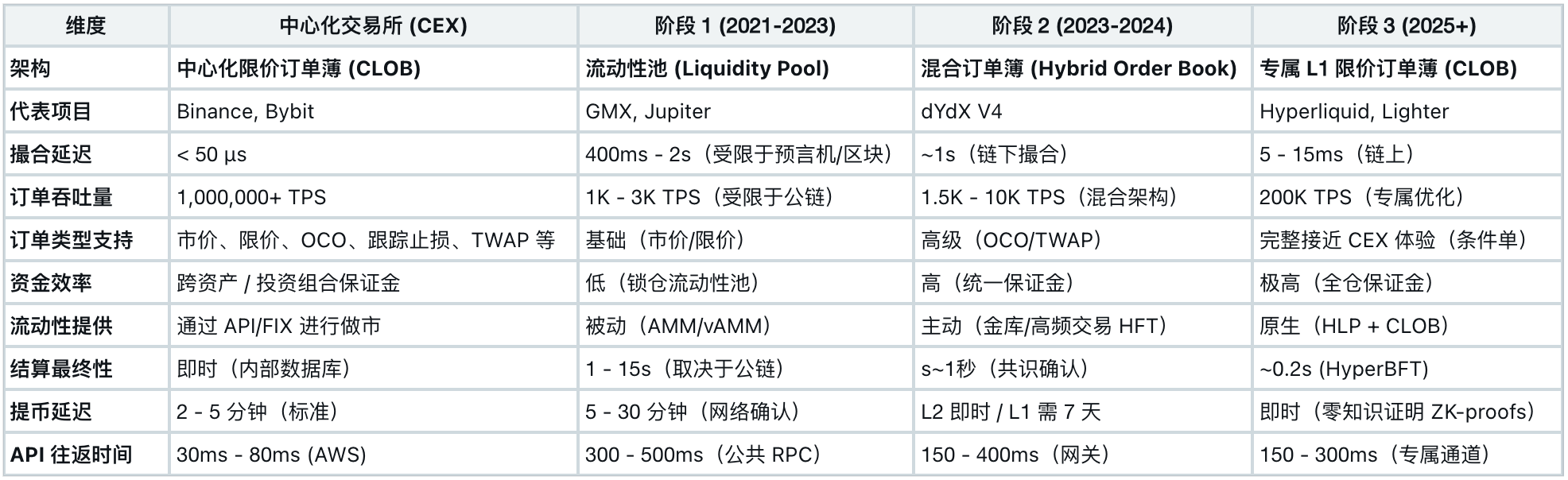
3. Structural Constraints of Solana
Solana is a general L1, and compared to dedicated L1s designed for Perps, there are inevitably performance gaps. However, the biggest constraint that Solana imposes on the Perp market is not speed and throughput, but unpredictability of ordering.
- Structural limitations of general block space. The matching and clearing logic of perpetual contracts must share block space with Memecoins, NFTs, and DeFi, lacking dedicated block channels, causing market makers to be unable to guarantee timely updates of quotes during significant market fluctuations.
- Conflicts between on-chain risk engines and computation units. Running a complete clearing and margin control model on-chain (such as multi-position cross-margining, asset correlation discounts, etc.) requires extremely complex mathematical computations in every transaction, consuming a large number of Compute Units (CUs). There is a strict limit on the maximum CUs available per account within each Solana Slot and total block CUs. This limits the possibility of designing complex, advanced risk engines for on-chain Perp DEX.
- Non-deterministic block production and ordering. Solana uses a leader-based block production model, where Leader nodes rotate among the network validators every 4 slots (approximately 1.6 seconds), and different validators run clients (such as Firedancer, Agave, etc.) that differ in transaction scheduling and packing logic. In CEX or dedicated L1s (like Hyperliquid), order books follow strict FIFO or deterministic matching rules. However, on Solana, the updating of market maker quotes and the order of transactions depend entirely on the current Leader’s scheduler. When market makers initiate order cancellations during sharp market price changes, if they are not able to get their cancellation transaction packed onto the chain before arbitrageurs eat the orders, they sustain direct losses.
- Multi-layered fee stacks increase uncertainty. Transaction costs include L1 base fees, priority fees, Jito Tips, and RPC landing service fees. The complex and dynamically changing fee stack makes it difficult for market makers to predict the comprehensive costs of updating single quotes accurately, undermining the profitability stability of high-frequency strategies.
For example, if a market maker places a sell order for BTC at $64,000, and the market suddenly drops, the market maker needs to cancel the order and re-list it at $63,000; in Hyperliquid/Binance, this is smoothly updated, but on Solana:
- On Solana CLOBs like Phoenix, updating an order consumes 100,000–300,000 CUs per transaction, and cancelling carries a cost.
- If this coincides with a meme launch or NFT minting, the new order may not be immediately available on-chain, and the market maker can only increase the chances of getting the cancellation transaction on-chain by paying higher priority fees and Jito Tips.
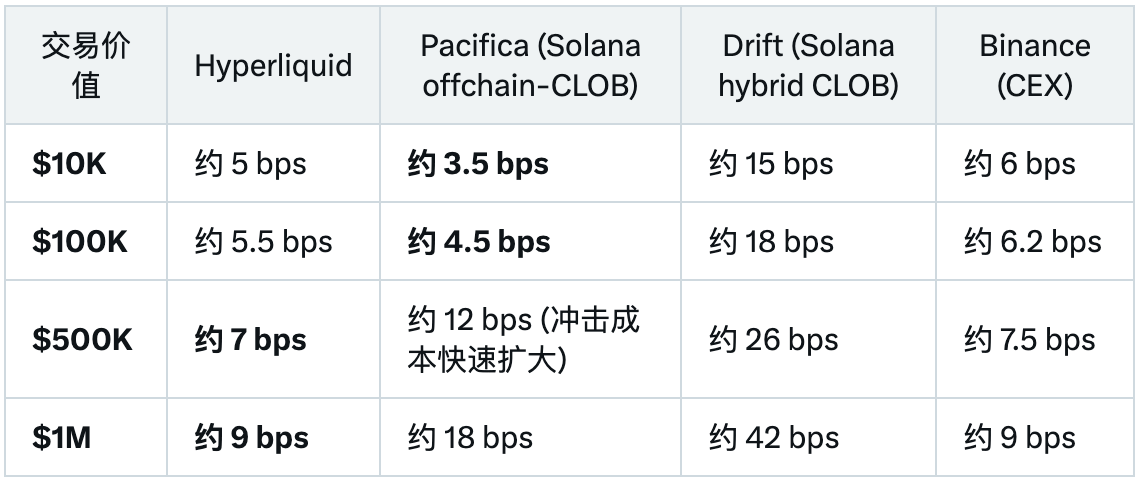
The unpredictability of ordering directly erodes market makers’ returns, forcing them to factor risks into spreads, causing market makers to actively widen spreads and reduce depth to buffer against uncertainty, creating a vicious cycle: market makers exit → liquidity thins → slippage rises → user loss.
On the trading experience front, @Blockworks calculated the round-trip friction costs of BTC under different Perp DEXs (base transaction fee Taker Fee + market impact costs Slippage/Impact), showing that Solana Perp has significantly higher slippage than Hyperliquid and Binance in large transaction scenarios:
4. Solana's Counterattack: Protocol Layer + Application Layer
The Solana ecosystem is advancing transformation on two fronts, implementing targeted measures for MM's core pain points.
Protocol Layer
Alpenglow Upgrade
Alpenglow (led by Anza) is the largest consensus layer reconstruction in Solana to date, replacing the existing PoH and Tower BFT, introducing Votor voting and Rotor dissemination mechanisms, ultimately reducing finality from the current ~12.8s to 100-150ms. This significantly shortens the waiting time for market makers to receive trade feedback, lowering the risks of passive one-sided positions. It is expected to launch by 2026.
MCP (Multiple Concurrent Proposers)
The current Solana operates under a single Leader model, where each block is solely produced and packed by one node, leading to serious censorship risks and MEV extraction risks. Anza's proposed Constellation architecture introduces MCP technology:
- Breaking Single Leader Monopoly: At the same time, it allows multiple concurrent validators to propose transaction batches and submit them to the consensus network. Since multiple proposers can concurrently pack transactions, the "state transitions" and logical execution rhythms within blocks are greatly accelerated, allowing the network to continuously handle state updates.
- Neutrality Guarantee: Since arbitrageurs cannot achieve front-running trades via a single channel (e.g., by sending a flood of junk packets to a specific Leader), the probability of market maker quotes being "sniped" significantly decreases, making Solana’s L1 physical environment more neutral and fair.
Doubling CU to 100M
To effectively solve the issue of compute preemption between financial contracts and clearing engines without sacrificing overall composability, the Solana community is promoting the increase of the per block limit on computation units (CU) from the original amount to 100M CUs (expected to launch in mid-2026):
- Improved Capacity: With the CU limit doubled, the clearing module and complex cross-margin accounting logic will no longer be constrained by stringent local CU resource limits during execution, effectively reducing the transaction execution failure rate under high concurrency.
- Further Reduction in Transaction Rates: The substantial expansion of block physical capacity will lower the actual foundational cost per transaction, providing ample and inexpensive resources for on-chain high-frequency market making and massive orders.
Jito BAM and ACE Framework
Before the complete reconstruction of L1 consensus, Jito took the lead by providing a locally available "high-speed execution channel" through its plugin client patches—Jito BAM (Block Assembly Marketplace). It went live in September 2025. Currently, it covers about 30% of the network's stake, combined with the original Jito client’s 30%, forming a strong network coverage.
Jito BAM is a new block assembly algorithm with a micro-auction market that changes the previous logic of random packing based solely on priority fees, replacing it with a strict intra-block deterministic auction based on Fee/CU (tip efficiency per computation unit). Its core is the TEE (Trusted Execution Environment, AMD SEV-SNP) encrypted memory pool—transactions are invisible to anyone (including node operators) before execution, structurally eliminating the information asymmetry needed for sandwich attacks. At the same time, it generates on-chain cryptographic audit trails (Attestation) that any observer can use to verify ordering fairness.
The killer feature of the BAM framework is the introduction of ACE (Application-Controlled Execution) logic, with the first widely piloted and implemented plugin being the Maker Priority Plugin:
- Sub-slot Deterministic Cancels: The plugin allows market makers to submit specific "quote updates" and "cancel order" commands to BAM through specific cryptographic proofs or dedicated channels.
- Deterministic Packing Guarantee: At the sub-slot level, the market maker's cancellation and price updates will be forcibly prioritized at the front of the block before being executed by the taker.
- Value Illustration: Even in the event of network congestion, as long as the market maker's cancellation transaction is sent, it can be cleared before the arbitrage taker acts with nearly 100% success rate. This completely cuts off the arbitrageur's behavior of "sniping stale quotes" against market makers, making the on-chain order book’s spreads have a physical narrowing basis approaching CEX.
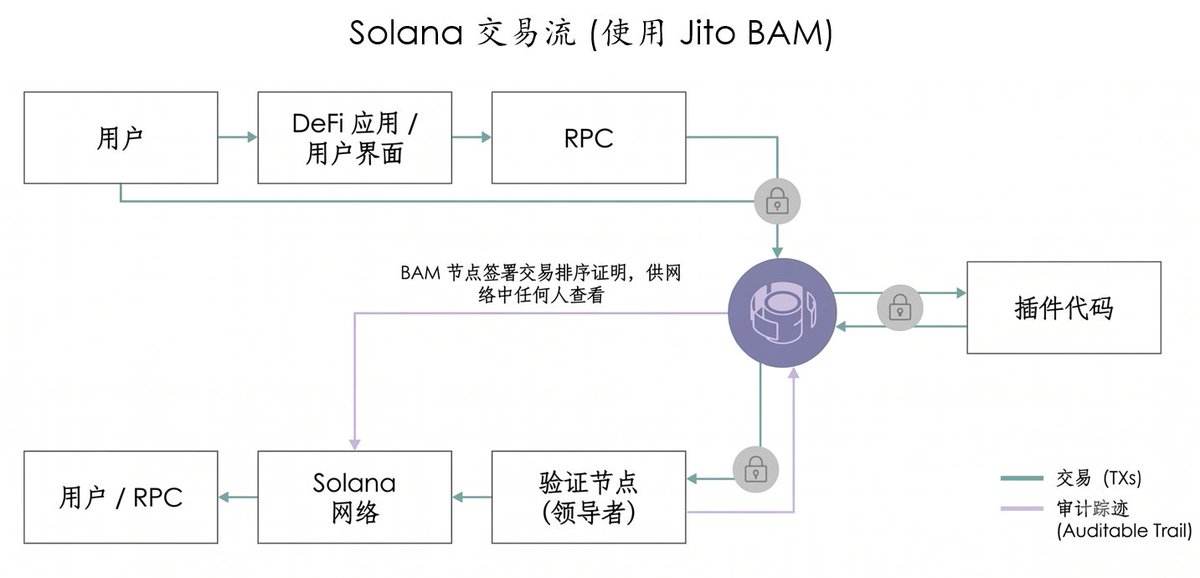
If these upgrades are implemented and achieve the required adoption rates, they will systematically improve the executing determinacy and capital efficiency of Solana Perp.
Application Layer
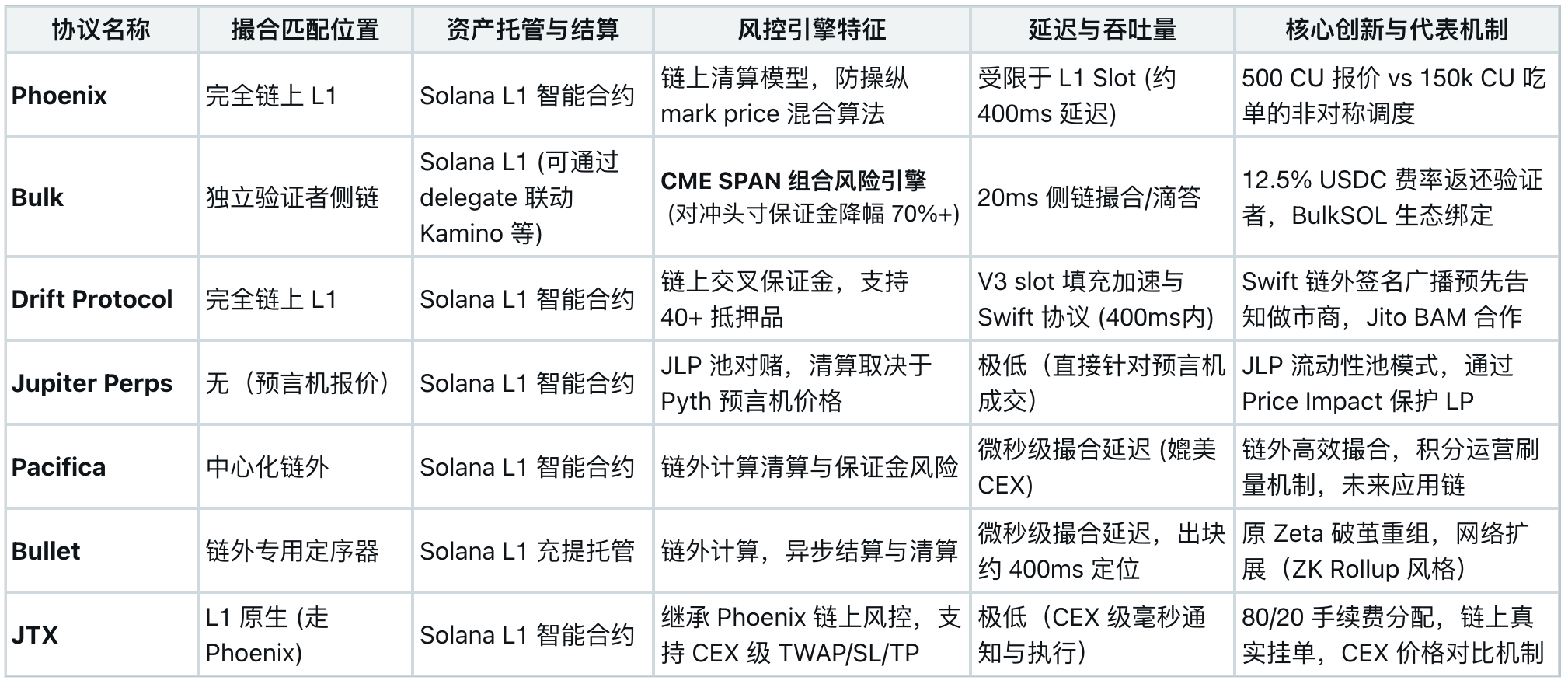
To resolve the conflict between L1 performance limits and transaction demands, various differentiated Perp architecture systems have emerged in the Solana ecosystem. These solutions have made different trade-offs and engineering choices between "full decentralization composability" and "extreme trading execution performance":
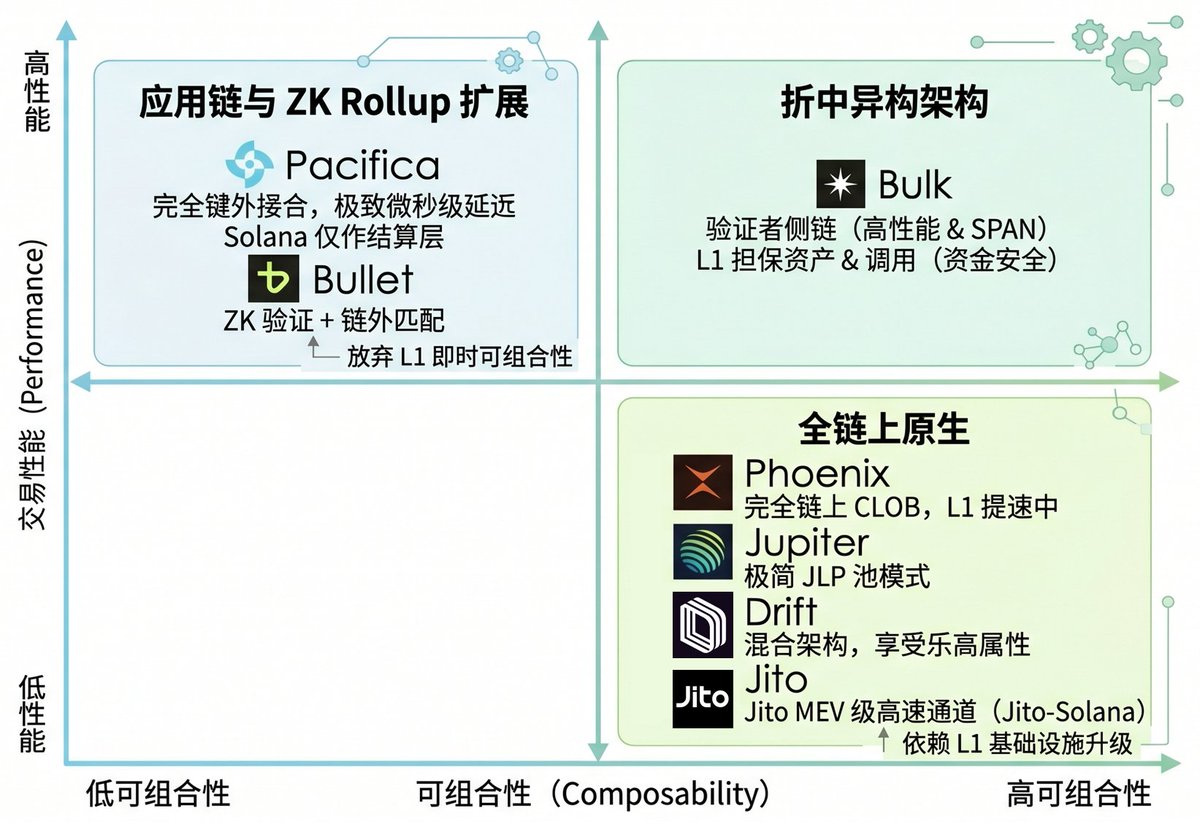
Phoenix
@PhoenixTrade, as the first high-profile fully on-chain CLOB on Solana, was created by the Ellipsis Labs team behind the Prop AMM SolFi. Due to SolFi’s experience, the team has deep insights into optimizing Solana’s computation.
- Technical Architecture: A fully on-chain non-custodial CLOB. The matching logic for all buy and sell orders, status of the order queue, and position settlements are completely driven by smart contracts on Solana L1.
- Asymmetric Defense Mechanism at the Computational Layer: The single-time consumption for quote update transactions is only 500 CUs, while the consumption for taker execution logic is 150,000 CUs. This cleverly achieves nearly 300 times the prioritized packing scheduling rates for market makers under Solana’s existing CU scheduling mechanisms.
- Advantages: Extreme composability. All trading states are on L1 chain, allowing the held open positions to be easily used as collateral for other lending protocols, and supports atomic-level basis trading with other DeFi Lego.
- Disadvantages: Trading delays are constrained by the performance limits of Solana L1 Slots, still having the potential for congestion lag during extreme fluctuations.
JTX
@jtx_trade is a significant expansion of Jito to upper trading terminals/consumer applications and is strictly not a Perp DEX, but a front-end trading terminal.
- Technical Architecture: Deeply integrating Perp into Phoenix Perps, establishing it as the preferred decentralized contract matching layer. It realizes a true on-chain order mechanism where limit orders are directly queued on the Solana chain and executed by smart contracts within the same Slot when prices are met. It supports various automated order types such as TWAP and stop-loss orders of CEX level.
- Advantages: Benefiting from Jito's experience and dominant position in Solana trading flow, in combination with Jito BAM's Maker Priority Plugin, market makers and users can achieve lower trading latencies.
Bulk
@bulktrade has proposed an innovative heterogeneous expansion architecture, with its core logic being: transferring matching and risk control engines to run on a dedicated sidechain, while keeping fund settlement and custody on Solana L1.
- Technical Architecture: Users deposit and lock margins in smart contracts (Kamino, Loopscale, etc.) on Solana L1, but subsequent matching, trading, and clearing engines are processed in a sidechain operated by Solana validators (running Bulk-Agave clients). Currently, over ten major validator nodes support testing (accounting for over 5% of the total stake).
- Advantages: Market maker-oriented HFT mechanism, gas-free high-frequency orders, 20ms quote update frequency, FIFO matching with "priority for cancellations." Since the sidechain validators are also Solana validators, theoretically users can use collateral on Kamino to provide margin, allowing trading on the sidechain through delegation mechanisms, ensuring a certain degree of composability.
Pacifica
- Technical Architecture: The depositing, locking, and settlement extraction of funds are retained in Solana L1 smart contracts. Meanwhile, all order book listings, matching, and position accounting are conducted asynchronously on centralized off-chain servers.
- Advantages: Extremely strong performance, almost identical to CEX experience, once surged to 62% of Solana Perp market share by leveraging point rewards in January 2026.
- Disadvantages: Completely sacrifices on-chain composability. Various state information related to transactions, such as positions, orders, and liquidation statuses, cannot be verified on-chain, preventing integration with other Solana applications. The project roadmap plans to migrate it onto an independently operating Substrate application chain, which will directly face Hyperliquid in hand-to-hand competition.
Jupiter Perps
- Technical Architecture: Utilizes the JLP (Jupiter Liquidity Pool) oracle pricing pool mechanism. There is no matching engine or order book; users directly gamble with leverage against mixed assets (SOL, BTC, ETH, USDC, etc.) at the latest transaction prices of the Pyth oracle.
- Advantages: Extremely simple experience, highly friendly to retail investors. JLP tokens have high annualized returns and are widely accepted as high-quality collateral on platforms like Kamino.
- Disadvantages: Fixed transaction rates are rigidly determined by oracle quotes (simulating slippage through additional Price Impact), making it unable to withstand high-frequency and large-scale professional trades. Currently, monthly transaction volumes fluctuate between $8B - $10B, forming the basic market for retail investors.
5. Solana's Long-Term Advantages: What HyperLiquid Cannot Do
The secret of business competition is simple: attack the disadvantages brought by the advantages of competitors.
HyperLiquid, in pursuit of extreme performance, has given up the general-purpose smart contract execution environment—Hypercore cannot natively execute arbitrary DeFi logic. This means that Perps on HyperLiquid are isolated: they cannot be combined with lending protocols (such as opening a Perp position directly using collateral positions from Aave/Kamino), cannot be referenced by on-chain option protocols as price sources, and cannot use Perp positions as modular components of DeFi Lego. Although HyperEVM attempts to fill this gap, there is still a fundamental difference in depth compared to Solana’s native composability.
Advantages of Long-tail/RWA Perp Pool Model: Order books will always face the dilemma of "which came first, the chicken or the egg," as market makers can only profit when there is sufficient Taker flow, and traders are willing to enter only when there is enough liquidity. Breaking this deadlock requires substantial market maker incentives (Token rewards, transaction fee rebates, etc.). However, the characteristics of RWA assets are decentralized liquidity and limited market maker coverage, making the oracle-LP pool model more suitable than CLOB for such scenarios.
DeFi Composability Flywheel: When Solana's Perp protocols can read on-chain states from Kamino, Jupiter, and Orca, and be invoked by on-chain options, structured products, and automated strategies, its ecological depth will surpass that of any single application chain. Jupiter’s JLP was once the largest source of arbitrage trading and income on Solana; this capability is not available to a single Perp chain.
The synergy between spot and Perp ecosystems forms a unique network effect. Solana has already dominated on-chain stock trading volumes, and with cross-chain asset entrances like Sunrise, it can quickly provide liquidity on Solana after TGE of new assets like Monad and Coinbase; terminals like JTX achieve an integrated user experience of spot and Perp, facilitating the transformation of large retail memecoin traffic into derivative participation through simplified UI, sharing infrastructure to lower cold-start friction.
These advantages point towards Solana's long-term positioning in "composability + long-tail/RWA + retail entry," rather than merely replicating HyperLiquid's professional CLOB model.
免责声明:本文章仅代表作者个人观点,不代表本平台的立场和观点。本文章仅供信息分享,不构成对任何人的任何投资建议。用户与作者之间的任何争议,与本平台无关。如网页中刊载的文章或图片涉及侵权,请提供相关的权利证明和身份证明发送邮件到[email protected],本平台相关工作人员将会进行核查。
