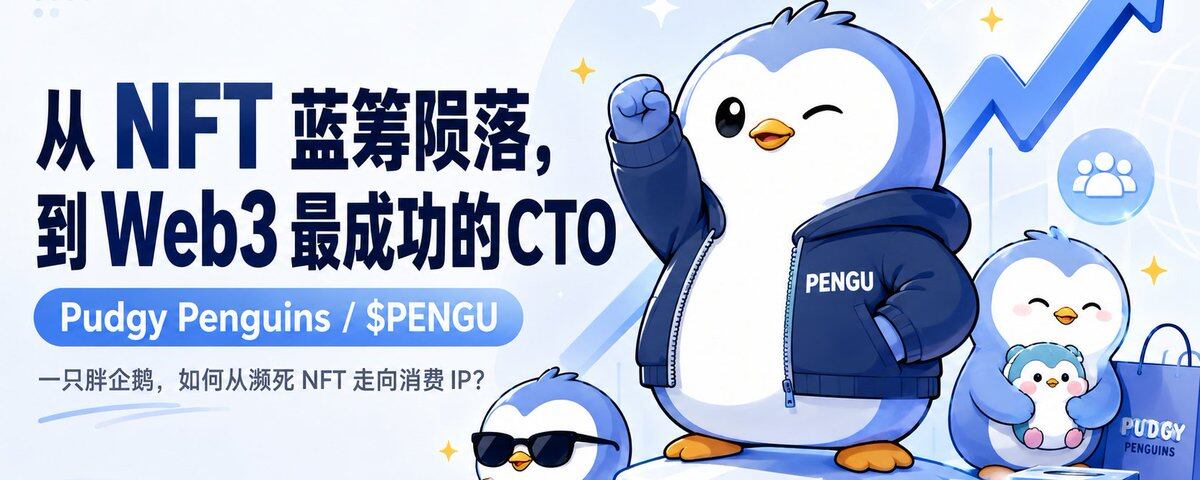
A few days ago, I tweeted about preparing to acquire a Fat Penguin NFT, and many friends asked why? NFTs have long gone out of style, why spend so much money on one now?
Most Chinese users first heard of Fat Penguins because of the $PENGU airdrop in 2024. That airdrop was quite generous, we could even say "sunshine all around." Even if you didn’t own a Fat Penguin NFT, if you had been trading on Solana for a while, you might have received $PENGU worth several hundred dollars.
The truly exaggerated part was that the floor price of Fat Penguin NFTs skyrocketed to over 30 ETH just before the airdrop. Each Fat Penguin NFT could claim about 1.7 million tokens, while each Lil Pudgy could claim about 188,000 tokens. Based on the coin price at that time, one big Penguin corresponded to tens of thousands of dollars, at its peak exceeding $100,000, and one Lil Pudgy also surpassed $10,000 at its highest. Like on-chain influencer @wenxue600, who owned many, it's not exaggerated to say he received a million-dollar airdrop based on his holdings.
However, many brothers who received the airdrop did not understand the story behind it.
$PENGU is not a suddenly emerged Meme Token, the Fat Penguin behind it almost died during the craziest era of NFTs.
In 2022, the floor price of Pudgy Penguins dropped to about 0.5 ETH, and the community even voted to oust the founder. Four years later, it entered 3,100 Walmart stores across the United States, collaborated with Manchester City and the NHL, and launched a payment card accessible through the Visa network, with a revenue target of $120 million in 2026.
This might be the most incredible resurrection in Web3 history.
How did the Fat Penguin survive? The story begins in 2021, when 8,888 Pudgy Penguins were sold out in less than 20 minutes at 0.03 ETH each. Within a month of launch, The New York Times even featured a special report on it. At that time, hardly anyone doubted that it would become the next blue-chip NFT.
But what truly made Pudgy special was not how it took off, but how it later fell and then got back up again.
By the end of 2021, the promised games, tokens, and ecosystem were not fulfilled. The mystery egg eventually hatched into a fishing rod, and the community directly turned the Rods into "Rogs," mocking that the project was like a rug pull.
More seriously, there was a trust crisis, as the original team was accused of emptying the treasury and intending to sell the project before exiting. By January 2022, holders directly initiated a vote on Discord to remove founder Cole. For the first time, an NFT community voted out its founder like shareholders.
However, removing the founder did not mean the project would survive. At that time, Pudgy's floor price dropped to about 0.5 ETH, the community was divided, the project treasury was nearly empty, and some holders even used Wrapped Penguins to bypass the original team's royalties. That penguin was no longer "in trouble," but was truly almost gone.
The turning point happened in April 2022, when @LucaNetz purchased the Pudgy Penguins IP and operating rights for 750 ETH, which was about $2.5 million at that time. This transaction was later referred to as Web3's most successful CTO (Community Takeover).
However, the reality after taking over was not as ideal as a fairy tale; one could even say it was very harsh. Luca later recalled: when the team took over, there was almost no money in the account, and then they faced the collapse of the NFT bubble, with transaction volume plummeting 95%, ETH dropping about 80%, and the royalty model collapsing; during the toughest times, 80% of the team members went 11 months without being paid.
The turnaround for Pudgy was not simply changing the owner and then pulling the NFT floor price back up. What it did right was not treating the NFT price as a product but seeing the roles behind the NFT as a true consumer IP.
In 2023, Pudgy Toys began entering Amazon and Walmart's stores, and within less than a year, the products were available in all 3,100 Walmart locations in the United States. Each toy includes a QR code that brings ordinary consumers who know nothing about wallets or NFTs into the Pudgy World. Interestingly, these physical toys utilize the penguin characters owned by community holders, and eligible NFT holders can also receive IP licensing revenues.
This means that NFT holders did not just buy a picture; they could also participate in the creation and distribution of brand value. This was the most critical step for Pudgy to move from OpenSea to Walmart.
Looking at 2026, Pudgy's roadmap increasingly resembles a traditional business project:
- Collaborating with the NHL to host offline events at the 2026 Winter Classic;
- Launching co-branded collectibles and peripherals with Manchester City and continuing to expand after the first round of cooperation;
- Launching the Pengu Card, integrating with the Visa payment network, supporting Apple Pay and Google Pay, covering around 150 million merchants globally, and the virtual card quickly gained 100,000 registrations;
- The free web game Pudgy World has officially launched, and the digital content obtained from scanning after purchasing physical toys has also begun to have real usage scenarios;
- The Vibes TCG collectible card game has sold over 4 million cards.
The CEO has set a revenue target of $120 million for 2026 and has publicly expressed the hope to push for an IPO before 2027. In fact, when looking at all the routes together, it becomes very clear. NFTs brought it the first batch of owners and disseminators, toys brought it into average households; social media and memes kept the penguin image spreading, while games, cards, and payment products continuously increased usage scenarios; $PENGU lowered the threshold for participation from an expensive NFT to a larger internet community.
The reason for the collapse of the NFT bubble is that most NFT projects ultimately fail because of "what to do after selling the pictures." Pudgy almost died there as well, but it survived in the end. Because it no longer relied on the next batch of people to buy in at higher prices, but began to answer a more important question: can this penguin become a real brand that people like, buy, and use?
So, I want to buy a Fat Penguin NFT, not just because NFTs have risen again recently. Although I didn’t hold a Fat Penguin NFT back then, just having used Solana for a longer time, I did receive thousands of dollars worth of $PENGU airdrop. Now looking back to buy an NFT, treating it as a credential of this IP and community, is also a good choice for me.
Recently, I’ve noticed that the Fat Penguin Chinese community @PudgyChina is restarting. When the market is good, everyone talks about prices; instead, bear markets are more suitable for building the community seriously. Interested parties can also follow: @PudgyChina @pudgypenguins @LucaNetz
免责声明:本文章仅代表作者个人观点,不代表本平台的立场和观点。本文章仅供信息分享,不构成对任何人的任何投资建议。用户与作者之间的任何争议,与本平台无关。如网页中刊载的文章或图片涉及侵权,请提供相关的权利证明和身份证明发送邮件到support@aicoin.com,本平台相关工作人员将会进行核查。


