Darkbloom: Build a private AI inference network with idle Macs, costing 50% less than traditional APIs.
Written by: Grok
Assisted by: AididiaoJP, Foresight News
Darkbloom is a research project launched by Eigen Labs that routes encrypted AI inference requests to hardware-verified Apple Silicon Macs, providing costs about 50% lower than traditional centralized API providers while maintaining considerable model performance. Mac users can simply run a simple CLI tool to convert idle computing power into revenue, and operators cannot see the request prompts. The project entered the public Alpha phase in mid-April 2026, and as of now, the Darkbloom network has processed more than 600 million tokens of AI inference tasks, attracting the attention of developers and hardware owners.
Project Background and Product Mechanism
The demand for AI inference continues to grow, but centralized cloud services rely on large-scale data centers, which are costly and offer limited privacy protection. Darkbloom targets the idle computing power of over 100 million Apple Silicon Macs worldwide. These devices have a unified memory architecture and an efficient Neural Engine, giving them significant energy efficiency advantages when running large models locally.
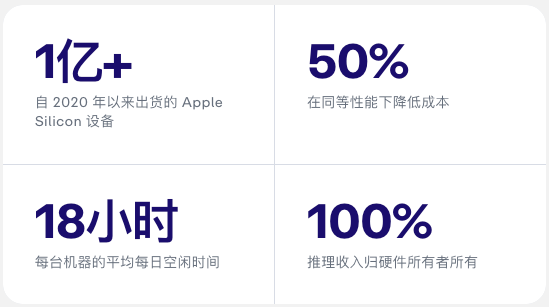
Darkbloom's core is to turn idle Apple Silicon Macs into a verifiable private AI inference network. It employs an architecture of "encrypted routing + hardware trust roots + hardened execution," allowing developers to obtain performance close to traditional cloud services at an extremely low cost while greatly enhancing privacy protection.
The developer experience is very simple. They only need to change the base_url of the OpenAI-compatible client to Darkbloom's interface address and fill in the API Key; the entire calling process is almost the same as using OpenAI. If traditional cloud services are likened to centralized power plants, Darkbloom is more like a distributed microgrid, where users need to change just one line of configuration to connect to a computing network composed of Macs worldwide.
Requests are encrypted before leaving the client, and the coordination layer is only responsible for routing matching without accessing plaintext content. The final task will land on a Mac node that has been rigorously hardware-verified. These nodes run within a single hardened process, leveraging Apple Silicon's unified memory architecture and Neural Engine to perform inference, and immediately clear all prompt data after completion. The entire process is like sealing an envelope twice; the post office only handles the delivery, the recipient can only see the final result but cannot open the envelope to view the content.
Privacy protection is Darkbloom's biggest differentiation. The project leverages Apple Secure Enclave to generate hardware-bound keys, combined with System Integrity Protection (SIP) and regular challenge-response mechanisms to ensure that the node's operating environment can be publicly verified. Even the owner of a Mac cannot view or export user prompts through conventional means. Compared to the "trust platform" of traditional cloud APIs, Darkbloom builds trust at the hardware and operating system level.
For Mac users, the entry barrier is extremely low. A single command can install the CLI tool, and devices will join the network as nodes. Currently in the public Alpha phase, users can retain all inference income, with the main marginal cost being electricity. The project supports text generation, image generation (FLUX.2 series), and a hybrid expert model with up to 239 billion parameters, with prices generally about 50% lower than mainstream aggregators.
According to the public guidelines, the setup steps are as follows:
- Own a Mac powered by Apple Silicon (M1 or above);
- The system version is macOS 14 or higher;
- Install Darkbloom Provider (CLI tool) via a single command;
- Keep the device online and connected to a stable network;
- The system will automatically receive and process AI tasks routed over the network.
After installation, the device can run as a provider node, and users can view node status and income in real-time.
This mechanism allows Darkbloom to find a balance between ease of use and privacy, retaining the convenience of centralized services while leveraging existing hardware to achieve dual advantages in cost and privacy.
Practical Use Cases and Competitive Landscape
Developers can access private inference at extremely low costs, particularly suitable for data-sensitive scenarios, such as internal corporate tools, personalized assistants, or applications with high compliance requirements. The OpenAI compatibility brings the switching cost close to zero, requiring only a single line of configuration change.
Mac users, on the other hand, gain passive income opportunities. The project provides an earnings calculator, allowing users to estimate income based on model memory, model selection, and expected utilization rates. During the public Alpha period, operators can retain all inference income, with potential adjustments to a higher percentage share later. The marginal cost primarily consists of electricity consumption, which is a minimal incremental expense for most users.

According to the latest ranking data, the top provider earns less than 6 dollars per day, while the fifth-ranked provider earns even less than 2 dollars. Earnings are influenced by memory configurations, online duration, model demand, and node health. As more high-memory models become available and user numbers grow, earnings are expected to improve further.
In terms of competition, traditional cloud service providers (such as OpenAI, Anthropic, Google Vertex) offer high performance but at higher costs, and privacy is controlled by the platform. Other decentralized inference projects often depend on GPU clusters or blockchain incentives, while Darkbloom focuses on the unique energy efficiency and hardware trust roots of Apple Silicon, emphasizing participation without the need for additional hardware procurement. Compared to purely decentralized storage or computing networks, Darkbloom focuses more on low-latency real-time inference and privacy closed loops.
Team, Economics, and Risk Outlook
The project is driven by Eigen Labs, with core contributors including research engineer Gajesh Naik. He has a wealth of experience in the blockchain and developer ecosystem, and Darkbloom is viewed as a natural extension of Eigen's efforts in verifiable computing. The team emphasizes open source practices, with the codebase and papers publicly available and subject to community review.
In terms of economics, Darkbloom currently primarily relies on actual inference income distribution, with operators retaining a high percentage during the Alpha phase, starting supply without dependency on token incentives. This reduces early speculative risk but also means growth is more reliant on real demand. Users pay based on usage, with transparent and competitive pricing.
Risks are primarily concentrated in the uncertainties of the early stage. The network is still in research preview / public Alpha, and performance, availability, and SLA have not reached production-level standards. Hardware wear and tear, fluctuations in power costs, model cold start delays, and instability of supply-side utilization may all impact actual experience. On the regulatory front, decentralized inference involves cross-border data and privacy compliance, and future policy changes may bring additional requirements. Furthermore, reliance on a single hardware ecosystem (Apple Silicon) also poses a certain concentration risk.
Overall, Darkbloom provides a path to leverage existing hardware while enhancing privacy and reducing costs. It is not a simple replacement for existing cloud services, but rather a supplementary layer targeting specific scenarios. As more Macs join and model optimizations occur, the network's economic model and reliability will further be tested by the market.
Reference Links:
免责声明:本文章仅代表作者个人观点,不代表本平台的立场和观点。本文章仅供信息分享,不构成对任何人的任何投资建议。用户与作者之间的任何争议,与本平台无关。如网页中刊载的文章或图片涉及侵权,请提供相关的权利证明和身份证明发送邮件到support@aicoin.com,本平台相关工作人员将会进行核查。


