
Author: Pine Analytics
Translated by: AididiaoJP, Foresight News
Abstract
Solana has effectively won the tokenized stock market, with about 97% of the total on-chain trading volume for tokenized stocks in May 2026 (approximately $869 million on Solana, while all other chains combined accounted for about $24 million). However, the four issuers defining this market—Backpack Securities (SPCX), Ondo Global Markets, xStocks (Backed Finance), and PreStocks—are not the same product. They appear almost identical on price charts, but the underlying legal instruments are distinctly different, sitting on a spectrum from redeemable real securities to purely synthetic private market exposure.
This distinction is typically invisible until problems arise—it was in May 2026 that PreStocks encountered issues.
The actual ownership for holders (ranked from best to worst):
- Backpack / SPCX—closest to actual ownership. Tokens can be redeemed for underlying shares via ACATS/DTCC channels (for qualified holders only), recognized as UCC Article 8 securities, providing actual ownership rights. Disadvantage: redemptions are limited to registered holders; the original on-chain tokens remain as SPV debt rights.
- Ondo Global Markets—strongest protection in a non-redeemable model. Structured notes against bankrupt isolated SPV, 1:1 + buffered collateral, with third-party securities agents holding first priority rights, validated daily—but explicitly no shareholder rights.
- xStocks—the most DeFi-native (Raydium, Jupiter, Kamino), but with no shareholder rights, and (contrary to common marketing) the collateral "may not always be the underlying stocks." Holders take on credit risk.
- PreStocks—the weakest stance: synthetic exposure to pre-IPO SPV, no rights, questionable endorsement. In May 2026, Anthropic and OpenAI declared that the underlying shares' transfer was invalid/unauthorized, causing tokens to drop 34–40%; PreStocks displayed an implied valuation of Anthropic exceeding $1.3 trillion, while the actual asset was only about $23 million, with the promised proof report never released.
The decisive variable for on-chain pricing is arbitrage: tokenized stocks have two prices—an on-chain price available 24/7 and an underlying stock price determined by traditional markets that close overnight and on weekends. When there is an active underlying market available for arbitrage (such as xStocks, Ondo, Backpack during U.S. stock trading hours), the peg remains tight, with typical swap slippage tolerances for liquid names around 0.1–0.5%. However, during non-trading hours, on weekends, or in the case of PreStocks with no publicly traded underlying assets, premiums and discounts can widen, and prices may diverge sharply. Liquidity is also highly concentrated in a few star assets (TSLAx, NVDAx, CRCLx, SPCX), while over 100 long-tail names have wide quotes and high slippage.
The bottom line is: Solana has won the trading venue, but the open question is which structure will win over holders—regulation is tilting the answer. The actual effect of the SEC staff statement in January 2026 was to pressure purely synthetic models, supporting issuer-sponsored and redeemable custody structures. Therefore, for anyone choosing these tokens, determining what you actually hold comes down to the law.
Background
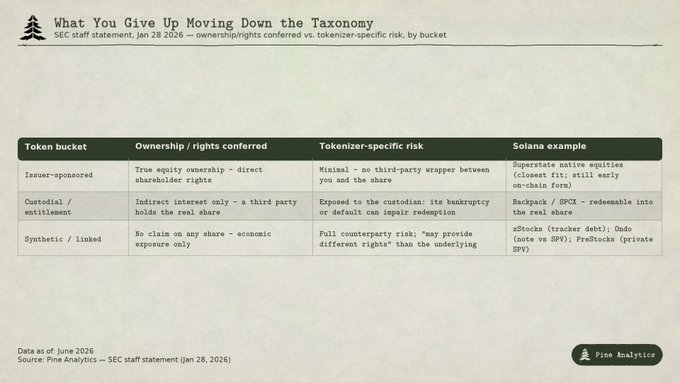
Tokenized stocks refer to crypto assets that document ownership on the blockchain, pegged to equity value. On January 28, 2026, SEC staff issued a statement (from the Division of Corporation Finance, Division of Trading and Markets, and Division of Investment Management) establishing a governance taxonomy, distinguishing:
- Issuer-supported tokens—can represent true equity ownership.
- Custodial/Rights tokens—third parties hold real shares and issue tokens reflecting indirect interests.
- Synthetic/Linked tokens— purely economic exposure, with no claims to shares.
The core warning of the statement: third-party tokenized securities "may provide rights different from those of the underlying," and holders may face risks specific to the tokenizing party (such as bankruptcy), while direct shareholders do not. This perspective informs all below.
Detailed Analysis of Four Products
Backpack Securities—SPCX
Issuer and Mechanism: SPCX is issued by the regulated U.S. broker Backpack Securities and went live on Solana on June 11–12, 2026, coinciding with the SpaceX NASDAQ IPO—reportedly the first time newly listed stocks have had a simultaneous on-chain market. Each token is backed 1:1 by actual SpaceX shares, held in regulated custody. Liquidity is routed through Sunrise DeFi.
Legal Structure and Holder Rights: Backpack's structure is the strongest for holders, as tokens can be redeemed for underlying stock. Qualified (onboarded, KYC) holders can redeem tokens for real shares and transfer them to any traditional broker via ACATS/DTCC settlement channels. On the brokerage side, this is UCC Article 8 securities rights, providing actual ownership (dividends, corporate actions, transfers). Note: the original on-chain tokens are still described by Backpack as "tokenized debt/SPV debt." Redemption of real shares is limited to qualified holders—random secondary market buyers not registered are closer to debt holders below.
On-chain Market Data—Spreads and Value: As of June 15, SPCX exceeded $100 million in 24-hour trading volume, accounting for about 40% of early tokenized stock trading on Solana. The underlying SpaceX equity IPO was priced at $135, closing its first day at $160.95 (+19%), reaching an intraday high of $225.64 on June 16. Due to SpaceX being new and highly volatile, the tokenized form carries significant new listing/crypto access premium: tokenized variants (such as BitMart's bSPCX ~145 USDT, and third-party SPCXON) diverged significantly from NASDAQ prices during U.S. stock post-trading and pure crypto periods (with no active equity market for arbitrage).
Risks: Concentration (currently a single underlying), redemptions limited to qualified holders, and standard custody/operational risks of brokers.
Ondo Global Markets
Issuer and Mechanism: Ondo tokenized stocks are structured notes—debt instruments issued by the bankrupt-isolated SPV Ondo Global Markets (BVI) Limited. Launched in January 2026, currently listing 264 tokenized stocks and ETFs, reporting a TVL exceeding $1 billion, making it the most comprehensive equity/ETF offering among the four products. Token holder rights are governed by Swiss law.
Legal Structure and Holder Rights: This represents the strongest protections in a non-redeemable model. Tokens are backed 1:1 by underlying securities held at a regulated custodian + buffered collateral; Ankura Trust Company serves as verifying and securities agent, holding first priority secured interests in the collateral, verified daily, monthly reconciliation, isolated accounts, independent board, and annual audits. However, the rights gap is clear and directly drawn from Ondo's legal documents: "You will not appear on the shareholder register," "You do not have shareholder voting rights, shareholder information rights, or other shareholder rights." Broadridge integration allows holders to express voting preferences, which Ondo may adopt—this is a governance experience function, not ownership.
On-chain Market Data—Spreads and Value: Ondo leads the tokenized stock market by value—accounting for about 58–60% on RWA.xyz in the first half of 2026, with around 264 listed assets and over $1 billion in TVL. Due to Ondo's model having collateral backing and being subject to institutional arbitrage, on-chain prices closely track the underlying NAV during U.S. stock trading hours; deviations occur during non-trading hours, similar to other products.
Risks: Holders have a debt claim against the SPV, not equity—no shareholder rights; exposure to issuer/custodian operational failures (mitigated but not eliminated by the securities agent structure).
xStocks (Backed Finance)
Issuer and Mechanism: xStocks is an SPL token issued on Solana by Backed Assets (JE) Limited, launched on June 30, 2025. The listing covers over 130 stocks and ETFs—AAPLx, TSLAx, NVDAx, METAx, GOOGLx, COINx, CRCLx, MSTRx, and SPYx and QQQx. Each is a bearer debt instrument classified as a tracker certificate. xStocks is the most DeFi-native option: Raydium serves as the primary AMM, Jupiter aggregates quotes, Kamino accepts xStock as lending collateral.
Legal Structure and Holder Rights: Only economic exposure—no shareholder voting, no direct dividend rights (dividends are passed through a rebase mechanism), no legal claims to the underlying shares or rights to residual assets in a corporate liquidation. Important correction to common marketing: xStocks is often described as "fully backed 1:1 by the underlying stocks," but xStocks product disclosures (appearing on Kraken and Bybit risk pages) indicate that the collateral "may not always be the underlying stocks," "other qualified assets (including cash collateral) may be used as alternative collateral." Holders bear the credit and solvency risk of Backed, regardless of the underlying performance.
On-chain Market Data—Spreads and Value: xStocks reached approximately $293.5 million in AUM on Solana by mid-May 2026, with accumulated on-chain trading volume exceeding $3 billion and DEX trading volume over $517 million at the start of 2026. Liquidity is concentrated in a few names (TSLAx, NVDAx, CRCLx); these names have a typical swap slippage tolerance of about 0.1–0.5% on Raydium/Jupiter. Spread mechanics: During U.S. stock trading hours, on-chain pools and real equities are closely pegged due to arbitrage; long-tail asset order books are thin, leading to wide quotes and steep slippage; weekends and post-trading hours, with TradFi closed, prices are entirely determined by crypto supply and demand, resulting in premiums/discounts.
Risks: Issuer credit risk, alternative collateral risk, thin long-tail liquidity, no shareholder status.
PreStocks
Issuer and Mechanism: PreStocks tracks exposure to private equity through an SPV, tracking pre-IPO private companies (such as OpenAI, Anthropic, and SpaceX before listing). Publicly available trading volume data is scarce and unverified: traceable highest third-party daily trading volume was approximately $29 million (April 2026), while platform-quoted data ($54 million daily ATH, over $750 million in total) has not been confirmed by any third party. Operates under Regulation S—not available to U.S. persons (and several other jurisdictions).
Legal Structure and Holder Rights: The weakest stance for holders. Tokens only grant economic exposure—no ownership, voting, dividend, or information rights. Claims entirely depend on the enforceability of upstream SPV interests in privately held companies with strict transfer restrictions. PreStocks itself denies being a broker, advisor, exchange, transfer agent, custodian, or VASP.
On-chain Market Data—Spreads and Value: This is the most decoupled of the four products, as there is no public underlying market to arbitrage—"prices" are the platform/inferred marks, not arbitrage NAV. Structural fragility materialized in May 2026: Anthropic and OpenAI publicly stated that the tokenized underlying pre-IPO SPV share transfers were invalid/unauthorized (Anthropic: "transfers to the SPV are invalid under our transfer restrictions"), causing affected tokens to drop 34–40% (Anthropic down -34% over 7 days, OpenAI -39%; intraday around -40%). Compounding the issue, platforms displayed an implied valuation of Anthropic exceeding $1.3 trillion, while total assets were only about $23 million, and the promised third-party proof report was never published. The spread/discount here reflects not only liquidity but also genuine doubts about the enforceability of endorsements.
Risks: Controversial/potentially unenforceable endorsements, no proof, no shareholder rights, illiquid private underlying, excluding U.S. persons.
On-chain Spreads and Stock Prices
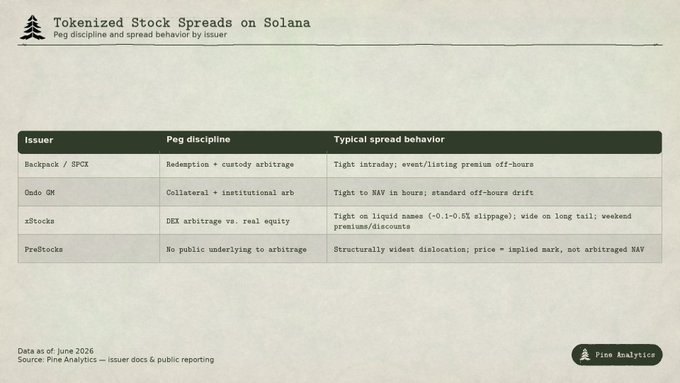
Why does the spread exist? Tokenized stocks have two prices: on-chain trading price (determined by DEX/CEX demand 24/7) and underlying stock price (determined by equity markets that close overnight and on weekends). The gap between the two tells the story.
During U.S. stock trading hours—arbitrageurs (or authorized participants capable of minting/redeeming real shares) keep the on-chain price approximately equal to the underlying. The peg remains tight; typical slippage tolerance for liquid names is about 0.1–0.5%.
During non-trading hours and weekends—equity markets are closed, with no fresh NAV anchoring tokens, prices fluctuate entirely based on crypto demand. Premiums and discounts arise—most severe around events (such as popular new listings like SPCX, or pre-IPO names reacting to news).
Liquidity concentration. Among the four issuers, trading volume is concentrated in a few star assets (TSLAx, NVDAx, CRCLx, SPCX). Over 100 long-tail asset order books tend to be thin, meaning that any meaningful scale comes with wide quotes and steep slippage.
Conclusion
The January 2026 SEC staff statement strengthened scrutiny over synthetic equities while opening a regulatory path for true rights models—December 2025's DTC no-action letter preserved the indirect holding framework of UCC Article 8. This trajectory favors issuer-sponsored and redeemable custody models (such as Backpack and Superstate's native equity), and pressures purely synthetic models (like PreStocks). The SPV transfer dispute with PreStocks is the clearest live example of the specific risks of tokenizing parties warned by the SEC: token trading appears normal until the relevant companies declare the endorsements invalid.
This regulatory boundary directly maps to the practical differences between the four products. While they all track stock prices on charts, legally and structurally, they are four distinct tools—Backpack is closest to owning and redeeming real shares, Ondo is the best-protected note, xStocks is the most DeFi-native tracker certificate, and PreStocks is the most speculative synthetic SPV exposure.
On-chain, the key variable determining spreads is whether there exists an arbitrageable active underlying market—this is why liquid xStocks names hold tight during trading hours, while PreStocks may diverge sharply. The venue issue has been resolved, but the structural issue remains—this, not the ticker, is what each holder is actually choosing.
免责声明:本文章仅代表作者个人观点,不代表本平台的立场和观点。本文章仅供信息分享,不构成对任何人的任何投资建议。用户与作者之间的任何争议,与本平台无关。如网页中刊载的文章或图片涉及侵权,请提供相关的权利证明和身份证明发送邮件到support@aicoin.com,本平台相关工作人员将会进行核查。


