Is Bitcoin's imaginary enemy itself or Wall Street?
😂 I find that many friends have a common point, which is that they imagine "Wall Street" as their "opponent," believing that the rise and fall of Bitcoin are controlled by Wall Street, and that Wall Street makes money by manipulating Bitcoin's price.
Especially the tendency to think that the biggest enemy is Wall Street. Pumping and dumping are both Wall Street.
However, I personally believe this theory is incorrect!
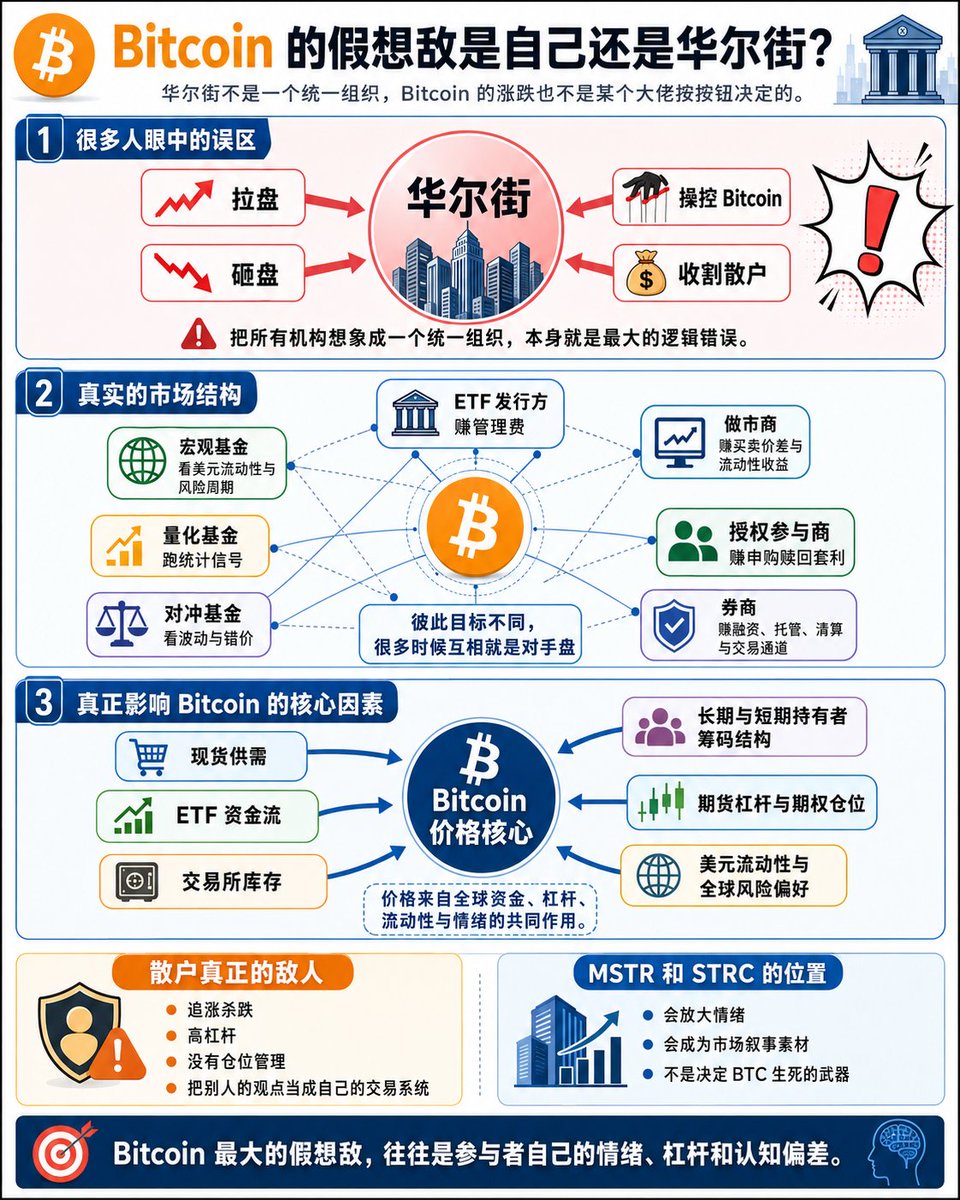
The biggest mistake is imagining "Wall Street" as a unified organization, as if BlackRock, Fidelity, Goldman Sachs, JPMorgan, market makers, hedge funds, quantitative funds, macro funds, pension funds, brokers, proprietary trading, and ETF authorized participants are all sitting in the same conference room discussing how to pump Bitcoin today and how to dump Bitcoin tomorrow. 😂
The reality is completely different.
所谓华尔街, at its essence, is a collection of completely different institutions. ETF issuers make money from management fees, market makers earn from bid-ask spreads and liquidity, authorized participants profit from arbitrage in subscriptions and redemptions, macro funds look at dollar liquidity and the cycle of risk assets, quantitative funds chase statistical signals, hedge funds consider volatility and mispricing, and brokers earn from financing, custody, clearing, and trading channels.
The goals, cycles, cost of capital, risk control models, and profit methods of these institutions are all different, and often, they are even opponents to each other.
Therefore, packaging these complex institutions into the imaginary enemy called "Wall Street" and then deducing that Wall Street manipulates Bitcoin prices to harvest retail investors is flawed logic from the very beginning.
Of course, I am not saying that institutions won’t leverage emotions, nor am I saying that market manipulation doesn’t exist. Every financial market has emotional trading, leverage squeeze, liquidity hunting, and narrative amplification. Bitcoin is no different. As long as there is leverage in the market, stop losses, liquidation lines, option positions, and liquidity gaps, there will always be people trading around these positions.
But this is a different matter from Wall Street uniformly controlling Bitcoin.
The market often needs a story. When prices drop, people look for reasons; when they rise, they also seek explanations. Today, it could be said that MSTR is facing liquidation, tomorrow it might be ETF outflows, the day after it could be rising U.S. Treasury yields, and later it could be an issue with a specific exchange. Stories can influence emotions, and emotions can amplify volatility, but the stories themselves are not the core logic of Bitcoin.
The true price core of Bitcoin is still determined by spot supply and demand, ETF capital flow, exchange inventory, the chip structure of long-term and short-term holders, futures leverage, option positions, dollar liquidity, and global risk appetite.
In other words, Bitcoin’s rise and fall is not decided by a certain Wall Street big shot pressing a button, but rather is the result of global capital, leverage, liquidity, and emotions working together.
The real enemy of retail investors is often not Wall Street, but themselves.
Chasing prices, high leverage, lack of position management, rushing in upon hearing good news, rushing out upon hearing bad news, viewing short-term fluctuations as conspiracies, perceiving market narratives as garbage, treating others' opinions as their own trading systems.
These are the main issues.
The cruelest aspect of the Bitcoin market is that many people verbally claim to believe in long-term value, but their actual operations are all based on short-term emotions. When prices rise, they feel it will never stop; when they drop, they feel it’s the end of the world. Once prices retract, they start looking for an external enemy to explain their losses: Wall Street, exchanges, market makers, MSTR, ETFs—whoever has the attention will be pushed out to take the blame.
Recent events with MSTR and STRC are the best examples!
Viewing Wall Street as an imaginary enemy can feel comfortable because it makes losing money seem like it’s not your own fault, but rather because others are too wicked. This is the dopamine brought by conspiracy theories, "It’s not because our army is incompetent, it’s because the common enemy is too cunning."
But the market will not become simpler because of such explanations.
Bitcoin's greatest imaginary enemy has always been the emotions, leverage, and cognitive biases of the participants themselves. Demonizing Wall Street does not make retail investors safer; rather, it distracts from what should be truly observed.
What really deserves attention is the direction of capital flows, leverage structure, on-chain chips, ETF subscriptions and redemptions, macro liquidity, and one's own positions. MSTR and STRC may indeed serve as amplifiers in the current phase of Bitcoin, but they are not weapons that determine BTC’s life or death.
Moreover, it has become very clear from the data that I publish BTC and ETH spot ETF data daily. These are the institutions and Wall Street's actual purchases, although they may be used for hedging, it doesn’t matter, as they have not been sold after buying, meaning that Wall Street is currently known to be a long-term investor in Bitcoin.
On-chain data further shows that high-net-worth investors holding more than 10 bitcoins are indeed long-term investors, with nearly 75% of Bitcoin not moving for over 155 days, most of which are high-net-worth institutions, including many Wall Street investors.
#Bitget is here for VIPs! Crypto, U.S. stocks, CFDs, global opportunities all in one place.
免责声明:本文章仅代表作者个人观点,不代表本平台的立场和观点。本文章仅供信息分享,不构成对任何人的任何投资建议。用户与作者之间的任何争议,与本平台无关。如网页中刊载的文章或图片涉及侵权,请提供相关的权利证明和身份证明发送邮件到support@aicoin.com,本平台相关工作人员将会进行核查。


