Key Takeaways:
- NASA released Hubble’s MACS0329-0211 image on June 12, 2026.
- MACS0329-0211’s mass helps lens galaxies from about 5 billion years ago.
- Hubble data may help NASA researchers map dark matter and early galaxies.
The image, released June 12, 2026, shows what NASA described as looking “somewhat like a swarm of bees returning to their hive.” The cluster is packed with galaxies bound together by gravity.
MACS0329-0211 contains large elliptical galaxies, thin edge-on spiral and lenticular galaxies, and face-on spirals with visible arms. Together, they form one of the universe’s largest gravitationally bound structures.
Galaxy clusters are not just collections of stars and gas. Their enormous mass bends space-time, allowing them to act as natural telescopes through gravitational lensing.
In the Hubble image, faint arcs appear in the upper-right quadrant. Those arcs are distant background galaxies whose light has been stretched and magnified by the cluster’s gravity.
Near the center, bright white intersecting curves form a distorted figure-eight shape. NASA said this may be another distant galaxy whose light was magnified and distorted by the massive cluster.
Gravitational lensing is a visible confirmation of Einstein’s General Theory of Relativity. Massive objects curve space-time, and light follows that curved geometry rather than traveling in a perfectly straight line.
When alignment is especially strong, lensing can produce giant arcs, multiple images of the same galaxy, or Einstein rings. In weaker cases, astronomers use subtle distortions to map dark matter across large regions of space.
MACS0329-0211 sits at a redshift of about 0.4503, meaning its light left when the universe was roughly 8 billion to 9 billion years old. Its look-back time is about 5 billion years.
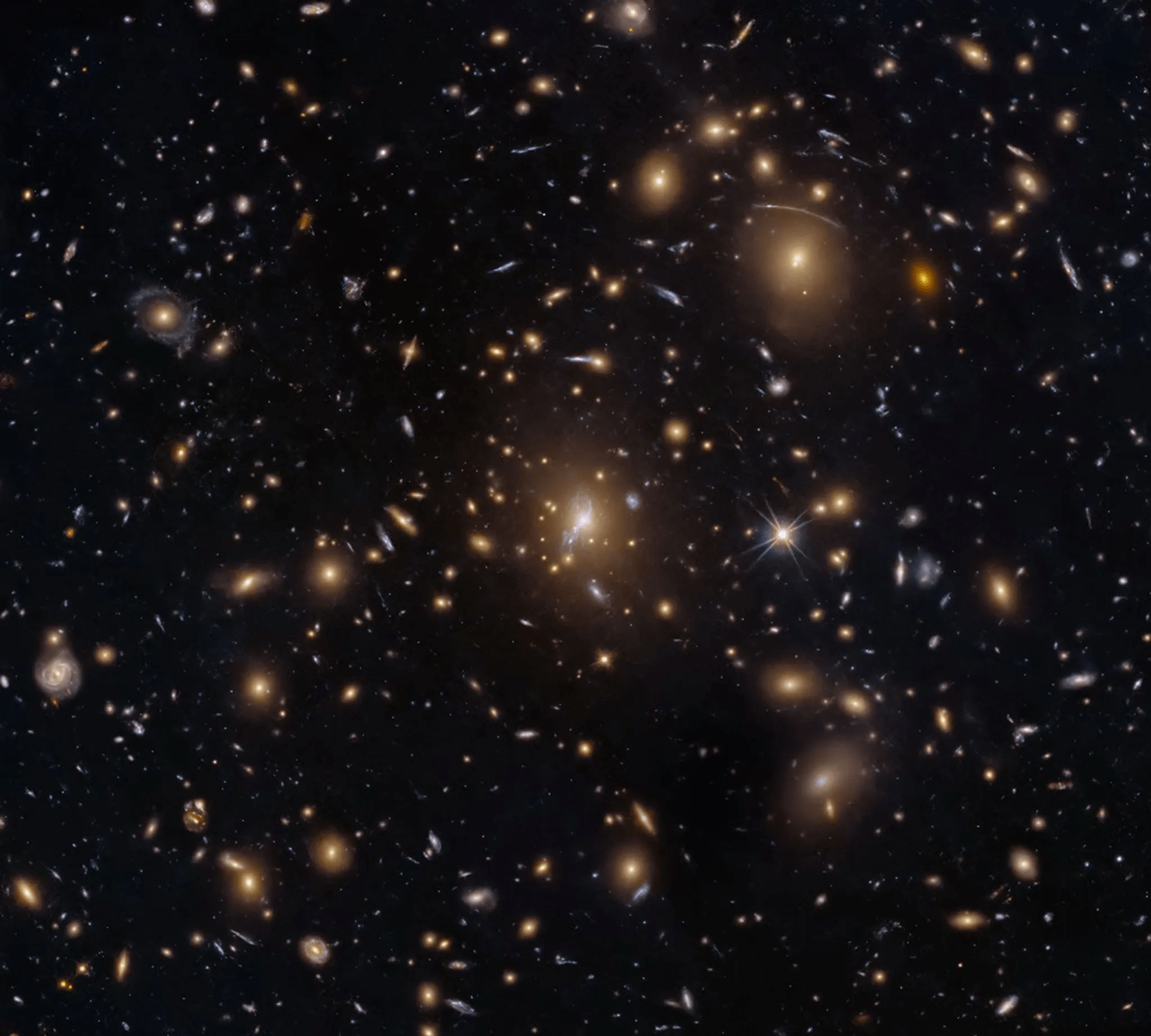
NASA Hubble Space Telescope image showcasing the galaxy cluster MACS0329-0211. NASA, ESA, M. Postman (STScI); Image Processing: G. Kober (NASA/Catholic University of America)
A 2024 kinematic study using Very Large Telescope spectroscopy estimated the cluster’s mass at about 9.2 × 10^14 solar masses within a radius of about 1.71 megaparsecs, or roughly 5.6 million light-years across.
The cluster was observed as part of a program studying X-ray bright galaxy clusters. Hubble used the Advanced Camera for Surveys and Wide Field Camera 3 to collect visible and infrared data.
Galaxy clusters are signposts for how the universe’s large-scale structure formed over billions of years. They also help researchers study dark matter, galaxy evolution and the assembly of massive cosmic systems.
MACS0329-0211 appears relatively relaxed overall, but studies indicate it sits in a rich environment with nearby galaxy groups and evidence of recent infall. Its brightest cluster galaxy also shows active star formation, ultraviolet emission and radio emission.
For astronomers, the value of the image extends beyond its visual drama. It captures cluster galaxies from one era of cosmic history while using gravity to reveal still more distant galaxies from earlier times.
免责声明:本文章仅代表作者个人观点,不代表本平台的立场和观点。本文章仅供信息分享,不构成对任何人的任何投资建议。用户与作者之间的任何争议,与本平台无关。如网页中刊载的文章或图片涉及侵权,请提供相关的权利证明和身份证明发送邮件到support@aicoin.com,本平台相关工作人员将会进行核查。


