Share a cold fact about AIDS, solely as educational information with no guidance.
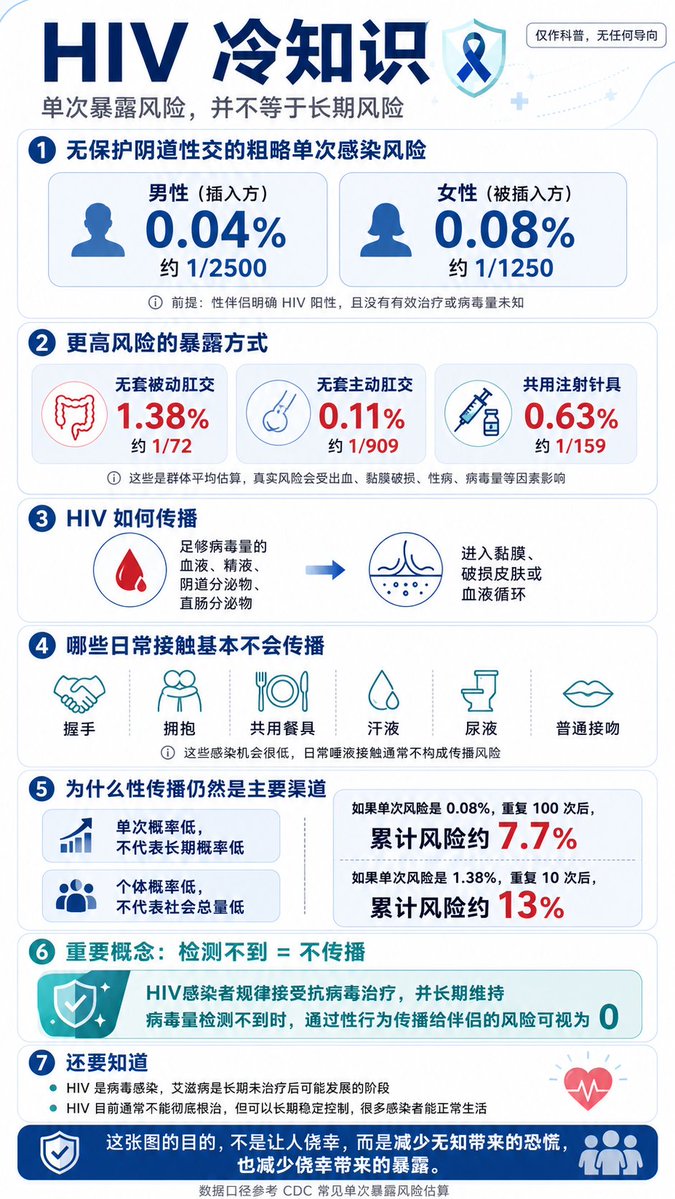
0.04% and 0.08%, what does this probability mean? This is a rough estimate of the risk of a single exposure provided by the CDC when a sexual partner is confirmed to be HIV positive with no effective treatment or unknown viral load, in an unprotected state.
In simpler terms, if one engages in unprotected sexual activity with an HIV positive patient, the probability of male transmission is 0.04%, while the probability for females is 0.08%.
In fact, it is more accurate to refer to this as the probability of HIV infection. HIV is a viral infection, and AIDS is a severe immune deficiency stage that may develop after long-term untreated HIV.
This probability is not to encourage a sense of complacency but rather to make individuals truly recognize the risks they might face.
HIV transmission requires several conditions to be present simultaneously. The partner's bodily fluids must contain sufficient virus, which must enter one's mucous membranes, broken skin, or bloodstream through blood, semen, vaginal secretions, rectal secretions, etc.
Common high-risk scenarios include unprotected anal sex, unprotected vaginal intercourse, and sharing injection needles, especially when the other person is HIV positive, untreated, and with an unknown viral load.
Ordinary handshakes, hugs, sharing utensils, sweat, urine, contact with intact skin, and casual kissing generally do not transmit HIV. The CDC also indicates that the risk of contracting HIV through oral sex is low, and routine exposure involving saliva typically does not pose transmission risks.
From the perspective of single exposure risk, unprotected receptive anal intercourse, which is when one is penetrated, carries the highest risk. The CDC estimates that if the partner is HIV positive and there is no condom, no pre-exposure prevention, and no effective treatment, the risk of infection from each episode of receptive anal intercourse is approximately 1/72.
For insertive anal intercourse, the risk is about 1/909. In unprotected vaginal intercourse, the receptive partner's risk is approximately 1/1250, and the insertive partner's risk is about 1/2500. The risk of sharing injection needles is also relatively high, approximately 1/159.
This is also why the probability of HIV among men who have sex with men is the highest, especially for those who are receptive, being roughly 17 times higher than the infection probability for women and 36 times higher than for men.
Of course, these numbers are merely average estimates for the population and do not reflect the actual risk for every individual. Real risk is influenced by many factors. If condoms are used correctly throughout, or if the other partner has been on long-term consistent medication and maintains an undetectable viral load, the risk significantly decreases.
Currently, there is a very important concept in HIV education that states undetectable equals untransmittable. If an HIV positive person consistently receives antiviral treatment and maintains an undetectable viral load, the risk of transmitting HIV through sexual activity can be considered zero.
This concept is crucial because many people's fears about HIV are rooted in outdated information. Today's HIV can be effectively managed with long-term treatment; with early detection and early treatment, many infected individuals can live normal lives for a long time.
Some may ask, if the transmission probability through sexual contact is so low, is sexual contact the main transmission channel for AIDS?
In reality, sexual contact is indeed the largest transmission channel for AIDS, as the low probability of infection from a single act does not contradict the primary routes of transmission on a population level.
The low HIV infection probability in a single sexual act appears to be high because HIV is not particularly easily spread through everyday contact. HIV cannot be transmitted through air, water, sweat, or ordinary saliva, nor can it penetrate intact skin. To contract the virus, there must be a sufficient viral load in blood, semen, vaginal secretions, rectal secretions, etc., that comes into contact with mucous membranes, broken tissues, or directly enters the bloodstream.
The low probability of a single act does not imply a low long-term probability. Individual risk being low does not mean the total societal risk is low.
A single risk of less than one in a thousand may seem very low. However, if it involves a long-term sexual partner and occurs repeatedly dozens or hundreds of times, the risk will continuously accumulate. Suppose a certain behavior has a single risk of 0.08%; while it is indeed low once, after 100 occurrences, the cumulative risk would be approximately 7.7%.
If it involves unprotected receptive anal intercourse, the single risk is noticeably higher, estimated by the CDC to be around 1.38%, resulting in about a 13% cumulative risk after 10 times and nearly 50% after 50 times.
This principle is similar to playing the lottery; the probability of winning with a single lottery ticket is very low, but if society buys tens of millions of tickets every day, someone will eventually win. A probability of 99.99% of not winning is still zero, and a 0.001% chance of winning equates to 100%.
Currently, HIV cannot be completely cured with standard medications, but it can be treated, and it can be controlled very well in the long term.
The CDC reveals that most people can control their viral load within 6 months of treatment; although HIV cannot be cured, treatments enable infected individuals to lead long and healthy lives. Moreover, if the viral load remains undetectable over the long term, there will be no transmission through sexual activity, which means the risk for an HIV positive person who undergoes regular treatment and maintains an undetectable viral load of transmitting the virus to their partner is zero.
Of course, reaching the AIDS stage can be far more severe, but that does not mean there is no hope. The challenge will simply be much greater.
In conclusion, the purpose of this informative post is not to tell everyone "the probability is low, so don't be afraid," but rather to transform the perception of HIV risk from causing fear to a more scientific understanding.
#Bitget has arrived, it's VIP! Crypto, US stocks, CFDs, a global opportunity at one stop.
免责声明:本文章仅代表作者个人观点,不代表本平台的立场和观点。本文章仅供信息分享,不构成对任何人的任何投资建议。用户与作者之间的任何争议,与本平台无关。如网页中刊载的文章或图片涉及侵权,请提供相关的权利证明和身份证明发送邮件到support@aicoin.com,本平台相关工作人员将会进行核查。


