Every four years, the competition on the green field quietly impacts another global market—cryptocurrency. From 2014 to 2022, during the three World Cups, Bitcoin and the entire cryptocurrency market experienced varying degrees of fluctuations during the events. The 2026 World Cup in the US, Canada, and Mexico officially opened on June 11, marking the largest edition in history, with 48 teams and 104 matches, and also the deepest integration of the cryptocurrency industry with sports events.
So, what do historical data tell us? What path will this year's market take? Let the data speak; Huobi HTX will take you through a systematic review.
Does the 'World Cup Curse' really exist? A review of market data from three World Cups
In traditional financial markets, the 'World Cup Curse' has a long history. According to historical data, from 1994 to 2022, during the 8 completed World Cups, the Shanghai Composite Index has shown 5 declines and 3 increases. In the cryptocurrency market, the market trends are even more complex and fluctuating. Some research institutions suggest that this may be related to the high overlap between the 'de-leveraging cycle after inherent market bubbles' and the '4-year World Cup hosting cycle.' Let's review the market data for each of the three World Cups.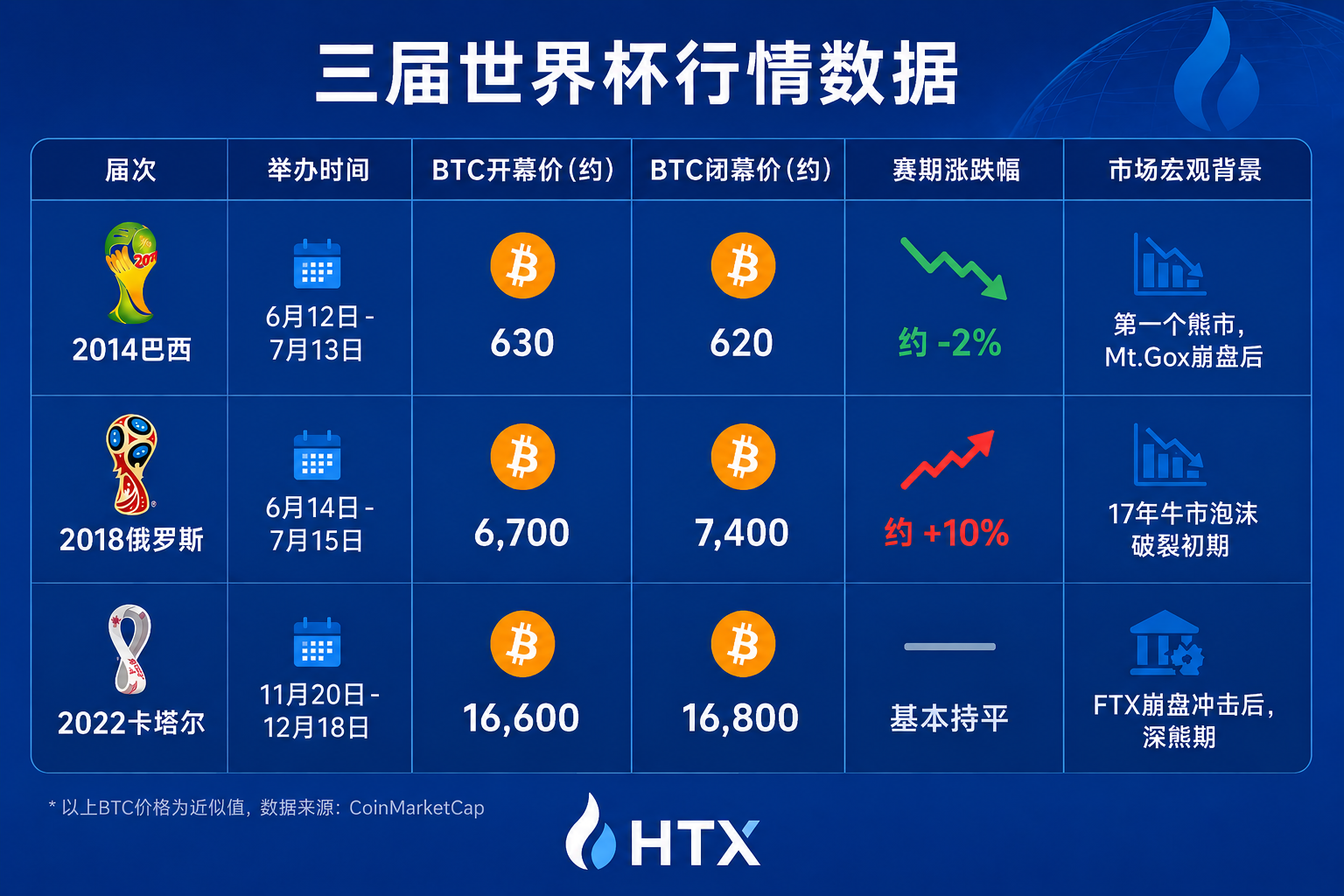
2014 Brazil World Cup: Silence in the First Bear Market
2014 was one of the 'darkest moments' experienced by the crypto market. At the beginning of the year, the world's largest exchange, Mt.Gox, declared bankruptcy due to the theft of 850,000 Bitcoins, severely damaging market confidence. Bitcoin fell from a historical high of $1,156 at the end of 2013, reaching a yearly high of only $1,017, and closing at around $320 by the end of the year.
During the World Cup (June-July), Bitcoin's price fluctuated sideways in the $600-$650 range, and regardless of how many goals were scored on the green field, the crypto market remained almost indifferent. Thus, the macro bear market combined with black swan events meant that World Cup buzz could not reverse the trend.
2018 Russia World Cup: A Fleeting Rebound
2018 marked the beginning of another brutal bear market in crypto history. Bitcoin plummeted from nearly $20,000 at the end of 2017 to about $3,200 by the end of the year, with a decline of over 70% for the year.
However, during the World Cup (June 14 - July 15), Bitcoin experienced a brief rebound, rising from about $6,700 to around $7,400, with a gain of nearly 10%. However, this good news was short-lived, as after August the market continued downward, falling below $4,000 by the end of the year. The World Cup rebound during the bear market was more of a recovery from overselling than a trend reversal, often leaving those who chased highs trapped.
2022 Qatar World Cup: Despair at the Bottom Beneath the FTX Black Swan
The cryptocurrency market backdrop for this World Cup was most unusual. On the eve of the opening ceremony, the world's second-largest cryptocurrency exchange, FTX, declared bankruptcy in November 2022, leading to a systemic shock in the market, with Bitcoin falling from $21,000 to below $16,000, and a total market value evaporation of over $150 billion throughout November.
During the World Cup, Bitcoin fluctuated in the $16,000-$17,000 range, with changes close to flat. More notably, fan tokens surged sharply before the event and then crashed collectively after the opening. CHZ (Chiliz) soared by 42% in the 7 days leading up to the World Cup and by 95% in the 30 days prior; however, after the opening, CHZ dropped by 17.19%, the Spanish national team fan token SNFT dropped by 27.40%, the Brazilian national team fan token BFT dropped by 17.20%, and the Argentine national team fan token ARG dropped by 13.21%. The motto “buy the expectation, sell the facts” was vividly illustrated.
Summary of Patterns: Common Logic Behind the Three Sets of Data
By viewing the three sets of data together, the following meaningful patterns can be distilled:
Pattern One: The World Cup market in the cryptocurrency sector is fundamentally an extension of the macro cycle. All three World Cups happened to occur during bear or adjustment periods in the cryptocurrency market (2014, 2018, and 2022 were all years of decline for Bitcoin). This is not a coincidence—The World Cup is held every four years, and the de-leveraging cycle in the crypto market operates on a roughly four-year dimension (highly coinciding with Bitcoin's halving cycle). When the overall trend is downward, the World Cup buzz can only create localized fluctuations without changing the overall direction.
Pattern Two: Sports-themed tokens strictly follow the logic of “expectations lead, facts sell”. This pattern was most evident in 2022: the window for fan tokens was in the 1-3 months preceding the event, while the start of the tournament signaled a sell-off. In participating in such theme-based speculation, the most important thing is not “what to buy,” but “when to sell.”
Pattern Three: The correlation between the cryptocurrency market and global stock markets continues to strengthen. With institutional funds entering the playing field, the correlation between cryptocurrency and US stocks has notably increased. This means that analyzing the cryptocurrency market can no longer be done in isolation; macro indicators such as the Federal Reserve's policies and global risk sentiment must also be monitored.
Huobi HTX Perspective: The 2026 World Cup Faces a Completely Different Background
Armed with historical patterns, we will look at this year's unique aspects.
Background One: Bitcoin is in a “power-up period” after halving
The fourth Bitcoin halving will occur in April 2024. Historically, significant bull markets often emerge within 12-18 months after each halving (e.g., 2013, 2017, and 2021 proved this). Bitcoin could briefly exceed an all-time high of $126,000 in 2025 but then entered a correction, fluctuating between $60,000 and $80,000 in the first half of 2026. This is in stark contrast to the deep bear markets during the previous three World Cups— the market was in a "high-level correction" rather than a "systemic collapse."
Background Two: The maturity of crypto infrastructure and unprecedented participation depth
Before the 2026 World Cup, the cumulative trading volume of “World Cup champion” contracts on just the Polymarket platform had approached $1.6 billion, with on-chain prediction markets becoming one of the most watched emerging forms of participation during the World Cup. The integration of the crypto industry with sports events has evolved from superficial marketing such as sponsoring jerseys and issuing NFTs into a genuine value network and settlement infrastructure.
Background Three: The acceleration of institutional funding and the compliance process
After the approval of Bitcoin spot ETFs in the United States, the continuous inflow of institutional funds has fundamentally changed the market structure. The volatility of the crypto market is systematically decreasing, and the frequency of "extreme one-sided market" conditions is reducing, which means strategies need to be adjusted accordingly.
Ultimately, no matter how good a strategy is, it requires a stable and secure platform for execution. Huobi HTX, established in 2013, is one of the oldest leading cryptocurrency exchanges in the world, with a track record of 30 months without security incidents since the end of 2023, and boasts over 50 million registered users globally, serving over 130 countries and regions. In the context of global events like the World Cup, characterized by emotional volatility, Huobi HTX's advantages are particularly pronounced, including deep liquidity, comprehensive risk control tools, real-time market information, and a one-stop ecosystem. From spot trades to contracts, leverage, earning coins, and lending, Huobi HTX has constructed a one-stop service system covering the complete asset management cycle, ensuring that whether you are a trader or a long-term holder, you can find suitable products here.
It is worth noting that during the World Cup, Huobi HTX has launched the "World Cup Guessing Red Packet Activity," allowing participants to guess and interact for a chance to share a prize pool of 100,000 USDT. The activity runs from June 12 to July 20, 2026 (UTC+8), covering 34 matchdays during the World Cup. Users just need to enter the Huobi Square activity section, participate in the voting for the first match of the day, and qualify for the next day's red packet; expressing analytical opinions in the comment section may also earn more exposure in community interactions; participating for 7 days will also automatically unlock the eligibility for a larger red packet on the 8th day.
Additionally, Huobi HTX has simultaneously launched the "US-Canada-Mexico World Cup Guessing Activity." From now through July 20 at 3:00 AM (UTC+8), eligible users may register and complete designated tasks to receive guessing tickets and participate in both champion guessing and single-match guessing, collectively sharing a total prize pool equivalent to $500,000 in $HTX tokens. Users successfully predicting the final champion may individually win rewards equivalent to up to $15,000. Lock in Huobi HTX, enjoy the matches, and share exclusive World Cup benefits.
Conclusion: History does not simply repeat itself, but patterns never lie
History will not provide standard answers but will leave clues worth referencing. The data from the three World Cups tells us that the cryptocurrency market will not alter macro trends due to the arrival of the world’s largest sports event, but it will indeed create phased opportunities on an emotional level— the key lies in whether you have understood the patterns in advance and prepared accordingly.
The context of the 2026 World Cup is different from the past three editions— a post-halving power-up cycle, a more matured market infrastructure, broader institutional participation, and an expanding global cryptocurrency user base. This means that there are both new opportunities and new uncertainties. The whistle for the World Cup has already been blown. Whether seizing the event hotspots, capturing market opportunities, or participating in guessing activities and sharing benefits, Huobi HTX will accompany users in witnessing this global celebration moment together.
免责声明:本文章仅代表作者个人观点,不代表本平台的立场和观点。本文章仅供信息分享,不构成对任何人的任何投资建议。用户与作者之间的任何争议,与本平台无关。如网页中刊载的文章或图片涉及侵权,请提供相关的权利证明和身份证明发送邮件到support@aicoin.com,本平台相关工作人员将会进行核查。


