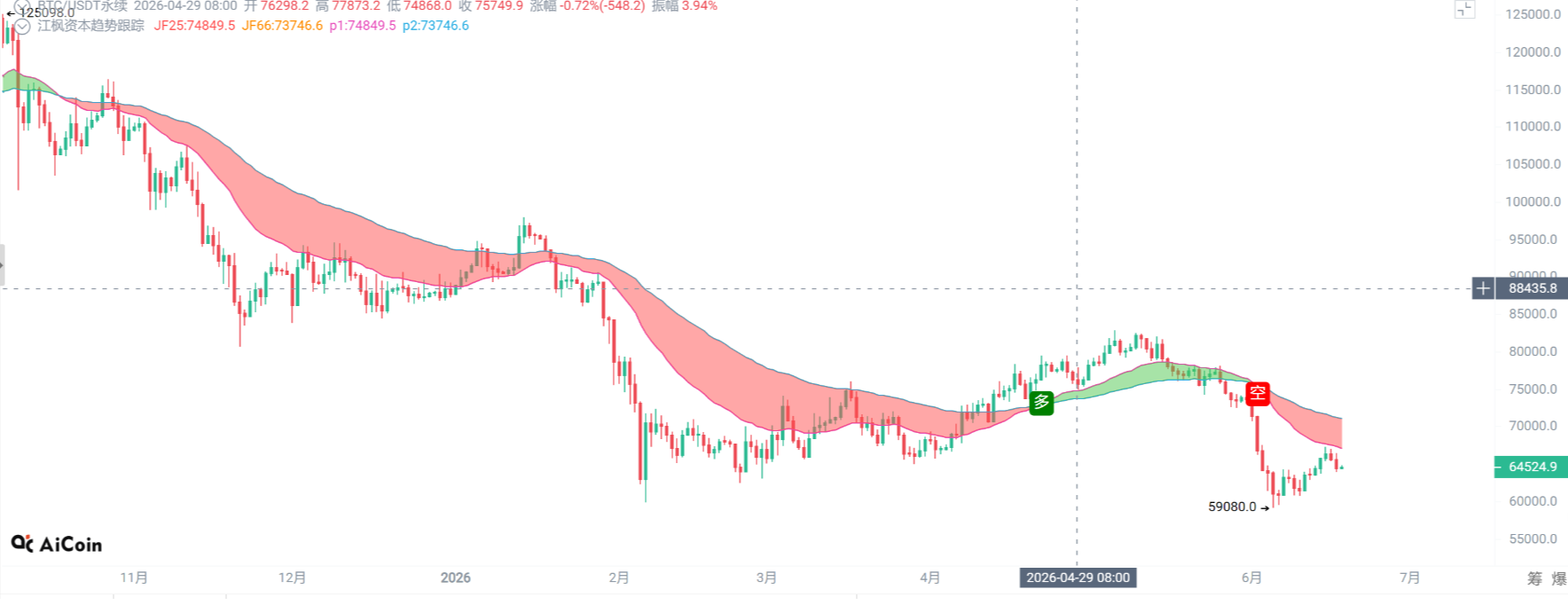
According to CNBC, the CME Group is preparing to sue the U.S. Commodity Futures Trading Commission (CFTC) this Thursday, targeting the latter's decision to allow Kalshi's Bitcoin perpetual contracts at the end of May and permit them to expand similar products to other crypto assets. The dispute in this lawsuit is not about a specific product but whether perpetual contracts should be classified under the traditional futures approach or swaps under the Dodd-Frank Act. Current and soon-to-be former CEO of CME, Terrence Duffy, has publicly stated that perpetual contracts essentially fall under swaps and should adhere to stricter reporting, clearing, and trading requirements, thus questioning the legality of the CFTC's approval of Kalshi's perpetual products as "futures." For Kalshi, this means that the recently opened business door, viewed by the industry as the starting point for a compliant perpetual market in the U.S., could be shut again by a lawsuit at any moment; for CME, which already dominates the Bitcoin futures market and claims exclusive licenses with all benchmark providers, believing all perpetual contracts should pass through their channels, this is a defensive battle concerning market territory and regulatory influence. The CFTC has yet to provide an official response to this anticipated lawsuit, but regardless of where the court ultimately stands, the classification dispute of "are perpetual contracts futures or swaps" has already cast an uncertain precedent on Kalshi and the entire crypto derivatives market seeking to operate within the U.S. compliance framework.
Futures or Swaps
In Duffy's narrative, the lawsuit's starting point is not about rates but whether the label has been incorrectly applied. A perpetual contract is a derivative product with no expiration date, widely traded on crypto exchanges. He has repeatedly emphasized in interviews that such products "essentially belong to swap trading under the Dodd-Frank Act," yet the CFTC approved them under the name of futures. CME plans to use the argument of "mislabeling" perpetual contracts as one of its core points in the lawsuit, questioning whether the CFTC bypassed the stricter reporting, clearing, and trading obligations that should apply to swaps when it approved Kalshi's Bitcoin perpetual contracts at the end of May, putting a product that should enter a heavily regulated channel onto a relatively mature but lighter pathway like futures.
Once the label is rewritten, the regulatory landscape shifts as well. If the court adopts CME's view and categorizes perpetual contracts under the Dodd-Frank Act's swaps, it means that such products in the U.S. market will need to adhere to different licensing, business qualifications, and compliance requirements than futures, significantly raising the compliance costs and entry barriers for operators. More critically, the approval framework that the CFTC previously built for products like Kalshi's was designed under the premise of "futures," and if the judiciary identifies a classification error, this framework will likely need to be rewritten: whether existing approvals need adjustments, how subsequent products will need to report, and how regulatory interpretations will align must all be reexamined under the new legal categorization. For all platforms trying to launch perpetual contracts compliantly in the U.S., this is not just a case dispute but involves redrawing the boundaries of what the market can do and who qualifies to do it in light of judicial decisions.
Kalshi's Early Approval
A turning point occurred at the end of May. The CFTC approved Kalshi to launch Bitcoin perpetual contracts, and this decision was formally categorized under the "futures" framework, making it one of the first compliant crypto perpetual products in the U.S. and interpreted by the market as a clear regulatory milestone. For CME, which has long dominated the Bitcoin futures market, this is not just an ordinary approval: a competitor getting compliance status for a similar underlying contracts means that a new track paved by the regulator suddenly appears in a category it is familiar with. More critically, Duffy stated that CME has exclusive licensing arrangements with benchmark index providers, and the narrative that "all perpetual contracts should go through CME" creates a blatant conflict with the CFTC's direct approval of Kalshi's products; when the CFTC chose to legally treat perpetuals as futures and granted the first license to others, it almost inevitably became the direct trigger for CME to resort to litigation.
Kalshi did not stop at just the Bitcoin product. After obtaining approval for Bitcoin perpetual contracts, it expanded its product line to other cryptocurrencies, creating a "first mover + expansion" path that amplifies effects for both peers and regulators: for other platforms wanting to launch compliant perpetual products in the U.S., if they do not obtain similar approvals quickly, Kalshi might occupy seven or eight parts of the future market space; for the CFTC, once the first example opens up, more applications are bound to follow, while the dispute over whether perpetuals should be viewed as futures or swaps under the Dodd-Frank Act remains unresolved, making each additional new product release heighten its legal risks. For CME, the faster Kalshi expands its perpetual contracts to more crypto assets, the more likely its advantage in the Bitcoin futures market will be diluted, and by the time its product matrix is formed, any attempts to reverse regulatory interpretations through lobbying or internal battles will be significantly constrained. Thus, shifting the battlefield to the courts became its key choice to hinder the extension of this new channel during a period where regulations are still undefined.
Exclusive Licensing and Regulatory Boundaries
When CME shifted the battlefield from regulatory procedures to the courts, it was not just trying to overturn an approval document but was using "exclusive licensing + legal qualification" to redefine the entire market's entry thresholds. Duffy claims that CME has exclusive licenses with "all benchmark providers," logically extending to mean that as long as perpetual contracts are anchored to these benchmark indices, they should be traded through CME's channel. CME's own Bitcoin futures are already tied to specific price indices, and it has exclusive agreements with index providers. Although the specific terms have not been disclosed, Kalshi's approval of perpetual contracts by the CFTC is objectively viewed as a challenge to this agreement—allowing another exchange to design perpetual products around similar crypto assets is read by CME as diluting its commercial control over the "benchmark + product design" combination.
Even more sensitive is CME tying this commercial arrangement to the Dodd-Frank Act: once the court adopts its viewpoint and classifies perpetual contracts under the more heavily regulated swaps instead of futures, new entrants will not only face higher compliance costs but may also be forced to bypass CME's already defined exclusive license areas regarding which indices to use and how to design contracts, thereby creating de facto market entry barriers. U.S. antitrust and financial regulators have always been wary of large exchanges abusing market power. The CFTC's prior approval of Kalshi's perpetual contracts was seen as a signal of leaning toward innovation and diverse competition, but now CME has countered this as an excessive act of "ignoring exclusive licenses and misjudging legal attributes." This compels regulators to redraw a clearer boundary between encouraging new products and preventing leading platforms from bundling market access through benchmarks, licenses, and rules, and where this line is ultimately drawn will directly determine the competitive structure of the U.S. crypto derivatives market for the next decade.
The Crypto Variable in Washington's Regulatory Game
From Washington's perspective, this is no longer just a dispute between two agencies but is drawing a nationwide regulatory red line for crypto derivatives. The CFTC is viewed as the core regulatory authority for commodities and derivatives, and in recent years has been extending its reach into digital assets. Now, by being the first to provide a "futurization" answer for perpetual contracts, it openly announces its jurisdictional intentions over this product form. However, there has been long-standing controversy in the U.S. regarding the division of responsibilities across agencies in digital assets, and rules have been inherently unstable. CME's lawsuit at this moment effectively elevates the technical question of "are perpetual contracts futures or swaps under the Dodd-Frank Act" into a political exam question concerning the CFTC's boundaries of power and regulatory style: if the court supports the CFTC, it means the government tends to "incorporate" innovative products using a traditional futures framework in crypto derivatives; conversely, it would push perpetuals under the more stringent reporting, clearing, and trading obligations of swaps, also spotlighting the CFTC's current innovative posture on trial.
For other exchanges, over-the-counter platforms, and institutions planning structured products, this classification battle directly determines future compliance pathways. If Kalshi-style perpetual contracts are ultimately confirmed to be able to launch under the futures pathway, more platforms will view "accessing the CFTC futures regulatory framework" as the only channel for compliant domestic perpetuals, and designs regarding margin, leverage, and clearing mechanisms will use this as a template; if the court adopts CME's viewpoint and recognizes perpetuals as swaps, it means similar products must endure a higher compliance burden under the Dodd-Frank Act, and many ideas hoping to package ETF-like structured products with perpetual contracts will face stricter trading and reporting requirements right from their design phase. The final classification conclusion for perpetual contracts in the U.S. is not just about resolving one approval dispute but serves as a reference framework for global regulators: whether to classify such no-expiration contracts as ordinary futures within the current derivatives framework or to consider them as higher-risk, must-list swaps. Countries will likely first look at the outcome of this lawsuit in Washington when designing their own crypto derivatives rules.
Litigation Directions and Compliance Uncertainty
Based on current publicly available information, this lawsuit is still at the "planned to sue" stage, with the suing court, case number, and specific causes of action not disclosed, and the CFTC has not issued a formal response. The potential directions are roughly three: if CME prevails in court, the perpetual contracts will be more convincingly pulled back to the swap track under the Dodd-Frank Act, leading all similar products within the U.S. to face higher capital requirements, more intensive reporting and clearing obligations. When exchanges and project parties design no-expiration contracts, the more they mimic swaps in risk-return structures and margin mechanisms, the more they should expect to enter a high-burden channel; if the CFTC wins this lawsuit, the regulatory practice of viewing perpetual contracts as futures will receive judicial endorsement, and the Kalshi model may become a template for other platforms, but it will also acknowledge that the CFTC has greater discretionary power in case-by-case approvals, making any attempts to "skirt" in product forms, benchmark selections, or licensing arrangements subject to easier identification as evasion of the existing futures market. The third more common scenario is that both sides reach a settlement during the lengthy litigation, concluding with rewritten rules, and refining the definitions and approval processes for perpetual contracts. This will force exchanges, project parties, and institutional investors to restructure and clarify product terms again, marking clearly which rate mechanisms, index sources, and leverage structures fall within regulatory red lines and which can seek more lenient spaces in future rules. The biggest uncertainty currently lies in the timeline and legal details: when the case will be filed, whether there will be motions to temporarily freeze subsequent approvals, and whether the CFTC will issue new guidance during the litigation process will determine whether the U.S. domestic perpetual contract market hits the pause button or is forced to continue under stricter rules. For the market, what truly needs to be closely monitored are the disclosures of the lawsuit details, the court's first round of judicial judgment on the classification of perpetual contracts, and whether the CFTC will take the opportunity to update approval standards.
Join our community to discuss and strengthen together!
AiCoin exclusive Hyperliquid benefits: https://app.hyperliquid.xyz/join/AICOIN88
AiCoin exclusive Aster benefits: https://www.asterdex.com/zh-CN/referral/9C50e2
On-chain Telegram community: https://t.me/AiCoinWhaleData
On-chain community: https://www.aicoin.com/link/chat?cid=N6OVMor5g
AiCoin on-chain Twitter: https://x.com/aicoinwhaledata
免责声明:本文章仅代表作者个人观点,不代表本平台的立场和观点。本文章仅供信息分享,不构成对任何人的任何投资建议。用户与作者之间的任何争议,与本平台无关。如网页中刊载的文章或图片涉及侵权,请提供相关的权利证明和身份证明发送邮件到support@aicoin.com,本平台相关工作人员将会进行核查。