Key Takeaways:
In his appearance on the Galaxy Brains podcast, Binance founder Changpeng Zhao, known as CZ, complimented Hyperliquid’s innovation, praising the decentralized exchange’s high-performance blockchain, onchain order books, gasless orders, sub-second execution and up to 40x leverage. He further added that the platform has carved out a niche for itself, one that Binance cannot easily compete in because users can trade without conventional identity checks.
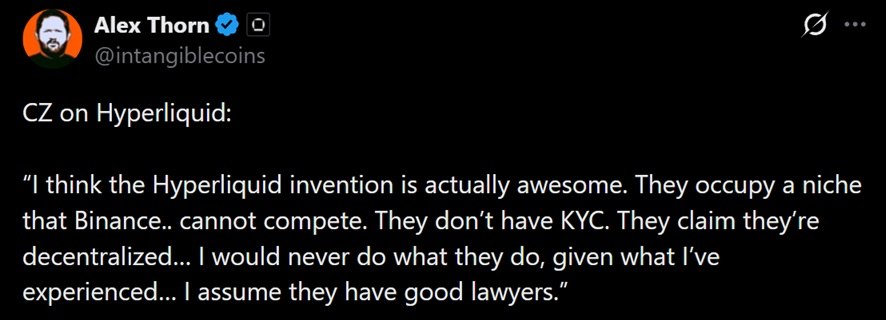
Image source: X
That same feature, CZ cautioned, is also its biggest liability, flagging compliance risks and pointing to his own history. CZ pleaded guilty to anti-money-laundering violations in 2023 and served a four-month U.S. prison sentence in 2024. In sum, he admires what Hyperliquid has built, but claims he would “never operate it the same way” given the regulatory environment today.
While CZ weighed in on the compliance side of things, Uniswap founder Hayden Adams went after the rules themselves. Reacting to a discussion of investor-protection law, he opined on X:
“The main impact of securities law seems to be only people who are already millionaires can invest in startups. Hard to imagine that’s the right approach”.
The critique revives a long-running fight over accredited-investor rules, which restrict many early-stage deals to the already wealthy. Adams has reason to engage given Uniswap Labs spent two years under regulatory pressure before the U.S. Securities and Exchange Commission (SEC) dropped its probe, and a New York judge dismissed a scam-token class action against the company with prejudice in 2026.
The two statements come from very different founders, but they point at the same fault line, i.e. the trade-off between compliance and access. CZ’s argument is that permissionless venues like Hyperliquid win users precisely because they sidestep gatekeeping, even as that invites enforcement risk.
On the other hand, Adams’s argument is that the gatekeeping itself, in the form of securities law, locks ordinary people out of the most lucrative opportunities. Both land at a sensitive moment for decentralized finance ( DeFi), especially since Hyperliquid has been one of 2026’s breakout stories, with HYPE trading at record highs and U.S. regulators only beginning to define how onchain derivatives and tokens should be treated.
As Washington debates market-structure legislation, the candor from two of the industry’s most influential builders adds fuel to the question of how to protect investors without freezing out the very people the rules claim to serve.
免责声明:本文章仅代表作者个人观点,不代表本平台的立场和观点。本文章仅供信息分享,不构成对任何人的任何投资建议。用户与作者之间的任何争议,与本平台无关。如网页中刊载的文章或图片涉及侵权,请提供相关的权利证明和身份证明发送邮件到support@aicoin.com,本平台相关工作人员将会进行核查。


