Why is it said that a million builders are the hardest core moat in the crypto world?
Written by: Joseph Chalom, Sharplink CEO
Translated by: Saoirse, Foresight News
I just concluded my trip to Asia, during which I had in-depth discussions with Ethereum developers and ecosystem leaders. Special thanks to the Nonce Classic, Four Pillars, and DSRV teams in Seoul, as well as the partners from SNZ and the newly established Ethereum Community Center in Hong Kong. This center, supported by the Ethereum Foundation, is the first permanent physical Ethereum community in Asia.
What touched me most on this trip was not just the vibrant atmosphere of the industry, but also the rigorous and pragmatic attitude of local builders and their lofty vision. The global Ethereum ecosystem has produced a large number of high-quality projects, innovative experiments, and long-term strategies that deeply moved and inspired me.
A set of data also became vibrant because of this offline exchange: According to data provided by Electric Capital, the total number of developers contributing to Ethereum has surpassed one million, with a specific count of 1,012,824; no other ecosystem in the crypto industry can compare with it.
A milestone worth our attention
While a million is a round number, many such numbers are often hollow, but this data is extraordinary. Behind the number lies the largest pool of technical talent gathered from the global open permissionless blockchain network, and crucially, the size and professional depth of this talent pool is still expanding.
Among these million developers, approximately 232,000 have remained active in development over the past 12 months.
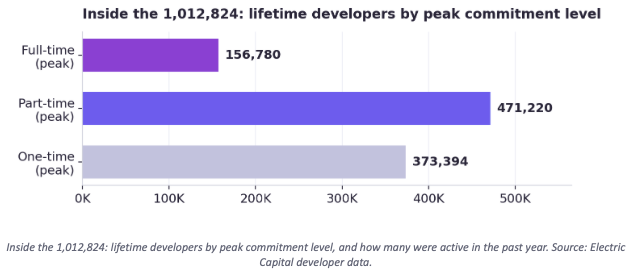
Ethereum has accumulated 1,012,824 developers: peak full-time count of 156,780, peak part-time count of 471,220, and peak single participation count of 373,394, with part-time developers comprising the largest portion of the total group. Source: Electric Capital
Why choose Ethereum? This is the real key question
For a long time, discussions in the crypto industry have revolved around transaction speed, fees, and throughput. Every emerging public chain claims to be "faster than Ethereum." But the most important question in the crypto space has never been which chain performs best; rather, it is another core question:
Which chain will top developers choose to build on long-term?
On this question, Ethereum is unique and irreplaceable. Its advantages lie not only in the technical aspects but also in multiple dimensions including its institutional framework, industry culture, economic system, and composability. This is the result of a decade-long accumulation of developers, infrastructure, industry standards, development tools, liquidity, academic research, various applications, and collaborative industry systems that no other ecosystem can replicate.
Ethereum has already become the underlying universal operating system for programmable finance and on-chain native asset issuance.
What are the million developers building now? And how do they continue to construct the industry's moat?
The value of the million developer community lies primarily in the industry's most challenging and far-reaching issues they are currently tackling: layer 1 protocol scalability, privacy technology, quantum resistance, and future intelligent autonomous systems to operate on-chain.
Glamsterdam Upgrade: Innovating while Upholding Core Foundations
The Glamsterdam upgrade scheduled for 2026 perfectly illustrates how Ethereum iterates and innovates while adhering to core values. The core changes of this upgrade include the standardized proposer-builder separation mechanism (ePBS) and block-level access lists (BALs), both of which will enable parallel execution, significantly increasing network throughput, and are also expected to raise the gas limit, substantially enhancing the layer 1 mainnet's carrying capacity.
While meeting the future market scalability needs, it ensures the network remains trusted, neutral, secure and stable, with fair distribution of MEV — this is a tangible embodiment of Ethereum's continuously reinforcing moat.
Synchronizable Composability: Making Dozens of Rollups Function as One Complete Public Chain
Composability has always been Ethereum's trump card advantage, and the next breakthrough is extending that capability to all layer two networks. Native, foundational Rollups paired with synchronizable composability can address the problem of ecosystem fragmentation: within a single atomic transaction, a Rollup's smart contract can directly call contracts on the mainnet or other layer two networks, eliminating the need for cross-chain bridges and the waiting time associated with them.
Teams from Linea, Ethereum Economic Zone, Gnosis, Zisk, etc., are collaborating with the Ethereum Foundation to advance related R&D, combining this architecture with real-time proof technology. The end result is that dozens of Rollups are no longer isolated networks, but are integrated into one, directly responding to external criticisms of Ethereum's ecological fragmentation.
Quantum Resistance: Ethereum’s Most Outstanding Leading Track
No mainstream public chain ecosystem can anticipate and lay out post-quantum security systems like Ethereum. Relying on the "Lean Ethereum" development route, Ethereum Foundation established a post-quantum security team in early 2026, alongside the official site pq.ethereum.org, in addition to over a dozen client teams running the post-quantum interoperability development testnet weekly; the entire open-source collaborative migration plan has taken shape, with the goal of landing approximately by 2029.
Once quantum computing presents security risks, institutions managing trillions of dollars in custodial assets will focus on one thing: which public chain has done the earliest and most comprehensive protective preparations.
The Moat Beyond Developers: Composability, Unified Standards, and Industry Trust
The developer talent advantage of Ethereum will continue to compound, rooted in its underlying architectural design. Its core network effect is not liquidity, but extreme composability: lending, stablecoins, exchanges, wallets, tokenized assets, oracles, layer two Rollups, and other applications are like financial building blocks that can be freely assembled, relying on unified industry standards for interoperability, thus developers do not need to build an entire system from scratch.
EVM is the universal application layer of the crypto industry, and the Solidity programming language can be used across Base, Arbitrum, Optimism, Polygon, zkSync, Scroll, Linea, and hundreds of other networks.
Mastering Ethereum development technology maximizes development choices, creating a positive feedback loop: more developers enter → supporting tools continually improve → market liquidity increases → institutions keep entering → attracting more developers to build interoperable protocols and assets. Liquidity generates more liquidity, and composability continually amplifies composability advantages.
Ethereum firmly occupies the core territory of value accumulation, rather than being limited to short-term on-chain activity levels.
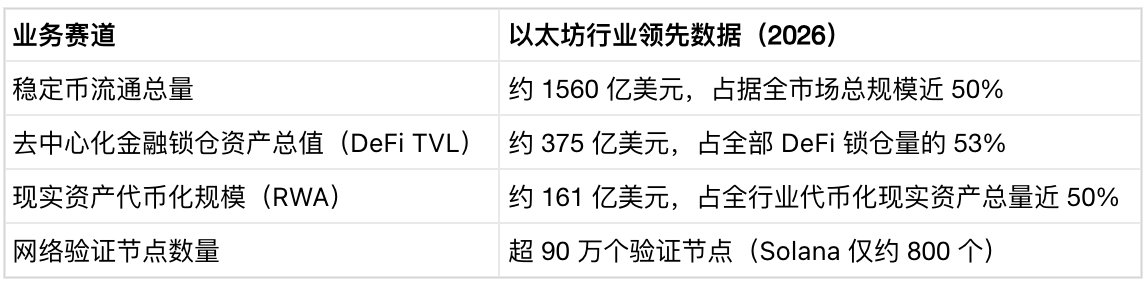
The three core advantages continuously widen the lead gap:
- Trusted Neutrality: Ethereum has over 900,000 validating nodes, while Solana has only about 800. This highly decentralized and neutral platform property is a core quality highly valued by large financial institutions;
- Modular Architecture: Rollups like Base, Arbitrum, and Optimism have not fragmented the Ethereum ecosystem but have expanded it into an interconnected modular on-chain economy, with all layer two networks inheriting the mainnet's security assurances;
- Industry Ecological Culture: Ethereum gathers top researchers, cryptographers, and EIP standard makers in the industry who define the overall direction of the crypto industry's development. This cultural barrier formed by talent accumulation is hard for any forked project to replicate.
A Unique Ethereum
Simply generating short-term on-chain activity and becoming the long-term coordinating foundation of global native finance, earning the trust of leading financial institutions, are two vastly different things. In the minds of institutions that hold the most concrete quantities of assets, Ethereum occupies absolute mainstream recognition; these institutions prioritize security, trust, and liquidity. During my time at BlackRock, I witnessed this industry trend up close.
The development principle of the tech industry is: In the long run, ecological resources will concentrate around unified standards, adequate liquidity, and developer consensus; this is the unbreakable moat of Ethereum.
After exchanging with local developers, builders, and ecosystem leaders in Seoul and Hong Kong, I am more convinced than ever of Ethereum's competitive advantage. I have seen top talents building the next generation of financial infrastructure — the future entrepreneurs and designers of intelligent autonomous financial systems; it is this group of teams and practitioners that will reshape the entire world.
The future of Ethereum is happening now.
免责声明:本文章仅代表作者个人观点,不代表本平台的立场和观点。本文章仅供信息分享,不构成对任何人的任何投资建议。用户与作者之间的任何争议,与本平台无关。如网页中刊载的文章或图片涉及侵权,请提供相关的权利证明和身份证明发送邮件到support@aicoin.com,本平台相关工作人员将会进行核查。


