The controlling party of SIREN cashed out 64.8 million USDT in two days and is already loading up for the next round of "manipulation."
Written by: Sanqing, Foresight News
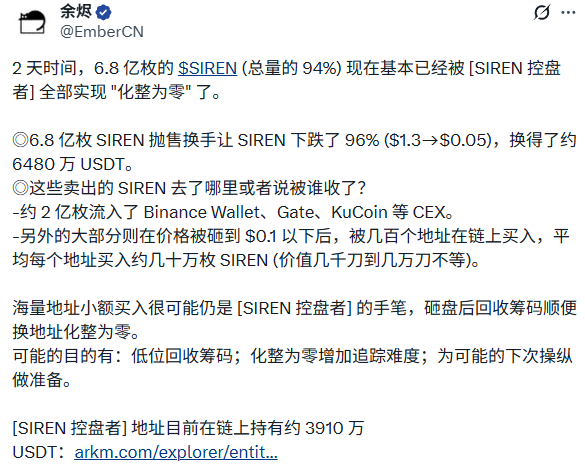
From June 13 to 15, the AI Meme token SIREN on the BNB Chain plummeted from about $1.3 to $0.05 in two days, a decrease of approximately 96%. On-chain analyst Yujin's monitoring shows that the same controlling entity sold approximately 680 million SIREN during this period, accounting for about 94% of the total supply, cashing out about 64.8 million USDT.
SIREN is an AI narrative token on the BNB Chain, launched via four.meme, featuring a dual-personality AI trading assistant, the conservative Golden and the aggressive Crimson. It combines meme and AI functional narratives, which is exactly the soil for its early capital attraction and multiple rounds of price increases.
This is the fourth round of manipulation recorded by Yujin for SIREN. According to GMGN market data, SIREN's current market value is approximately $53 million. The price, liquidity, and actions of a single entity are highly correlated, rather than driven by product fundamentals.
Absolute control is the starting point of this business
The actions of the controlling party can be traced back to the end of June 2025. At that time, it bought a large amount of chips for about $0.045 through hundreds of wallets, spending approximately $21.8 million. These dispersed addresses were later grouped together, proving they belonged to the same entity.
Accumulating at low prices is the prerequisite for all subsequent operations.
From the beginning of 2026 to March, SIREN increased approximately 26 times from $0.08 to $2.1 within about a month and a half. After the surge, the controller aggregated 66.5% of the total supply (about 484.6 million tokens, worth about $1.04 billion at that time) from hundreds of wallets to 48 addresses within a few hours.
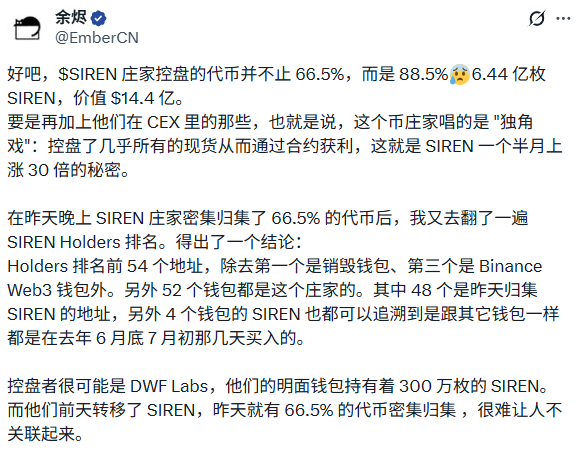
Yujin later corrected: the actual controlling ratio reached as high as 88.5%, approximately 644 million tokens, with a peak value of about $1.44 billion. Coupled with the portion deposited in exchanges, it was almost a one-man show.
When one entity holds 90% of the spot, the candlestick chart is no longer the market, but a script.
The cycle of pump and dump is a repeatedly verified cash flow
After mastering absolute chips, the controller turned "pumping to attract, dumping to kill, low buyback, and again pumping" into a replicable cash flow model.
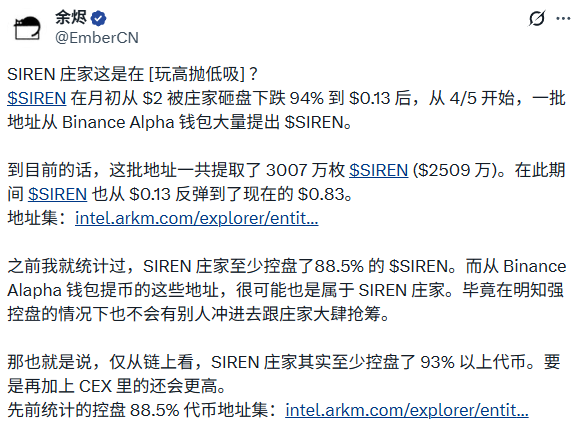
At the beginning of April, the controller first dropped the price from about $2 to $0.13, a single drop of 94%; then withdrew about 30.07 million SIREN from the Binance Alpha wallet for re-aggregation, bringing the controlling ratio back up to over 93%; next, within 24 hours it increased by 185%, bringing the price back to $2.18.
The dumped chips were bought back by themselves, while retail investors' liquidations became the profits for the counterparty.
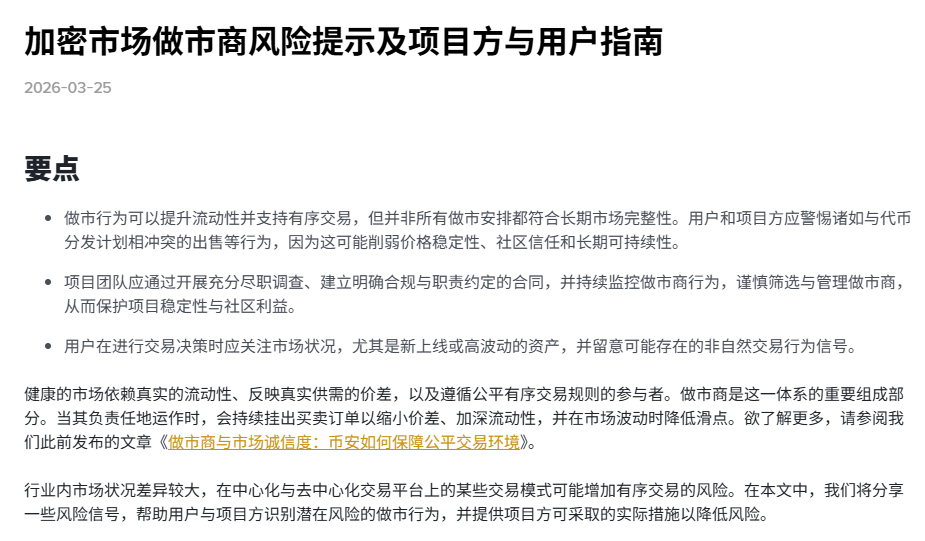
This strategy relies on the interaction between spot and contracts: raising the spot price to attract bulls, dumping triggering chained liquidations, while the controller profits from the spot price difference and also reaps from the contract direction and funding rates. Binance issued a risk warning for market makers during the same period, interpreted by the market as a warning against similar behaviors.
By June, this model had successfully operated four complete cycles.
Breaking into pieces lays the groundwork for the next round
On June 13, the controller sold about 17 million tokens through multiple addresses within two hours, with the price halving from $0.47 to $0.23, at which point on-chain holdings still accounted for about 94% of the total.
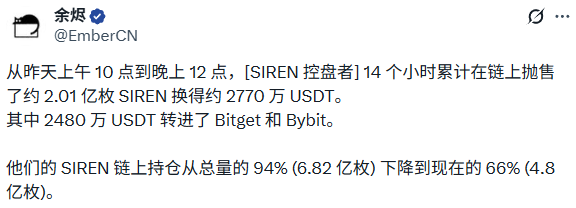
On June 14, a total of about 201 million tokens were sold within 14 hours, resulting in approximately 27.7 million USDT, with about 24.8 million flowing into Bitget and Bybit, and on-chain holdings decreasing from 94% to 66%.
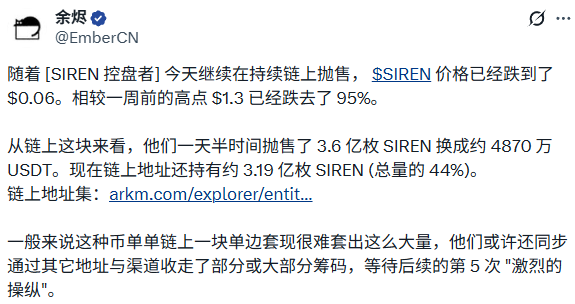
In total, approximately 680 million tokens were sold over two days, with about 200 million flowing into Binance wallets, Gate.io, KuCoin, and others.
What really deserves caution is the direction of the remaining chips.
After the price fell below $0.1, hundreds of small addresses on-chain began to make small purchases, with average purchases in the hundreds of thousands of tokens, worth thousands to tens of thousands of dollars each. Yujin judged that these purchases were most likely still made by the controller, with the aim of low buybacks, breaking into pieces to increase tracking difficulty, and building momentum for the next round of manipulation.
The "same entity" inference is based on the high consistency of wallet clustering, fund flow, and behavioral patterns. There were earlier discussions related to DWF Labs, but the specific identity has not been confirmed.
The controller's addresses continue to change, but the behavioral patterns remain unchanged. During aggregation, it concentrates on a few wallets; during dumping, it disperses to a large number of new addresses, repeatedly covering the path through exchanges.
Currently, this entity still holds approximately 39.1 million USDT on-chain. Yujin judges that this may be for the yet-to-come fifth "intense manipulation" preparations.
This article is based on public analysis and does not constitute investment advice. The meme market is extremely risky, and highly controlled tokens are especially likely to become harvesting tools. Please participate rationally and control positions.
免责声明:本文章仅代表作者个人观点,不代表本平台的立场和观点。本文章仅供信息分享,不构成对任何人的任何投资建议。用户与作者之间的任何争议,与本平台无关。如网页中刊载的文章或图片涉及侵权,请提供相关的权利证明和身份证明发送邮件到support@aicoin.com,本平台相关工作人员将会进行核查。


