
Author: Zhang Yongyi, Geek Park
On June 9, Anthropic released its strongest public model to date, Claude Fable 5. As usual, this should have been a celebration for paid users—your monthly payment has finally granted you early access to the flagship.
But there was a line in the announcement that immediately sparked huge controversy: after June 22, Fable 5 will be removed from all subscription plans, and continued use will require separate purchase of usage credits.
In other words, even if you buy a membership, the flagship model will only allow you to use it for 14 days.
A model that comes with a "eviction notice" on the day of its release is unprecedented in the large model industry.
Many regarded it as a misstep or arrogance on Anthropic's part. My view is quite the opposite: this is not a mistake, it is a preview.
AI subscription models are heading towards an inevitable demise—not because any company is greedy, but because the premise upon which subscriptions are based is being dismantled by AI itself.
Flagship model with a 14-day countdown
Let’s clarify the facts. According to Anthropic's official arrangement (June 9, 2026), Fable 5 is included for free in the Pro, Max, Team, and enterprise plans billed by seat from the date of launch until June 22; starting June 23, it will be removed from these plans, and every subsequent token will be deducted from prepaid usage credits, at a rate exactly aligned with the API.
This rate is not cheap: $10 per million input tokens, $50 for output tokens, exactly double that of the previous flagship, Opus 4.8. Even more subtly, even during the free access period, Fable 5 counts towards subscription limits at approximately double the weight—doing the same tasks burns through the credits at double the speed compared to Opus.
User reactions were predictable. On Hacker News, some directly stated that this "give-and-take" approach is unsettling, suspecting that Anthropic is trying to push subscription users toward pay-as-you-go; others tested it, reporting that on the $100 monthly Max plan, a single agent programming session consumed nearly $100 worth of tokens.
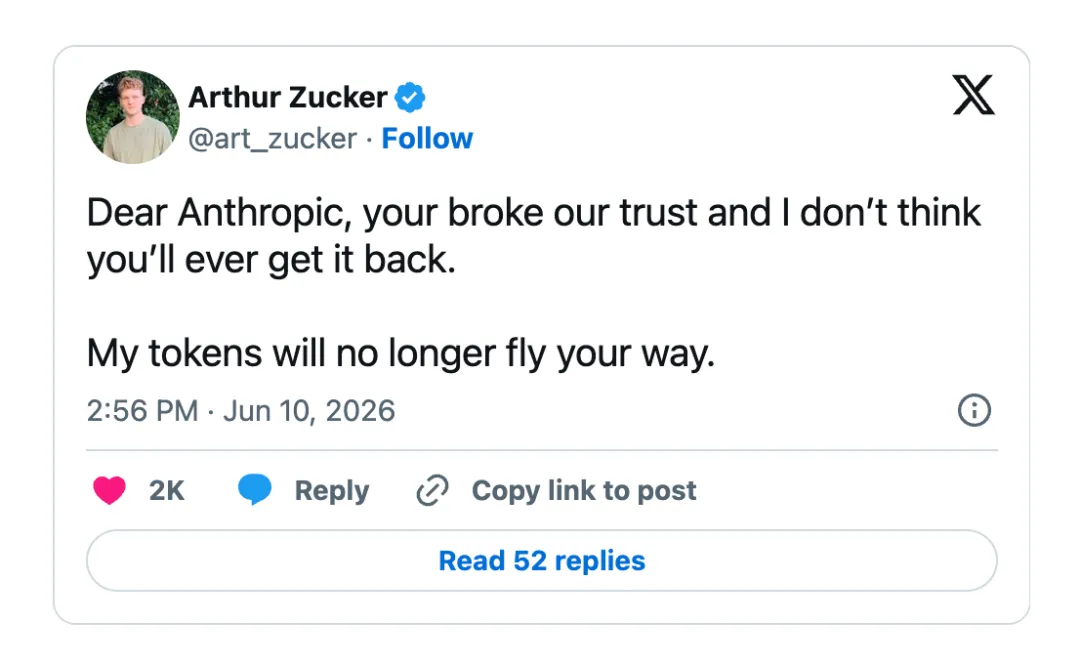
Users are expressing frustration on social media about not having enough token usage | Image source: twitter
Moreover, this is not just Anthropic's action. For the past eight weeks, the entire industry has been doing the same thing: OpenAI switched Codex from message-based billing to token-based billing aligned with the API on April 2, subsequently extending it to all existing enterprise customers.
On April 20, GitHub froze new registrations for Copilot personal editions, announcing a week later a full transition to AI Credits billing, completing the switch by June 1—Pro tier at a monthly fee of $10, accompanied by $10 in credits.
Anthropic's own actions were the most aggressive: starting April 4, it prohibited third-party agent frameworks like OpenClaw from consuming subscription limits, with usage switching to pay-as-you-go; on April 21, the Claude Code section in the Pro plan pricing page quietly turned into a red X, and after the community reacted, it was retracted within 24 hours with the official explanation being "a small test for about 2% of new registered users"; on May 14, it was formally announced that starting June 15, the Agent SDK and non-interface calls would be removed from the subscription pool, measured instead at API rate fees with independent credits.
Three companies, eight weeks, all in the same direction—this is not a coincidence; it is the entire industry presenting the same answer to the same mathematical problem.
What does that mathematical problem look like?
Pricing has never been about computing power
Research firm SemiAnalysis has recently brought this mathematical problem to the forefront. They purchased each subscription tier from Anthropic and OpenAI, ran long programming tasks until they exhausted their weekly limits, and then converted those usages into monetary value according to API prices: how much are they worth?
Previously, the general understanding in the industry was that a $200 monthly package could at most provide about $2000 worth of tokens. The actual tested results far exceeded that: $20 for Claude Pro had a ceiling of about $400; the $200 Max 20x tier could provide around $8000. OpenAI's side is even more striking—$20 for ChatGPT Plus could yield about $700, and $200 for Pro 20x could yield around $14,000.
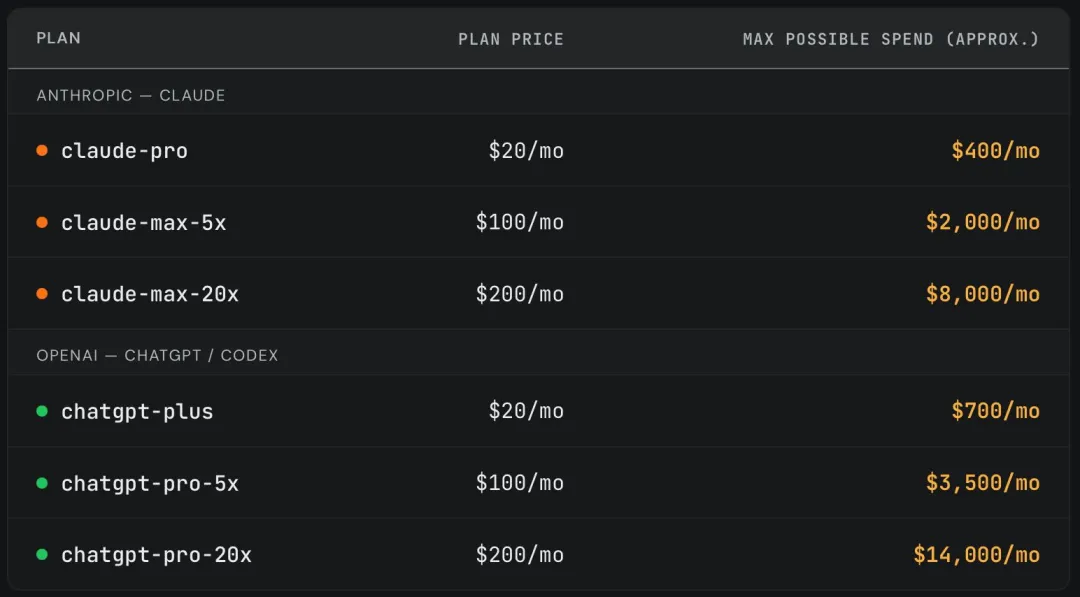
The highest subsidy multiple is 70 times|Image source: SemiAnalysis
Two fair points should be made upfront: this is the upper limit value when "running to capacity," not the typical usage level for ordinary users; the API pricing includes profit margins, and the converted figures do not equal the actual computing cost. But pricing must cover the upper limits—insurance companies cannot assume no one will file a claim.
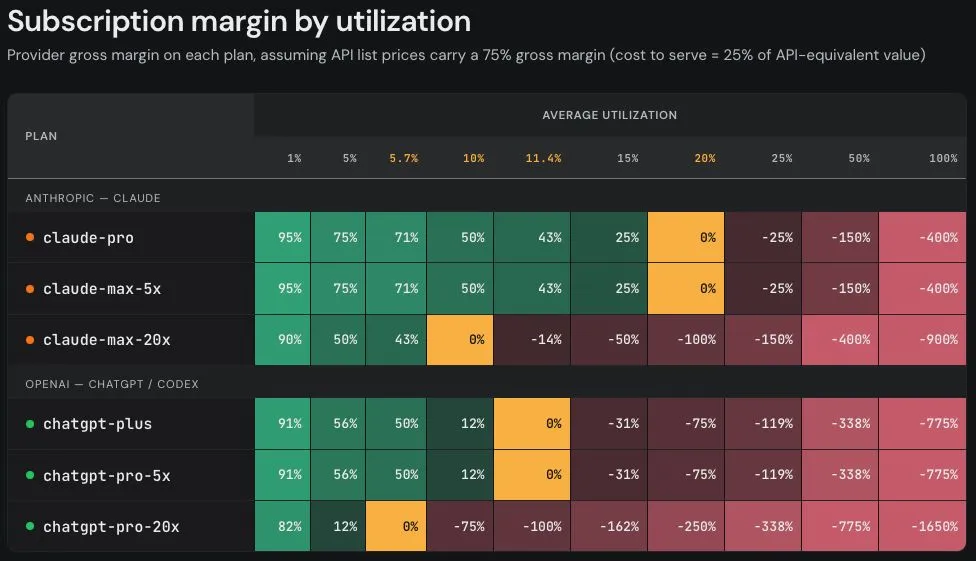
![]() SemiAnalysis comparison of consumable amounts across subscription tiers|Image source: X @kimmonismus / SemiAnalysis
SemiAnalysis comparison of consumable amounts across subscription tiers|Image source: X @kimmonismus / SemiAnalysisThe subsidy itself is not fatal. Streaming services have provided subsidies before, ride-sharing apps have provided subsidies before; burning money for growth is an age-old skill of the internet. What is truly fatal is that the AI subscription model fundamentally differs from them.
Netflix dares to sell subscriptions by month based on two things: the marginal cost of adding one more movie approaches zero, and a person can only watch for a maximum of 24 hours a day. The same goes for Spotify. The implicit premise of subscription models is that consumption is locked by human physiological limits—what is truly priced is never the content, but human time.
The AI of the chatbot era barely meets this premise. No matter how much one can chat, the amount typed on a keyboard per day is limited; the idle credits of light users are sufficient to cover the excess consumption of heavy users.
Then, the Agent arrived.
What is an agent task like? It reads 20 documents, makes plans, modifies code, runs tests, reads error messages, and iterates—one cycle with an agent can consume 5 to 30 times the tokens of a regular conversation. More critically, it doesn’t require your presence. I have my own experience: recently, I asked an agent to organize flight data for two airports, and while I went to take a shower, the task was completed by the time I returned, and my credits ran low. You sleep, but the meter keeps running.
The agent is not canceling the price ceiling; it is canceling the consumption ceiling. And the entire evolution direction of the AI industry—in longer tasks, more autonomy, and multiple parallel instances—is racing towards the same endpoint:
Completely removing human involvement from the consumption phase.
GitHub stated plainly in the announcement that agent usage "is becoming the default." In other words, the remaining scenarios where subscriptions could barely hold—where a person sits in front of a screen and chats line by line—will only account for a smaller and smaller percentage in the value map of AI.
At this point, some might ask: isn’t it a good idea to raise prices if the subsidies are too deep?
They tried, but ended up with a worse result. Looking back at SemiAnalysis's table, there's an anomalous detail: the more expensive the tier, the higher the subsidy multiple.
On the Claude side, the multiple for the $20 tier is 20 times, while the $200 tier is 40 times; on the OpenAI side, it increases from 35 times to 70 times. Half of this is due to pricing design—higher tiers amplify the credits, which is equivalent to giving discounts to big customers; the other half is due to user behavior—users willing to spend $200 on a 20x package are aiming to max out usage, while light users will never appear in that tier.
This has a name in the insurance world: adverse selection. When the pricing of a policy attracts only the highest-risk policyholders, that policy will have no actuarial meaning. Any fixed price will accurately filter out those users whose usage exceeds it—this is not a management issue; it's a structural issue; adjusting prices will only make the filter narrower.
Throughout 2025, the industry actually tried every fix available. In January, Sam Altman admitted on X that the $200 ChatGPT Pro was losing money because usage far exceeded expectations—raising the pricing tier failed.
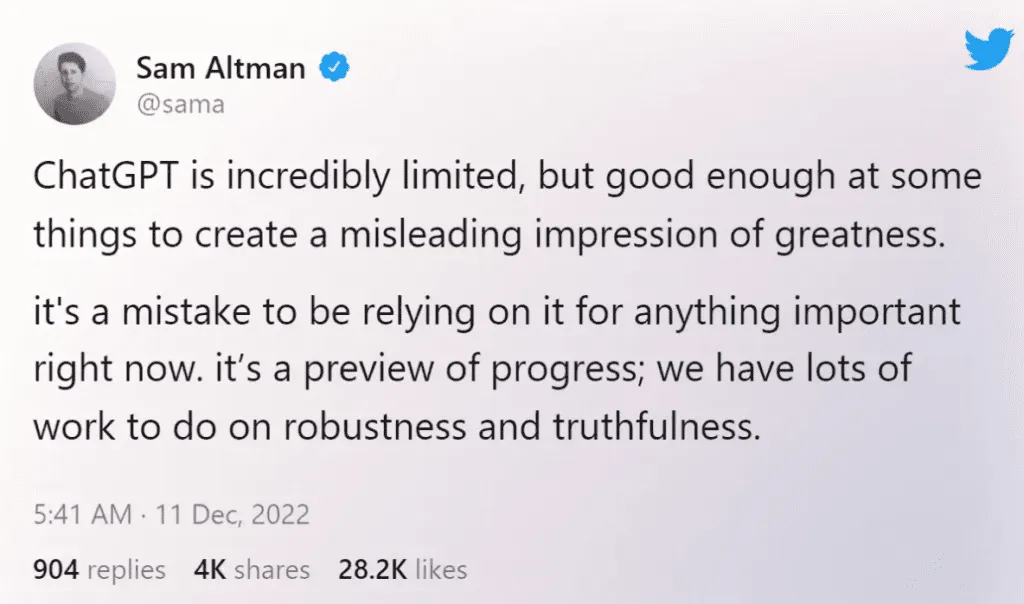
OpenAI tried but failed|Image source: X
By mid-year, Cursor switched from request-based billing to computing power-based billing, resulting in massive cancellations, and the CEO publicly apologized—changing rules halfway failed; in the summer, Anthropic imposed weekly limits on Claude Code, claiming that some users were running agents around the clock, consuming computing power in the tens of thousands—traffic control only elicited anger.
After all patches failed, the collective showdown occurred in these eight weeks. Nick Turley, project head for ChatGPT at OpenAI, made it clear on the BG2 podcast: "In the current era, providing unlimited plans may be like offering unlimited electricity plans."
The shell remains, but the core is dead
Of course, there is a strong rebuttal that sounds credible: the subscription model is clearly still alive and well. ChatGPT Plus is still $20 a month, Claude Pro is still being sold, and GitHub’s code completion has even retained the monthly subscription. Isn’t calling its demise alarmist?
This rebuttal deserves serious consideration because it describes a real phenomenon. But it misjudges what has died.
The soul of the subscription model has never been the form of "charging once a month," but rather the promise of "fixed price, worry-free use"—you don’t have to calculate the cost of each use, and this was the reason why it triumphed over pay-per-use models in the first place.
What is happening now is: the charging cycle remains, but the promise has been withdrawn.
The $10 monthly fee for GitHub Pro includes $10 in credits, which is exhausted once used—this is not a subscription, this is a prepaid recharge card wrapped in a subscription disguise. Anthropic's credits are deducted at API rates, and OpenAI's credits support automatic recharge. The subscription model will not be canceled; it will be hollowed out: the shell remains, but the core is dead.
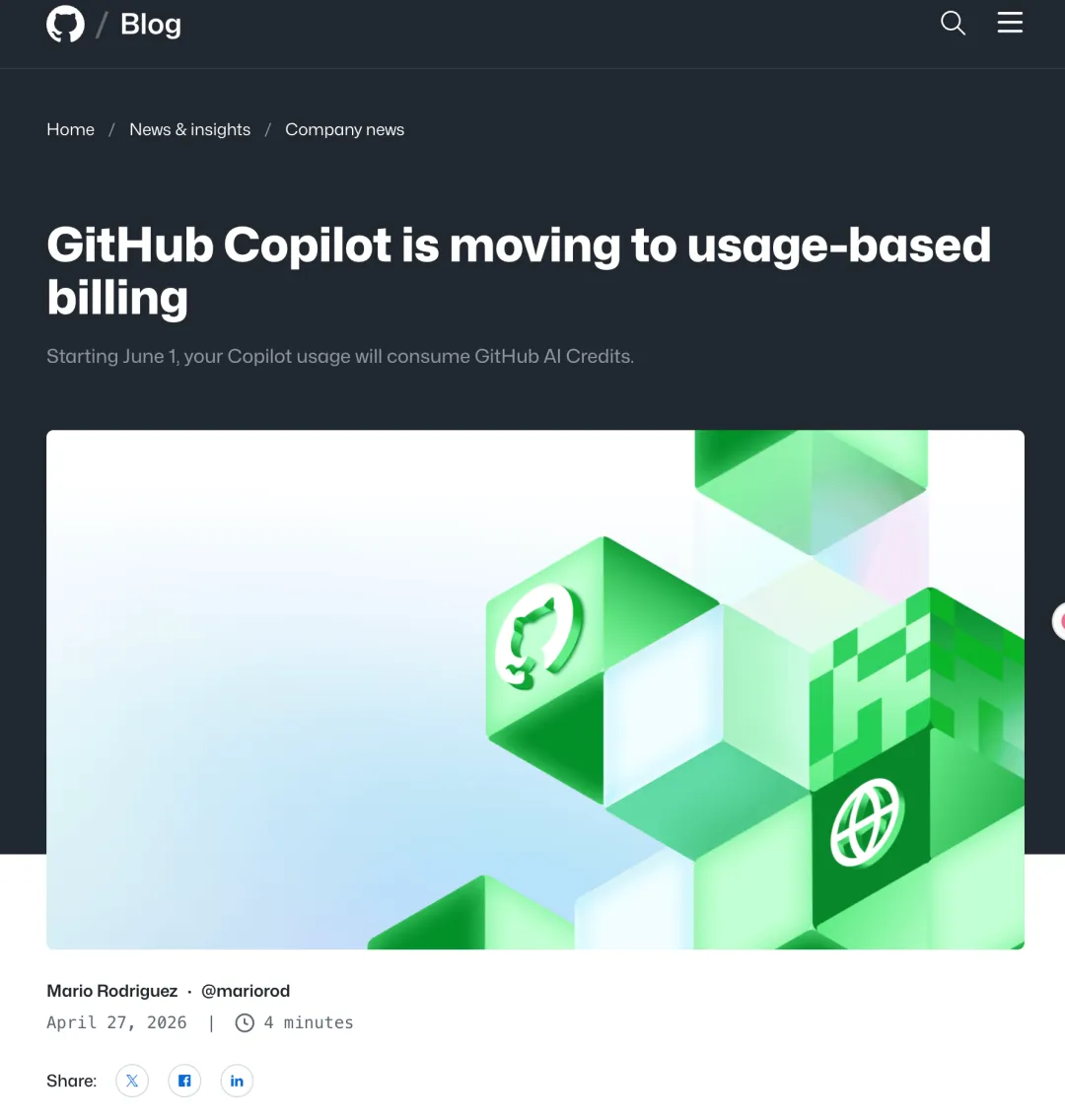
Official announcement of GitHub Copilot's transition to AI Credits billing|Image source: GitHub
There remains one true haven: pure chatting. It can still be monthly billed because it's the last scenario in AI where consumption is still locked by human time. But the moat cannot protect this haven—the R&D dollars in this industry are pushing AI from "you ask, it answers" to "it actively helps you complete tasks." Chatting subscriptions will not be killed; they will be marginalized: remaining stationary, watching real value and real income slowly shift into the pay-as-you-go world.
There is also a timing coincidence that is hard to overlook: according to TechCrunch (June 2026), at the time of Fable 5's release, Anthropic is preparing to go public along with OpenAI. For the past three years, the subsidies have been funded by venture capital; public market investors will not accept a profit and loss statement that reads "the more heavy users, the more losses incurred." The timeline for capital exit dictates that the showdown cannot be postponed indefinitely.
This means different things for different people. For companies, AI spending will now need to be managed like cloud spending—according to The Information, Uber’s CTO stated in an internal memo that the company burned through its entire AI budget for 2026 in just four months. Budgeting, installing monitoring, and routing models by task will become mandatory for every team. For individual users, it used to be light users subsidizing heavy users, now, everyone pays for their own meter.
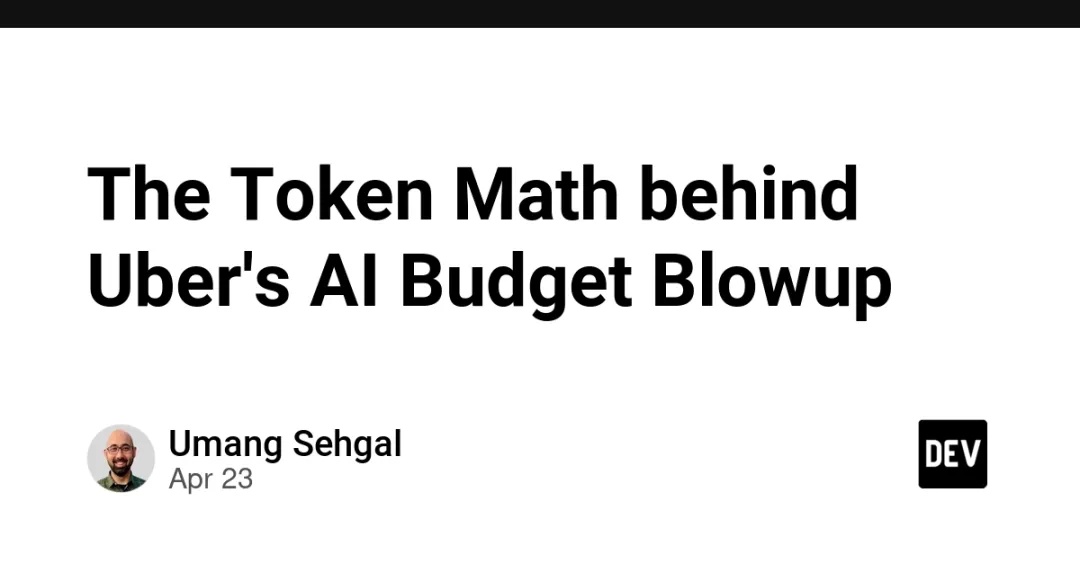
Uber's AI budget transformation has also caused quite an uproar | Image source: The Information
To be honest, this may not all be bad. After the return of price signals, "is this task worth letting AI handle?" has finally become a real question—when an industry begins to seriously answer this question, it often marks the start of its departure from a money-burning narrative towards a normal business.
Writing this, I want to add: before the meter is installed, the current subscription model may be the most generous moment this industry has towards users—so use it, and cherish it.
The logic is hidden in SemiAnalysis's table. Viewed from a user perspective, it is not a death sentence but an active benefits list: you pay $200 a month, and the platform allows you to burn up to $14,000 in computational power. This level of subsidy hasn’t been seen since the ride-hailing and food delivery wars—and we remember the outcome of those two battles; after subsidies exited, prices never returned to previous levels.
So, for the hefty tasks that need to be done, do them now. For instance, the window for Fable 5 to remain in the subscription ends on June 22; instead of waiting until the credit era arrives to meticulously account for costs, it is better to schedule those long tasks you have always wanted to run but thought were too expensive. This is not considered taking advantage—it is just being a clear-headed beneficiary in a pricing error that is destined to be corrected.

Turley's analogy might be deeper than he intended. The true mark of electricity becoming infrastructure is not that it reaches every household, but that every household installs a meter—because from that moment, no one discusses "should electricity be billed monthly," people only discuss the price of electricity.
There will be no obituary for the subscription model. It will only become a small line in your expenditure details called "entrance fee" on some quiet billing day.
Until then—use it while you still can, and cherish it.
免责声明:本文章仅代表作者个人观点,不代表本平台的立场和观点。本文章仅供信息分享,不构成对任何人的任何投资建议。用户与作者之间的任何争议,与本平台无关。如网页中刊载的文章或图片涉及侵权,请提供相关的权利证明和身份证明发送邮件到support@aicoin.com,本平台相关工作人员将会进行核查。


