How does the mixed yield design of mETH reshape the ETH staking paradigm?
Written by: Cheeezzyyyy (@0xCheeezzyyyy)
Translated by: AididiaoJP, Foresight News
Discussions around liquid staking are mostly focused on yield. However, at a scalable level, yield is only a part of the equation. More critically, and often overlooked, is time.
In capital markets, time is never neutral; it is always priced.
Whenever capital is locked, delayed, or unable to respond promptly, implicit costs arise. These costs manifest as missed opportunities, inefficient capital allocation, or being forced to hold extra liquidity elsewhere as a buffer. Over time, these costs accumulate into a "time premium"—an implicit drag that is rarely explicitly calculated but is always felt.
It is at this point that the Hybrid Blended-Yield model of @mETHProtocol ($mETH) demonstrates a fundamental difference.
Structural Inefficiency of Traditional Staking Models
Traditional staking models have always exhibited this inefficiency. While capital generates yield, it lacks responsiveness. Withdrawal queues have historically lengthened from weeks to over a month, and in rapidly changing markets, this lag has become a constraint. Capital cannot be redeployed in a timely manner when conditions change, arbitrage opportunities cannot be captured promptly, and portfolio managers are forced to operate under limited flexibility.
For institutions, this is not just an inconvenience but fundamentally alters the way assets are positioned. Staked ETH is often modeled as a "semi-static exposure"—able to generate yield, but operationally constrained. This distinction limits the scale of allocation.
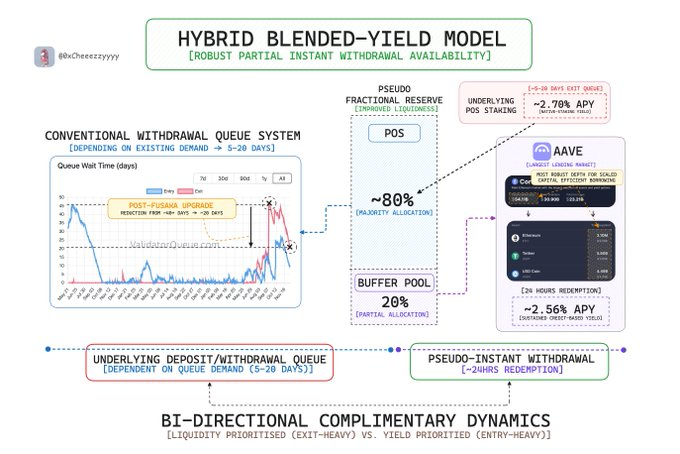
Detailed Explanation of Mixed Model Design
mETH directly addresses this issue through its mixed yield design.
The core lies in introducing a dual liquidity mechanism. Approximately 20% of the TVL in the protocol is reserved as a Buffer Pool, enabling redemptions within about 24 hours. At the same time, capital that does not need to be immediately available for liquidity is dynamically deployed into yield strategies (such as via Aave), minimizing idle capital.
This design is subtle yet powerful.
It no longer forces a trade-off between liquidity and yield, but aligns both. Capital remains productive while being accessible. Liquidity is available without sacrificing efficiency.
This creates a continuous optimization loop: when redemption demand increases, the buffer pool absorbs the demand, providing immediate liquidity; when demand is lower or deposit queues are congested, excess capital is deployed to earn yield. The system continually adjusts to ensure capital is always in a working state or readily available.
Bidirectional Optimization: Eliminating Queue-Induced Inefficiency
The most structurally attractive aspect of this model is how it handles both ends of Ethereum's inherent constraints.
In traditional staking, withdrawal and deposit queues are seen as bottlenecks. In the design of mETH, they become variables to be optimized.
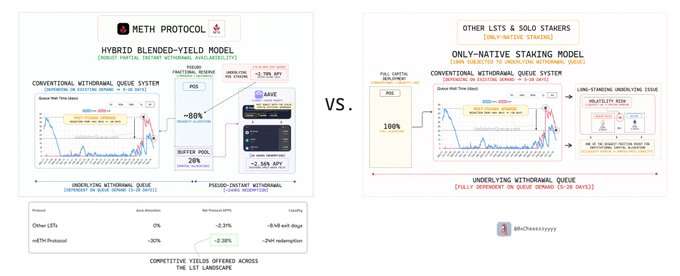
When the withdrawal queue is congested, the Buffer Pool absorbs redemption demand, allowing for nearly instant exits and maintaining capital responsiveness. This eliminates the need to wait through weeks of settlement windows, most of which historically embedded a "time premium."
Conversely, when the deposit queue is congested, the capital waiting to be staked does not remain idle but is dynamically deployed into external yield venues to continue generating returns.
This creates a bidirectional optimization dynamic:
- Under exit-dominant conditions, liquidity is prioritized;
- Under entry-dominant conditions, yields are prioritized.
The result is that capital is never trapped in a non-productive state.
Capital no longer oscillates between "locked" and "active" but exists on a continuous spectrum—always in a state of liquidity, productivity, or both.
This efficiency gain continues to compound. By actively managing both ends of the queue, mETH effectively internalizes time risk and transforms it into a source of optimization, significantly reducing idle capital, enhancing flexibility, and tightening the overall cost structure of holding staked ETH.
More explicitly, mETH eliminates the "death zone" in staking—capital is technically allocated but functionally idle. It is these death zones that introduce the greatest implicit costs over time.
Enhanced Asset Dynamics: Broader Implications
The result is a meaningful shift in how the ETH yield exposure behaves.
Historically, investors had to choose between yield and flexibility. Higher yields often came with longer lock-up periods and lower responsiveness, while liquidity strategies sacrificed returns for accessibility.
mETH challenges this paradigm by eliminating that trade-off.
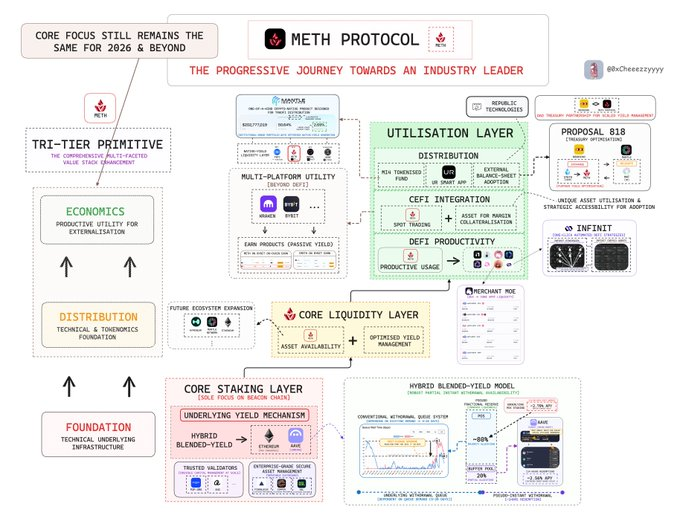
When capital can both generate yields and maintain responsiveness, it can integrate more seamlessly into broader financial strategies. It can be used as collateral without introducing time risk; can be quickly redeployed as market conditions change; can engage in arbitrage, hedging, and liquidity provision without the friction of delayed settlements.
Essentially, ETH begins to resemble an active capital unit rather than a passive staking derivative.
The deeper implication is that it compresses the time premium embedded in traditional staking. By reducing redemption delays and ensuring continuous capital utilization, mETH minimizes the opportunity cost of being locked.
This leads to tighter spreads, more efficient pricing, healthier liquidity dynamics, and ultimately becomes a more competitive asset in the eyes of savvy capital allocators.
Why This is Crucial for Institutional Demand
Perhaps the most interesting implication is that this aligns highly with the overall direction of institutional adoption—as evidenced by the recent entrants into the space.
Institutional allocators are not solely chasing yield. They seek yields that meet operational requirements such as liquidity, custody, collateral utility, risk management, and capital efficiency.
The architecture of mETH becomes particularly relevant here.
A liquid staking token that can provide productive yields, predictable redemption paths, broad ecosystem integration, and institutional-grade infrastructure begins to resemble a treasury asset, rather than merely a staking tool.
Structurally, this aligns with the evolutionary trajectory of ETH itself:
Store of value → Productive asset → Institutional collateral → Yield-bearing reserve asset.
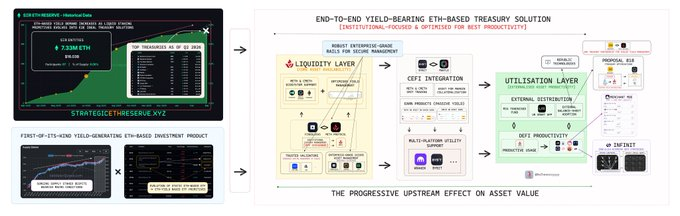
The distinction here is subtle yet important.
As the treasury demand for liquid staking ETH continues to accelerate, institutions assessing assets look not only at yield but also at their functionality as efficient capital.
- Can it be used as collateral?
- Can it be predicted for redemption?
- Can it maintain liquidity under stress conditions?
- Can it seamlessly integrate into custody, trading, and treasury operations?
These are the ultimate questions determining the scale of allocations.
This is where the mixed yield architecture of mETH becomes a meaningful differentiator.
By reducing redemption delays, minimizing idle capital, and maintaining ongoing liquidity readiness, the protocol effectively transforms staking yields into a more institutionally consumable product. It no longer forces allocators to choose between productivity and flexibility but allows both to coexist within the same asset framework.
More importantly, this model reinforces Mantle's broader institutional strategy.
With robust custody integration, battle-tested security, strong ecosystem adoption, and strategic CeFi distribution through partners like Bybit and Kraken, mETH increasingly resembles a complete ETH yield exposure treasury solution rather than a standalone liquid staking token.
The Appeal of Long-Term Positioning
The mixed yield model is not merely an optimization of the staking mechanism but an optimization of capital itself.
As institutional demand for productive ETH exposure continues to grow, the protocols most likely to capture this demand will be those that can maximize yield, liquidity, accessibility, and trust simultaneously.
mETH represents a meaningful step towards that future:
- Capital remains productive without sacrificing responsiveness
- Liquidity is available without introducing opportunity costs
- ETH can ultimately function as a fully efficient unit of capital in both DeFi and institutional markets
Because ultimately, the most valuable yield is not necessarily the highest one, but the one you can actually use when you need it the most.
免责声明:本文章仅代表作者个人观点,不代表本平台的立场和观点。本文章仅供信息分享,不构成对任何人的任何投资建议。用户与作者之间的任何争议,与本平台无关。如网页中刊载的文章或图片涉及侵权,请提供相关的权利证明和身份证明发送邮件到support@aicoin.com,本平台相关工作人员将会进行核查。


