Author: Nancy, PANews
After more than twenty years of waiting, Musk has finally brought SpaceX into the capital market.
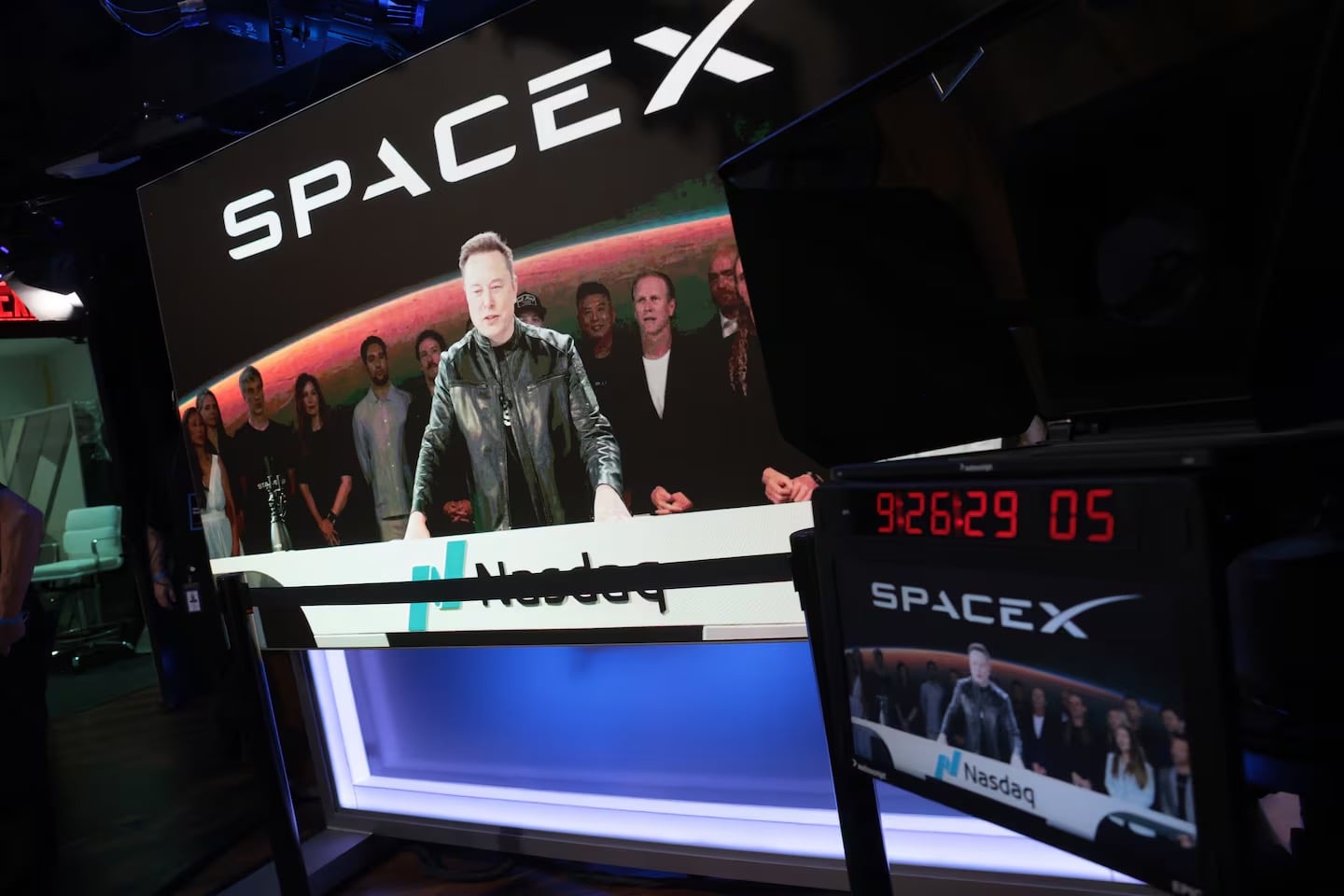
“It's hard to believe that a company that started in a small warehouse in El Segundo is now about to conduct the largest IPO in history. We hope that in the future, anyone who wants to go to the moon, anyone who wants to go to Mars, or even anyone who wants to visit any corner of the solar system will have the opportunity to do so. One day, we hope to take you there, not just a few astronauts. No matter who you are, SpaceX wants to take you to the moon, take you to Mars, and ultimately beyond that. I am very confident that with this amazing team at SpaceX, we will make all of this a reality in the near future.” Musk stated via remote connection during the Nasdaq bell-ringing ceremony for SpaceX while at the Texas Starbase headquarters.
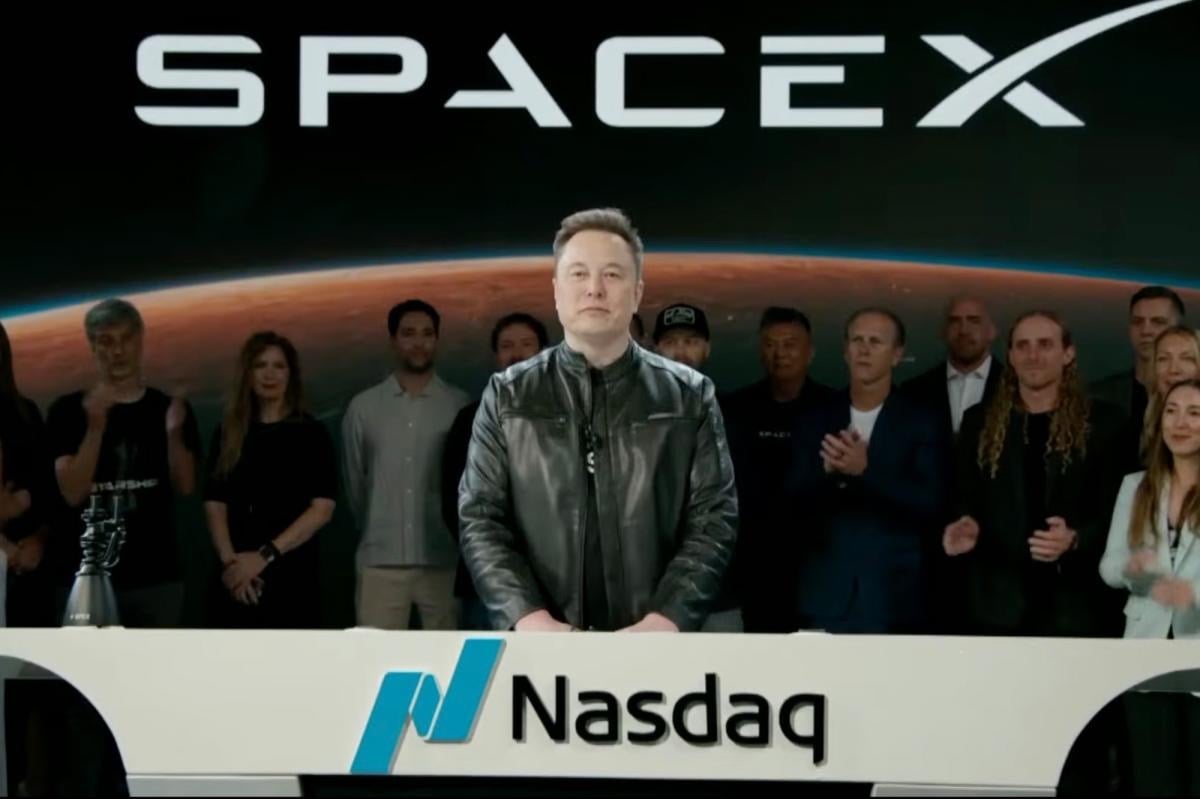
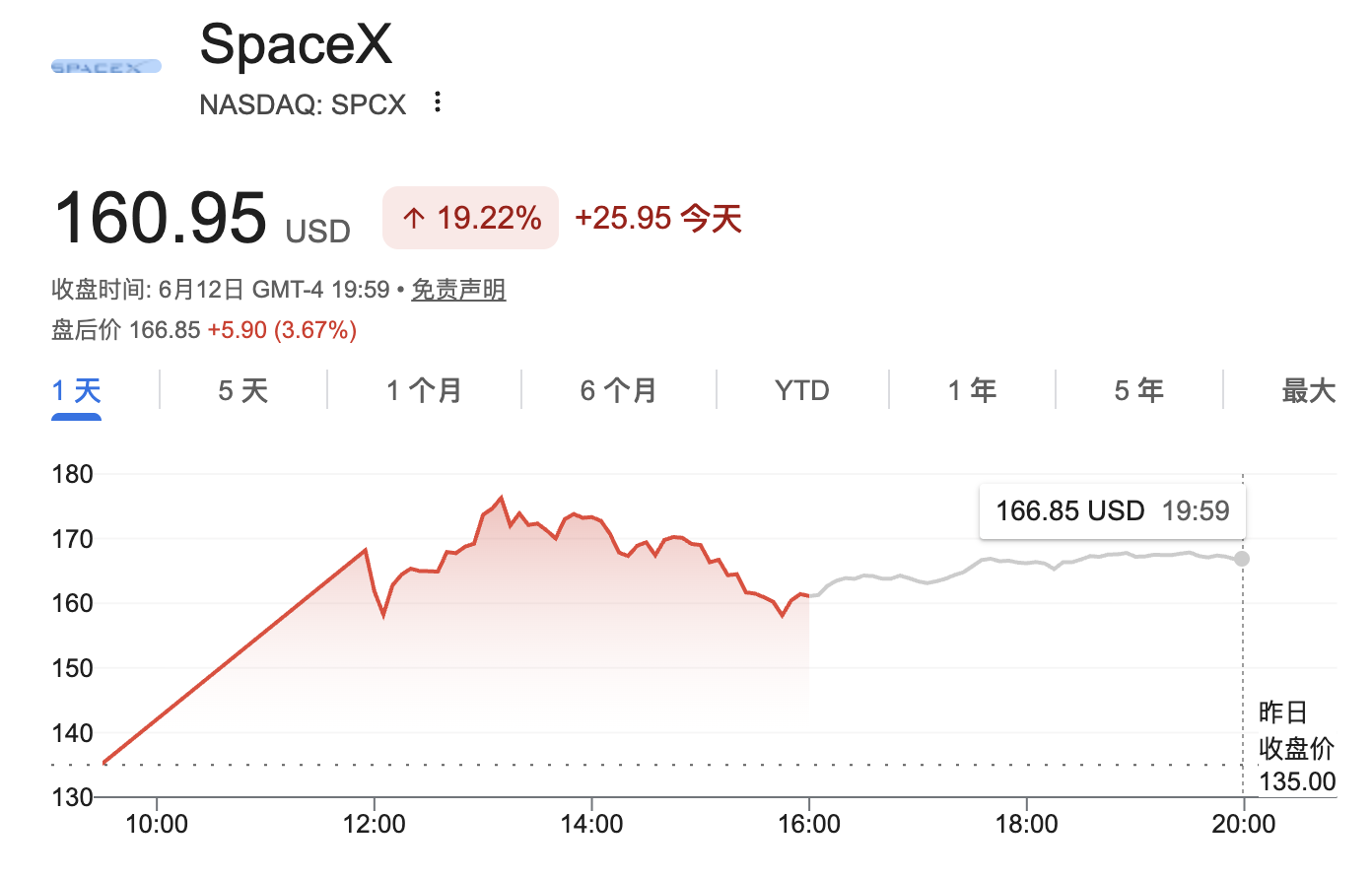
On the evening of June 12, SpaceX officially rang the Nasdaq opening bell, with the stock symbol "SPCX." At the close, SpaceX's stock price continued its strong upward trend, rising more than 30% at one point from the issuance price of $135, ultimately closing up 19.22% at $160.95, bringing the total market capitalization to approximately $2.1 trillion, catapulting it to the sixth largest company by market value in the United States.
This space giant, which had three failed rocket test launches and at one point faced cash flow depletion, has often pushed Musk into desperate situations. Now, it has successfully opened the door to the public market with a sky-high valuation, setting a new record for the largest IPO in history and marking a new chapter for the commercial space industry.
Global capital collectively "fighting for rockets," crypto users ultimately "run alongside"
On the eve of the listing, Wall Street had already entered into the time frame of SpaceX.
For this century's IPO, SpaceX assembled a luxurious underwriting team, with 23 Wall Street investment banks participating in the issuance, with Goldman Sachs as the lead underwriter along with Morgan Stanley, Bank of America, Citibank, and JPMorgan Chase.
To compete for customer resources, executives from many investment banks personally put on their gear and held exclusive roadshow events aimed at ultra-high-net-worth individuals and institutional clients. Goldman Sachs, Bank of America, and others even placed rocket models in their headquarters lobbies, and Musk's mother, Maye Musk, also appeared at JPMorgan's roadshow. According to market estimates, this IPO is expected to bring over $500 million in underwriting revenue to the underwriting banks.
Analysts pointed out that major investment banks not only hoped to facilitate SpaceX's smooth listing but also expected to boost market confidence through this iconic IPO, creating a more favorable market atmosphere for the upcoming IPOs of large companies like OpenAI and Anthropic.
From the long-term vision of a multi-planet civilization to the large-scale commercialization layout of orbital AI, SpaceX's heated roadshow ignited the imagination of investors, attracting global capital. Multiple media outlets reported market news stating that SpaceX's IPO has accumulated over $250 billion in subscription demand, far exceeding the planned fundraising scale of approximately $75 billion, with a subscription oversubscription multiple nearing 4 times.
Institutional funds became the main force in this IPO subscription, with about 1,000 institutional investors participating. Among them, BlackRock's single subscription amount reportedly exceeded $5 billion; the Saudi Public Investment Fund (PIF), Kuwait Investment Authority (KIA), and other Middle Eastern sovereign wealth funds also submitted subscription orders totaling several billion dollars.
Retail investors were equally enthusiastic. Bloomberg cited insiders stating that SpaceX's retail subscription demand exceeded $100 billion, far surpassing the allocation scale for retail investors. According to the current issuance arrangement, most retail subscription applications are expected to not receive a full allocation, and some might not even receive a winning bid.
As for the subscription results from crypto investors, the actual allocations were very limited, with nearly all failing, leaving only a few with low assurance numbers. Among them, Kraken users received an average allocation of about 4.2786 shares of SPCX, equivalent to about $600, regardless of the subscription amount, essentially receiving a small assurance reward, with the remaining funds fully refunded. Gate employed a pro-rata allocation approach, with a winning bid rate of about 3% of the principal, slightly better than other platforms. Binance announced a full refund and additionally purchased $1 million worth of SPCXB tokens for an airdrop, averaging about $40 per person; Bitget also issued a full refund and provided approximately $10 in fee discount coupons as compensation; Bybit, on the other hand, in addition to the refund, offered an additional compensation of 10% annualized wealth management returns for the funds deposited for 4 days.
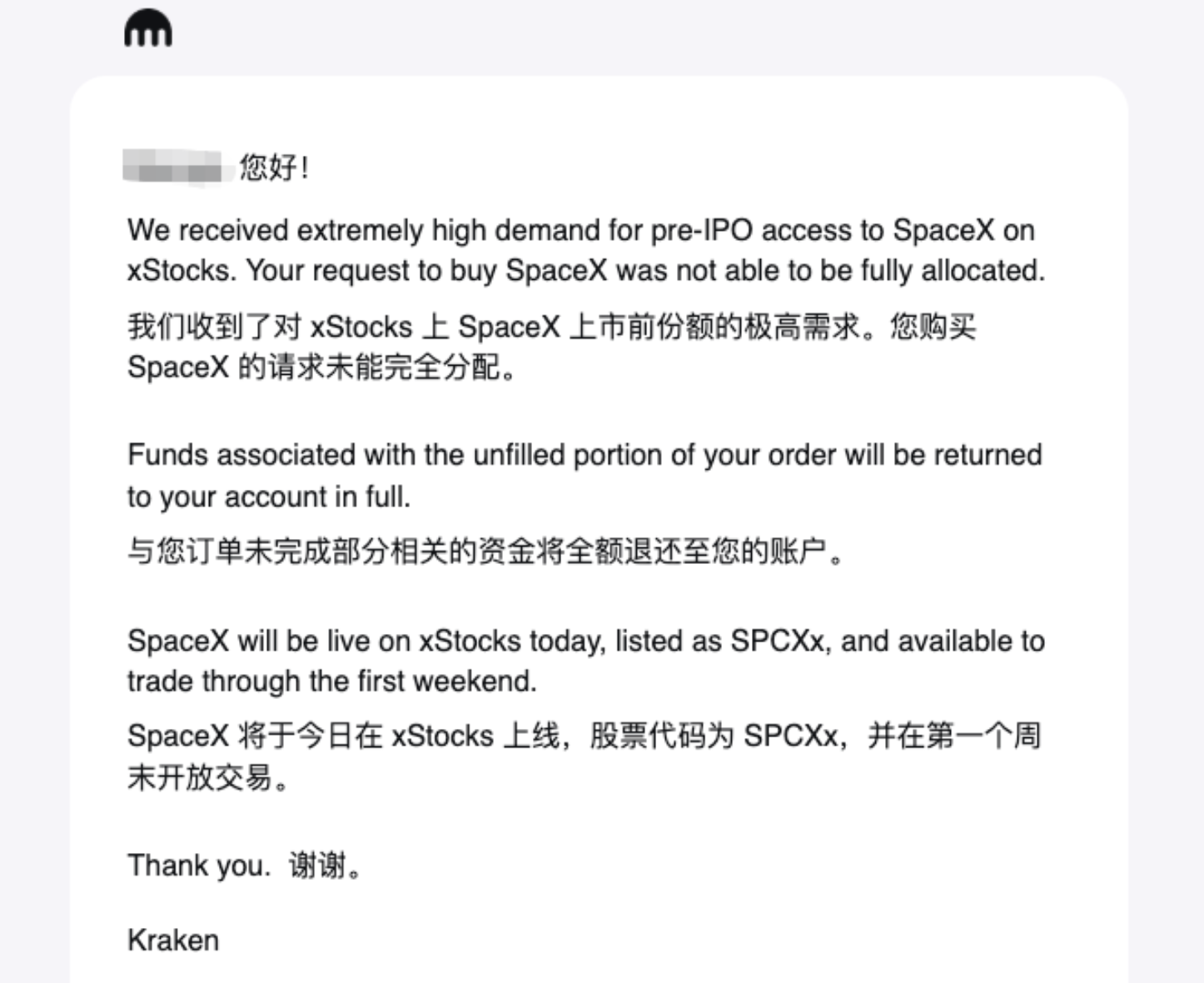
Users who were initially enthusiastic about participation ultimately found their efforts wasted, only receiving full refunds or symbolic compensation, which also triggered dissatisfaction, even causing some new stock group chats to turn into rights protection groups. The primary reason for this phenomenon is that most exchanges rely on xStocks as the underlying asset provider, while the current round of institutional and retail subscription demand significantly exceeded the underwriting quota, leading to a drastic reduction in orders on several platforms, some of which even had their allocations canceled.
However, this still did not affect the enthusiastic sentiment surrounding SpaceX. During the opening phase of SPCX, trading did not start as scheduled at the usual Eastern Time of 9:30, but was delayed. This was primarily due to the special mechanism of such large-scale IPOs, where exchanges typically initiate an opening cross-quotation process to concentrate buy and sell orders, balance supply and demand, and determine a reasonable opening price; this situation has also occurred in large IPOs like Meta, Alibaba, and Figma.
In fact, to cope with the potentially historic transaction volume and order processing pressure, Nasdaq, Castle Securities, Jane Street, and S&P Global began multiple rounds of internal drills and system stress tests weeks in advance. S&P Global stated that in the past six weeks, they have increased processing capacity by about 200% through system upgrades and real-time testing, indicating that this was special preparation for the potentially unprecedented transaction scale, a level of preparation rarely seen in previous large IPO projects.
Early venture capitalists made a fortune, cafeteria staff also welcomed "immense wealth"
After the ringing of the bell for SpaceX's trillion-dollar IPO, an unprecedented wealth realization also unfolded.
For early investors who have accompanied SpaceX through its long growth cycle, this listing brought historic returns. For example, Google’s stake in SpaceX is expected to exceed $100 billion; the shares held by hedge fund D1 Capital Partners are valued at approximately $20 billion; legendary investor Ron Baron has cumulatively participated in 27 rounds of financing for SpaceX over the years, with his shares now valued at about $12 billion; while the well-known Silicon Valley venture capital firm Andreessen Horowitz is expected to achieve its largest investment return since its founding from SpaceX, with its share value expected to exceed $10 billion.
U.S. university investment funds have also benefited from this wealth feast. For example, about 10% of the University of North Carolina system's endowment fund has exposure to SpaceX; the University of Washington in St. Louis holds SpaceX-related assets representing over 15% of its fund size; Stanford University also holds a considerable stake in SpaceX.
In addition to institutional investors, SpaceX employees also received considerable returns. SpaceX currently has about 22,000 employees, as well as hundreds of former employees who have already left. According to analysis from investment platform Hill, about 400 current and former employees have stock holdings valued at over $100 million, becoming a new generation of billionaires.
In addition to Musk becoming the world's first trillionaire, SpaceX COO Gwynne Shotwell and CFO Bret Johnsen are also expected to have shares valued at over $1 billion each. SpaceX director, board member, and Valor Equity Partners founder Antonio Gracias's shares may be valued at about $68 billion; another director, Luke Nosek, is estimated to hold shares worth about $5 billion.
Moreover, more than 4,400 employees have joined the ranks of millionaires in this IPO. From rocket welders, manufacturing engineers, to administrative personnel and cafeteria staff, many have shared in the dividends of the company's growth. According to WSJ, many people initially received shares when they were valued at less than $2 each when SpaceX had yet to achieve rocket recovery. As the company underwent multiple rounds of financing, stock splits, and continuous increases in valuation, the value of their holdings also surged.
For example, former welder Juan Hernandez joined SpaceX in 2015 with a salary of $28 per hour and initially received approximately $10,000 in equity incentives; although he sold part of his shares when the company's valuation was about $36 billion, the value of the remaining shares is still about $880,000; a former SpaceX engineer received stock incentives many years ago, which are now worth over $28 million.
However, many employees missed out on further appreciation by selling their shares too early. According to WSJ, some sold shares to pay off their spouse's student loans, some used the proceeds to buy vacation homes for their parents, and others invested in their own startup projects, leading them to miss out on wealth growth of several dozen times or even a hundredfold.
Is the trillion-dollar space story really expensive?
A company that is still burning cash has become the world's most expensive IPO, and Musk's market dream has sparked debate in the market.
From financial data, SpaceX is still far from entering a mature profit stage. The prospectus shows that in the first quarter of this year, the company's revenue grew 15% year-on-year, reaching $4.69 billion, but during that quarter, the net loss reached $4.28 billion. Since its establishment in 2002, the company has accumulated losses of about $41.3 billion and admitted in the prospectus that it may still be unable to achieve sustainable profitability in the future.
However, supporters argue that traditional profit models are not sufficient to measure the value of SpaceX. In their view, SpaceX is not just a rocket launch company; it is a platform-type enterprise that integrates satellite internet, artificial intelligence, and future space infrastructure, with its true value stemming from growth potential over the coming decades.
For instance, technology industry analyst Daniel Newman stated that if investors look long-term to five years, SpaceX's performance will be exceptional. The issuance price of $135 per share may seem expensive after a year, but looking back after five years, it may be considered quite cheap.” He revealed that he plans to buy slightly on the first day of SpaceX's IPO to avoid completely missing the opportunity due to short-term judgment errors; he also anticipates that a more ideal entry opportunity may arise in the first 12 months post-listing.
Currently, Oppenheimer has given SpaceX an outperform rating and set a target price of $190 for the next 12 to 18 months, indicating about a 40% upside from the $135 issuance price. New Street Research also made an optimistic assessment, giving an initial coverage target price of $165, corresponding to about a 22% upside.
Additionally, insiders revealed that SpaceX has disclosed to investors that it has received investment-grade ratings from three major bond rating agencies, which may help reduce costs when it continues to raise funds after the IPO.
However, there is also considerable skepticism in the market. Valuation guru Aswath Damodaran believes that SpaceX's current pricing is too high, and he would not buy immediately, expecting a repeat of substantial corrections seen with Facebook and Uber (which once dropped over 50%), advising patience for lower levels, noting that the AI business makes SpaceX's story grander but also increases volatility, suggesting that short-term performance may be under pressure.
Wall Street personality Jim Cramer believes that the main risk of SpaceX's IPO is not under-subscription but that short-term funds allocated may liquidate their holdings soon after the listing, amplifying price volatility.
Veteran short seller James Chanos stated that SpaceX's highly publicized listing is more driven by investor enthusiasm for Musk and ZAI than by financial fundamentals, making it difficult to justify the company's valuation based on any reasonable business assumptions—this is an IPO supported by hope and dreams.
One side presents the harsh financial reality of huge losses, while the other side showcases the grand imagination of a starry sea. As a pioneer in the space economy, SpaceX has no reference samples; the future is full of uncertainties. With the ringing of the trillion-dollar bell, the market begins to price the dream of space.
免责声明:本文章仅代表作者个人观点,不代表本平台的立场和观点。本文章仅供信息分享,不构成对任何人的任何投资建议。用户与作者之间的任何争议,与本平台无关。如网页中刊载的文章或图片涉及侵权,请提供相关的权利证明和身份证明发送邮件到support@aicoin.com,本平台相关工作人员将会进行核查。


