Written by: Yicai, Fan Zhijing
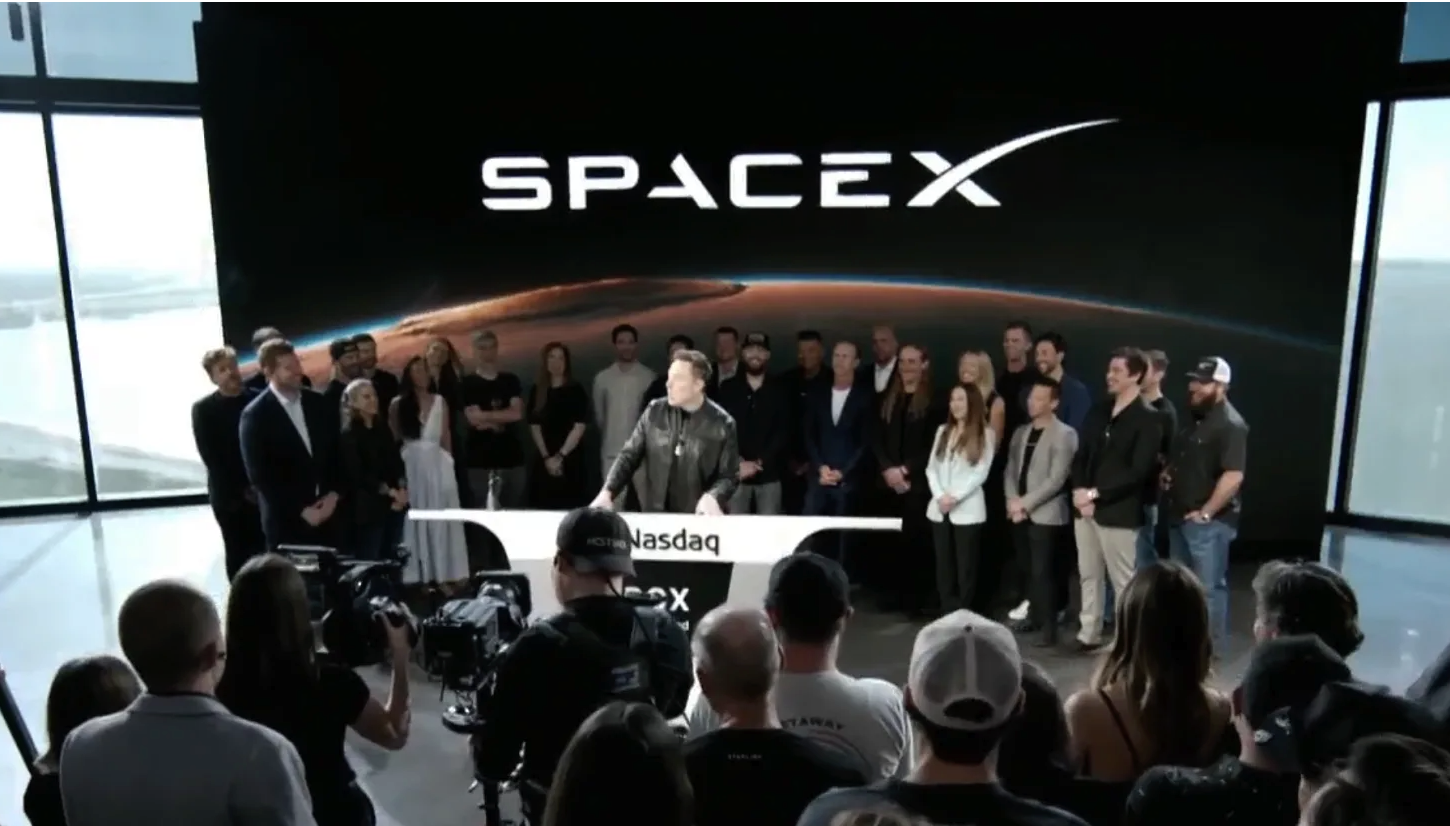
The highly anticipated space exploration company SpaceX completed its listing on the Nasdaq exchange on June 12 local time. Investors flocked in to participate in this largest initial public offering (IPO) in global history, while betting on Elon Musk's vast business empire that spans space rockets, internet services, and artificial intelligence.
By the close of trading, SpaceX's market capitalization exceeded $2 trillion, and enthusiasm in the after-hours market remained high, with the stock price rising over 1.5%. Next week, several leveraged ETFs linked to the company will increase, potentially bringing greater volatility to the market.
Milestone Listing
SpaceX's IPO is the largest ever, with an offering price set at $135, corresponding to a market value of $1.77 trillion. The stock opened at $150, and during midday trading, it surged over 30%, reaching $176.53, before oscillating back down to close at $160.99, a gain of 19.22%, positioning it as the sixth-largest company by market value in the U.S., with a total market value of $2.1 trillion. Musk’s personal wealth subsequently rose to about $1.05 trillion, making him the world’s first billionaire with a net worth exceeding $1 trillion. This is equivalent to the entire GDP of Switzerland, and according to the Bloomberg Billionaires Index, it amounts to about seven times Warren Buffett’s $145 billion.
The listing is widely viewed as a rehearsal for a new generation of mega-corporate IPOs. Market participants are also using this to observe investors' willingness to participate, as they assess the upcoming listings for AI giants Anthropic and OpenAI.
The IPO realizes Musk's vision of deepening ventures in the aerospace and technology fields over many years, with total fundraising reaching $75 billion, more than double the record amount raised by Saudi Aramco in 2019. The underwriters have the right to issue additional shares, a decision typically made within 30 days of listing, and if executed, the company’s valuation is expected to rise further.
SpaceX has also rewritten the rules of IPO operations on Wall Street. Although it cannot currently be included in the S&P 500 index, it will quickly be added to the Nasdaq 100 index according to new Nasdaq regulations. At that point, passive funds and ETFs tracking that index will automatically allocate to the stock, providing new buying support for its price. ERShares CEO Joel Shulman commented: “Looking at a century in business, it's hard to find entrepreneurs that can match him. Musk is extremely visionary and has outstanding execution abilities.” According to Nasdaq's new fast inclusion rules, this stock can enter the index about a month after its listing, whereas traditional candidates often have to wait up to a year.
Some analysts believe SpaceX's IPO will trigger a reallocation among investors. As funds shift towards this stock, other tech leaders may face selling pressure. On Friday, the stock prices of several aerospace and satellite companies fell sharply, completely erasing the gains since SpaceX submitted its IPO application in April: Rocket Lab fell 8%, Intuitive Machines fell 12.5%, and Planet Labs fell 9%.
Despite the market's enthusiasm for this IPO, accurately pricing SpaceX remains a significant challenge. The company forecasts revenue of $18.7 billion by 2025, corresponding to a price-to-sales ratio as high as 94 times, with annual losses exceeding $4 billion. SpaceX claims its target market size is a staggering $28.5 trillion, declaring this the largest market opportunity in human history. Over the past three years, more than 80% of the payloads sent to low Earth orbit globally have been completed by the company, and with its Starlink business continuing to generate revenue, many investors believe its growth foundation is solid.
Currently, analysts have divergent views on its valuation: Morningstar believes its fair market value is about $780 billion this month; CFRA initiated coverage on the stock on Friday and issued a sell rating. Nancy Tengler, CEO and Chief Investment Officer of Laffer Tengler Investments, stated: “Investing in this stock cannot be solely about fundamentals; it’s like Amazon back in the day — a company that fundamentally changes people's lifestyles. Even if the stock price falls to $100, our long-term thesis won't change; we want to remain participants for the long term.”
Funds are eager to participate
SpaceX is expected to have only about 3%-4% of its shares available for public trading.
The market's enthusiasm for SpaceX's listing has also prompted the ETF industry to launch several new products. Investors can engage in high-risk leveraged trading of this stock through these leveraged ETFs after its listing.
ProShares' Global Investment Strategy Manager Simeon Hyman announced on Thursday that after SpaceX's official listing on Friday, ProShares would launch a two-fold leveraged ETF on the following Monday — ProShares Ultra SpaceX, with the trading code SPCF, aiming to achieve twice the daily volatility of SpaceX's common stock. Hyman stated that companies like SpaceX, which choose to remain unlisted for an extended period, have accumulated significant potential investment demand in the secondary market.
Meanwhile, Themes ETFs is also preparing two related leveraged products: a two-fold long SpaceX ETF (code SPCH) and a two-fold short SpaceX ETF (code SSPC). The company's Chief Revenue Officer Paul Marino stated on Thursday that the products are tentatively scheduled to officially list at 4:00 AM Eastern Time next Monday on the Chicago Board Options Exchange (Cboe).
Ordinary investors will also be able to indirectly allocate to SpaceX stock through funds tracking the Nasdaq 100 index and other indices. However, leveraged ETFs carry extremely high risks and are not suitable for investors who intend to hold the underlying stock for the long term. For short-term speculators, if SpaceX's stock price rises on a single day, leveraged ETFs will amplify the profits; but if their bet on the direction is wrong, losses will also be amplified accordingly.
Hyman cautioned that investors trading these products need to be prepared for risk management while reasonably combining their overall investment portfolio. He also mentioned that single-stock leveraged ETFs have now become one of the fastest-growing subcategories in the leveraged ETF domain.
Themes also alerted investors to the risks associated with using its leveraged ETFs to go long and short on SpaceX. The company wrote in its product announcement on Wednesday evening that if the holding period exceeds one trading day, even if SpaceX's stock price remains stable, the related funds may incur losses. If traders misjudge the direction of stock price movements, they will suffer significant losses. The announcement especially warned: if SpaceX's intraday price fluctuates by more than 50%, investors may lose all principal within a single trading day.
免责声明:本文章仅代表作者个人观点,不代表本平台的立场和观点。本文章仅供信息分享,不构成对任何人的任何投资建议。用户与作者之间的任何争议,与本平台无关。如网页中刊载的文章或图片涉及侵权,请提供相关的权利证明和身份证明发送邮件到support@aicoin.com,本平台相关工作人员将会进行核查。


