The biggest risk of Bitcoin may not be the Federal Reserve, not regulation, and not even quantum computers themselves.
But rather, a person who has been missing for over a decade.
Because if the quantum era truly arrives, the toughest challenge will not be the wallets of ordinary users, but the batch of Bitcoins left by Satoshi Nakamoto. The public key is permanently engraved on the chain, the holder's life or death is unknown, and the private key is untraceable. Worth tens of billions of dollars, these have been dormant for seventeen years, never moving a single satoshi.
What's more troublesome is that, whether these coins move or not, Bitcoin will face a question that no one is willing to answer. Moreover, part of this question cannot be solved technically.
The real danger is not all addresses
Many people mistakenly believe that once quantum computers appear, all Bitcoins will become immediately invalid.
This is not the case. The security of Bitcoin private keys is based on the assumption that "it is computationally infeasible to derive the private key from the public key." The threat from quantum computers is the Shor algorithm breaking this assumption. But the key is — to run the Shor algorithm, an attacker must first obtain the public key.
And Bitcoin addresses are essentially hashes of public keys. Normally, the public key does not appear directly on the chain and is only exposed when the user initiates a transaction and submits a signature.
So the real danger lies with those addresses where the public key has already been disclosed.
The highest risk comes from the P2PK format outputs widely used in the early Bitcoin network. In this structure, the complete public key has been permanently written to the blockchain from the moment it was generated. Attackers do not need to wait for the holder to initiate a transaction; they can directly try to derive the private key — with no buffer period.
In 2026, researchers from Google, Stanford, and the Ethereum Foundation estimated that there are still over 1.7 million Bitcoins locked by P2PK.
Among these, the most sensitive portion consists of the assets held by those early mining addresses that people are familiar with — often referred to as the assets left by the "suspected Satoshi/Patoshi miner."
According to analysis and conservative estimates, this early leading miner accumulated about 600,000 to 700,000 Bitcoins; along with the uncertain attribution, the broader estimate could be close to 1 million coins. A significant portion of these assets uses the P2PK format, and the public key was fully exposed on the chain many years ago.
Thus, a problem that seems to belong to cryptography ultimately turns into a question about Satoshi Nakamoto.
Dilemma
The greatest risk of the Satoshi address is to never move? In fact, just the opposite: both moving and not moving are problems.
If these Bitcoins, dormant for seventeen years, suddenly move, the market will first be plunged into a question without an answer: who is moving these coins? Is it the real Satoshi Nakamoto? A legitimate heir? Or the world's first successful large-scale quantum attack?
If these coins remain still, as quantum computing power gradually increases, they will become the most valuable target for attackers.
Technically speaking, the protocol still follows the rules: anyone who obtains the private key can utilize the assets. However, on a market and belief level, the impact far exceeds the value of the assets themselves. Bitcoin’s core narrative of "immutability and absolute ownership" will face its most direct test at this moment.
Why no one can "move" for Satoshi
Many people's first reaction is: since the old algorithm has risks, can't it just be upgraded to a quantum-resistant algorithm?
The problem is, Bitcoin does not have a "system upgrade button."
The National Institute of Standards and Technology officially released the first batch of post-quantum cryptography standards in 2024, and the Bitcoin community has corresponding technical proposals — QRAMP (Quantum Resistant Address Migration Protocol) and other solutions, with the core idea being to set a migration window for users, allowing them to move assets from old addresses to new post-quantum addresses.
For ordinary users, this is logically clear: as long as the private key is still there, they can actively complete the migration.
But Bitcoin assets do not exist in "accounts"; they are locked in scripts in the form of UTXO. The only way to move these assets is to provide a signature corresponding to the private key.
Network nodes do not know your private key. Core developers do not know your private key. Miners do not know. No automated program knows.
This is not a problem of engineering capability but the fundamental logic of cryptography — it is this design of "only the private key holder can utilize the assets" that makes Bitcoin Bitcoin. Now, the same logic has also sealed the possibility of anyone completing the migration for Satoshi.
For addresses that have not exposed the public key, there is theoretically a technical path to migrate to a new quantum-resistant address, but it requires a hard fork and high coordination within the community. For P2PK addresses with exposed public keys, this route does not work.
Those suspected Satoshi assets are precisely in the most challenging range: the public key is fully exposed, while the holder is likely to have permanently disappeared.
Three choices for the Bitcoin community
If quantum computing genuinely poses a threat, this batch of dormant assets will eventually need to be addressed. Theoretically, there are only three choices.
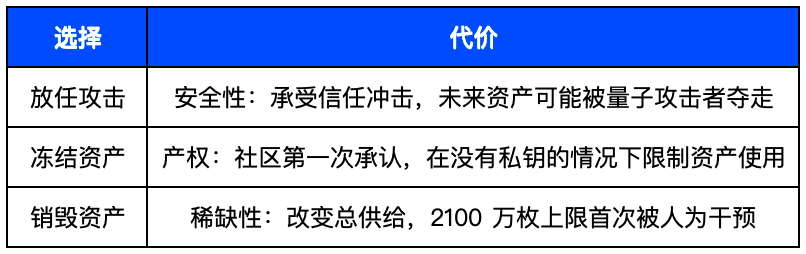
Three paths, each of which requires the Bitcoin community to pay a price it has never paid before.
Not just a technical issue, but a business issue
The impact of quantum threats on Bitcoin will ultimately manifest in very concrete commercial forms.
For institutions holding coins, this is a tail risk pricing problem. Over the past few years, numerous public companies and sovereign wealth funds have begun to include Bitcoin in their balance sheets. One of the core reasons for their purchases is the narrative of "absolute scarcity, absolute ownership, unmodifiable protocol." Once a quantum threat forces the community to choose between "amending the protocol" and "accepting asset theft," whichever outcome occurs, this narrative will be damaged to varying degrees.
This risk has almost never been seriously quantified in any institutional holdings report — it cannot be hedged like interest rate or liquidity risks; rather, it resembles a structural hidden danger that the market has collectively chosen to ignore.
For exchanges and custodians, this is an infrastructure upgrade that will come sooner or later. The National Institute of Standards and Technology, the UK National Cyber Security Centre, and the NSA have sequentially published timelines for the transition to post-quantum cryptography, requiring key systems to complete the switch between 2031 and 2035.
This means that compliant crypto asset custodians will have to prove that their signature systems, key management processes, and cold wallet solutions meet post-quantum safety standards. This entails real engineering and compliance costs, ultimately affecting custody fees and institutional access thresholds.
For mining companies and infrastructure investors, this is a long-term variable that impacts valuation assumptions. The business model of Bitcoin mining is based on the premise of "protocol stability and predictable rewards." Once the community initiates a significant protocol upgrade in response to quantum threats, mining machines, algorithms, and block generation rules may all be adjusted accordingly. Even if the upgrade ultimately goes smoothly, the uncertainty during the transition period alone is enough to affect mining companies' financing costs and long-term investment returns.
And the deepest business issue is: who will lead this upgrade? Bitcoin has no CEO, no board of directors, and no legal entity that can be held accountable or authorized. This design has allowed it to withstand countless political and regulatory pressures over the past fifteen years. But it also means that when difficult collective decisions need to be made, no one can make the call, nor does anyone need to take responsibility.
An upgrade to an agreement involving trillions of dollars in assets relies on a globally decentralized consensus formed by developers, miners, and node operators without legal obligation. This is practically an impossible governance structure in business logic — yet Bitcoin has functioned for fifteen years based on this structure.
Can it work again?
A system without an owner, how to handle the owner's legacy?
Apple will not face this issue. After Jobs left, there was still a board of directors.
Tencent will not face this issue. After the founder retired, there was still a management team.
But Bitcoin is different. It has a founder. And this founder left behind a fortune worth tens of billions of dollars, then disappeared completely. No will, no heirs, no legal procedures, not even anyone knows if he is still alive.
Satoshi Nakamoto designed a system that does not require trusting anyone; this is his greatest legacy to the world.
But perhaps even he did not foresee: seventeen years later, the most difficult problem of this system would be the very key he left behind.
The migration of Bitcoin to a quantum-resistant state has never been a question of "can it be done." The real question is: when technology, property rights, and commercial belief conflict simultaneously, how will a system without an owner manage the owner's legacy?
This answer may be more worthy of attention than the quantum computer itself.
What do you think? If the quantum era truly arrives, what path do you believe the Bitcoin community will ultimately choose? Feel free to leave your judgment in the comments.
*The content of this article is for reference only and does not constitute any investment advice. The market carries risks, and investment should be cautious.
免责声明:本文章仅代表作者个人观点,不代表本平台的立场和观点。本文章仅供信息分享,不构成对任何人的任何投资建议。用户与作者之间的任何争议,与本平台无关。如网页中刊载的文章或图片涉及侵权,请提供相关的权利证明和身份证明发送邮件到support@aicoin.com,本平台相关工作人员将会进行核查。


